Dear friends,
There is a profound difference between a museum and a cathedral. A museum holds history; a cathedral holds a heartbeat. As we journey together through this list of the Top 10 UNESCO Catholic Churches, I invite you to see these not merely as architectural marvels or tourist destinations, but as “theology in stone.” They are vast, silent prayers that have risen from the earth for centuries, testifying to the enduring love of God and the resilience of the human spirit.
In my years of priesthood, I have found that sacred spaces have a unique way of catechizing us. The soaring arches of the Gothic style pull our eyes upward, reminding us that we are made for more than this world. The intricate baroque altars speak to us of the abundance of God’s grace. Even the very stones, worn smooth by the knees of millions of pilgrims, tell a story of a faith that survives wars, plagues, and the erosion of time. These sites, recognized by UNESCO for their universal value, are treasures for all of humanity, yet for us, they are family heirlooms.
Whether you are planning a pilgrimage or simply traveling in your heart from your armchair, let us walk these holy aisles together. Let us listen to what the Spirit might be whispering through the stained glass and the silence. These are not just buildings; they are bridges to the Eternal.
May this guide serve as a lamp for your own spiritual imagination, illuminating the beauty of the Church Universal.
Table of The Top 10 UNESCO Catholic Churches in the World
| Rank | Sacred Site | Location | UNESCO Inscription | Spiritual Essence |
|---|---|---|---|---|
| 10 | Sanctuary of Bom Jesus do Congonhas | Minas Gerais, Brazil | 1985 | The Passion & The Prophets |
| 9 | Baroque Churches of the Philippines | Philippines (Various) | 1993 | Resilience & Inculturation |
| 8 | Cologne Cathedral | Cologne, Germany | 1996 | Majesty & Epiphany |
| 7 | Cathedral of Seville | Seville, Spain | 1987 | Triumph & History |
| 6 | Mont-Saint-Michel | Normandy, France | 1979 | Solitude & Spiritual Warfare |
| 5 | Basilica of San Francesco | Assisi, Italy | 2000 | Peace & Poverty |
| 4 | Cathedral of Santiago de Compostela | Galicia, Spain | 1985 | The Pilgrimage of Life |
| 3 | Chartres Cathedral | Chartres, France | 1979 | The Light of Mary |
| 2 | Basilica of the Sagrada Família | Barcelona, Spain | 1984 / 2005 | Creation Praising God |
| 1 | St. Peter’s Basilica (Vatican City) | Vatican City | 1984 | The Rock of Unity |
Top 10. Sanctuary of Bom Jesus do Congonhas (Brazil)
We begin our journey in the rolling hills of Minas Gerais, Brazil. Here stands a striking testament to the colonial faith of the Americas: the Sanctuary of Bom Jesus do Congonhas. As you approach the basilica, you are greeted not immediately by the doors, but by a dramatic staircase adorned with twelve life-sized soapstone statues of the Old Testament Prophets. Carved by the hands of the legendary artist Aleijadinho—who suffered from a debilitating disease and had to have his tools strapped to his wrists—these figures stand as silent sentinels of suffering and hope.
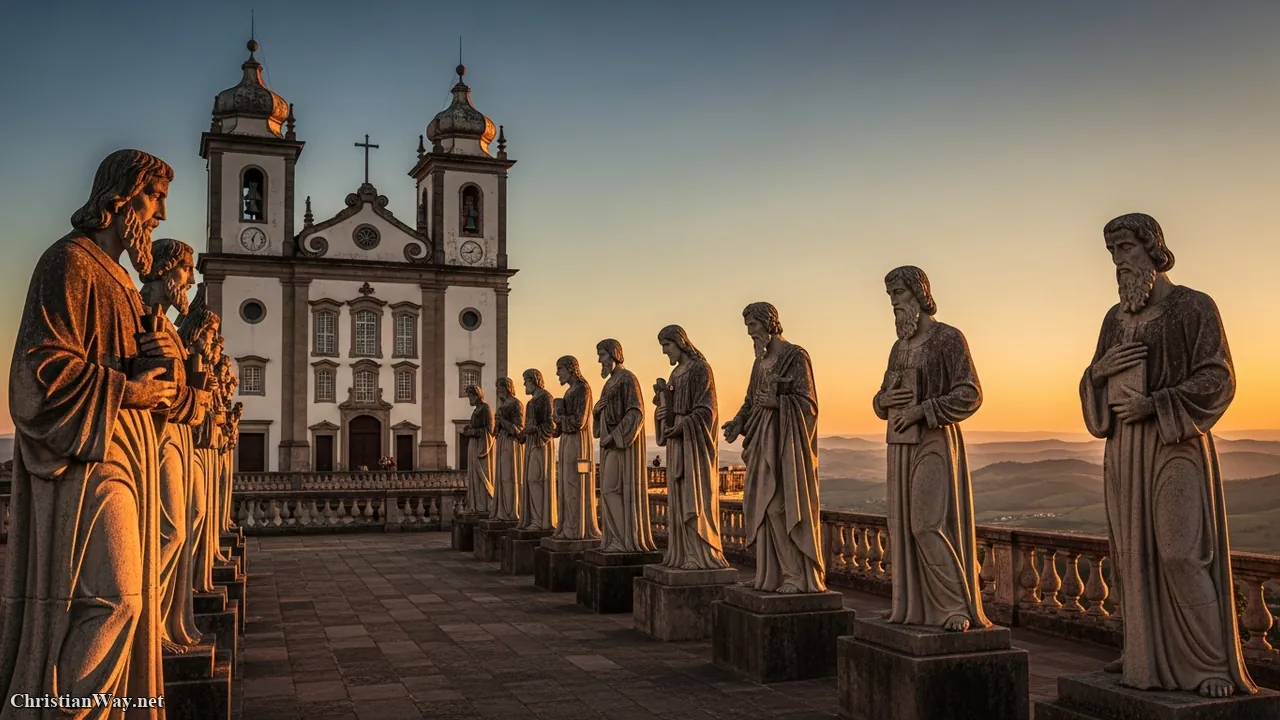
Theologically, this site moves us deeply into the mystery of the Passion. The “Via Crucis” (Way of the Cross) chapels leading up to the church contain expressive, almost theatrical wooden figures that invite the pilgrim to walk step-by-step with Christ. It reminds us that our faith is not a sterile set of ideas, but a visceral encounter with the Suffering Servant. The prophets outside point to the fulfillment inside: Jesus, the Good Lord (Bom Jesus).
For those of us carrying heavy burdens, Congonhas is a visual sermon on endurance. Just as Aleijadinho carved beauty out of his own physical pain, we are called to offer our own sufferings to God, allowing Him to chisel us into something beautiful. It is a place that teaches us that the cross is always the prelude to the crown.
Spiritual Highlights:
- The Prophets: The twelve soapstone statues are considered the masterpiece of Brazilian Baroque.
- The Lesson: “He was pierced for our transgressions, he was crushed for our iniquities.” (Isaiah 53:5)
Top 9. Baroque Churches of the Philippines (Philippines)
Travel with me now to the vibrant archipelago of the Philippines, where faith has weathered both typhoons and time. The UNESCO inscription here covers four distinct churches, including the magnificent San Agustin in Manila and the fortress-like Paoay Church in Ilocos Norte. These structures are built in a style known as “Earthquake Baroque”—squat, massive, and reinforced with thick buttresses to withstand the trembling of the earth.
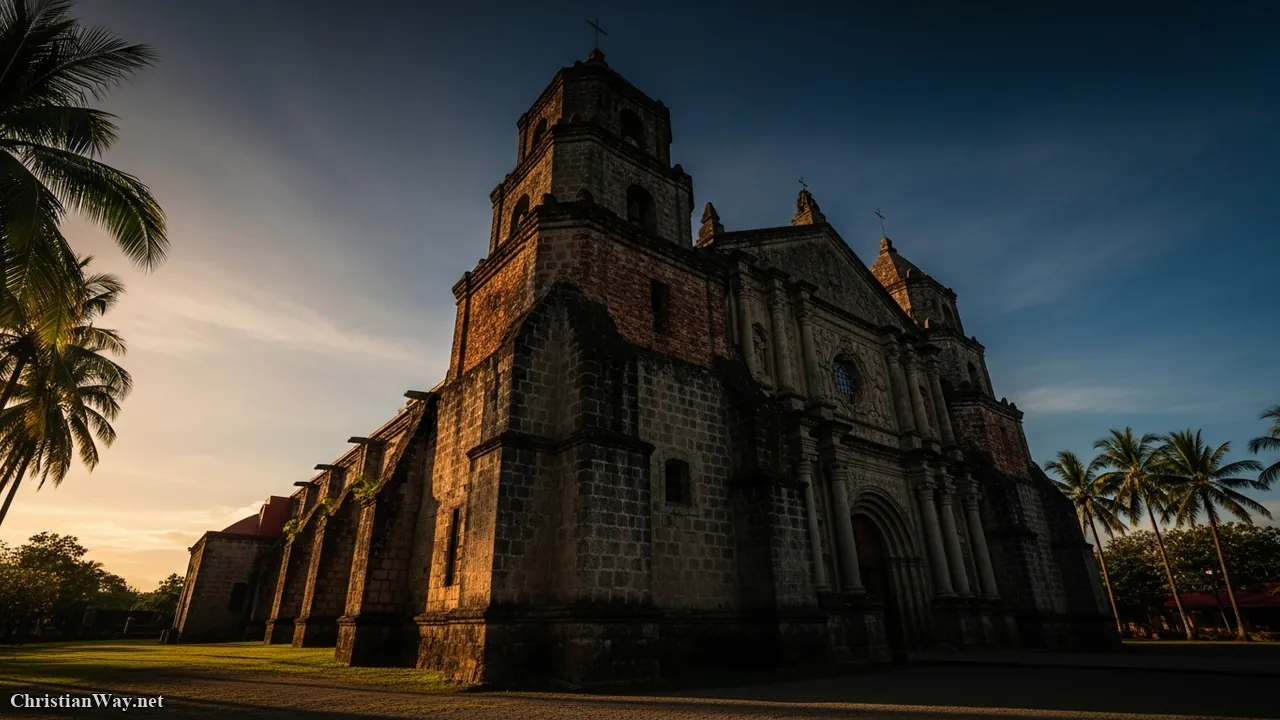
There is a beautiful theology in this architecture. The European designs were not simply copied; they were adapted to the local reality. This is the mystery of the Incarnation: the Word becoming flesh in a specific time and place. These churches demonstrate how the Gospel takes root in every culture, becoming “Filipino” without ceasing to be Catholic. The massive buttresses of Paoay, appearing almost like elbows bracing against the ground, speak to us of a faith that is sturdy, prepared for the shocks of life.
In a world that often feels unstable, these stone giants offer a comforting thought: God provides the strength we need to stand firm. When the ground beneath your feet feels shaky—be it from financial worry, family strife, or doubt—remember the Paoay church. We are built on the Rock, and the gates of the netherworld, nor the quakes of the earth, shall prevail against it.
Spiritual Highlights:
- San Agustin Church: The oldest stone church in the Philippines (1607), surviving WWII bombings.
- Key Concept: Inculturation—faith expressing itself through local culture and resilience.
Top 8. Cologne Cathedral (Germany)
Rising like dark, twin flames from the banks of the Rhine, the Kölner Dom (Cologne Cathedral) is a masterpiece of High Gothic architecture that took over 600 years to complete. It is a building of overwhelming verticality, pulling the human eye—and the human heart—irresistibly upward. Inside, the sheer height of the nave makes one feel small, yet held; a tiny part of a majestic whole.
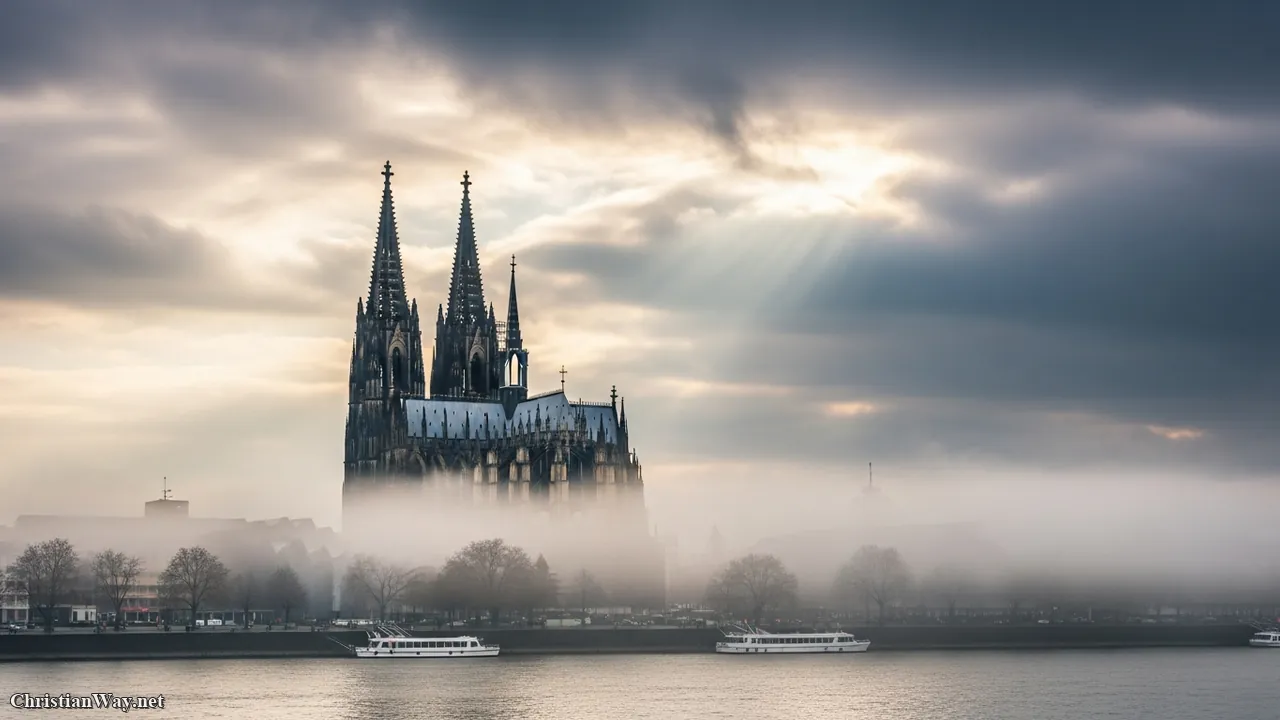
The spiritual heart of this cathedral is the Shrine of the Three Kings, a golden reliquary said to contain the bones of the Magi. This connects the cathedral directly to the Epiphany—the revelation of Christ to the Gentiles. The wise men journeyed from afar, following a star, seeking the Truth. This cathedral stands as a monument to that search. It survived the devastating aerial bombings of World War II, standing tall amidst the rubble of the city, a symbol of God’s presence when all else falls apart.
For the modern seeker, Cologne asks a poignant question: What star are you following? Like the Magi, we are all on a journey, often through darkness. This sacred space encourages us to keep our eyes fixed on the light of Christ, for He is the destination of every human longing.
Spiritual Highlights:
- The Reliquary: The Shrine of the Three Kings is the largest reliquary in the Western world.
- Scripture: “We saw his star when it rose and have come to worship him.” (Matthew 2:2)
Top 7. Cathedral of Seville (Spain)
The Cathedral of Saint Mary of the See in Seville is a monument to the triumph of faith and the complexity of history. It is the largest Gothic cathedral in the world, a cavernous space of gold, stone, and shadow. Yet, its bell tower, the Giralda, was originally a minaret for the Great Mosque that stood on this site. The Christians who built the cathedral did not destroy the tower; they crowned it with a cross and a statue of Faith.
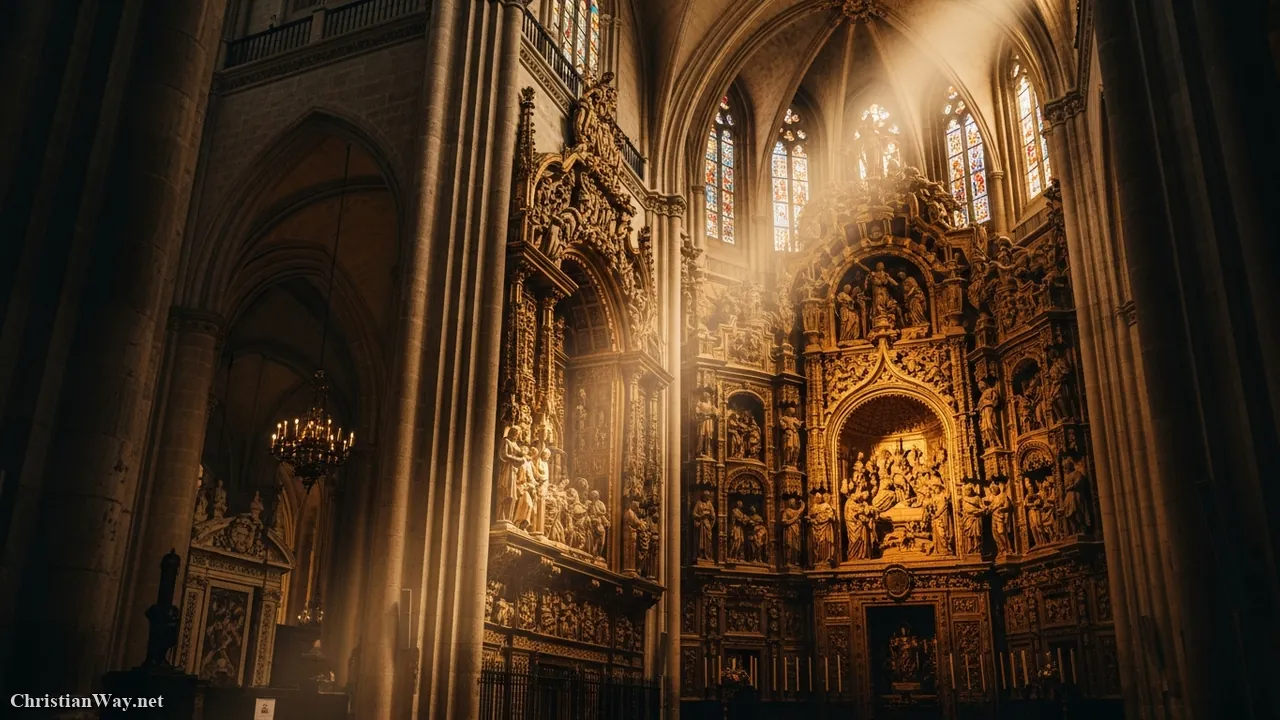
This architectural layering speaks to the universality of the Church. It reminds us that Christianity does not erase the past but redeems it. The vastness of the interior, with its monumental retablo (altarpiece) depicting the life of Christ in intricate detail, is designed to leave the pilgrim awestruck at the glory of God. It is a place of “maximalism”—where art, history, and gold combine to say that nothing is too good for the Lord.
Walking through Seville Cathedral, we are invited to consider the “Giralda” in our own lives—those parts of our past, perhaps before we knew Christ, or moments of error. God does not demand we pretend they didn’t happen; instead, He wants to crown them, to transform our past into a tower from which we can ring out the bells of His mercy.
Spiritual Highlights:
- The Giralda: A symbol of continuity and the baptism of culture.
- Christopher Columbus: His tomb is held aloft by four allegorical figures, reminding us of the spread of the Gospel to the New World.
Top 6. Mont-Saint-Michel (France)
There are few sights in the world as stirring as Mont-Saint-Michel rising from the tidal flats of Normandy. It is a “pyramid of the seas,” a Benedictine abbey perched on a rocky island that is cut off from the mainland by the tides. At the very pinnacle stands the golden statue of Saint Michael the Archangel, sword drawn, piercing the sky.
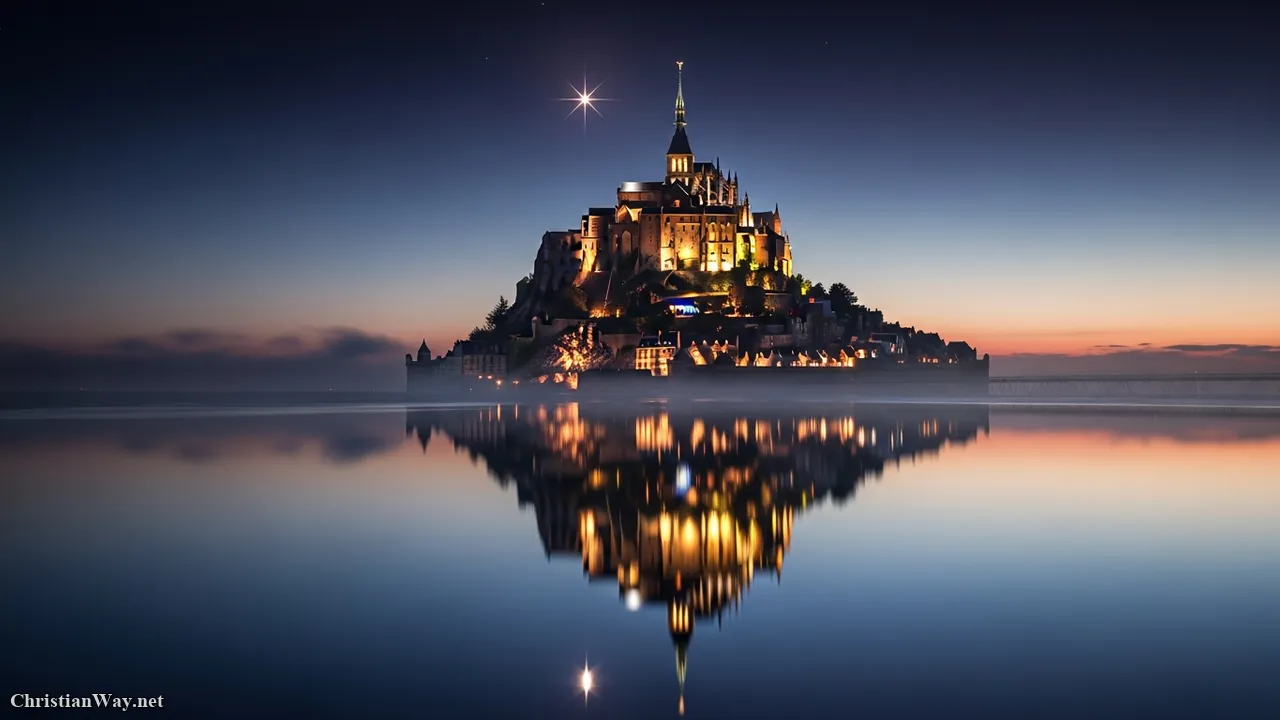
This is a place of spiritual warfare and monastic solitude. The theology here is one of ascent. The pilgrim must climb the winding streets, past the distractions of the world, up to the abbey, and finally into the silence of the sanctuary. It represents the soul’s struggle to rise above the “tides” of sin and chaos to reach the peace of God. Saint Michael, the protector of the Church, watches over this fortress of prayer.
In our noisy, hyper-connected world, Mont-Saint-Michel offers a stark challenge: Do we have a fortress? Do we have a place of silence where we can retreat to fight our spiritual battles? We may not live on an island, but we must cultivate an “interior castle” where the tides of the world cannot reach, and where we can converse with God in peace.
Spiritual Highlights:
- The Archangel: Dedicated to St. Michael, reminding us of the reality of spiritual battle.
- The Tides: Symbolize the shifting nature of the world versus the stability of the Church.
Top 5. Basilica of San Francesco (Assisi, Italy)
If St. Peter’s is the head of the Church, Assisi is surely its heart. The Basilica of San Francesco, built into the side of Mount Subasio, houses the tomb of the Poor Man of Assisi, St. Francis. The complex is divided into an Upper and Lower church, adorned with the revolutionary frescoes of Giotto, which broke away from stiff Byzantine styles to show a human, weeping, living Jesus and a gentle Francis.
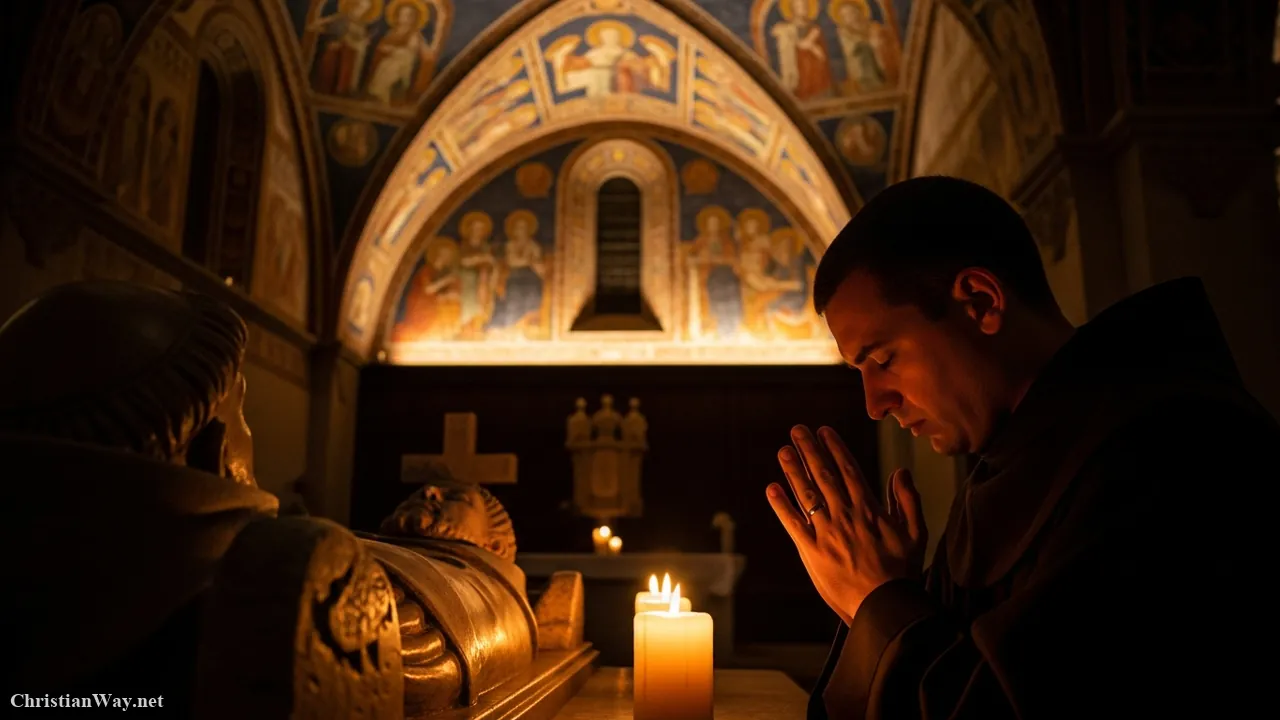
The theology of this place is the theology of Kenosis—self-emptying. Despite the grandeur of the frescoes, the spiritual core is the crypt where Francis lies. He wanted to be buried in the “Hill of Hell” (where criminals were executed), which was renamed the “Hill of Paradise.” It is a testament to the power of humility. Francis stripped himself of worldly wealth to possess the greatest treasure: Christ.
Visiting Assisi acts as a balm for the ambitious soul. Here, “success” is redefined. We are reminded that we are not loved for what we achieve or what we own, but for who we are. As we stand before the tomb of the man who preached to birds and tamed wolves, we are invited to drop our defenses and embrace the simplicity of the Gospel.
Spiritual Highlights:
- Giotto’s Frescoes: A visual Bible that humanized the saints for the first time in art history.
- The Crypt: The simple stone coffin of St. Francis, a place of profound peace.
Top 4. Cathedral of Santiago de Compostela (Spain)
This cathedral is the finish line. For over a thousand years, pilgrims have walked the Camino de Santiago (The Way of St. James), enduring blisters, rain, and exhaustion to reach this sacred spot in Galicia. It is believed to hold the remains of St. James the Great, the apostle who was the first to drink the cup of martyrdom.
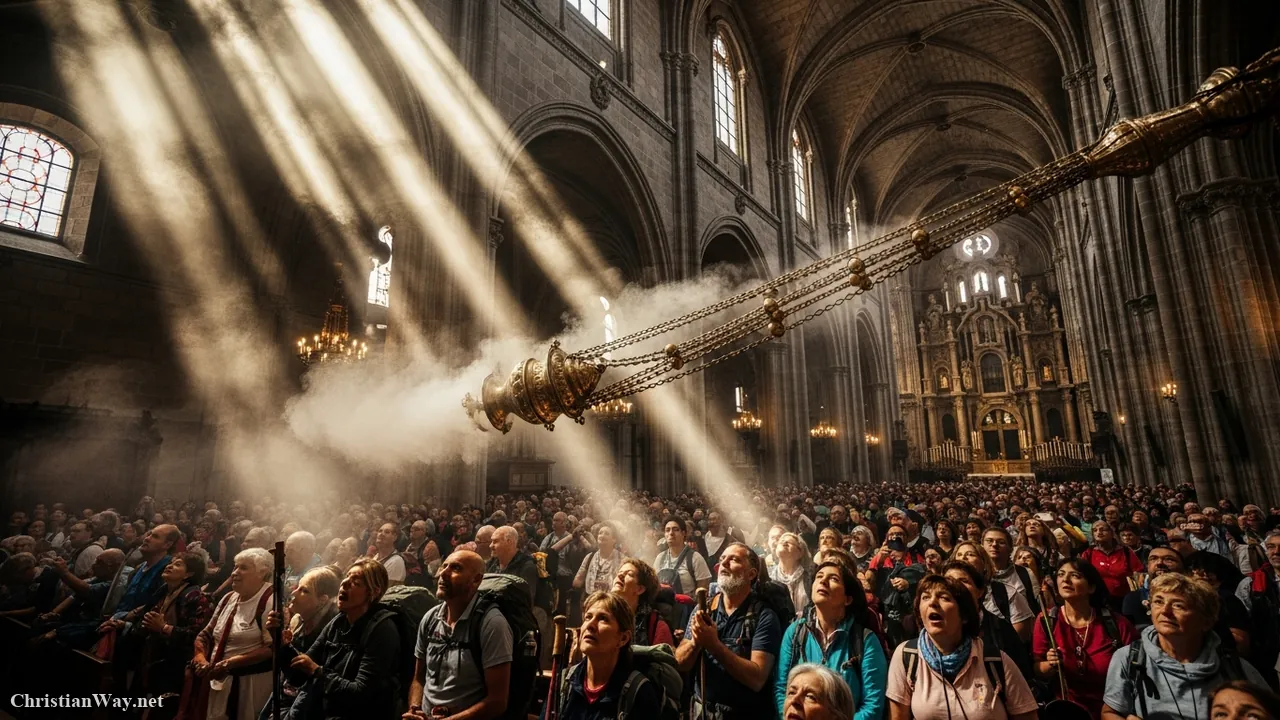
The spiritual essence of Santiago is “The Journey.” The cathedral is not just a destination; it is a witness to the pilgrim Church on earth. The Portico of Glory, the magnificent Romanesque entrance, welcomes the tired traveler with a vision of the heavenly court. The famous Botafumeiro—a massive thurible swinging through the transept—was originally used to cover the scent of unwashed pilgrims, but it has become a symbol of our prayers rising like incense, chaotic and beautiful, to God.
This site speaks to anyone who feels weary in their walk with Christ. It reminds us that we are not wandering aimlessly; we are pilgrims with a destination. Every step, every stumble, and every act of perseverance brings us closer to the Father’s house. As Christian Way often reminds us, the walk itself is part of the prayer.
Spiritual Highlights:
- The Botafumeiro: A 53kg incense burner that swings at 68km/h, symbolizing the grandeur of prayer.
- The Hug: It is a tradition to hug the statue of St. James behind the altar, embracing our apostolic heritage.
Top 3. Chartres Cathedral (France)
To enter Chartres Cathedral is to enter the color blue. The “Chartres Blue” stained glass, much of it original from the 12th and 13th centuries, creates a mystical twilight that has hushed pilgrims for 800 years. This cathedral is the high point of French Gothic art and a premier center of Marian devotion, housing the Sancta Camisa, believed to be the tunic worn by the Virgin Mary at Christ’s birth.
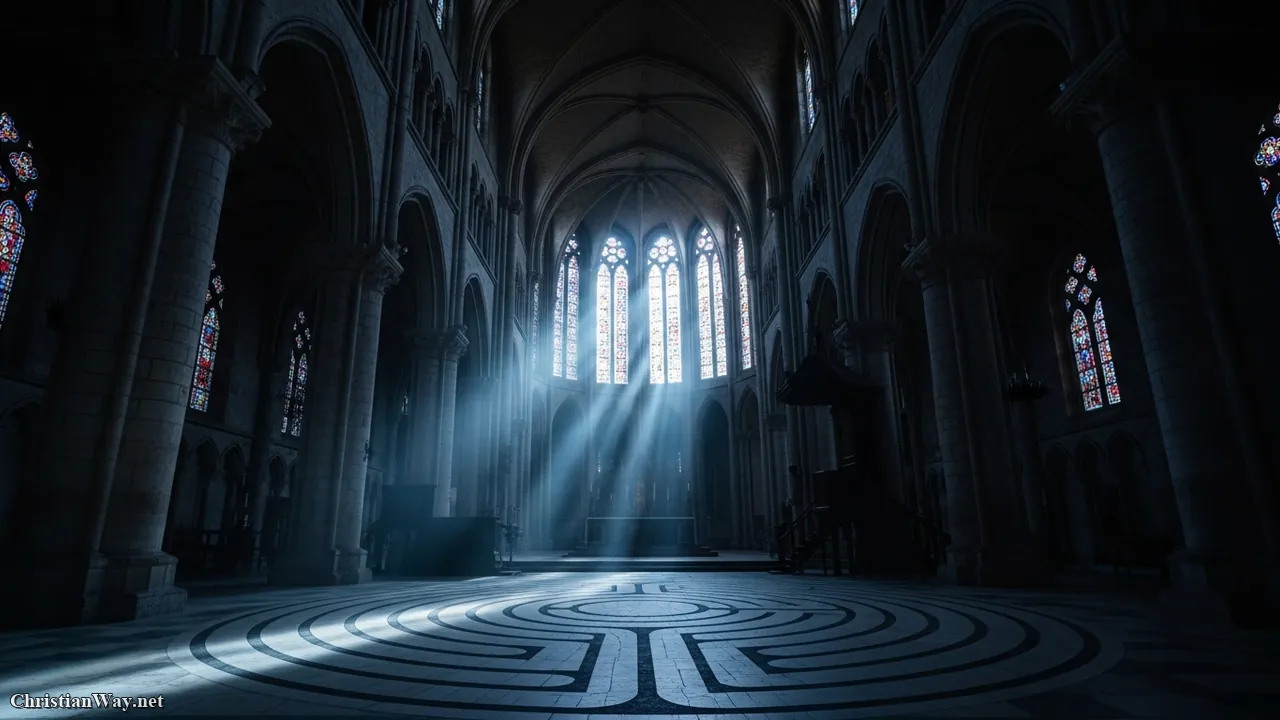
The theology here is one of illumination. The darkness of the church represents the womb or the world before Christ; the light streaming through the windows represents the Divine Grace penetrating our humanity. On the floor lies the famous Labyrinth. Unlike a maze, which has dead ends, a labyrinth has only one path. It is a metaphor for the Christian life: the path may twist and turn, but if you keep moving forward, you will reach the Center, which is God.
Chartres invites us to trust the path. In times of confusion, when we cannot see the road ahead, we are called to trust the geometry of God’s grace. Like the stained glass, we are jagged shards of glass on our own, but when held together by the Lead of the Spirit and illuminated by the Son, we form a beautiful image.
Spiritual Highlights:
- The Labyrinth: A walking meditation on the floor of the nave.
- Sancta Camisa: A relic connecting us to the tenderness of the Nativity.
Top 2. Basilica of the Sagrada Família (Spain)
In Barcelona, we encounter a cathedral that is still being born. The Sagrada Família, the masterwork of the Servant of God Antoni Gaudí, is unlike any other church on earth. It is a “Bible in Stone” where architecture and nature fuse completely. The columns inside branch out like trees, creating a forest of prayer, and the light that filters in is dappled, like sunshine through leaves.
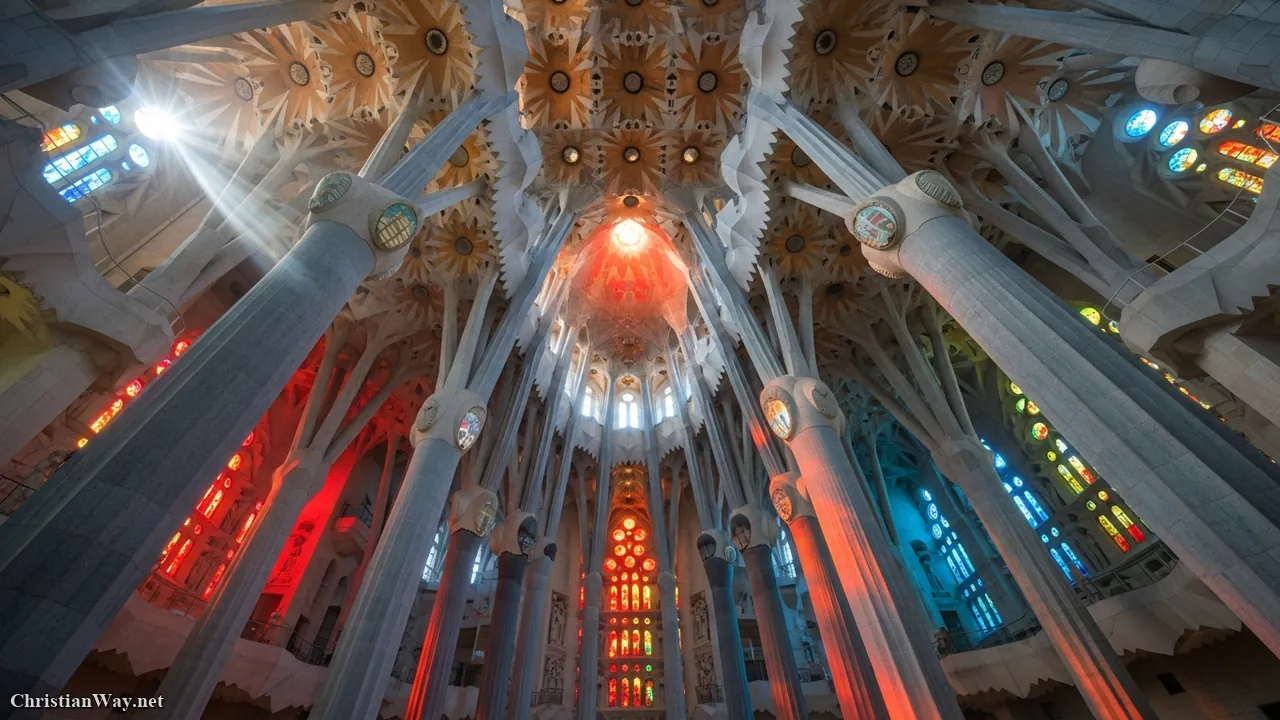
Gaudí’s theology was that “originality consists of returning to the origin.” He looked to God’s creation—nature—to design a house for God. The Nativity Façade is a joyful explosion of life, with turtles, birds, and leaves surrounding the Holy Family. The Passion Façade is stark, skeletal, and bone-chilling. It is a church that catechizes through beauty, designed to lift the soul of even the most secular tourist.
The fact that it is unfinished (since 1882) is its own spiritual lesson. The Church is always semper reformanda—always reforming, always building. We, too, are unfinished works. God is the architect, and He is not done with us yet. Gaudí once said, “My Client is not in a hurry.” We can take comfort in that patience.
Spiritual Highlights:
- The Light: Gaudí used color to dictate the mood—cool blues for dawn (Nativity), warm reds for sunset (Passion).
- The Vision: A synthesis of faith, nature, and geometry.
Top 1. St. Peter’s Basilica (Vatican City)
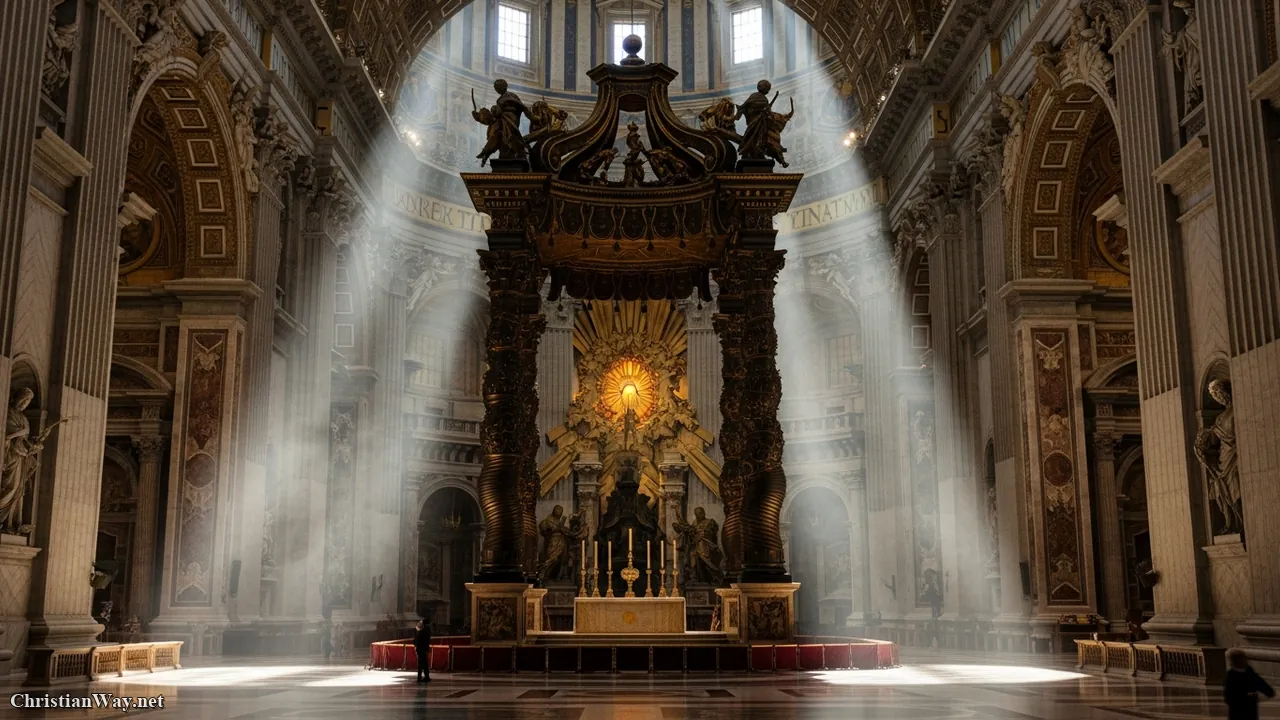
We arrive at the threshold of the Apostles. St. Peter’s Basilica in Vatican City is not merely the largest church in the world; it is the visible sign of the unity of the Church. Built over the humble grave of a fisherman—Peter, the Rock—it stands as a testament to the promise of Christ: “On this rock I will build my church.” (Matthew 16:18).
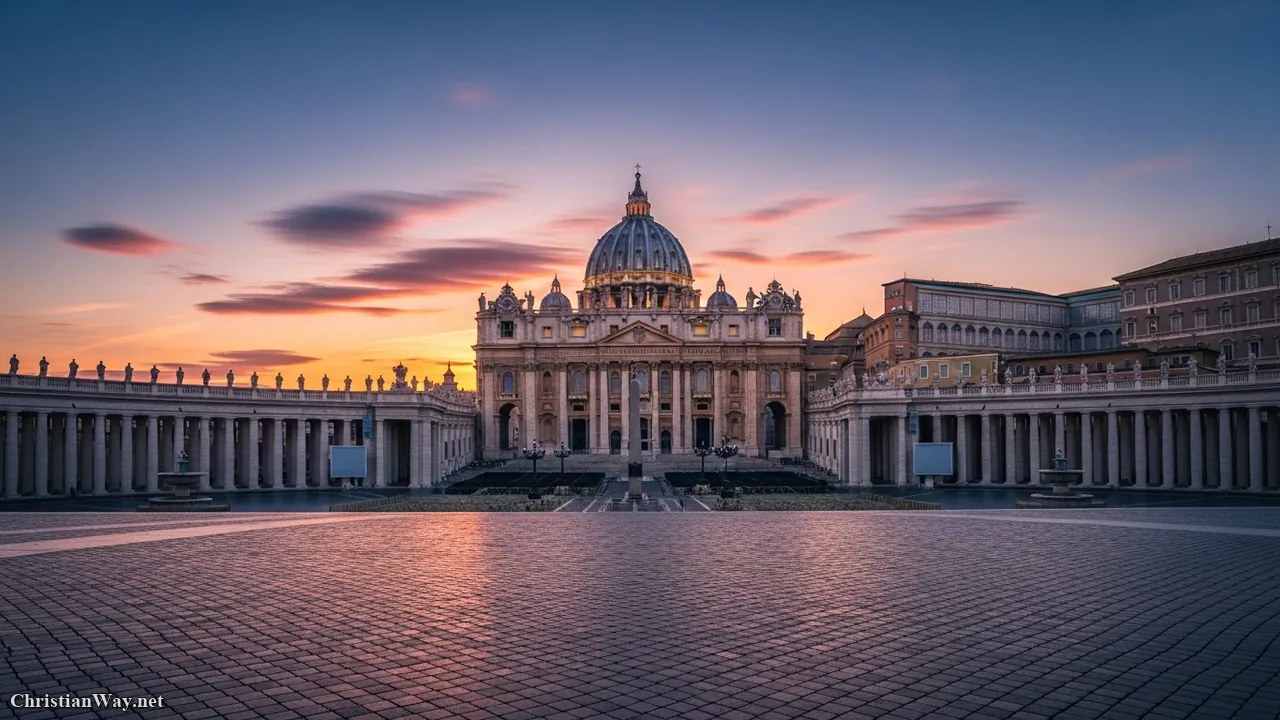
The theology of St. Peter’s is one of embrace. Bernini’s massive colonnade in the piazza reaches out like two great arms to welcome the world—believers and non-believers alike. Inside, under Michelangelo’s soaring dome, one encounters the Pietà, a marble miracle of sorrow and beauty. But the spiritual center is deep underground, in the Scavi, where the bones of Peter lie. The grandeur above rests entirely on the witness of the martyr below.
St. Peter’s challenges us to consider our foundation. Upon what are we building our lives? Is it the shifting sands of opinion, or the solid rock of apostolic faith? It calls us to unity—to remember that despite our differences, we are one Body, held together by the Spirit, shepherded by the successor of that fisherman who said, “Lord, you know that I love you.”
Spiritual Highlights:
- The Tomb of Peter: The physical and spiritual anchor of the entire structure.
- Bernini’s Colonnade: Symbolizing the maternal arms of the Mother Church.
Reflect and Pray
Dear friends, we have traveled from the limestone of France to the soapstone of Brazil, from the Gothic spires of Germany to the modern curves of Spain. These UNESCO Catholic Churches are more than heritage sites; they are evidence of a love story between God and humanity that has spanned millennia.
As you step away from this screen, I invite you to close your eyes for a moment. Picture the site that spoke most deeply to your heart. Place yourself there. Whether it is the silence of Mont-Saint-Michel or the color of Chartres, know that the God who inspired these masterpieces is the same God who dwells within you. You, too, are a temple of the Holy Spirit—a living stone in the Church of God.
Would you like me to guide you in a specific prayer for pilgrims, or perhaps help you plan a spiritual itinerary for one of these destinations?
— Fr. John Matthew, for Christian Way