Dear friends in Christ,
Life is a journey. We feel this truth whenever we leave home before dawn, travel through unfamiliar streets, wait beside a hospital bed, send a child into a new season of life, begin work in a different place, or stand at a crossroads without knowing which road lies ahead. Some journeys are measured in miles. Others are measured in tears, prayers, years of waiting, and decisions that quietly shape the soul.
There are seasons when the road feels clear. We know where we are going, who walks beside us, and what we must do next. But there are also seasons when the way ahead feels uncertain. We may carry fear about our family, our health, our work, our finances, or the future of those we love. We may wonder whether God sees us when the road is long and the destination remains hidden.
Saint Christopher speaks to these moments with a simple and enduring image: a strong man carrying a child across a dangerous river, only to discover that the child is Christ Himself.
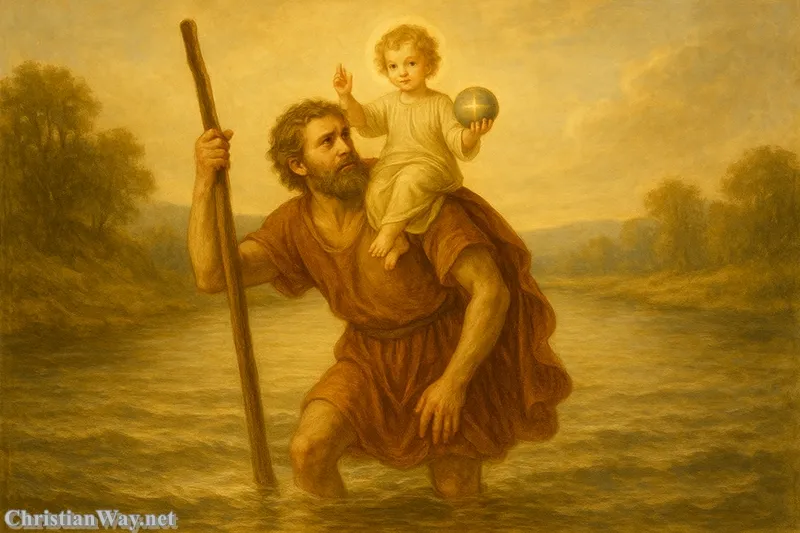
For centuries, Christians have remembered Saint Christopher as the patron saint of travelers. The image associated with him is not merely about a physical crossing. It points toward the deeper calling of every Christian: to bear Christ in our hearts, to carry His love into the lives of others, and to serve those whom God places along our path.
The details of Saint Christopher’s early life are not preserved with the clarity we have for some other saints. The Church’s tradition honors him as a martyr, while the familiar story of him carrying the Child Jesus comes through later medieval devotion, especially the Golden Legend. What remains spiritually clear is the meaning Christians have received from his witness: the one called “Christ-bearer” becomes an image of humble service, courage, and faithful love.
Saint Christopher: The Patron Saint of Travelers and the Bearer of Christ invites us to consider what it means to travel with faith. It asks whether we seek God only for protection from danger, or whether we are also willing to become instruments of His protection, mercy, and compassion for others. It reminds us that the road to holiness is not always dramatic. Often, it begins when we notice someone struggling to cross a difficult river and choose, with God’s help, to help carry their burden.
The Name That Reveals a Calling
The name Christopher comes from a Greek expression meaning “Christ-bearer.” This meaning has given Christian devotion a deep and beautiful way of understanding the saint. To bear Christ is not simply to speak His name. It is to allow His presence to shape the way we live.
A Christian bears Christ when he chooses honesty in a place where dishonesty would be easier. A Christian bears Christ when she comforts someone who is grieving. A parent bears Christ when patiently caring for a child after a long and exhausting day. A worker bears Christ when treating others with dignity. A young person bears Christ when refusing cruelty, gossip, or pride. A stranger bears Christ when offering help to someone who appears lost, frightened, or alone.
The world may not always recognize these acts as holy. They may seem too ordinary to matter. But Christ is often carried into the world through ordinary love.
Jesus said, “Whosoever shall receive one such little child in my name receiveth me” (Matthew 18:5). His words reveal a mystery that changes how we see people. Christ comes close to us through the vulnerable, the overlooked, the poor, the elderly, the sick, the frightened, and the forgotten. When we make room for them, we make room for Him.
This is why the story of Saint Christopher has touched so many hearts. In the traditional account, Christopher does not begin by looking for a life of comfort. He seeks the greatest king he can serve. After learning that earthly power is limited and that even evil trembles before the Cross, he comes to understand that Christ alone is truly Lord. A hermit directs him toward a life of service: helping travelers cross a dangerous river.
The story is simple, but its spiritual meaning is profound.
Christopher does not carry the child because he expects to receive glory. He carries him because someone needs help. He does not know at first that the child is Jesus. He simply sees a person who cannot cross the river alone.
That is often how Christ comes to us.
Christ Comes to Us in the Person Before Us
We may imagine that serving Christ must always look dramatic. We may think that God will call us only through great signs, distant missions, or extraordinary acts. But very often, Christ comes quietly.
He comes in the person who asks for patience when we are tired.
He comes in the family member who needs forgiveness.
He comes in the neighbor whose sorrow is hidden behind a polite smile.
He comes in the child who needs attention when we are distracted.
He comes in the friend who calls at an inconvenient moment.
He comes in the person whose weakness makes us uncomfortable.
Jesus tells us in Matthew 25 that whatever we do for “one of the least of these” is done for Him. He identifies Himself with the hungry, the thirsty, the stranger, the sick, the imprisoned, and the forgotten. This does not mean that every difficult encounter is easy to understand. It does mean that Christian love must never become abstract.
We cannot claim to love Christ while refusing to see Him in those who need mercy.
Saint Christopher reminds us that the person in front of us may be carrying more than we can see. Someone may look strong and still be exhausted. Someone may smile and still be grieving. Someone may appear successful and still feel deeply alone. Someone may speak harshly because pain has made the heart afraid.
To bear Christ is not to solve every problem. It is to become willing to love where love is needed.
The River as a Sign of Life’s Difficult Crossings
In the familiar tradition, Saint Christopher carries travelers across a river. One day, a small child asks to be carried. Christopher lifts the child onto his shoulders and begins to cross. As the water grows stronger, the child becomes heavier and heavier until Christopher fears he will not be able to reach the other side.
When they arrive safely, the child reveals Himself as Christ. The weight Christopher carried was not merely the weight of one child. He had carried the One who bears the world.
This story should be received as sacred tradition and spiritual symbol rather than as a detailed historical record. Yet symbols can reveal truths that reach deeply into the human heart.
Every person knows something about rivers.
There are rivers of grief that feel impossible to cross.
There are rivers of illness, where each day brings uncertainty.
There are rivers of family conflict, where words have created distance.
There are rivers of financial pressure, where the future feels fragile.
There are rivers of loneliness, where no clear path appears.
There are rivers of regret, where we keep looking back at choices we cannot undo.
There are rivers of fear, where every step feels unsafe.
Sometimes we are the ones trying to cross. At other times, God calls us to help someone else.
The Christian life does not promise that we will never face deep waters. In fact, Scripture often speaks of God’s presence precisely in places of difficulty. The Lord says through the prophet Isaiah, “When thou passest through the waters, I will be with thee; and through the rivers, they shall not overflow thee” (Isaiah 43:2).
Notice that God does not say His people will never pass through waters. He promises that He will be with them in the waters.
This is the hope Saint Christopher offers to travelers of every kind. Christ does not always remove the river. But He does not leave us to cross it alone.
When the Burden Feels Heavier Than Expected
Perhaps you have entered a season that seemed manageable at first, but has gradually become heavier. A responsibility that began as an act of love now feels exhausting. A family struggle has lasted longer than you expected. A financial concern has become a constant weight. A health problem has changed the rhythm of your days. A grief you thought had softened has returned unexpectedly.
The story of Saint Christopher speaks to the moment when the child becomes heavy.
Many people feel ashamed when they reach that point. They believe they should be stronger. They tell themselves that others carry more difficult burdens. They fear that admitting exhaustion means they are failing.
But exhaustion is not always failure. Sometimes it is simply a sign that we are human.
Even Jesus, on the way to Calvary, fell beneath the weight of the Cross. Simon of Cyrene was called to help carry it. This detail in the Gospel is deeply consoling. The Son of God accepted help. The One who came to save the world allowed another person to walk beside Him in suffering.
We too need help.
There are seasons when prayer must be joined with practical support. A person may need a doctor, a counselor, a priest, a pastor, a trusted friend, or a family member who can listen without judgment. There is no shame in saying, “I cannot carry this alone.”
Saint Christopher teaches us that strength is not pretending we have no limits. True strength is accepting the help God sends and becoming willing, when we are able, to offer that help to others.
The Patron Saint of Travelers
Saint Christopher has long been honored as a protector and intercessor for travelers. Vatican guidance for pastoral care on the road recalls Saint Christopher as “Christ’s Bearer” and places him among the saints and heavenly companions whom Christians invoke as they face the dangers and responsibilities of travel. More recently, Pope Francis referred to Saint Christopher as patron of motorists while speaking to leaders of Italy’s automobile association.
This devotion is especially meaningful because travel is never merely about movement from one place to another.
Travel can bring joy. It can unite families, open new work opportunities, allow people to visit loved ones, and lead us toward beauty and rest. Yet travel can also carry risk. Roads can be dangerous. Journeys can bring fatigue. People may feel vulnerable in unfamiliar places. Many travel because they have no choice: migrants seeking safety, workers leaving home to support their families, refugees fleeing violence, students moving far away, or patients traveling for treatment.
To pray through the intercession of Saint Christopher is not to treat faith as a charm or a guarantee against every difficulty. A medal, image, or prayer is not magic. It does not remove our responsibility to drive carefully, rest when tired, obey laws, maintain vehicles, and respect the safety of others.
Christian prayer does not replace wisdom. It deepens wisdom.
When we ask Saint Christopher to pray for us, we are placing our journey before God. We are asking for protection, yes, but also for patience, attentiveness, gratitude, and love. We are asking not only to arrive safely, but to travel as people who reflect Christ.
A Christian driver can bear Christ by refusing rage.
A Christian traveler can bear Christ by respecting workers and strangers.
A Christian passenger can bear Christ by showing patience when plans change.
A Christian family can bear Christ by making travel a time of care rather than conflict.
A Christian can bear Christ by noticing someone in need on the road.
Travel Safely, Travel Prayerfully, Travel Kindly
There is a quiet prayer that many people may offer before leaving home:
“Lord Jesus, guide us on our way. Keep us alert, patient, and safe. Protect those we love. Help us to be considerate of every person we meet. Bring us home in peace.”
This prayer is simple, but it carries a beautiful truth. We do not travel alone. God is present in the car, on the bus, in the train station, at the airport, on the motorbike, and along the road.
Yet we must also remember that our choices affect other people.
Careless driving can place lives at risk.
Anger on the road can become dangerous.
Distraction can harm the innocent.
Impatience can make us forget that every vehicle carries a person loved by God.
Saint Christopher calls travelers to reverence for life. To travel safely is not only a personal concern. It is an act of love for others.
Perhaps the greatest prayer we can offer before beginning a journey is not only, “Lord, protect me,” but also, “Lord, make me a protection to others.”
Carrying Christ in the Family
Saint Christopher’s image also speaks deeply to family life. Parents carry children in many ways. They carry them physically when they are small. They carry their worries when they are older. They carry hopes for their education, their friendships, their health, and their future. They carry sleepless nights, difficult decisions, and prayers that may never be spoken aloud.
A mother who holds a sick child in the middle of the night is bearing Christ-like love.
A father who works honestly to provide for his family is bearing Christ-like love.
A grandparent who prays daily for children and grandchildren is bearing Christ-like love.
A brother or sister who chooses patience instead of rivalry is bearing Christ-like love.
Family life often appears ordinary from the outside. Meals are prepared. Clothes are washed. Schoolwork is reviewed. Bills are paid. Arguments are resolved. Children are comforted. Elderly relatives are visited. These actions may seem repetitive, but they are not meaningless.
God often hides great holiness within ordinary love.
The Holy Family of Nazareth was not a life of constant public miracles. Mary, Joseph, and Jesus lived quietly. They worked, prayed, traveled, worried, celebrated, and carried the responsibilities of home. Yet their home became a dwelling place of God.
Saint Christopher reminds families that love is not only expressed in large gestures. Love is revealed through faithfulness.
Bearing One Another’s Burdens
Saint Paul writes, “Bear ye one another’s burdens, and so fulfil the law of Christ” (Galatians 6:2). This verse could stand beside the image of Saint Christopher carrying the Child Jesus across the river.
To bear another person’s burden does not mean controlling their life. It does not mean taking away every difficulty. It does not mean allowing unhealthy patterns to continue without boundaries. Sometimes love requires truth. Sometimes it requires saying no. Sometimes it requires asking for help.
But love always refuses indifference.
It says, “Your pain matters to me.”
It says, “You do not have to face this alone.”
It says, “I will pray for you.”
It says, “I will stay with you as far as I can.”
Many people today carry burdens in isolation. They may have hundreds of online connections and still feel unseen. They may work beside others every day and still have no one with whom they can speak honestly. They may carry depression, anxiety, debt, family conflict, addiction, grief, or shame while appearing completely fine to everyone around them.
The Church is called to become a place where burdens can be shared.
Not every problem can be solved quickly. But every person deserves to be treated with compassion. Saint Christopher calls us to become people who make crossing easier for others.
The Weight of Christ’s Love
In the traditional story, Christopher is astonished by the child’s weight. He says that carrying the child felt as though he had carried the whole world upon his shoulders.
The child reveals that Christopher has carried not only a child but Christ, the Creator and Savior of the world.
This image can help us understand something important about love.
Love is often heavy.
To love someone truly is to allow their needs to matter. It is to make room in our plans. It is to forgive when we would rather remain angry. It is to be patient when we are tired. It is to remain present when escape would be easier. It is to offer practical help when words are not enough.
The Cross reveals the weight of divine love. Jesus does not love us from a safe distance. He takes upon Himself the suffering of the world. He enters betrayal, pain, rejection, injustice, and death. He bears the weight of sin not because sin is beautiful, but because His mercy is stronger than our brokenness.
When Saint Christopher carries Christ, he becomes an image of the Christian disciple who learns to carry the weight of love.
But there is a vital difference: we do not carry the world by ourselves.
Many people live as though everything depends on them. They feel responsible for every person’s happiness, every family problem, every outcome at work, every future decision, and every fear that rises in the heart. This can become unbearable.
Christ asks us to love. He does not ask us to become God.
We are called to serve, to pray, to work, to forgive, and to remain faithful. But we must finally place the results in His hands.
Let Christ Carry What You Cannot
Jesus says, “Come unto me, all ye that labour and are heavy laden, and I will give you rest” (Matthew 11:28). These words are not spoken only to people with visible burdens. They are spoken to every heart that has become weary.
Perhaps you are carrying guilt from the past.
Perhaps you are carrying fear for a child.
Perhaps you are carrying a marriage that feels fragile.
Perhaps you are carrying a financial burden that seems impossible.
Perhaps you are carrying the memory of someone you loved and lost.
Perhaps you are carrying a question that has no answer yet.
Christ does not say that these burdens are unimportant. He says, “Come unto me.”
To come to Christ may mean praying honestly. It may mean returning to the sacraments. It may mean reading Scripture slowly. It may mean asking another believer for prayer. It may mean seeking help from those trained to care for the mind and body. It may mean accepting that some crosses must be carried one day at a time.
But it always means refusing to believe that you are alone.
Saint Christopher’s great strength was not that he could carry every weight forever. His strength was that he came to know who the Child truly was.
When we know Christ, even our burdens begin to change. They may remain real, but they are no longer meaningless.
The Journey of Migrants, Refugees, and the Displaced
Saint Christopher is especially meaningful for people who travel not for pleasure, but from necessity. Across the world, many leave home because of war, hunger, poverty, persecution, work, education, illness, or the desire to create a safer future for their children.
To leave one’s home can be deeply painful.
A person may carry a suitcase, but also carry memories, family hopes, fear of the unknown, and sorrow at leaving behind familiar streets, language, food, worship, and community. A migrant may face suspicion. A refugee may face trauma. A worker living far from home may carry loneliness that others cannot see.
The Scriptures are filled with journeys of displacement.
Abraham leaves his homeland in trust.
Jacob travels in fear and hope.
The people of Israel wander through the wilderness.
Ruth leaves her own people and finds a new home.
Mary and Joseph flee into Egypt with the child Jesus to escape violence.
Jesus Himself knows what it is to be carried as a child into a foreign land.
For this reason, Christians are called to look upon migrants and strangers with compassion. This does not mean ignoring the practical responsibilities of communities and nations. Wisdom, law, safety, and order matter. But the Gospel never permits us to forget the humanity of those who are far from home.
Saint Christopher invites us to pray for everyone who travels under difficult circumstances: those seeking safety, those separated from family, those crossing borders in fear, and those working far from home for the sake of those they love.
Welcoming the Stranger as Christ
Jesus says, “I was a stranger, and ye took me in” (Matthew 25:35). This does not always require us to solve global problems personally. But it does call us to examine our hearts.
Do we see the stranger as a problem before we see them as a person?
Do we allow fear to become contempt?
Do we speak about people in ways that forget their dignity?
Do we notice the worker, the delivery driver, the cleaner, the traveler, the newcomer, and the person who feels out of place?
To bear Christ is to remember that He may come to us in someone who is far from home.
A kind word can become shelter.
A patient welcome can become a bridge.
A small act of practical help can become a sign of God’s mercy.
Saint Christopher and the Courage of Ordinary Service
The greatness of Saint Christopher is not found in a throne, a palace, or a public title. It is found in service.
He stands in the Christian imagination as someone who chose to use his strength for others.
This is an important message in a world that often teaches us to use strength only for ourselves. We may seek strength in order to gain influence, security, status, money, admiration, or control. But the Gospel asks a different question:
How will you use the strength God has given you?
Perhaps you have physical strength. Use it to protect, assist, and serve.
Perhaps you have knowledge. Use it to guide without humiliating others.
Perhaps you have money. Use it with generosity and wisdom.
Perhaps you have influence. Use it to defend those who have no voice.
Perhaps you have time. Use some of it for someone who needs companionship.
Perhaps you have faith. Use it to encourage the discouraged.
Perhaps you have experienced suffering. Use it to become more compassionate toward those who are hurting.
Jesus says, “Whosoever will be great among you, let him be your minister” (Matthew 20:26). In the Kingdom of God, greatness is not measured by how many people serve us. It is measured by how faithfully we serve others.
Strength That Kneels
The strongest people are not always the loudest.
A strong person can apologize.
A strong person can admit weakness.
A strong person can listen.
A strong person can protect another without controlling them.
A strong person can forgive.
A strong person can pray when the heart is afraid.
A strong person can kneel before God.
Saint Christopher is often pictured as large and powerful, but the true power of his story lies in humility. He carries the child. He bends beneath the weight. He serves someone who appears small and vulnerable.
Then he discovers that the One he carried is the Lord of heaven and earth.
This is the surprise of Christian love. When we serve the weak, we are not lowering ourselves. We are meeting Christ.
A Saint for the Road Within
Not every journey requires a vehicle, a passport, or a map. Some of the most difficult journeys happen within the heart.
There is the journey from resentment to forgiveness.
There is the journey from fear to trust.
There is the journey from grief to a gentler form of hope.
There is the journey from shame to mercy.
There is the journey from self-reliance to surrender.
There is the journey from distraction to prayer.
There is the journey from loneliness to a renewed sense of belonging in God.
These journeys can take time. We may make progress, then feel ourselves moving backward. We may pray for change and still find old wounds returning. We may become discouraged because we do not yet feel healed.
Saint Christopher reminds us to keep crossing.
You do not need to see the entire road at once.
You need only take the next faithful step.
Perhaps the next step is a prayer.
Perhaps it is an apology.
Perhaps it is a doctor’s appointment.
Perhaps it is speaking honestly with someone you trust.
Perhaps it is returning to church after a long absence.
Perhaps it is forgiving yourself for something God has already forgiven.
Perhaps it is resting because you have carried too much alone.
God is patient with the traveler.
He does not shame us for walking slowly. He walks with us.
Do Not Be Afraid of the Next Step
When the Israelites stood before the Red Sea, they could see danger behind them and water before them. There seemed to be no way forward. Yet God made a path where they could not see one.
We may not always experience such dramatic answers. But the same God still leads His people.
Sometimes He opens a door.
Sometimes He closes a door that would have harmed us.
Sometimes He sends someone to help.
Sometimes He gives strength that we did not know we possessed.
Sometimes He asks us to wait.
Sometimes He simply gives enough grace for today.
Faith does not mean we never feel afraid. It means we take the next step with Christ.
Bearing Christ Into a Wounded World
The world needs Christ-bearers.
It needs people who carry peace into angry conversations.
It needs people who carry truth into confusion.
It needs people who carry mercy into places of shame.
It needs people who carry hope into grief.
It needs people who carry patience into family life.
It needs people who carry faith into workplaces, schools, hospitals, streets, and homes.
It needs people who are not ashamed to live with kindness.
Saint Christopher: The Patron Saint of Travelers and the Bearer of Christ calls us to become such people.
We may not carry a child across a river. But we may carry groceries for an elderly neighbor. We may give someone a ride. We may sit with a grieving friend. We may help a child understand a lesson. We may answer a worried message. We may offer prayer for a person who has no strength left to pray.
These acts are not small in the Kingdom of God.
The world may remember Saint Christopher as a traveler’s saint, but his deeper witness is this: Christ is carried through love.
Reflect and Pray
Dear friends, perhaps you are standing before a difficult crossing today. Perhaps the river of life feels deep, the current feels strong, and you are unsure how to reach the other side. Perhaps you are carrying a burden that has become heavier than you expected. Perhaps someone near you needs help, and you are wondering whether you have enough strength to give.
Do not forget that Christ walks with you.
He is present in the road ahead. He is present in the person who needs your love. He is present in the burdens you place before Him. He is present when you feel too tired to continue. And He is able to carry what you cannot carry alone.
Saint Christopher, faithful bearer of Christ and patron of travelers, pray for us. Protect those who journey by road, sea, and air. Watch over families separated by distance, workers far from home, migrants seeking safety, and all who travel with fear. Teach us to use our strength in service, to see Christ in those who need help, and to carry His love into every place we go.
Lord Jesus Christ,
You came to us in humility and entrusted Yourself to human care.
Guide us through every journey of life.
When the road is uncertain, give us courage.
When the burden is heavy, give us strength.
When another person needs help, make us ready to serve.
Teach us to bear Your name with love,
so that through our words and actions
others may meet Your mercy and peace. Amen.
May Saint Christopher accompany you in every journey, and may Christ carry your heart safely through every river you are called to cross.
— Fr. John Matthew