Dear friends in Christ,
There are certain offices in the Christian world whose meaning reaches far beyond a title, a cathedral, or a public ceremony. The Archbishop of Canterbury is one of them. To many people, the name Canterbury brings to mind an ancient English city, soaring stone towers, royal occasions, historic pilgrimages, and the worldwide Anglican Communion. Yet beneath these visible signs lies a quieter and more demanding calling: to serve Christ’s people with humility, to preserve unity without seeking control, and to point believers beyond any human leader toward the Good Shepherd who alone gives His life for the flock.
The Archbishop of Canterbury is often described as a great religious leader, and in one sense this is true. The office carries history, pastoral responsibility, public visibility, and a unique place within both the Church of England and the wider Anglican family. But Christian leadership must always be understood through the example of Jesus. He did not gather disciples in order to become admired. He washed their feet. He did not seek comfort above all things. He walked toward the cross. He did not use authority to make people smaller. He used His authority to heal, forgive, teach, and serve.
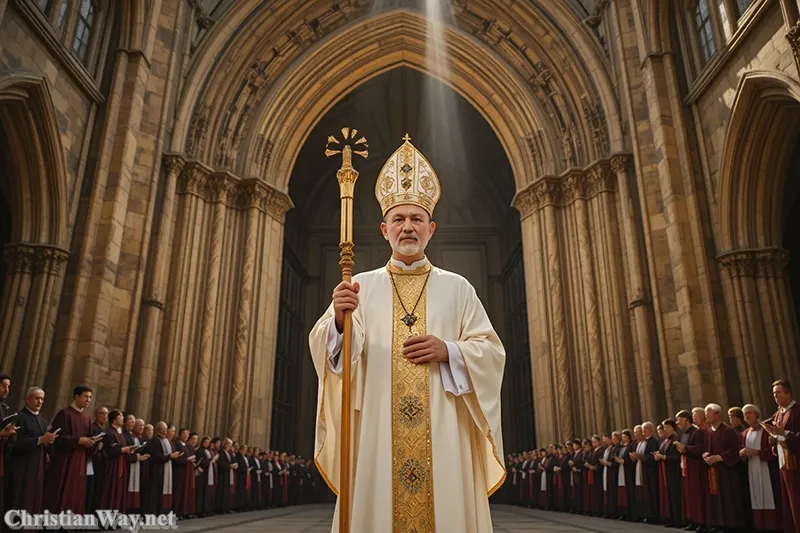
This is the light in which the Archbishop of Canterbury must be seen. The office is not meant to be a throne of privilege. It is a ministry of service. The Archbishop is called to be a bishop, a pastor, a teacher, a listener, a convener of prayer, and a visible focus of unity for Anglican Christians around the world. The task is beautiful, but it is also heavy. It involves carrying the hopes, divisions, questions, griefs, and diverse experiences of a worldwide communion of churches.
The title itself carries more than fourteen centuries of Christian memory. Canterbury Cathedral was founded in 597 through the mission associated with Saint Augustine of Canterbury, sent from Rome to proclaim Christ in England. Over time, Canterbury became the principal seat of the Archbishop of Canterbury and is now recognized as the mother church of the worldwide Anglican Communion.
Yet the deepest importance of the office does not come from age alone. Ancient buildings can be beautiful, inherited customs can be precious, and historic titles can carry real meaning, but none of these save the human heart. The Church is alive only because Christ is alive. The Archbishop of Canterbury serves faithfully only when the office remains close to the One who says, “I am the good shepherd: the good shepherd giveth his life for the sheep” (John 10:11).
To reflect on The Archbishop of Canterbury: History, Role, and Unity in the Anglican Communion is therefore to reflect on Christian leadership itself. It asks what it means to be a shepherd in a divided world. It asks how authority can serve love rather than pride. It asks how Christians from many cultures, nations, languages, and theological traditions can remain connected in Christ without losing the gifts God has placed within their local communities.
Christ Is the True Shepherd of the Church
Before speaking about Canterbury, England, bishops, councils, or the Anglican Communion, Christians must begin with Jesus Christ. The Church does not belong to an archbishop, a bishop, a priest, a pastor, a denomination, or a nation. It belongs to Christ.
Jesus calls Himself the Good Shepherd. This image is not simply gentle or poetic. It reveals the nature of true spiritual leadership. A shepherd knows the flock. He protects the vulnerable. He searches for those who are lost. He remains near when danger comes. He does not abandon the wounded sheep because caring for it is inconvenient. He gives himself for those entrusted to his care.
Every Christian leader is called to reflect something of this shepherding love. A parent guiding a child in faith, a teacher helping young people grow in wisdom, a priest visiting the sick, a pastor preaching the Gospel, a bishop carrying responsibility for a diocese, and an archbishop serving a larger church all stand beneath the same calling: to lead in the spirit of Christ.
The Archbishop of Canterbury has a visible ministry, but visibility can be dangerous if it becomes separated from humility. A public role can tempt a person to seek approval, defend personal influence, or treat criticism as an enemy. But Christ shows another way. He teaches that greatness is measured not by the number of people who obey us, but by the depth of love with which we serve them.
Jesus tells His disciples, “Whosoever will be great among you, let him be your minister” (Matthew 20:26). These words are the measure of every Christian office. The Archbishop of Canterbury is called to be a servant before being a public figure, a disciple before being a teacher, and a fellow sinner in need of grace before being a spiritual guide.
The Cross Is the Measure of Christian Authority
The cross changes the meaning of leadership. In the world, authority can easily become a way of protecting status, controlling others, or avoiding weakness. In the Gospel, authority becomes the willingness to carry burdens for the good of others.
The Archbishop of Canterbury must often speak into situations of conflict, sorrow, injustice, war, migration, poverty, faith, public life, and human suffering. Such a role requires courage. Yet Christian courage is not harshness. It is the strength to speak truth with mercy, to listen before judging, to defend the vulnerable, and to remain faithful even when every response seems incomplete.
The cross teaches that leadership will often involve misunderstanding. Jesus was misunderstood by crowds, opposed by religious leaders, abandoned by many disciples, and betrayed by someone close to Him. Yet He did not return hatred for hatred. He remained faithful to the Father’s love.
This does not mean Christian leaders should remain silent when wrong is done. Silence can leave wounded people unprotected. The Church must speak truth about injustice, abuse, cruelty, dishonesty, and the dignity of every human person. But truth must never become an excuse for contempt. The goal of Christian leadership is not to win arguments. It is to lead people more deeply toward Christ.
Canterbury: A See Shaped by Mission, Memory, and Martyrdom
The history of Canterbury begins with mission. Saint Augustine of Canterbury arrived in England in 597, sent to proclaim the Gospel and help establish Christian life among the English people. The cathedral that grew from this mission became England’s first cathedral, a place of worship, pilgrimage, learning, and Christian witness across many centuries.
This beginning matters because the office of Archbishop of Canterbury was never meant merely to preserve an institution. It was born from the Church’s missionary calling. Augustine did not arrive to build a monument to himself. He came to proclaim Christ, baptize believers, form communities of prayer, and help people encounter the mercy of God.
The Christian story of Canterbury is also marked by suffering. One of its most remembered figures is Thomas Becket, Archbishop of Canterbury in the twelfth century. His conflict with King Henry II and his death in Canterbury Cathedral in 1170 became a defining moment in English religious history. His martyrdom turned Canterbury into one of the great pilgrimage destinations of medieval Europe.
The story of Becket is not simply a dramatic chapter from the past. It reminds the Church that spiritual authority and political power can become entangled in painful ways. Christian leaders must always be careful when earthly influence begins to shape the life of the Church. The Church cannot become the servant of political ambition, cultural pride, or national self-interest. She belongs to Christ.
Through the centuries, Canterbury has witnessed reform, conflict, renewal, pilgrimage, war, prayer, and changing social life. The English Reformation reshaped the relationship between the Church of England and Rome, while the office of Archbishop of Canterbury remained central within the life of the English Church. The Church of England’s own history describes the development of an English Church led by the Archbishops of Canterbury and York, formed within the wider Christian life of the West.
A Cathedral Is More Than Stone
Canterbury Cathedral is magnificent, but stone alone cannot create faith. A cathedral becomes holy not because its walls are ancient, but because it becomes a place where people pray, repent, worship, grieve, give thanks, and seek Christ.
The same is true of every church, whether it is a great cathedral, a village chapel, a simple room, or a gathering beneath a tree. The Church is not made holy by outward beauty alone. It becomes holy when the people gathered there learn to love God and neighbor.
Canterbury’s long history can therefore speak to every Christian community. It reminds us that faith is received from those who have gone before us, but it must also become alive within us. We cannot live only on the prayers of past generations. We must pray today. We cannot depend only on the courage of saints from long ago. We must choose faithfulness in the circumstances God has placed before us.
The Archbishop Within the Church of England
The Archbishop of Canterbury has a particular role within the Church of England. The Archbishop is the diocesan bishop of Canterbury and also carries wider pastoral responsibility in the southern province of the Church of England. Alongside the Archbishop of York, the Archbishop of Canterbury helps serve the wider life, unity, and mission of the Church of England.
This role includes teaching, pastoral care, public witness, leadership among bishops, participation in church governance, and service to communities throughout England. Yet the Archbishop is not meant to act alone. Anglican life includes bishops, priests, deacons, lay people, parishes, dioceses, schools, religious communities, councils, and many ordinary believers who each carry a share of the Church’s mission.
This is important because Christianity is never meant to become a stage where a few leaders act while everyone else watches. The Body of Christ has many members. Parents teach children to pray. Teachers shape young minds. Workers bear witness through honesty. Young people bring hope and courage. Elderly believers offer wisdom and prayer. Those who suffer may become powerful witnesses through patient faith.
The Archbishop’s task is not to replace the calling of others. It is to encourage the Church to live more fully as the people of God.
A Bishop Must Remain a Disciple
Every bishop, including an archbishop, remains a disciple of Christ. He or she must still pray, listen to Scripture, confess sin, receive mercy, seek wisdom, and grow in humility.
This is one of the most important truths about leadership in the Church. No human office makes a person beyond weakness. No title removes the need for repentance. No position gives someone permission to stop listening.
The Gospels show this clearly in the life of Saint Peter. Peter was chosen to strengthen his brothers and care for the flock, yet he also denied Jesus in the hour of fear. His failure did not become the end of his story because Christ restored him. The risen Jesus asked Peter, “Lovest thou me?” and then entrusted him with the care of His sheep (John 21:15–17).
Christian leadership must always be shaped by this kind of humility. A leader who has received mercy becomes more able to show mercy. A leader who remembers personal weakness becomes less likely to humiliate others. A leader who knows that Christ alone is perfect becomes more willing to listen, repent, and begin again.
The Archbishop and the Anglican Communion
The Archbishop of Canterbury’s global role is perhaps the part of the office most often misunderstood.
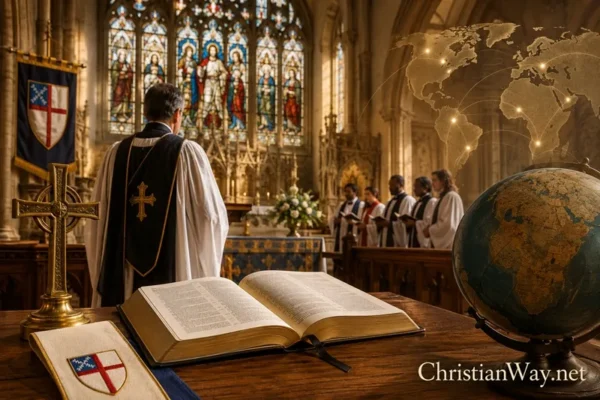
The Anglican Communion is not a single worldwide church governed through one centralized authority. It is a fellowship of autonomous and interdependent Anglican churches, united through faith, worship, historical relationship, mutual service, and what Anglicans often call “bonds of affection.” The Anglican Communion Office describes the Archbishop of Canterbury as a focus of unity within this global fellowship rather than as a universal ruler over all Anglican churches.
This distinction is deeply important. The Archbishop of Canterbury does not exercise direct canonical authority over every Anglican province in the world. Anglican churches in Africa, Asia, the Americas, Europe, Oceania, and the Middle East govern their own local life. They have their own bishops, synods, customs, pastoral challenges, and cultural contexts.
Yet they remain connected through a shared Anglican inheritance: Scripture, prayer, episcopal ministry, worship, mission, pastoral care, and the desire to remain in communion with one another.
The Archbishop serves this communion as primus inter pares, meaning “first among equals.” This phrase does not mean that the Archbishop is unimportant. It means that leadership is exercised in relationship with other leaders, not above them as a distant monarch.
A Focus of Unity Rather Than a Central Ruler
Unity is not the same as control. A family is not united because one person forces everyone else to think, speak, and act in identical ways. A family is united when its members remain connected through love, truth, patience, and shared responsibility.
The Anglican Communion is diverse. Its churches worship in many languages. They live in different cultures. They face different social realities. A parish in rural England may have concerns very different from a church in Kenya, Pakistan, Brazil, Australia, South Sudan, Japan, or the Caribbean.
The Archbishop of Canterbury is called to help these diverse churches remember that they belong to one wider Christian family. This ministry is often carried out through visits, prayer, listening, encouragement, relationship-building, and the willingness to hear the concerns of local churches firsthand. The Anglican Communion Office describes this as a pastoral ministry of unity, expressed through visits, partnership, and collegial service alongside other Anglican primates.
This kind of unity is fragile because it depends on humility. It cannot be forced. It cannot be protected only by documents or meetings. It grows when Christians pray for one another, listen across differences, serve together, and remember that Christ is greater than the divisions that tempt them.
The Instruments of Communion
Anglican Christians often speak of four “Instruments of Communion.” These are not instruments in the sense of legal control. They are shared structures meant to foster cooperation, prayer, mutual understanding, and common mission among Anglican churches.
The four are the Archbishop of Canterbury, the Lambeth Conference, the Anglican Consultative Council, and the Primates’ Meeting. Together, they help Anglican churches seek unity and collaboration across a global fellowship that remains decentralized and diverse.
The Lambeth Conference gathers Anglican bishops from around the world, usually at intervals of about ten years. It offers bishops time for prayer, Bible study, discussion, and reflection on the mission of the Church in a changing world.
The Anglican Consultative Council brings together bishops, clergy, and lay representatives from member churches. Its presence is especially meaningful because it reminds the Communion that the mission of the Church belongs not only to bishops or priests, but to all baptized believers.
The Primates’ Meeting gathers senior bishops, archbishops, and presiding leaders from Anglican provinces for prayer, fellowship, consultation, and discernment. The Archbishop of Canterbury convenes this meeting as first among equals, serving as convener, chair, and mediator. Yet the meeting does not function as a parliament that can simply impose binding decisions on every province. Anglican churches retain their local autonomy.
Prayer Before Power
These structures reveal something important about Anglican Christianity. The Communion seeks to hold together authority and relationship, order and freedom, local responsibility and global fellowship.
This is not always easy. Human beings often want simple answers. We may wish for one leader who can solve every disagreement, or one decision that makes every conflict disappear. But the Church is made of real people living in real cultures, carrying real histories, wounds, hopes, and convictions.
The Instruments of Communion are therefore not magical solutions. They are places where Christians can pray, listen, discern, argue honestly, seek reconciliation, and remember that they belong to one another in Christ.
The Church needs these spaces because unity is not maintained by ignoring conflict. It is maintained by bringing conflict into the light of prayer, truth, humility, and love.
Unity in a Diverse and Wounded Communion
Christian unity is one of the deepest desires of Jesus. Before His Passion, He prayed that His followers might be one, “that the world may believe” (John 17:21).
This prayer does not mean Christians must become identical. The New Testament itself shows different gifts, personalities, ministries, cultures, and missions within the Church. Peter, Paul, John, James, Thomas, Mary Magdalene, Priscilla, Lydia, and many others served Christ in different ways.
Unity means remaining connected to Christ and to one another despite difference.
The Anglican Communion carries a wide diversity of worship styles, theological emphases, cultural traditions, and pastoral practices. Such diversity can be a gift. A church in one country may teach another church how to endure persecution. A church in another place may offer wisdom about reconciliation after conflict. A community with few financial resources may show wealthier Christians the beauty of hospitality and prayer. A younger church may renew the faith of an older one with courage and joy.
Yet diversity can also become painful when Christians begin to treat one another as enemies. Disagreement about doctrine, ethics, culture, leadership, sexuality, worship, politics, and public life has tested relationships within the Anglican Communion.
The Archbishop of Canterbury cannot solve every disagreement. No human leader can. But the office can help create spaces for conversation, prayer, and mutual care. It can call Christians back to the Gospel when anger becomes louder than love. It can remind believers that the person with whom they disagree is still someone for whom Christ died.
Unity Must Never Ignore Truth
Christian unity does not mean pretending that convictions do not matter. Truth matters. Scripture matters. Conscience matters. The Church must be able to speak honestly about difficult questions.
But truth without love becomes hard. It can wound rather than heal. Love without truth becomes shallow. It may avoid difficult realities but leave people without guidance.
Jesus is full of grace and truth. The Church is called to reflect both.
The Archbishop of Canterbury’s ministry of unity is most faithful when it refuses both extremes: the temptation to treat disagreement as proof that another Christian is worthless, and the temptation to avoid truth simply because truth is difficult.
A shepherd must lead with courage, but also with tenderness. He must be willing to speak, but also willing to listen. He must care for those who feel marginalized, wounded, forgotten, or afraid. He must remember that unity is not an achievement of human diplomacy alone. It is a gift of the Holy Spirit.
A Ministry of Prayer, Presence, and Pastoral Care
The Archbishop of Canterbury’s most important work may not always be visible in public speeches or major events. Much of pastoral ministry happens through presence.
It happens when a leader visits communities affected by violence. It happens when Christians facing persecution are remembered in prayer. It happens when bishops gather to share sorrow, fatigue, or uncertainty. It happens when a grieving family hears that the Church has not forgotten them. It happens when young people are encouraged to believe that their lives matter to God.
The Anglican Communion Office describes the Archbishop’s international role as pastoral, marked by visits to Anglican provinces, encouragement of local ministries, and relationship-building with other Christian leaders.
This matters because people often do not need grand answers first. They need to know they are not alone.
Jesus did not only preach to crowds. He stopped for the blind man by the roadside. He spoke to the woman at the well. He entered the home of Zacchaeus. He wept at the tomb of Lazarus. He noticed the widow who gave two small coins.
A Christian leader must learn this same attentiveness. The Church becomes credible when it remembers faces, not only statistics; people, not only policies; wounds, not only debates.
The Church Must Protect the Vulnerable
Pastoral leadership also carries the responsibility to protect those who are vulnerable. The Church cannot claim to reflect Christ while ignoring abuse, exploitation, violence, or the suffering of those who have been harmed.
Any Christian leader, including an archbishop, must be willing to seek truth, support justice, listen to survivors, and place the dignity of wounded people above the protection of reputation.
The Good Shepherd does not walk past the injured sheep. He bends down to care for it.
This is a demanding calling because institutions often fear embarrassment. They may be tempted to hide failures, avoid difficult questions, or protect those with influence. But the Gospel does not permit such evasion. Christ calls His Church to repentance wherever it has failed.
The Archbishop of Canterbury’s ministry must therefore be understood not only as a ministry of unity, but also as a ministry of humility, accountability, compassion, and protection.
The Archbishop and the Wider Christian Family
The Archbishop of Canterbury also has an ecumenical role. Ecumenism is the patient work of seeking greater understanding, prayer, reconciliation, and visible unity among Christians divided by history.
Anglicans share much with other Christian traditions. They confess the Holy Trinity. They proclaim Jesus Christ as Lord. They read Scripture. They baptize in the name of the Father, Son, and Holy Spirit. They pray the Lord’s Prayer. They celebrate Holy Communion. They honor the ancient creeds. They seek to live the Gospel in worship, service, and mission.
Yet important differences remain between Anglicans, Catholics, Orthodox Christians, Lutherans, Reformed Christians, Methodists, Baptists, Pentecostals, and others. These differences concern authority, sacraments, ministry, worship, ethics, doctrine, and the life of the Church.
The Archbishop of Canterbury cannot erase these differences simply by goodwill. But the office can help Christians meet one another with honesty and respect. It can encourage dialogue that does not weaken conviction, but refuses hostility.
Christians must remember that division is a wound in the Body of Christ. It should never become a source of pride.
What the Archbishop of Canterbury Teaches Every Christian
Most believers will never meet the Archbishop of Canterbury. Many will never visit Canterbury Cathedral. Yet the meaning of this office can still speak to ordinary life.
It reminds us that leadership begins wherever someone else has been entrusted to our care.
A parent is called to lead through love, not fear.
A teacher is called to guide students without humiliating them.
A manager is called to use responsibility for the good of others, not for personal pride.
A friend is called to protect another person’s dignity, especially when gossip would be easier.
A Christian is called to become a peacemaker in a divided world.
We may never hold an ancient title, but we all have opportunities to serve. We all have moments when we can choose listening over harshness, mercy over resentment, honesty over convenience, and humility over the need to be right.
The Archbishop of Canterbury’s ministry reminds us that Christian authority is not about standing above others. It is about helping others stand closer to Christ.
Reflect and Pray
Dear friend, the Archbishop of Canterbury carries an ancient title, but the heart of the office is simple: to serve Christ and His people.
The Archbishop is called to be a bishop for Canterbury, a servant within the Church of England, and a focus of unity for the worldwide Anglican Communion. This work is not meant to create a distant religious monarchy. It is meant to encourage prayer, foster communion, strengthen churches in mission, support relationships across cultures, and point believers toward the One true Shepherd.
The history of Canterbury reminds us that the Church is carried through centuries not by human perfection, but by God’s faithfulness. Leaders come and go. Nations rise and fall. Cultures change. Yet Jesus Christ remains the same: merciful, patient, truthful, and near to those who seek Him.
May we pray for the Archbishop of Canterbury, for Anglican Christians around the world, and for all who carry responsibility in the Church. May they lead with courage, listen with humility, protect the vulnerable, and remain close to Christ.
Let us pray:
Lord Jesus Christ, You are the Good Shepherd and the true Head of Your Church. Bless the Archbishop of Canterbury with wisdom, humility, courage, and compassion. Strengthen all who serve within the Anglican Communion, and guide them in prayer, truth, mercy, and mutual love. Heal the divisions among Christians, protect those who suffer for Your name, and teach us all to become servants of peace in a wounded world. May every leader and every believer point beyond themselves to Your saving love. Amen.
May the peace of Christ dwell richly in your heart, and may His love guide you to serve others with humility, truth, and hope.
— Fr. John Matthew