A clear and pastoral reflection on Catholic faith, grace, sacraments, Scripture, prayer, and the call to live in Christ.
Dear friends in Christ,
To ask, “What do Catholics believe?” is to ask a question that reaches far beyond customs, church buildings, religious objects, or historical institutions. At its heart, Catholic belief is about God’s loving desire to draw humanity into communion with Himself through Jesus Christ. It is about the conviction that the eternal God has entered human history, taken upon Himself our suffering and sin, conquered death, and opened for us the way to everlasting life.
Catholicism is sometimes described only through its visible features: the Mass, the pope, devotion to Mary, the saints, confession, sacred images, or ancient traditions. These things are indeed part of Catholic life, but none of them can be properly understood apart from Jesus Christ. Catholic faith begins with Christ, is centered on Christ, and hopes to lead every human person into deeper union with Christ.
Catholics believe that Christianity is not merely a philosophy for living well, nor simply a collection of moral teachings. It is a response to something God has done. God has revealed Himself. He has spoken through the history of Israel, through the prophets, and finally and perfectly through His Son. Christianity begins not with humanity climbing upward toward heaven, but with God descending in mercy to meet humanity.
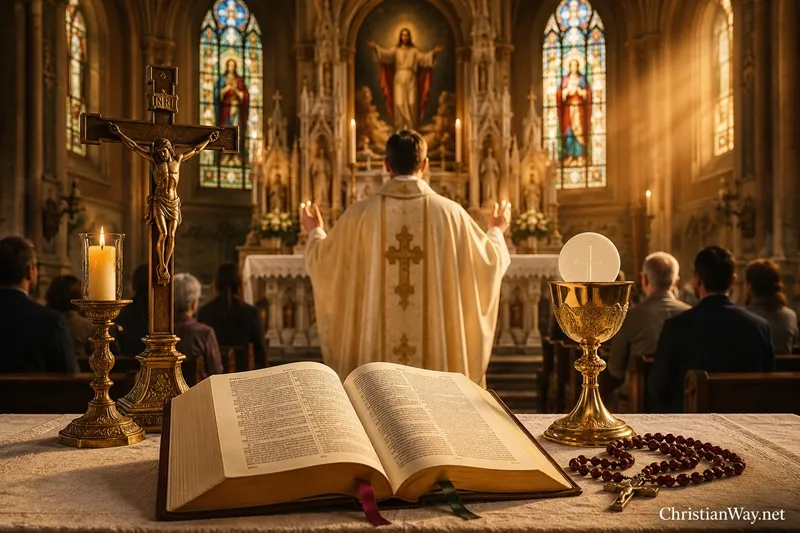
The Catholic faith is vast because it embraces the whole mystery of God, the dignity and brokenness of the human person, the meaning of salvation, the life of the Church, the sacraments, moral responsibility, prayer, death, resurrection, and eternal life. Yet beneath all these teachings lies one simple and radiant truth: God is love, and He calls us to share His life.
To understand what Catholics believe, therefore, we must not merely examine doctrines from a distance. We must try to see how these teachings form one living vision of reality—a vision in which creation is good, sin is serious, grace is powerful, Christ is victorious, and no human life is beyond the reach of divine mercy.
Catholics Believe in One God: Father, Son, and Holy Spirit
The foundation of Catholic faith is belief in one God. Catholics share this belief with all historic Christian traditions and confess it whenever they recite the Nicene Creed: “I believe in one God, the Father almighty, maker of heaven and earth.”
Yet the one God is not understood as solitary or distant. God has revealed Himself as a communion of three divine Persons: the Father, the Son, and the Holy Spirit. This is the mystery of the Holy Trinity.
Catholics do not believe in three gods. There is only one divine nature, one eternal being, and one God. Within this one divine life are three distinct Persons who are perfectly united in love. The Father is God, the Son is God, and the Holy Spirit is God, yet the Father is not the Son, the Son is not the Spirit, and the Spirit is not the Father.
The Trinity is not a puzzle invented by theologians. It arises from the way God reveals Himself in Scripture. Jesus speaks to the Father, declares His unity with the Father, promises the Holy Spirit, and commands His disciples to baptize “in the name of the Father and of the Son and of the Holy Spirit” in Matthew 28:19.
This teaching tells us something profound about the nature of reality. At the heart of all existence is not loneliness, conflict, or impersonal force, but eternal communion. God is love not merely because He chooses to love creation, but because love belongs eternally to His own divine life. The Father loves the Son, the Son receives and returns the Father’s love, and the Holy Spirit is eternally united with them in the mystery of divine communion.
For Catholics, faith in the Trinity shapes prayer and worship. Catholics pray to the Father, through the Son, in the Holy Spirit. Every Mass begins and ends in the name of the Trinity. Every baptism brings a person into the life of the Trinity. Every Christian vocation is ultimately a call to enter more deeply into this divine communion of love.
God Created the World Out of Love
Catholics believe that God freely created the universe from nothing. Creation is neither an accident nor an extension of God’s substance. It exists because God willed it in wisdom and love.
The opening words of Genesis, “In the beginning God created the heavens and the earth,” affirm that everything depends upon God. The visible world, the human body, time, matter, beauty, reason, and life itself are gifts.
Because creation comes from God, Catholics believe that the material world is fundamentally good. The body is good. Marriage is good. Food, work, friendship, art, and the natural world can all reveal something of God’s generosity. Sin has wounded creation, but it has not erased its original goodness.
Human beings hold a unique place within creation because they are made in the image and likeness of God. Every person possesses an inherent dignity that does not depend on wealth, health, intelligence, social usefulness, nationality, age, or achievement. The unborn child, the elderly person, the prisoner, the migrant, the person with disabilities, the poor, and the forgotten all bear the image of God.
This conviction lies beneath Catholic concern for human life and social justice. The dignity of the person is not given by the state and cannot be taken away by society. It comes from God.
Catholics Believe That Jesus Christ Is Truly God and Truly Man
At the center of Catholic faith stands Jesus Christ.
Catholics believe that Jesus is not merely a prophet, moral teacher, religious reformer, or inspiring spiritual leader. He is the eternal Son of God who became truly human while remaining truly divine. As the Gospel of John proclaims, the Word became flesh and dwelt among us.
This mystery is called the Incarnation. The Son of God did not merely appear human or temporarily inhabit a human body. He took a complete human nature. He possessed a human body, a human mind, a human will, and a human soul. He experienced hunger, fatigue, friendship, rejection, suffering, and death. Yet He remained the eternal Son, one in being with the Father.
Jesus reveals both God and humanity. In Him, we see the face of the invisible God, but we also see what human life is meant to become when fully united with divine love. He teaches with authority, forgives sins, welcomes sinners, heals the sick, confronts hypocrisy, and announces the coming of God’s kingdom.
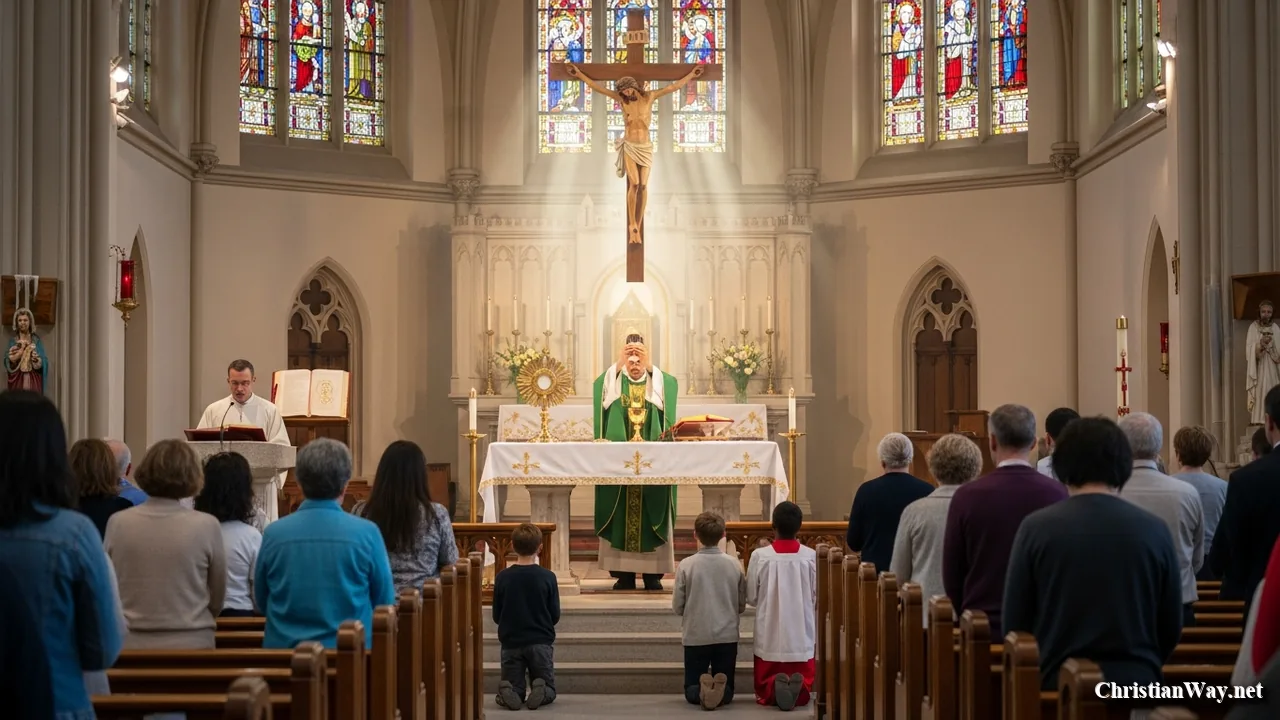
Catholics believe that everything Jesus said and did has saving significance. His hidden life in Nazareth sanctifies ordinary work and family life. His public ministry reveals the mercy and justice of God. His miracles are signs that the kingdom of God is breaking into a wounded world. His compassion shows that no suffering is invisible to the Father.
The Death and Resurrection of Jesus
Catholics believe that Jesus freely gave His life on the cross for the salvation of humanity. His death was a real historical event, but it was also a saving sacrifice. He bore the consequences of sin, reconciled humanity to the Father, and revealed the immeasurable depth of divine love.
The cross does not mean that the Father delighted in suffering or punished an unwilling Son. The Father, Son, and Holy Spirit act together in the work of salvation. The Son freely offers Himself in love. As Jesus says in John 10:18, no one takes His life from Him; He lays it down willingly.
On the cross, Christ enters into the darkest consequences of human sin—betrayal, violence, shame, abandonment, and death—and transforms them from within. Evil is not defeated by greater violence but by self-giving love. The cross reveals both the seriousness of sin and the greater power of mercy.
Catholic faith does not end at Calvary. On the third day, Jesus rose bodily from the dead. The Resurrection was not merely the survival of His memory or a spiritual experience within the disciples. Christ truly conquered death.
Because Jesus rose, death does not have the final word. The Resurrection confirms His divine identity, vindicates His mission, and opens eternal life to humanity. Christian hope is therefore not vague optimism. It is rooted in the victory of Christ.
Catholics believe that Jesus ascended into heaven and remains eternally Lord. He intercedes for humanity and will come again in glory to judge the living and the dead. History is moving toward fulfillment in Him.
Catholics Believe in the Authority of Scripture and Apostolic Tradition
Catholics believe that the Bible is the inspired Word of God. The Scriptures were written by human authors who used their own language, culture, literary forms, and abilities, yet the Holy Spirit guided them so that they faithfully communicate the truth God intended for our salvation.
The Bible is not regarded as a human book that later became sacred through Church approval. It is received as divine revelation expressed through human words. Catholics read the Old Testament as the history of God’s covenant with Israel and the New Testament as the fulfillment of that covenant in Jesus Christ.
Scripture holds a central place in Catholic worship and teaching. At every Mass, passages are proclaimed from the Old Testament, the Psalms, the apostolic writings, and the Gospels. Catholic prayer is filled with biblical language, and the Church encourages all believers to read, study, meditate upon, and pray with Scripture.
Catholics, however, do not believe that the Bible was intended to function apart from the living faith of the Church. Before the New Testament books were written and gathered into a recognized canon, the apostles were preaching, baptizing, celebrating the Eucharist, appointing leaders, and handing on the faith they had received from Christ.
This living transmission of the apostolic faith is called Sacred Tradition. Tradition does not mean every religious custom or every practice that developed over time. Sacred Tradition refers to the Gospel entrusted by Christ to the apostles and faithfully handed on in the life, worship, teaching, and witness of the Church.
Scripture and Tradition are not two competing revelations. They flow from the same divine source and communicate the same apostolic faith. Scripture is the inspired written Word of God, while Tradition is the living transmission of that Word within the community Christ founded.
The Teaching Office of the Church
Catholics believe that Christ gave the apostles and their successors a responsibility to preserve and interpret the deposit of faith. This teaching authority is known as the Magisterium.
The Magisterium consists of the bishops in communion with the bishop of Rome, the pope. Its purpose is not to invent new revelation or place itself above Scripture. Rather, it serves the Word of God by guarding, explaining, and faithfully handing on what has been received.
Catholics believe that the Holy Spirit protects the Church from formally teaching error when it definitively proclaims a doctrine concerning faith or morals under specific conditions. This gift is known as infallibility.
Infallibility does not mean that every statement made by a pope is perfect, inspired, wise, or free from personal limitation. Popes can make mistakes in judgment, administration, diplomacy, or personal conduct. Infallibility concerns particular acts of authoritative teaching, not every opinion or decision of Church leaders.
Catholics Believe That Christ Founded the Church
Catholics believe that the Church is more than a voluntary association of people who share religious interests. The Church is the Body of Christ, the People of God, and the temple of the Holy Spirit.
Jesus gathered disciples, chose twelve apostles, gave them authority to teach and baptize, and sent them into the world. He promised to remain with His people and to send the Holy Spirit to guide them.
Catholics believe that this apostolic community continues historically in the Church. Bishops are understood as successors of the apostles, and priests share in the bishops’ ministry. Through apostolic succession, the Church maintains visible continuity with the community established by Christ.
The Church is both spiritual and visible. She is a mystery of grace, yet she also possesses concrete structures, sacraments, leaders, laws, and communities. This visible dimension reflects the Incarnation itself: God communicates invisible grace through visible realities.
Catholics do not believe that every action of every Catholic accurately represents Christ. The Church is holy because Christ is holy, because the Holy Spirit dwells within her, and because she possesses the means of grace. Yet her members remain sinners in need of conversion.
The history of the Church contains extraordinary holiness, courage, service, learning, art, and sacrifice. It also contains scandal, corruption, violence, cowardice, and failure. Catholics should neither deny these sins nor allow them to obscure the faithfulness of Christ.
The holiness of the Church does not rest upon the moral perfection of her members. It rests upon Christ, who continues to call sinners, heal the wounded, and raise up saints in every generation.
The Pope and the Ministry of Unity
Catholics believe that Jesus gave Saint Peter a distinctive responsibility among the apostles. Christ renamed him Peter, meaning rock, entrusted him with the keys of the kingdom, and commanded him to strengthen his brethren and feed the flock.
The pope is the bishop of Rome and the successor of Saint Peter. Catholics understand his primary responsibility as serving the unity of the universal Church and protecting the apostolic faith.
The pope is not regarded as a new revelation, a divine figure, or a ruler without limits. He is a bishop and a servant of the Gospel. One of his traditional titles, “servant of the servants of God,” expresses the true purpose of his office.
Catholics recognize that the papacy is one of the most difficult issues in relationships with Orthodox and Protestant Christians. Yet they also believe that Christ desires visible unity among His followers. Honest dialogue about authority must therefore be pursued with humility, truth, patience, and love.
Catholics Believe That Salvation Is a Gift of Grace
Catholics believe that every human person needs salvation. Humanity was created for communion with God, but sin has damaged that communion and wounded human nature.
The doctrine of original sin does not mean that newborn children are personally guilty of Adam’s individual choice. It means that humanity inherits a fallen condition—a life deprived of original holiness and marked by disordered desires, suffering, separation, and death.
Human beings remain capable of good actions, reason, love, and moral responsibility, but they cannot heal the deepest wound of sin by their own effort. Salvation must come from God.
Catholics believe that salvation is entirely rooted in grace. Grace is God’s free and undeserved gift of His own life. No person can earn the Incarnation, the cross, forgiveness, or eternal life. God acts first.
Through Christ, the sinner is forgiven, justified, adopted as a child of God, and sanctified by the Holy Spirit. Salvation is not merely a legal declaration external to the person. It includes a real interior transformation. Grace heals, renews, and gradually makes the believer holy.
Faith and Works
Catholic teaching on faith and works is often misunderstood. Catholics do not believe that people purchase salvation by performing enough good deeds. Nor do they believe that human effort can replace the grace of Christ.
Catholics believe that justification begins with God’s grace and is received through faith. Yet saving faith is not meant to remain alone or lifeless. It expresses itself through love, obedience, mercy, and good works.
Saint Paul teaches that we are saved by grace through faith and not by works that would allow us to boast. The same apostle also teaches that what matters is “faith working through love” in Galatians 5:6. The Letter of James warns that faith without works is dead.
These teachings are harmonious when properly understood. Good works do not cause God to love us or place Him in our debt. They are the fruit of grace operating within us. When Christians love the poor, forgive enemies, resist sin, or serve their neighbors, they cooperate with the grace they have received.
Catholic spirituality therefore avoids two opposite errors. One is the belief that we can save ourselves through moral achievement. The other is the belief that our choices and actions have no spiritual significance. Grace does not destroy human freedom; it heals and elevates it.
Salvation is a living relationship with Christ. It begins in grace, grows through grace, and reaches fulfillment through grace. Yet the believer is called to respond freely, faithfully, and lovingly.
Catholics Believe in the Seven Sacraments
Catholics believe that Christ communicates His grace through seven sacraments: Baptism, Confirmation, the Eucharist, Reconciliation, the Anointing of the Sick, Holy Orders, and Matrimony.
A sacrament is a visible sign instituted by Christ that communicates invisible grace. The sacraments use ordinary elements and human actions—water, oil, bread, wine, spoken words, the laying on of hands, marital consent—to make Christ’s saving work present within the life of the Church.
This sacramental vision flows from the Incarnation. Because the Son of God took on a real human body, material creation can become an instrument of divine grace. God does not save humanity by pulling us away from creation, but by renewing us within it.
Baptism
Baptism is the beginning of Christian life. Through water and the invocation of the Trinity, a person is freed from sin, reborn in Christ, receives the Holy Spirit, and becomes a member of the Church.
Catholics baptize infants because baptism is understood primarily as God’s gift rather than a reward for intellectual maturity. Just as children receive natural life and family identity before they can understand them, they may receive supernatural life within the household of faith. As they grow, they must personally embrace and live the faith they have received.
The Catholic Church recognizes baptisms performed in many other Christian communities when water is used together with the Trinitarian formula and the intention to perform Christian baptism.
Confirmation
Confirmation strengthens the grace of baptism through a particular outpouring of the Holy Spirit. The confirmed Christian is called to mature discipleship, deeper participation in the Church, and courageous witness to Christ.
It recalls Pentecost, when the Holy Spirit empowered the apostles to proclaim the Gospel. Confirmation reminds believers that faith is not merely private comfort. Every Christian is sent into the world to bear witness through words, conduct, mercy, and courage.
The Eucharist
The Eucharist stands at the center of Catholic worship. Catholics believe that during the Mass, bread and wine truly become the Body and Blood of Jesus Christ, while retaining the outward appearances of bread and wine.
This change is traditionally called transubstantiation. The term attempts to protect the Church’s conviction that Christ is not merely symbolically remembered. He is truly, really, and substantially present.
Catholics base this belief upon the words of Jesus at the Last Supper—“This is my body” and “This is my blood”—and upon His teaching in John 6 concerning the bread of life.
The Mass is not understood as a new crucifixion or a repetition of Christ’s sacrifice. Jesus died once for all. Rather, the one sacrifice of Calvary is made sacramentally present. The Church is joined to Christ’s eternal self-offering to the Father.
Holy Communion is therefore both sacred meal and sacrifice. The faithful receive Christ as spiritual nourishment and are drawn into communion with Him and with one another.
This belief explains the reverence Catholics show toward the consecrated Eucharist. Genuflection, adoration, silence, and careful preparation arise from the conviction that the Lord Himself is present.
Reconciliation
In the sacrament of Reconciliation, also called confession or penance, Catholics confess serious sins to a priest, express sorrow, receive absolution, and undertake an act of penance.
Catholics do not believe that priests replace God or forgive sins by personal power. Christ alone is the source of forgiveness. The priest acts sacramentally in the name of Christ and the Church.
After His Resurrection, Jesus breathed upon the apostles and spoke of the authority to forgive sins in John 20:22–23. Catholics understand confession as a continuation of this ministry of reconciliation.
The sacrament brings honesty into the spiritual life. Sin thrives in secrecy, denial, and self-deception. Confession invites the sinner to name the wound, receive mercy, make amends where possible, and begin again.
For many Catholics, the words of absolution become a deeply personal encounter with Christ’s compassion: not merely the hope that one might be forgiven, but the sacramental assurance that forgiveness has been given.
Anointing of the Sick
The Anointing of the Sick is offered to those who are seriously ill, weakened by old age, or facing major medical danger. A priest anoints the person with oil and prays for healing, strength, forgiveness, and peace.
The sacrament is not reserved only for the final moments of life. It may be received whenever serious illness threatens or when a person’s condition significantly worsens.
Sometimes physical healing occurs, but the sacrament’s deeper purpose is union with Christ. It helps the suffering person face illness without despair and offers the assurance that suffering and death do not separate the believer from God’s love.
Holy Orders
Through Holy Orders, bishops, priests, and deacons are ordained for service within the Church.
Bishops receive the fullness of the sacrament and continue the apostolic ministry of teaching, sanctifying, and governing. Priests assist bishops, celebrate the Eucharist, preach, forgive sins sacramentally, and care for the faithful. Deacons serve through the ministry of the Word, the altar, and charity.
Ordination is not a claim that clergy are holier or more valuable than laypeople. It is a call to sacrificial service. Clergy remain human beings who require prayer, accountability, conversion, and grace.
Matrimony
Catholics believe that marriage is a covenant between one man and one woman ordered toward the good of the spouses and the welcoming and raising of children.
When two baptized Christians marry validly, their union is a sacrament. Their faithful love becomes a visible sign of Christ’s faithful love for the Church.
Marriage is therefore understood as more than a private contract based upon changing emotions. It is a lifelong covenant of mutual self-giving. Husband and wife are called to help one another grow in holiness through patience, forgiveness, fidelity, tenderness, sacrifice, and shared responsibility.
Catholic teaching holds that a valid sacramental marriage is indissoluble. The Church may sometimes determine through an annulment process that a valid marriage was never established because an essential element was absent from the beginning. An annulment is not a Catholic form of divorce; it is a judgment concerning whether a valid marital bond existed.
Catholics Honor Mary as the Mother of God
Catholics believe that Mary is the mother of Jesus Christ, who is one divine Person with both a divine and a human nature. Because the one she bore is truly God the Son, the Church calls her the Mother of God.
This title does not mean that Mary existed before God or created Christ’s divine nature. It protects the truth about Jesus. The child born from her is not merely a human person later joined to divinity. He is the eternal Son made flesh.
Catholics honor Mary because God honored her and because Scripture presents her as a model of faithful discipleship. At the Annunciation, she responds to God’s call with trust: “Let it be with me according to your word.” Her obedience stands in contrast to the disobedience of sin.
Mary points away from herself toward Christ. At the wedding at Cana, her instruction is simple: “Do whatever he tells you.” Authentic devotion to Mary should always lead the believer to listen more deeply to Jesus.
Catholics distinguish between worship and veneration. Worship belongs to God alone. Mary is venerated as the greatest of the saints and the mother of the Lord, but she is not regarded as divine.
Catholics also ask Mary to pray for them. This is understood in the same spiritual pattern as asking another Christian for prayer, though Mary’s unique closeness to Christ gives her intercession a special place in Catholic devotion.
The Immaculate Conception and the Assumption
Catholics believe that Mary was preserved from original sin from the first moment of her conception by the grace of Christ. This is the doctrine of the Immaculate Conception.
It does not refer to the virginal conception of Jesus. It refers to Mary’s own conception and teaches that Christ’s saving grace was applied to her in a unique and anticipatory way.
Catholics also believe that at the end of her earthly life Mary was taken body and soul into heavenly glory. This is the Assumption. Her glorification is understood as a sign of the destiny promised to the whole Church: the resurrection of the body and eternal communion with God.
These teachings are not meant to make Mary distant from ordinary believers. Rather, she reveals what grace can accomplish in a human life fully open to God.
Catholics Believe in the Communion of Saints
In the Apostles’ Creed, Catholics profess belief in the communion of saints. This means that all who belong to Christ are united in one spiritual family.
The Church includes believers on earth, souls being purified after death, and the saints who already share in the vision of God. Death does not destroy the bonds created by Christ.
Catholics honor the saints as witnesses to grace. Saints come from every century, nation, social class, personality, and vocation. Some were scholars, some laborers, some parents, some monks, some missionaries, some martyrs, and some people whose holiness was hidden within ordinary life.
Catholics do not worship saints. They ask the saints to pray for them because the saints are alive in Christ. Just as Christians on earth pray for one another, Catholics believe that Christians in heaven continue to love and intercede for the Church.
The saints do not compete with Jesus. Their holiness is the fruit of His grace. To honor a saint is ultimately to praise what Christ has accomplished in that person.
Catholics Believe That Prayer Is a Relationship With God
Catholic prayer takes many forms: praise, thanksgiving, repentance, petition, intercession, contemplation, and silent adoration.
The greatest prayer of the Church is the Mass, because it unites the faithful with the prayer and sacrifice of Christ. Yet Catholic life also includes personal prayer, family prayer, the Liturgy of the Hours, the Rosary, meditation on Scripture, devotional practices, and periods of silence before God.
Catholics may use statues, icons, crucifixes, candles, holy water, medals, and other sacred objects. These are not believed to possess independent magical power. They are physical reminders of spiritual realities.
A photograph of a loved one is not the person, yet it can awaken love and memory. In a similar way, a sacred image directs attention beyond itself. The crucifix reminds the believer of Christ’s sacrifice. An icon of a saint recalls the transforming power of grace. A candle expresses prayer through the visible language of light.
Because human beings possess bodies as well as souls, Catholic prayer often involves bodily gestures: standing, kneeling, bowing, making the sign of the cross, fasting, singing, and receiving sacramental signs. The body participates in worship because the whole person belongs to God.
Catholics Believe in a Moral Life Shaped by Love
Catholic morality is not simply a list of prohibitions. It is a response to grace and a path toward freedom in Christ.
Jesus summarizes the moral law through love of God and love of neighbor. The Ten Commandments provide a foundation, while the Beatitudes reveal the deeper character of the kingdom of God: humility, mercy, purity of heart, peacemaking, hunger for righteousness, and faithfulness under persecution.
Catholics believe that certain actions are objectively good or evil because human life possesses a God-given meaning. Moral truth is not created entirely by personal preference, cultural fashion, or political authority.
At the same time, Catholic moral teaching considers intention, knowledge, freedom, circumstances, and personal responsibility. The Church is called to proclaim truth clearly while accompanying individuals with patience and mercy.
Sin damages our relationship with God, with others, with creation, and with ourselves. Mortal sin involves grave matter committed with full knowledge and deliberate consent. It destroys sanctifying grace within the soul. Venial sin wounds but does not entirely break communion with God.
Even after serious sin, however, the door of mercy remains open. No sinner who sincerely turns to Christ is beyond forgiveness.
The Dignity of Human Life
Catholics believe that human life is sacred from conception until natural death. This conviction shapes Catholic opposition to abortion, euthanasia, murder, torture, racism, exploitation, and every act that treats human beings as disposable.
The same belief also demands care for mothers in crisis, children in poverty, refugees, victims of violence, persons with disabilities, prisoners, the elderly, and those who feel abandoned.
A truly Catholic defense of life cannot stop at condemning particular actions. It must become practical compassion. It must ask whether the frightened mother has support, whether the poor family has food, whether the elderly person has companionship, and whether the vulnerable are protected.
Catholic Social Teaching
Catholics believe that faith must shape social and economic life. The Church’s social teaching emphasizes human dignity, the common good, solidarity, subsidiarity, the dignity of work, concern for the poor, responsible stewardship of creation, and the pursuit of peace.
Private property is recognized, but possessions carry social responsibilities. Economic systems must serve people rather than reduce them to instruments of profit. Governments must protect justice and human dignity, while families, local communities, and voluntary associations should not be unnecessarily deprived of their proper responsibilities.
Catholics may disagree prudently about policies and political strategies. No political party perfectly expresses the whole Gospel. The Church’s task is not to become an instrument of political ideology, but to form consciences according to truth, justice, and charity.
Catholics Believe in Death, Judgment, Heaven, Hell, and Purgatory
Catholics believe that earthly life is meaningful and that human choices have eternal significance.
At death, each person undergoes particular judgment and enters the state appropriate to his or her relationship with God. The Church teaches the reality of heaven and hell, while also entrusting every person to the justice and mercy of God.
Heaven is not merely an endless continuation of earthly pleasure. It is perfect communion with the Trinity, the angels, and the redeemed. It is the fulfillment of every authentic human longing: truth without confusion, love without fear, beauty without decay, and life without death.
Hell is the definitive state of self-exclusion from communion with God. God does not delight in condemnation. He desires all people to be saved, yet He does not abolish human freedom. Love cannot be forced.
Catholic preaching must speak of judgment without cruelty and mercy without presumption. The cross reveals that God takes sin with absolute seriousness, but also that He goes to unimaginable lengths to save the sinner.
Purgatory
Catholics believe that those who die in God’s friendship but are not yet fully purified may undergo a final purification before entering heaven. This is called purgatory.
Purgatory is not a second opportunity for those who have definitively rejected God, nor is it a lesser form of hell. Everyone in purgatory is destined for heaven.
The doctrine reflects the biblical conviction that nothing unclean enters the fullness of God’s presence and that God completes the work of holiness begun in His children.
Purgatory should be understood as a work of mercy. Christ does not merely forgive us while leaving every wound, attachment, and distortion untouched. He heals us completely so that we may love with an undivided heart.
For this reason, Catholics pray for the dead. Such prayer expresses the communion of saints and entrusts departed loved ones to the purifying mercy of God.
The Resurrection of the Body
Catholic hope is not limited to the immortality of the soul. Catholics believe in the resurrection of the body.
At the end of history, Christ will return in glory, the dead will be raised, and creation will be renewed. The final Christian hope is not escape from the material world but the transformation of the whole person and the restoration of creation.
The risen body will not be subject to suffering, corruption, or death. Human identity will be fulfilled rather than erased. God’s plan is to make all things new.
Catholics Seek Unity With Other Christians
Catholics believe that all who are validly baptized and confess Christ share a real, though sometimes incomplete, communion.
The Catholic Church recognizes many gifts of grace outside her visible boundaries: Scripture, baptism, faith in Christ, prayer, holiness, martyrdom, and the work of the Holy Spirit. Catholics can therefore rejoice in the faith of Orthodox, Anglican, Protestant, and other Christian brothers and sisters.
At the same time, real differences remain concerning authority, the papacy, the Eucharist, the sacraments, justification, Mary, and other doctrines. Genuine unity cannot be built by pretending that these differences do not matter.
Ecumenism requires both truth and love. Catholics are called neither to compromise conviction nor to speak contemptuously of others. Christ prayed that His disciples might be one. Work for Christian unity is therefore not an optional courtesy but a response to the prayer of the Lord.
The Catholic vision of unity is not uniformity. Within the Catholic Church itself, many spiritual traditions, liturgical rites, cultures, theological approaches, and religious communities coexist. Unity means shared faith and sacramental communion, not the erasure of every difference.
What Catholic Faith Looks Like in Daily Life
The question “What do Catholics believe?” cannot be fully answered through doctrine alone. Belief is meant to become a way of life.
A Catholic life ordinarily includes Sunday Mass, regular prayer, reading Scripture, reception of the sacraments, examination of conscience, works of mercy, participation in the Church community, and continual conversion.
Yet Catholic faith is not lived only inside church buildings. It is lived in the patience of a parent caring for a tired child, the honesty of a worker who refuses corruption, the courage of a young person resisting peer pressure, the forgiveness offered after betrayal, and the quiet service given to someone who cannot repay it.
It is lived by the person who rises after moral failure and returns to confession. It is lived by the widow who continues to pray through loneliness, the student who seeks truth with humility, the caregiver who recognizes Christ in a suffering body, and the family that makes room at its table for someone who feels forgotten.
Catholics do not believe that holiness belongs only to priests, monks, nuns, or famous saints. Every baptized person is called to holiness.
For some, holiness unfolds through marriage and family life. For others, it takes shape through ordained ministry, religious life, consecrated life, or generous service in the world. The circumstances differ, but the call is the same: to love God with the whole heart and to love one’s neighbor as Christ has loved us.
This does not happen instantly. The Christian life is a pilgrimage. There are seasons of consolation and seasons of dryness, moments of clarity and periods of doubt, victories over sin and painful failures.
Catholic spirituality makes room for gradual growth. God is patient. Grace often works silently, like a seed beneath the soil. The faithful person is not the one who never struggles, but the one who continues to return to Christ.
What Holds All Catholic Teaching Together?
The many teachings of Catholicism are not isolated ideas. They form one coherent vision centered on communion.
The Trinity is eternal communion. Creation is called into communion with God. Sin breaks communion. Christ restores communion through His Incarnation, death, and Resurrection. The Church serves communion. The sacraments communicate divine life. Moral teaching protects love and communion. The saints reveal communion fulfilled. Heaven is eternal communion with God.
This is why Catholic faith is both deeply personal and unavoidably communal. Christ saves each person by name, but He does not ordinarily save us into isolation. He gathers us into a people, a body, and a family.
To believe as a Catholic is therefore not simply to agree with religious statements. It is to receive a life: the life of the Father given through the Son in the Holy Spirit.
It is to be baptized into Christ’s death and Resurrection, nourished by His Body and Blood, reconciled through His mercy, guided by His Word, united with His Church, and sent into the world as a witness to hope.
Catholic belief ultimately rests not upon human achievement but upon the faithfulness of God. Christians may fail, institutions may suffer scandal, cultures may change, and individuals may pass through doubt. Yet Christ remains.
He remains in the Gospel. He remains in the Eucharist. He remains among the poor and suffering. He remains in the quiet work of grace. He remains with His Church, not because her members are always worthy, but because His promise is faithful.
Reflect and Pray
Dear friends, the core of Catholic teaching is not an abstract system designed to burden the human heart. It is the announcement that we have been created by love, wounded by sin, redeemed by Christ, and called into everlasting communion with God.
Catholics believe in the Father who created us, the Son who redeemed us, and the Holy Spirit who sanctifies us. They believe that Jesus Christ is truly God and truly man, that He died and rose again, and that salvation is offered by grace.
They believe that Scripture is the inspired Word of God, that the apostolic faith lives within Sacred Tradition, and that Christ continues His work through the Church. They believe that the sacraments communicate grace, that the Eucharist is truly the Body and Blood of Christ, and that confession offers a real encounter with divine mercy.
They honor Mary and the saints, not as rivals to God, but as witnesses to what His grace can accomplish. They believe in the dignity of every human person, the call to holiness, the resurrection of the body, and the life of the world to come.
Yet these teachings are not meant to remain only in books or creeds. They are meant to shape the heart.
The Catholic is called to become a person of prayer in a distracted world, a person of hope in a fearful world, a person of mercy in a harsh world, and a person of truth in a confused world. The measure of faith is not merely how accurately we can explain doctrine, but whether that doctrine leads us to love God and our neighbor more faithfully.
Let us pray:
Lord Jesus Christ,
You are the living center of our faith
and the hope of every searching heart.
Draw us more deeply into the love of the Father.
Fill us with the grace of the Holy Spirit.
Forgive our sins, heal our wounds,
and free us from everything that keeps us from You.
Teach us to receive Your truth with humility,
Your mercy with gratitude,
and Your call with courage.
May our faith become love,
our worship become service,
and our hope become a light
for those who walk in darkness.
Keep Your Church faithful to the Gospel,
heal the divisions among Christians,
protect the weak, comfort the suffering,
and lead all people into the fullness of Your peace.
May the grace of Christ strengthen your heart, may His truth guide your mind, and may His love accompany you each day on the path to eternal life.
— Fr. John Matthew