Dear friends in Christ,
There are moments when the hardest battle is not fought in public, with weapons or loud words, but in the hidden chamber of the conscience. A person may be surrounded by pressure, fear, opportunity, praise, and threats. Friends may urge compromise. Powerful people may demand agreement. Silence may seem safer than truth, and surrender may seem easier than faithfulness. In such moments, the heart must ask a question that cannot be avoided: “Whom do I serve first?”
Saint Thomas More faced that question in a way that still speaks deeply to the Christian heart.
He was a lawyer, scholar, husband, father, public servant, and trusted adviser to a king. He was known for his intelligence, his humor, his learning, and his devotion to his family. He lived in a world of royal courts, political conflict, religious division, ambition, and danger. He understood the weight of public responsibility. He knew that decisions made by rulers could change the lives of ordinary people. He also knew that truth could become costly when it stood in the path of power.
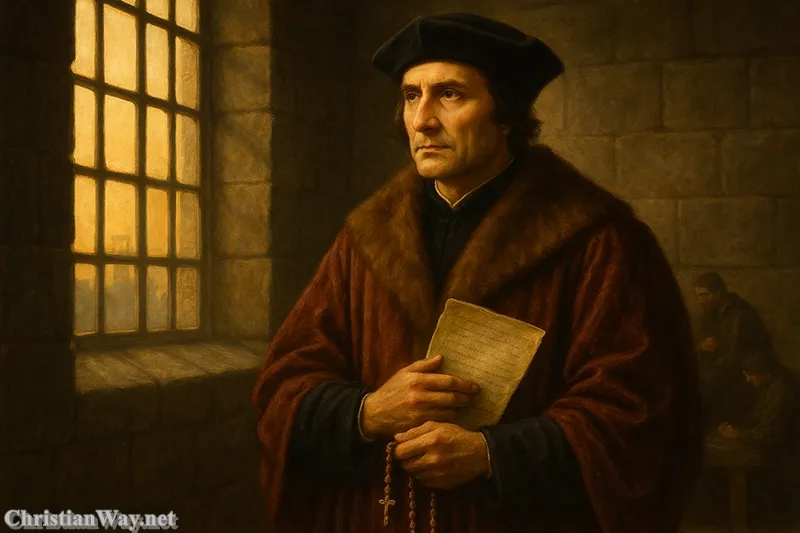
Yet Thomas More did not become a saint because he enjoyed conflict. He did not seek suffering for its own sake. He did not desire to become a public hero. He became a saint because, when the hour of testing came, he refused to abandon what he believed God had entrusted to his conscience.
Saint Thomas More: The Martyr of Conscience and the Courage to Stand for Truth is therefore not only the story of a man from sixteenth-century England. It is a witness for every person who has ever felt pressured to betray what is right. It speaks to the worker asked to act dishonestly. It speaks to the parent trying to protect the faith of a family. It speaks to the young person tempted to follow a crowd rather than follow Christ. It speaks to the public servant, the teacher, the business owner, the friend, the spouse, and the believer who must choose between comfort and integrity.
Thomas More reminds us that conscience is not merely personal preference. It is the quiet place within us where we stand before God. It is where we listen for truth, examine our motives, and seek to live with a heart that can remain honest before Christ.
His story teaches us that courage is not always loud. Sometimes courage is patient silence. Sometimes it is refusing to say what we know is false. Sometimes it is remaining faithful when others misunderstand us. Sometimes it is speaking gently but firmly, not because we wish to win an argument, but because love for God and love for truth cannot be separated.
A Man of Faith in the Middle of the World
Saint Thomas More was not a monk who withdrew from the concerns of society. He lived in the world. He worked in law and public life. He served in government. He knew the pressures of wealth, politics, reputation, family responsibility, and royal favor. Yet he tried to keep his heart centered on God.
This is one of the reasons his witness is so meaningful today.
Many Christians believe that holiness belongs only to those who live in churches, monasteries, or places set apart from ordinary life. They imagine that sanctity requires distance from work, responsibility, business, family conflict, public decisions, and the daily burdens that occupy most of our time.
But Thomas More shows us another path.
He teaches us that God can sanctify a person in the courtroom, in the home, at the workplace, in public office, at the dinner table, and in moments of private prayer after a long day. Holiness is not an escape from the world. It is learning to live in the world without allowing the world to possess the soul.
Thomas More had gifts that many people admired. He was educated, articulate, capable, and respected. He was part of the humanist culture of his time, a world deeply interested in learning, language, history, law, and the moral life. He loved books and serious conversation. Yet his intelligence was not meant merely to make him important. He sought to place it at the service of truth.
This is an important lesson for every person who has been given ability.
Knowledge can become pride if it makes us look down on others.
Success can become dangerous if it makes us forget our need for God.
Influence can become a temptation if it turns into a desire for control.
But gifts become holy when they are offered back to the One from whom all gifts come.
Saint Paul asks, “What hast thou that thou didst not receive?” (1 Corinthians 4:7). This question is not meant to diminish human effort. It is meant to awaken gratitude. We may work hard, study faithfully, build a career, care for a family, and develop our talents. Yet beneath all that effort remains a deeper truth: every breath, every opportunity, every strength, and every gift is finally received.
Thomas More understood that public honor was not the highest measure of a life. He had known success and influence. But when those things came into conflict with his conscience before God, he chose the path of faithfulness.
Holiness Does Not Require Leaving Ordinary Responsibilities
The life of Saint Thomas More is especially comforting for parents, workers, leaders, and all who live with daily responsibilities. He did not become holy by abandoning his duties. He sought holiness within them.
He was a husband and father. He cared about the education and formation of his children. His home was known for learning, prayer, conversation, and a deep concern for the moral life. He understood that family life is not a distraction from holiness. It is one of the places where holiness is learned.
A home becomes holy not because every day is peaceful or perfect. It becomes holy when love is practiced in ordinary ways. It becomes holy when family members forgive each other after conflict. It becomes holy when parents teach children to pray. It becomes holy when truth is spoken with gentleness. It becomes holy when the tiredness of daily work is offered to God.
Many people today feel torn between faith and responsibility. They may think they do not have enough time to pray as they should, enough energy to serve as they wish, or enough peace to become the person they hope to be. Their days are filled with work, children, bills, travel, illness, deadlines, and concerns about the future.
Saint Thomas More reminds us that God does not wait only in moments of quiet retreat. He meets us in the responsibilities we carry.
A parent can pray while preparing food for the family.
A worker can offer the day before beginning a difficult task.
A student can ask God for wisdom before an examination.
A business owner can seek integrity when making decisions.
A public servant can choose honesty even when dishonesty would be easier.
A person caring for an elderly parent can turn fatigue into a quiet offering of love.
These are not small things. They are the material from which faithfulness is formed.
Conscience: The Place Where We Stand Before God
The word “conscience” is often used in modern life, but it can be misunderstood. Some people imagine that conscience simply means doing whatever feels right to us personally. Others treat conscience as a private excuse for avoiding truth, responsibility, or the wisdom of faith.
But Christian conscience is something deeper.
Conscience is not simply a feeling. Feelings matter, and they can reveal much about what is happening within us, but feelings alone do not always lead us toward truth. We can feel angry and still be wrong. We can feel certain and still be confused. We can feel pressured by fear, pride, resentment, desire, or the need for approval.
A well-formed conscience is shaped by prayer, Scripture, truth, humility, moral reflection, and love of God. It is not the voice of self-will. It is the place where the human heart seeks to listen to God.
Thomas More’s conscience was not formed in a single day. It grew through years of prayer, study, work, friendship, family life, and service. He knew that conscience must be educated by truth. He did not imagine himself above God’s law. He desired to place himself beneath it.
This is why his witness remains so powerful.
He did not say, “I will do whatever I want.”
He said, in effect, “I must answer to God.”
There is a great difference between these two ways of living.
The first places the self at the center.
The second places God at the center.
Jesus says, “Ye shall know the truth, and the truth shall make you free” (John 8:32). This is a difficult word because many people think freedom means having no limits. But freedom without truth can become another kind of slavery. A person may follow every desire and still become trapped by fear, addiction, pride, anger, or the need for approval.
True freedom is the ability to choose what is good.
It is the freedom to speak honestly.
It is the freedom to refuse corruption.
It is the freedom to forgive rather than remain imprisoned by resentment.
It is the freedom to obey God even when the world says compromise would be easier.
The Quiet Work of Forming the Heart
Conscience must be formed slowly.
It is formed when we allow Scripture to question us.
It is formed when we pray honestly.
It is formed when we listen to wise people who love us enough to correct us.
It is formed when we examine our motives instead of assuming we are always right.
It is formed when we confess our sins and seek mercy.
It is formed when we choose truth in small things, long before we are asked to make difficult choices in great things.
This last point is especially important.
Most people are not suddenly asked to make a dramatic decision like the one faced by Saint Thomas More. But every day gives us smaller choices that shape the soul.
Will we tell the truth when a lie would be more convenient?
Will we treat another person fairly when no one is watching?
Will we resist gossip?
Will we keep a promise?
Will we apologize when we have caused harm?
Will we refuse to use others for our own advantage?
Will we choose patience when anger rises?
The conscience becomes strong through these ordinary acts of faithfulness.
A tree does not grow deep roots in one storm. Its roots grow slowly through many seasons. So it is with the soul. When the great storm comes, the person who has learned to seek God in small things is more able to stand.
A Time of Pressure and a Costly Choice
Thomas More lived during a time of immense political and religious tension in England. King Henry VIII sought to end his marriage to Catherine of Aragon and later asserted authority that placed the English Church under the crown. This conflict was not merely political. It touched questions of marriage, the unity of the Church, the authority of Christ, and the limits of earthly power.
Thomas More had served Henry VIII faithfully. He had risen to become Lord Chancellor, one of the highest offices in the land. He was respected by the king and admired for his ability. From the outside, it may have seemed that he had everything a person could desire: influence, status, security, and royal favor.
But these things became fragile when his conscience could no longer agree with the direction of the king’s demands.
Thomas More did not seek to provoke conflict. He tried for a time to remain silent. He did not rush into public attacks. He did not appear eager to humiliate anyone. He understood the danger of careless words. He hoped that silence might allow him to preserve peace without denying truth.
But there are moments when silence itself becomes a testimony.
The powerful people around him wanted more than outward obedience. They wanted agreement. They wanted him to declare with his own voice what he could not affirm before God. They wanted his conscience to become subject to political power.
This was the line he could not cross.
He was imprisoned in the Tower of London. There he experienced separation from family, uncertainty, loneliness, pressure, and the knowledge that his life was in danger. He was offered opportunities to save himself if he would simply agree to what he believed was false.
But Thomas More understood that a life preserved by betrayal would not truly be a life of freedom.
He knew the words of Jesus: “For what is a man profited, if he shall gain the whole world, and lose his own soul?” (Matthew 16:26).
This verse is one of the great questions of human life.
What are we willing to trade for comfort?
What truth are we tempted to surrender for safety?
What do we fear losing so much that we are willing to lose ourselves?
Thomas More’s answer was clear. No earthly gain was worth abandoning the truth he believed God had placed before him.
Courage Is Not the Absence of Fear
It would be wrong to imagine that Thomas More never felt afraid. He was a husband, a father, and a man who loved life. He understood the pain that his death would bring to those who loved him. He knew the suffering of imprisonment. He knew the cost of public rejection.
Courage does not mean that fear disappears.
Courage means that fear does not become our master.
A person may be afraid and still do what is right.
A parent may be afraid for a child and still make a difficult decision.
A worker may be afraid of losing a job and still refuse dishonesty.
A young person may be afraid of rejection and still refuse to follow a harmful crowd.
A Christian may be afraid of being misunderstood and still speak truth with love.
Thomas More teaches us that courage is not always dramatic. It is often quiet. It may look like a person kneeling in prayer when no one sees. It may look like someone holding onto faith during a long season of uncertainty. It may look like refusing to say a false word, even when silence brings suffering.
The courage of the saints is not stubborn pride. It is love made steady.
Truth Without Hatred
One of the most beautiful things about Saint Thomas More is that he did not allow his commitment to truth to become hatred.
This is not easy.
When people oppose us, misunderstand us, insult us, or treat us unfairly, we may begin with a desire to defend truth. But if we are not careful, that desire can become anger. We may start to see others not as persons created by God, but as enemies to defeat.
Thomas More lived in a time of sharp conflict. Religious divisions were painful. Political tensions were dangerous. Public words could become weapons. Yet his final witness was not one of bitterness. He did not desire revenge. He did not ask Christians to hate those who condemned him.
This is deeply important for Christians today.
Truth matters.
Moral conviction matters.
The teachings of Christ matter.
But truth spoken without love can become harshness. Love without truth can become emptiness. The Gospel calls us to hold both together.
Saint Paul writes that we are to speak “the truth in love” (Ephesians 4:15). This does not mean that truth becomes soft or vague. It means that truth must be carried in the spirit of Christ.
Jesus spoke strongly against hypocrisy, injustice, and sin. Yet He also ate with sinners. He touched the sick. He forgave those who had fallen. He wept over Jerusalem. He prayed for those who crucified Him.
The Christian is never called to love falsehood. But neither are we called to despise the people caught within it.
Love Does Not Mean Surrendering Truth
There is a false peace that comes from saying nothing when truth is needed. There is another false peace that comes from agreeing with everyone merely to avoid discomfort. But this is not the peace of Christ.
The peace of Christ is not built on pretending that wrong is right. It is built on reconciliation with God, honesty of heart, mercy toward others, and the courage to live faithfully.
Saint Thomas More teaches us that love does not require us to betray conscience.
A husband or wife may need to speak truth in a difficult marriage.
A parent may need to correct a child with tenderness.
A friend may need to confront someone who is walking toward harm.
A worker may need to refuse participation in dishonest practices.
A Christian may need to stand apart from popular opinion.
These moments require wisdom. They require humility. They require prayer. We should never assume that our first reaction is automatically the voice of God. But there are times when faithfulness requires a clear and loving refusal.
Thomas More’s life reminds us that a person can stand firmly without becoming cruel.
A Father, Husband, and Friend
It is easy to remember Thomas More only as a martyr or public figure. But before he was imprisoned, before he faced a king’s demands, and before he became a symbol of conscience, he was also a man of family life.
He loved his children. He cared deeply about their education. He encouraged learning not only for sons but for daughters, which was remarkable for his time. He wanted his home to be a place where faith and intellectual life could grow together. He valued friendship, conversation, humor, and the simple joys of daily life.
This matters because it reminds us that holiness is not cold.
Some people imagine saints as distant, severe, or unable to enjoy ordinary human life. But Thomas More’s witness shows that a deep life with God can include laughter, friendship, family affection, study, conversation, and gratitude.
Joy is not opposed to holiness.
In fact, real joy is one of the signs that the heart is rooted in God.
This does not mean that Christians never suffer. Thomas More suffered deeply. It does not mean that life is always easy. But it means that faith can give a person an inner freedom that cannot be destroyed by circumstance.
A person may lose public honor and still possess peace.
A person may face suffering and still love.
A person may be imprisoned and still remain inwardly free.
Thomas More’s life suggests that joy does not come from controlling every outcome. It comes from knowing that we belong to God.
The Holiness of a Christian Home
Families today face many pressures. Parents worry about finances, education, health, technology, relationships, and the future of their children. Husbands and wives may feel exhausted. Children may feel surrounded by competing voices. Homes can become places of tension rather than peace.
Saint Thomas More invites families to return to simple practices of faithfulness.
A shared prayer before sleep can matter.
A Scripture verse remembered in a difficult moment can matter.
A parent asking forgiveness after speaking harshly can matter.
A meal shared without distraction can matter.
A conversation about faith can matter.
A child seeing a parent pray can matter.
The home does not need to be perfect to become a place of grace. It simply needs to be open to Christ.
Thomas More teaches us that faith does not belong only in churches or public ceremonies. It belongs in the way family members speak to one another, forgive one another, and carry one another through ordinary burdens.
The Martyrdom of a Faithful Heart
After more than a year of imprisonment, Thomas More was executed in 1535. He died because he would not affirm what he believed violated the truth of the Church and the demands of his conscience before God.
His death was tragic. It was not something to celebrate as though suffering itself were good. A human life was taken. A family lost a father. Friends lost a companion. A nation lost a wise public servant.
Yet Christians remember his martyrdom because it revealed something greater than fear.
He showed that earthly power has limits.
A king may command the body, but God alone is Lord of the soul.
A court may condemn, but God sees the heart.
A crowd may judge, but Christ remains the final judge.
Thomas More’s martyrdom was not an act of rebellion for its own sake. It was an act of fidelity. He did not die to make himself important. He died because he could not betray the One whom he believed was greater than every earthly ruler.
This is why he remains such a powerful saint.
He reminds us that the conscience is sacred because it is where the human person meets God.
We should be humble about our conscience. We should seek to form it well. We should listen to wisdom, Scripture, and the Church. We should not confuse stubbornness with faithfulness.
But when a conscience has been sincerely formed in truth and prayer, there are moments when we must stand.
The Cost of Remaining Faithful
Most Christians will never be asked to die for their faith. Yet many are asked to make smaller sacrifices.
Perhaps you lose an opportunity because you refuse dishonesty.
Perhaps someone thinks less of you because you live according to Christian convictions.
Perhaps you choose integrity in business and earn less than you could have gained by compromise.
Perhaps you remain faithful in marriage during a season when leaving would feel easier.
Perhaps you protect a child from harmful influences even when others mock your concern.
Perhaps you forgive when the world tells you to get even.
Perhaps you turn away from a habit that has controlled you, even though change feels painful.
These sacrifices may not be seen by others. But they matter to God.
Jesus says, “If any man will come after me, let him deny himself, and take up his cross daily, and follow me” (Luke 9:23). The daily cross is not always dramatic. Often it is the small act of saying yes to God when self-interest urges us to say no.
Thomas More teaches us that faithfulness is not built in one final moment. It is formed through many daily choices.
A Patron for Public Life and Moral Courage
Saint Thomas More is often remembered as a patron of lawyers, judges, statesmen, politicians, and public servants. This is fitting, because he understood that public authority is not a prize for personal ambition. It is a responsibility before God.
The world needs leaders with conscience.
It needs people who can make decisions without selling themselves to popularity.
It needs people who remember that human dignity matters more than personal gain.
It needs people who can listen, seek wisdom, admit limits, and refuse corruption.
It needs people who understand that power is meant for service.
Jesus taught His disciples, “Whosoever will be chief among you, let him be your servant” (Matthew 20:27). This teaching stands against every form of leadership that uses people as tools.
A Christian leader is not called to make himself great. He is called to serve the common good.
This principle applies not only to governments. It applies to every place where a person has influence.
A manager leads through fairness.
A teacher leads through patience.
A parent leads through love and example.
A pastor leads through humility.
A business owner leads through integrity.
An older sibling leads through kindness.
Every person who has responsibility over another human being must remember that authority is a form of service.
Saint Thomas More teaches that public life becomes dangerous when it loses its soul. When truth is treated as flexible, when power becomes absolute, and when conscience is silenced, people suffer.
But when leaders remember that they answer to God, society becomes more humane.
The Danger of Compromise
Compromise is not always wrong. In daily life, compromise can be a form of wisdom. Families compromise. Friends compromise. Communities compromise. People with different needs and perspectives often find a path forward by giving up something for the sake of peace.
But there is a kind of compromise that wounds the soul.
It happens when we surrender what we know is right merely to avoid inconvenience.
It happens when we say what others want to hear, though we know it is false.
It happens when we ignore injustice because confronting it might cost us.
It happens when we allow fear to become more powerful than truth.
Thomas More’s life calls us to recognize this difference.
There is a time to be flexible.
There is a time to be patient.
There is a time to wait.
There is a time to seek understanding.
But there is also a time when faithfulness requires us to say, “I cannot do this.”
That sentence can be costly.
It may cost us approval.
It may cost us comfort.
It may cost us opportunity.
It may cost us peace with people who want us to agree.
But the person who says no to falsehood may discover a deeper peace: the peace of knowing that the heart remains free before God.
A Courage That Begins in Prayer
We cannot manufacture this kind of courage through personality alone.
Some people appear naturally bold, while others are quiet or hesitant. But Christian courage is not simply a trait of temperament. It is a grace that grows through prayer.
A person who prays learns to fear God more than human opinion.
A person who prays learns that earthly success is temporary.
A person who prays learns to see suffering in the light of eternity.
A person who prays begins to understand that Christ is worth more than comfort.
Thomas More’s strength did not come only from education or intelligence. It came from a heart that had learned to kneel.
This is why prayer matters so much in difficult times.
Before a major decision, we need silence.
Before speaking in anger, we need to ask God for wisdom.
Before judging another person, we need to remember our own need for mercy.
Before making a choice that affects others, we need to seek truth rather than convenience.
Prayer does not always make the path easier. But it makes the heart more available to God.
Mercy for Those Who Have Failed
The witness of Saint Thomas More can seem intimidating. We may look at his courage and feel that we could never be as strong. We may remember moments when we remained silent because we were afraid. We may think of times when we compromised, lied, avoided responsibility, or chose approval over truth.
But the story of a saint should never lead us to despair.
Saints do not stand above us to shame us. They stand beside us to point us toward Christ.
God is merciful.
Peter denied Jesus three times, yet Christ restored him.
David sinned deeply, yet he returned in repentance.
The prodigal son wasted his inheritance, yet the father ran to meet him.
Thomas doubted, yet Jesus invited him to come closer.
No failure needs to become the final word of our lives.
Perhaps you have remained silent when you should have spoken.
Perhaps you have spoken harshly when you should have been gentle.
Perhaps you have chosen comfort over integrity.
Perhaps you have become discouraged because the cost of faithfulness feels too high.
Bring these things to Christ.
He does not ask us to pretend that we have never failed. He asks us to return.
The mercy of God is not permission to avoid truth. It is the strength to face truth without being destroyed by shame.
Beginning Again With a Clearer Heart
Every day gives us another chance to begin again.
We may not be able to change yesterday. But we can choose truth today.
We may not be able to undo every consequence of the past. But we can ask forgiveness, make repair where possible, and walk in a new direction.
We may not feel courageous. But we can pray for courage.
We may not know the entire path. But we can take the next faithful step.
This is how conscience grows. It grows not through perfection, but through repeated surrender to grace.
Saint Thomas More teaches us that a faithful life is built one honest choice at a time.
Standing for Truth in a Divided World
Our world is filled with arguments, divisions, competing opinions, and quick judgments. People often speak without listening. They become certain before they understand. They treat those who disagree with them as enemies.
Saint Thomas More offers another way.
He calls us to love truth, but also to love the people with whom we speak.
He calls us to form convictions, but also to remain humble.
He calls us to resist falsehood, but also to resist cruelty.
He calls us to remember that every human person is more than an argument.
This is especially important for Christians. We are not called to win every debate. We are called to bear witness to Christ.
Sometimes this witness will include clear words. Sometimes it will include patient listening. Sometimes it will include silence. Sometimes it will include a willingness to suffer misunderstanding rather than respond with hatred.
The goal is not to protect our image. The goal is to remain faithful to love and truth together.
Saint Thomas More: The Martyr of Conscience and the Courage to Stand for Truth reminds us that Christian courage must always remain rooted in charity. A truth that makes us proud is not yet fully the truth of Christ. A conviction that causes us to despise others has lost the spirit of the Gospel.
The Lord calls us to stand firm, but He also calls us to kneel.
To stand firm for truth.
To kneel before God in humility.
Reflect and Pray
Dear friends, Saint Thomas More teaches us that conscience is not a burden to escape. It is a sacred gift, a place where God calls us into truth, courage, and freedom. He reminds us that the world may ask us to compromise, but Christ calls us to remain faithful. He shows us that real strength is not found in power, position, or approval. It is found in a heart that belongs to God.
Perhaps you are facing a difficult decision. Perhaps you feel pressure to agree with something you know is not right. Perhaps you are tired of standing alone. Perhaps you fear what faithfulness may cost you.
Do not lose heart.
The Lord who strengthened Saint Thomas More is near to you. He sees the choices no one else understands. He knows the burden of your conscience. He can give you wisdom to speak, grace to remain silent, humility to listen, and courage to do what is right.
Saint Thomas More, martyr of conscience and faithful servant of Christ, pray for us. Teach us to love truth without losing charity. Help us to resist fear, pride, and false compromise. Give courage to those who serve in public life, strength to families carrying difficult burdens, and peace to all who seek to follow Christ with an honest heart.
Lord Jesus Christ,
You are the Way, the Truth, and the Life.
Form our conscience in Your mercy and light.
When we are tempted to compromise, give us courage.
When we are tempted to judge harshly, give us compassion.
When we are afraid of standing alone, remind us that You are near.
Teach us to live with integrity, speak with love,
and remain faithful to You in every season of life. Amen.
May the witness of Saint Thomas More give you a clear conscience, a peaceful heart, and the courage to stand for truth with humility and love.
— Fr. John Matthew