Dear friends, peace be with you.
In our modern pilgrimage through life, we often find ourselves surrounded by structures of utility—buildings designed for commerce, efficiency, or temporary shelter. Yet, there was an era when the deepest aspirations of the human soul, yearning for the Divine, were given concrete form in stone and glass. We call this the Gothic age. It was a time when architects, masons, and theologians collaborated to create spaces that were not merely meeting halls, but foretastes of the New Jerusalem.
To enter a great Gothic cathedral is to step out of mundane time and into sacred space. These magnificent edifices, characterized by their soaring pointed arches, ribbed vaults that seem to defy gravity, and flying buttresses that support walls dissolved into shimmering stained glass, were designed with a singular purpose: to draw the eye, and thus the heart, upward toward God. They are theology writ large in limestone, teaching us that while we are rooted on earth, our true citizenship is in heaven.
Here at Christian Way, we believe that history is a great teacher of faith. In curating this list of Europe’s top Gothic churches, I have sought not merely the largest or most ornate, but those that most powerfully convey the spiritual audacity of medieval Christendom. As we journey together through this countdown, I invite you to look beyond the artistry and see the ardent faith that laid every stone, trusting that these sacred spaces can still inspire our own walk with Christ today.
A Summary of Sacred Treasures
| Rank | Church Name | Location | Approximate Origin |
|---|---|---|---|
| 10 | Seville Cathedral | Seville, Spain | 15th Century |
| 9 | St. Vitus Cathedral | Prague, Czech Republic | 14th Century |
| 8 | Burgos Cathedral | Burgos, Spain | 13th Century |
| 7 | Canterbury Cathedral | Canterbury, United Kingdom | 12th Century (Gothic elements) |
| 6 | Milan Cathedral (Duomo di Milano) | Milan, Italy | 14th Century |
| 5 | Westminster Abbey | London, United Kingdom | 13th Century |
| 4 | Sainte-Chapelle | Paris, France | 13th Century |
| 3 | Cologne Cathedral (Kölner Dom) | Cologne, Germany | 13th Century |
| 2 | Notre-Dame de Paris | Paris, France | 12th Century |
| 1 | Chartres Cathedral | Chartres, France | 12th/13th Century |
Top 10. Seville Cathedral (Spain)
We begin our journey in the sun-drenched expanse of Andalusia. Seville Cathedral, the largest Gothic cathedral in the world by volume, is an overwhelming testament to the sheer scale of Christian ambition following the Reconquista. Built upon the site of a former great mosque—and retaining the beautiful Giralda bell tower as a nod to that layered history—the cathedral was constructed by canons who famously declared their intent to build a church so immense that future generations would think them mad. When you stand within its cavernous nave, the sense of space is truly humbling; individual human concerns seem to shrink against the backdrop of such majesty.
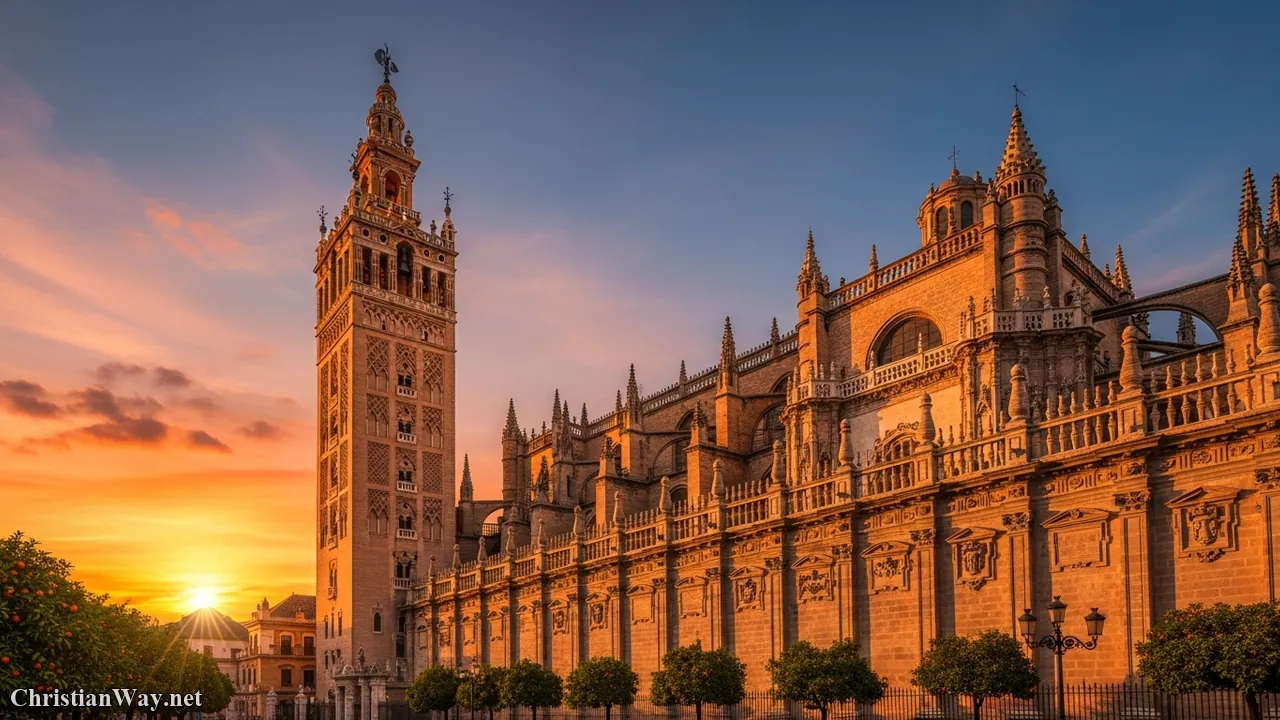
Theologically, the vastness of Seville reminds us of the incomprehensible greatness of the Creator. It is a space that demands awe. Yet, amidst this immense grandeur lies the intricate altarpiece depicting the life of Christ in astounding detail, a gentle reminder that the same God who spans the cosmos also intimately entered human history. It teaches us that our faith must hold together both the transcendent power of the Almighty and the intimate nearness of the Savior.
Spiritual Highlights:
- The tomb of Christopher Columbus, reminding us of the complex history of faith and exploration.
- The immense Retablo Mayor (Main Altar), a glittering golden wall of scriptural storytelling.
- “But will God indeed dwell on the earth? Behold, heaven and the highest heaven cannot contain You, how much less this house which I have built!” (1 Kings 8:27)
Top 9. St. Vitus Cathedral (Prague, Czech Republic)
Rising from the complex of Prague Castle like a crown of thorns transformed into stone lacework, St. Vitus Cathedral is a masterpiece that took nearly 600 years to complete. Its long gestation means it holds within its walls the evolution of Gothic architecture, from the solid confidence of the 14th century to the whimsical, almost organic fluidity of later Bohemian Gothic. The structure is dominated by the vision of its first architect, Matthias of Arras, and later Peter Parler, whose innovative net-vaulting in the choir creates a sense of dynamic movement, as if the ceiling itself is breathing.
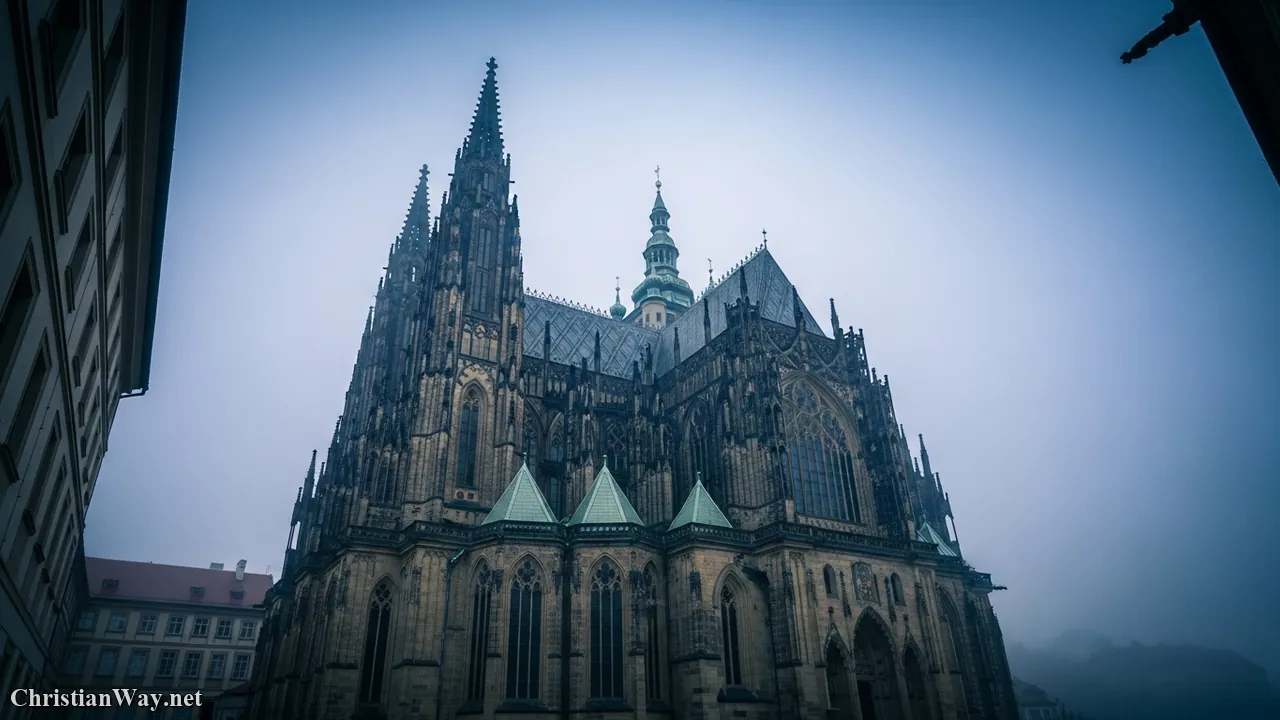
The spiritual heart of St. Vitus is the Chapel of St. Wenceslas, standing over the tomb of the patron saint. The walls here are encrusted with semi-precious stones—jasper, amethyst, and chrysoprase—evoking the foundations of the New Jerusalem described in the Book of Revelation. Entering this sacred space, one feels the deep connection between the suffering of the martyrs and the glory of the Kingdom to come. It is a poignant reminder that true beauty in the Church is often forged through centuries of perseverance and faithfulness.
Spiritual Highlights:
- The stunning stained glass window by Art Nouveau master Alphonse Mucha, showing how ancient faith inspires new forms of beauty.
- The Golden Gate, with its 14th-century mosaic of the Last Judgment, calling pilgrims to repentance before entering.
- A testament to patience: construction began in 1344 and was only officially completed in 1929.
Top 8. Burgos Cathedral (Spain)
As we return to Spain, we encounter the Cathedral of Saint Mary of Burgos, a structure of almost overwhelming intricacy. While French cathedrals often emphasize verticality and unified logic, Spanish Gothic, particularly here in Burgos, delights in surface decoration and complex additions over time. The spires, openwork traceries that seem too delicate to be stone, pierce the Castilian sky like filigrees of prayer. It is a cathedral that rewards the slow, contemplative gaze; every corner, every chapel, and every portal is teeming with sculptural life, from saints and angels to kings and prophets.
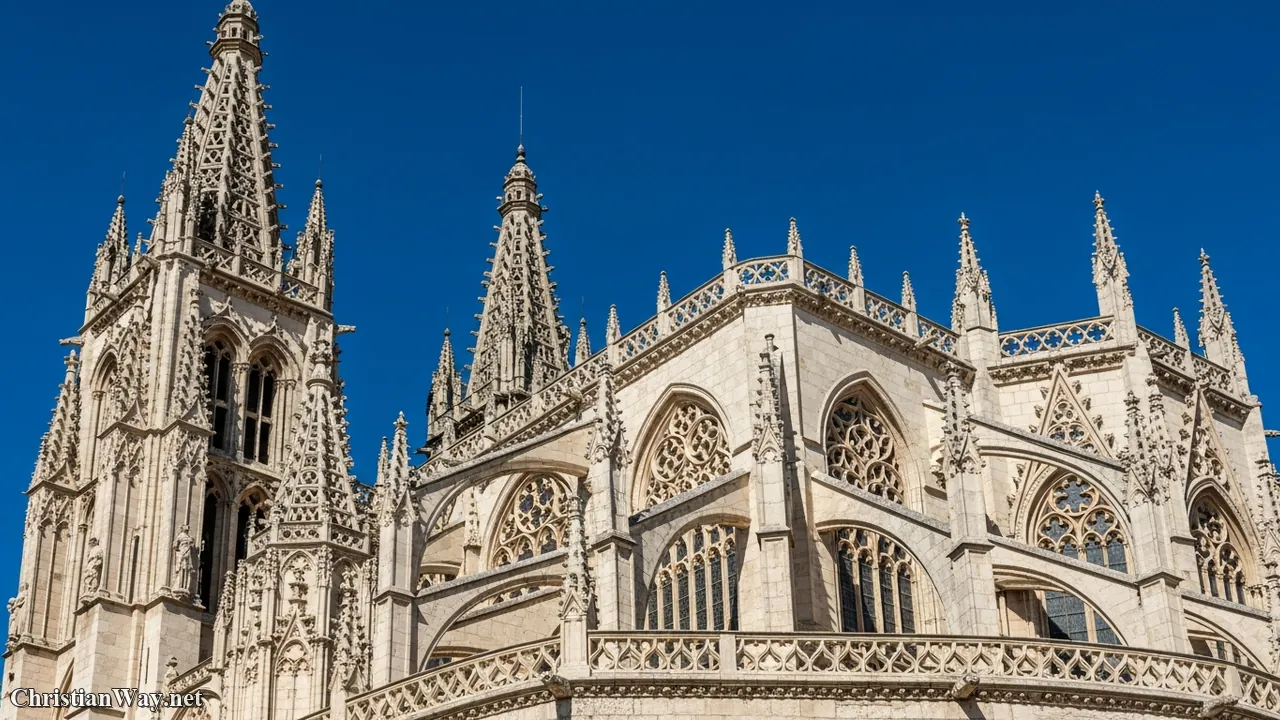
Burgos is situated on the Camino de Santiago, the great pilgrimage route to Compostela. For centuries, weary pilgrims have found solace within its walls. The cathedral serves as a magnificent waypoint, a reminder that the Christian life is a long journey requiring sustenance and rest. The incredible Constable’s Chapel at the east end is a stunning example of late, flamboyant Gothic—a burst of exuberant praise in stone that encourages the pilgrim to keep moving toward the final goal of unity with God.
Spiritual Highlights:
- The unique, octagonal Chapel of the Condestable, a masterpiece of Isabelline Gothic.
- The “Papamoscas” (Flycatcher) automaton clock, a whimsical reminder to stay awake and watchful.
- “Blessed are those whose strength is in you, in whose heart are the highways to Zion.” (Psalm 84:5)
Top 7. Canterbury Cathedral (United Kingdom)
Canterbury Cathedral is the mother church of the worldwide Anglican Communion and a site deeply scarred and sanctified by history. While its roots are Romanesque, its glorious transformation into Gothic began following a devastating fire in 1174. The rebuilding of the choir introduced the early English Gothic style, characterized by a rigorous, focused energy. Yet, the true spiritual gravity of Canterbury lies in the martyrdom of Archbishop Thomas Becket in 1170. For centuries, his shrine made this one of the most important pilgrimage sites in Christendom.
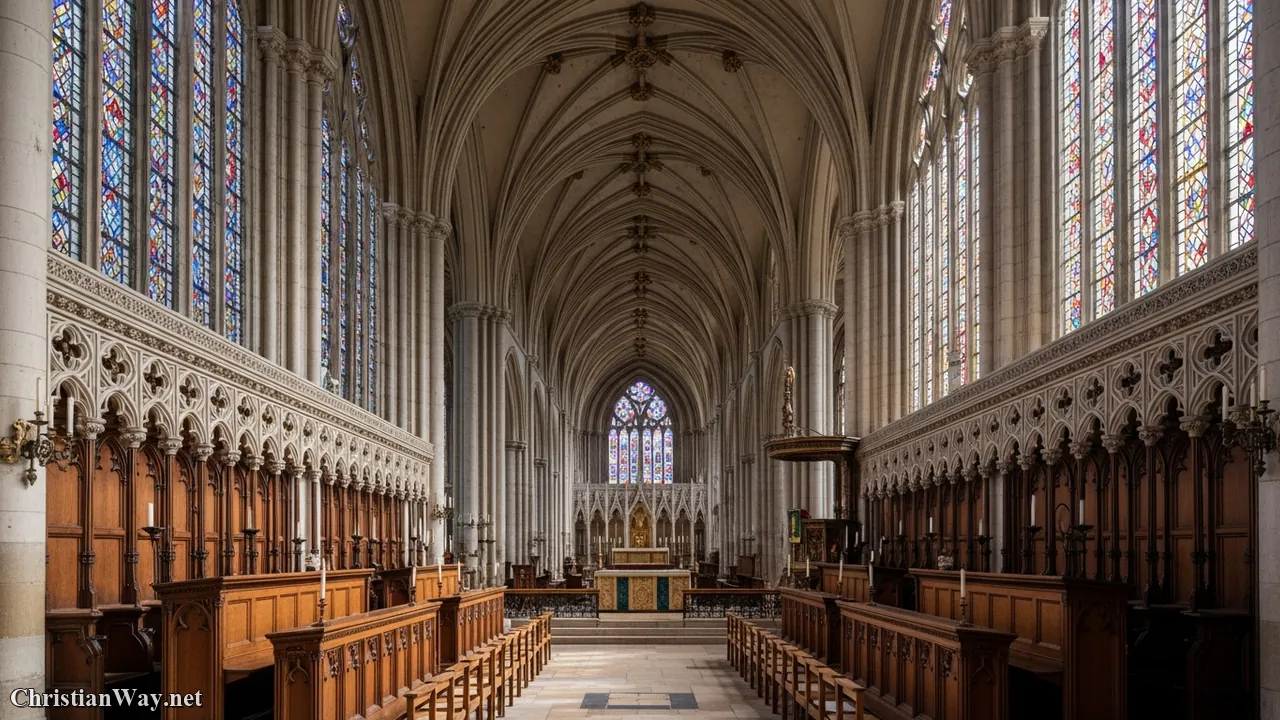
Walking the stones of Canterbury, particularly the site of the martyrdom and the subsequent Trinity Chapel where Becket’s shrine once stood, is a deeply moving experience. The architecture serves the memory of sacrifice. The stained glass windows—some of the oldest in England—tell the stories of miracles attributed to the saint. Canterbury reminds us that the Church is built not just on apostles and prophets, but on the blood of martyrs who stood firm against worldly powers for the sake of the Gospel truth.
Spiritual Highlights:
- The “Corona” or east end, designed to house the relic of Becket’s head struck by the sword.
- The magnificent perpendicular Gothic nave, designed by Henry Yevele, creating a lofty, unified space for the congregation.
- A place to meditate on the cost of discipleship and the courage of conviction.
Top 6. Milan Cathedral (Duomo di Milano) (Italy)
Italy generally resisted the “barbaric” Gothic style emerging from the north, preferring its classical roots. The great exception is the Duomo di Milano. It is a mountain of marble, a unique interpretation of Gothic that is distinctly Italian. Adorned with a staggering 135 spires and over 3,400 statues, the exterior is a cacophony of saints, martyrs, and biblical figures clamoring toward heaven. It took nearly six centuries to complete, resulting in a fascinating blend where Gothic structures are overlaid with Renaissance and Baroque decorations.
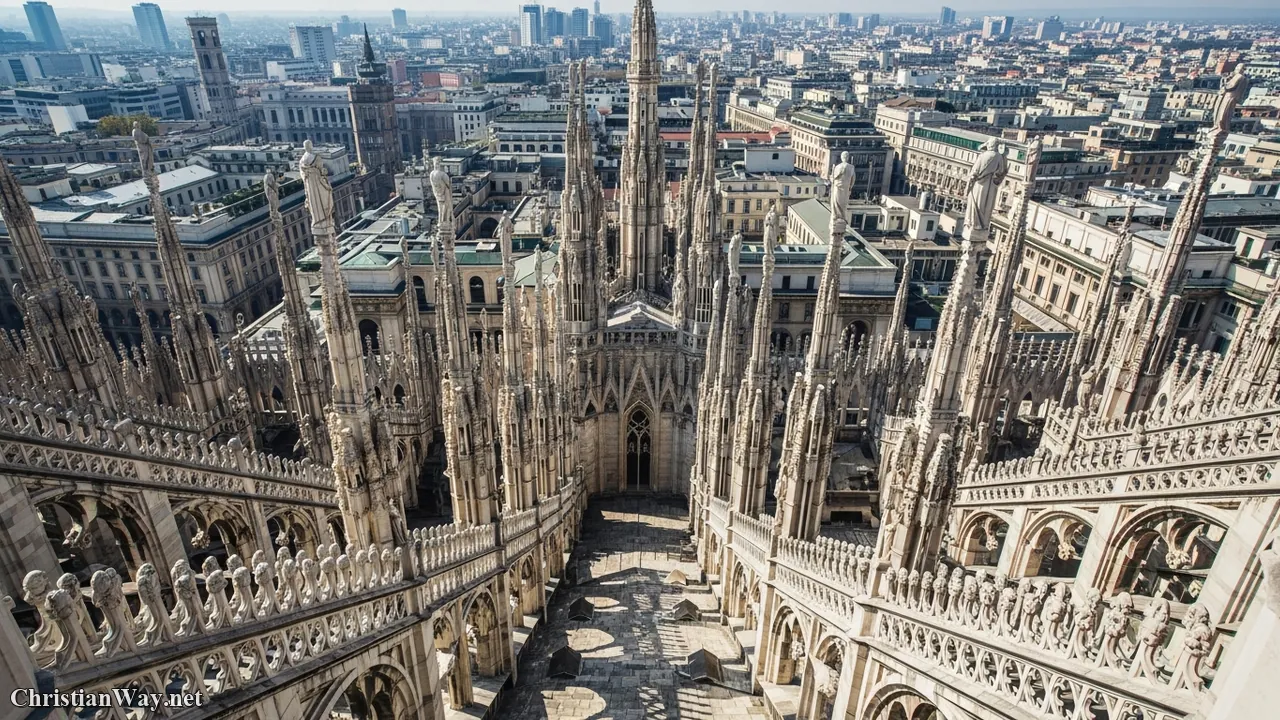
The interior, however, is surprisingly somber and vast. The massive pillars define five naves, creating a dark, forest-like atmosphere that contrasts sharply with the bright Italian sun outside. This darkness is not oppressive but inviting; it draws the soul inward to quiet contemplation. The Duomo teaches us about the diversity of the Body of Christ. Just as this cathedral interprets Gothic in a uniquely Italian vernacular, so too does the Gospel incarnate itself beautifully within every culture, without losing its essential truth.
Spiritual Highlights:
- The walkable roof terraces, allowing pilgrims to stand among the spires and statues, looking out over the city.
- The “Nivola” (cloud) lift mechanism, used once a year to retrieve the Holy Nail relic suspended above the altar.
- A visual representation of the Communion of Saints, surrounding us on every side.
Top 5. Westminster Abbey (United Kingdom)
Westminster Abbey is known globally as the stage for British royal coronations, weddings, and burials. Yet, beneath the pageantry lies one of the finest examples of English Gothic architecture, deeply influenced by the French cathedrals of Reims and Amiens. Initiated by King Henry III in the 13th century as a shrine to royal saint Edward the Confessor, the Abbey was designed to be a spectacular reliquary. Its extreme height (for an English church) and the stunning complex of chapels at the east end speak of a desire to merge earthly kingship with divine authority.
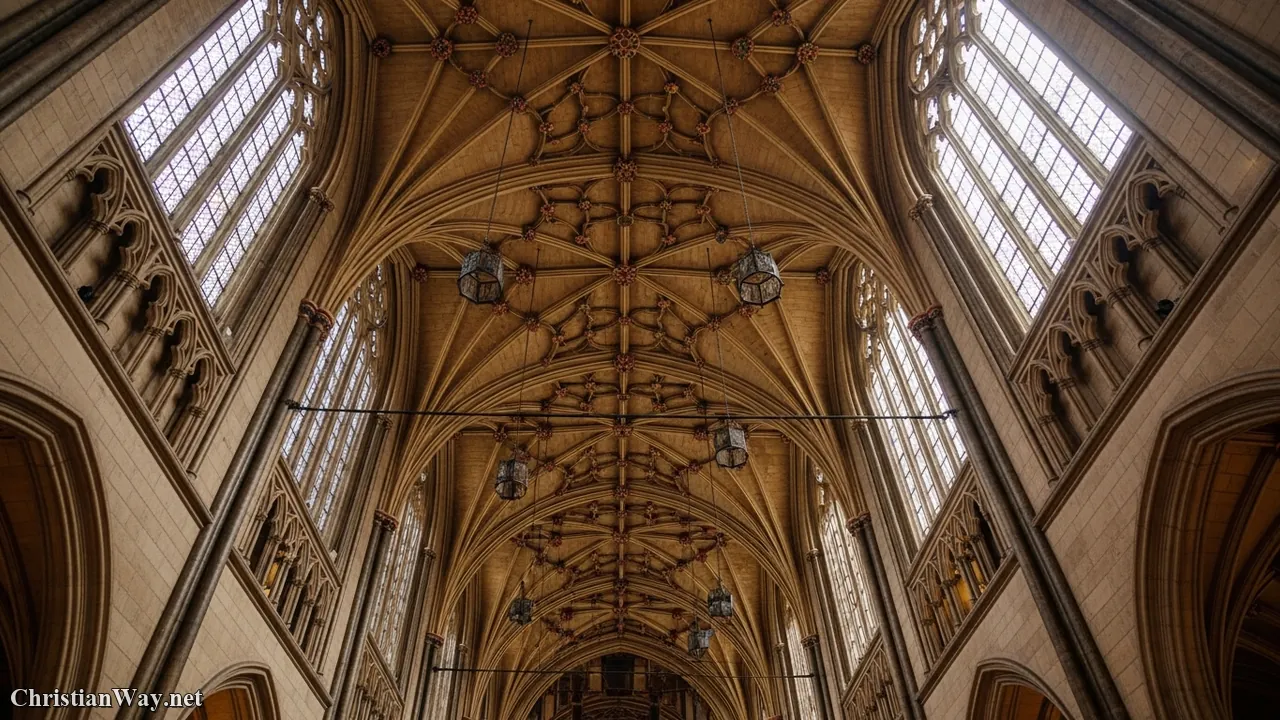
The Abbey is a “Royal Peculiar,” answering directly to the sovereign rather than a bishop, giving it a unique role in the nation’s spiritual life. The Henry VII Lady Chapel, added later, is perhaps the most stunning element. Its spectacular fan-vaulted ceiling, with hanging pendants that seem to defy gravity, is one of the great achievements of medieval engineering. Walking among the tombs of kings, poets, and scientists, we are reminded that all human glory must eventually bow before the King of Kings, and that our earthly achievements are but dust without faith.
Spiritual Highlights:
- The Shrine of St. Edward the Confessor, the spiritual heart of the Abbey, where the faithful still pray.
- The Henry VII Lady Chapel, the ultimate expression of late Perpendicular Gothic.
- The Poets’ Corner, reminding us that arts and intellect are gifts from the Creator.
Top 4. Sainte-Chapelle (Paris, France)
If other churches on this list are mighty fortresses of faith, Sainte-Chapelle is a fragile, exquisite jewel box. Built by King Louis IX (Saint Louis) in the mid-13th century to house the Crown of Thorns and other Passion relics, it is the supreme example of the *Rayonnant* style of Gothic. In this style, the walls have almost entirely disappeared. The structure is reduced to a skeletal stone frame holding vast sheets of stained glass. Entering the upper chapel on a sunny day is truly like stepping inside a kaleidoscope of divine light.
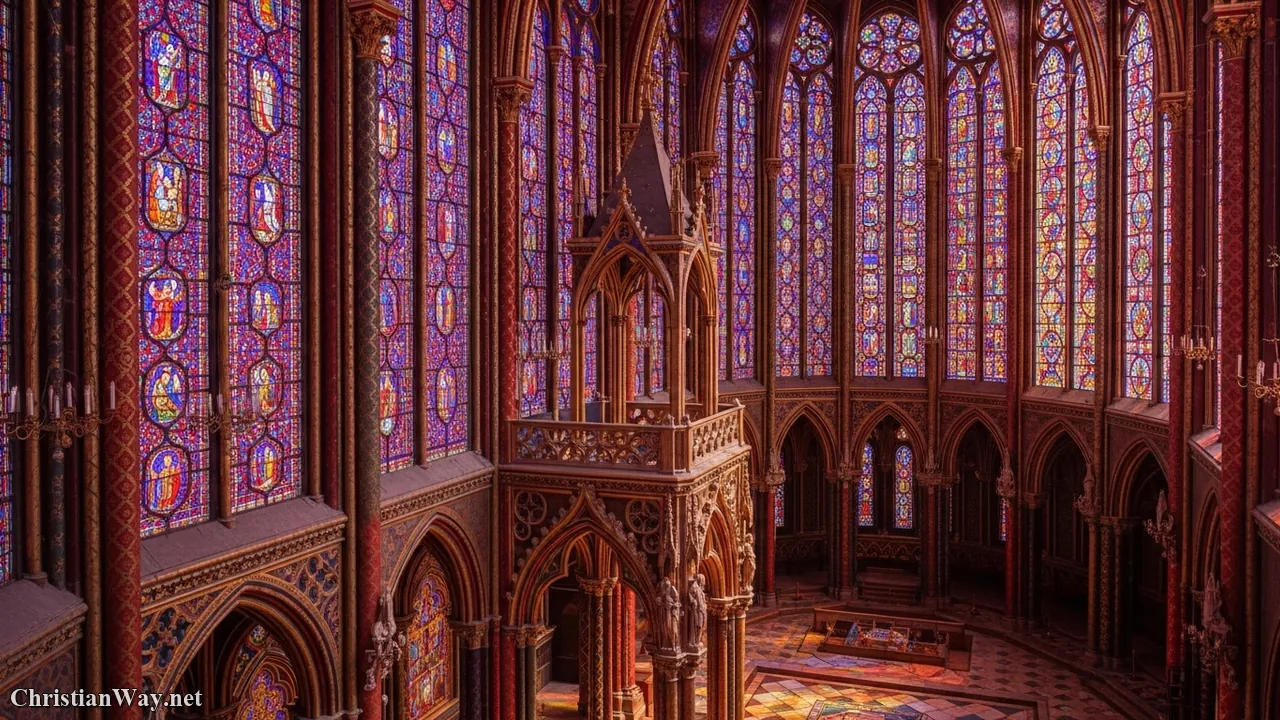
Sainte-Chapelle is a profound theological statement about the Incarnation. Just as light passes through the colored glass to illuminate the interior without breaking the glass, so too did the Divine Word enter the world through the Virgin Mary without diminishing His divinity or her humanity. The 1,113 scenes in the windows tell the story of salvation history, culminating in Christ’s passion. It is a space of intense, focused devotion, designed to bring the worshiper to their knees in awe of the spilled blood of the Lamb.
Spiritual Highlights:
- The walls are nearly two-thirds glass, creating an ethereal atmosphere not found anywhere else.
- The great rose window depicting the Apocalypse, emphasizing the final victory of Christ.
- Scripture thought: “I am the light of the world. Whoever follows me will not walk in darkness, but will have the light of life.” (John 8:12)
Top 3. Cologne Cathedral (Kölner Dom) (Germany)
Cologne Cathedral is the ultimate expression of the German High Gothic ambition to take the French models and push them to their absolute limits of height and verticality. Watching over the Rhine, its twin spires, completed only in the 19th century according to original medieval plans, were for a time the tallest structures in the world. The cathedral was built to house the Shrine of the Three Kings, the Magi who traveled to adore the Christ child, making Cologne a premier pilgrimage destination in Northern Europe.
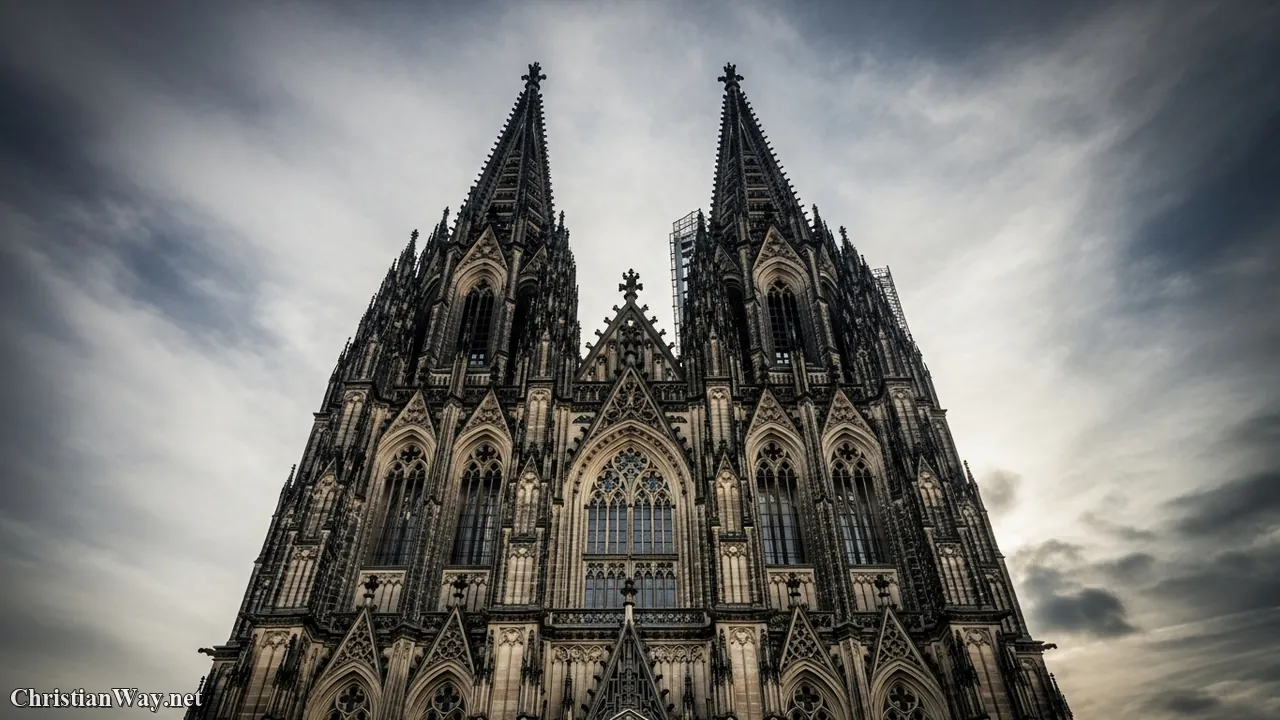
Standing in the nave of Cologne is an exercise in vertical vertigo. The eye is irresistibly drawn upward along shafts that run unbroken from the floor to the distant vaults. It is an architecture of yearning, a desperate, beautiful attempt by finite creatures to touch the infinite. The sheer vertical force of the building acts as a physical prayer. It reminds us that our souls, too, are designed to seek the things that are above, where Christ is, seated at the right hand of God.
Spiritual Highlights:
- The golden Shrine of the Three Kings behind the high altar, a masterpiece of medieval goldsmithing.
- The Richter Window, a modern stained glass addition using computer-generated color pixels, blending ancient faith with modern abstract art.
- A survivor: The cathedral remained standing, though damaged, amidst the total ruin of Cologne during WWII, a symbol of hope and endurance.
Top 2. Notre-Dame de Paris (France)
Notre-Dame de Paris is the sentimental heart of Gothic Europe. Standing on the Île de la Cité in the middle of the Seine, it is an early Gothic masterpiece that bridged the gap between the heavier Romanesque style and the soaring heights that were to come. Its facade is a model of harmonic balance and theological order, featuring the Gallery of Kings and the stunning central Rose Window forming a halo behind the statue of the Virgin and Child. It is a cathedral that sings of balance, reason, and deep faith.
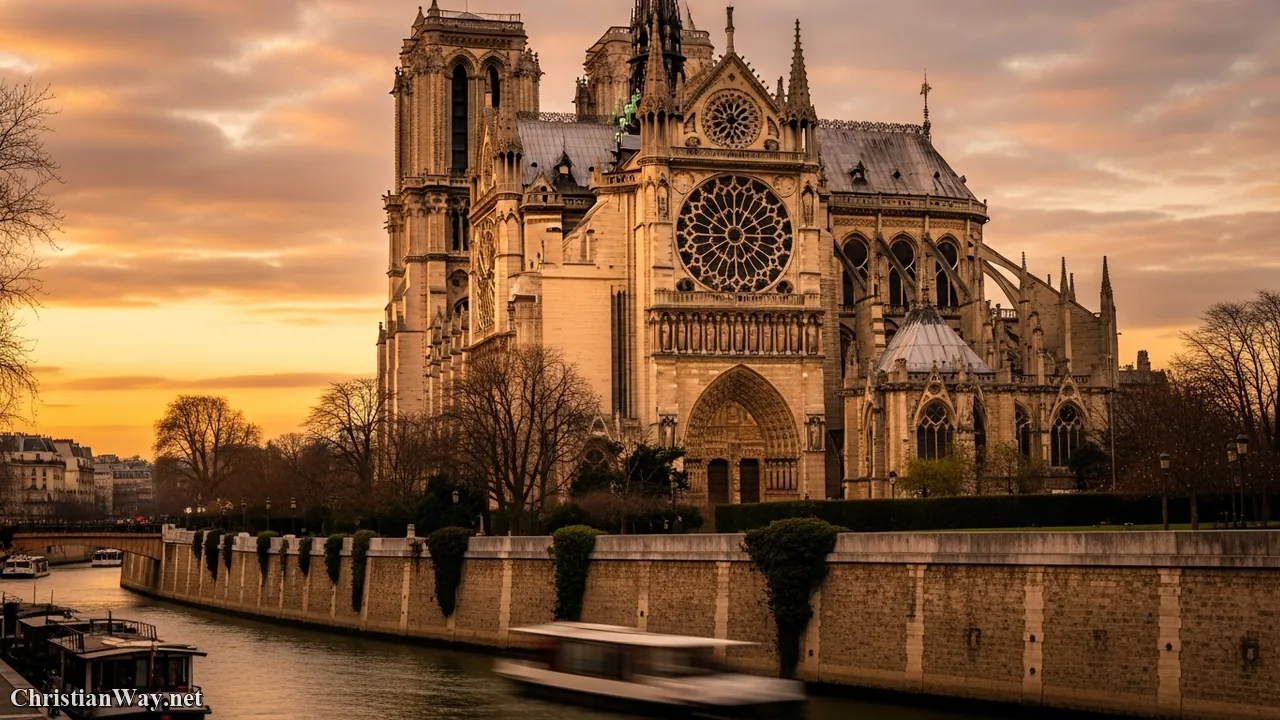
The tragic fire of 2019 showed the world just how deeply this building is embedded in the global consciousness. Seeing the spire fall was a collective trauma, yet the survival of the main structure, the rose windows, and the Crown of Thorns relic served as a powerful metaphor for the resilience of the Church. Notre-Dame is “Our Lady,” a mother who has watched over centuries of history, wars, and revolutions. She reminds us that though the structures of this world may burn, the foundation of faith established by Christ remains unshakable.
Spiritual Highlights:
- The three great Rose Windows, particularly the north rose, which are pinnacles of 13th-century glass art.
- The innovative use of flying buttresses, which allowed the walls to open up to light.
- A living testament to resurrection as it undergoes painstaking restoration.
Top 1. Chartres Cathedral (France)
We arrive at the summit of our journey: the Cathedral of Our Lady of Chartres. If you can visit only one Gothic cathedral in your lifetime to understand the spiritual depth of the movement, let it be this one. Chartres is the archetype, the incredibly well-preserved high-water mark of High Gothic. It was built relatively quickly after a fire in 1194, giving it a remarkable unity of style, save for its two contrasting spires—one a sturdy Romanesque pyramid, the other a flamboyant Gothic needle—which charmingly show the passage of time.
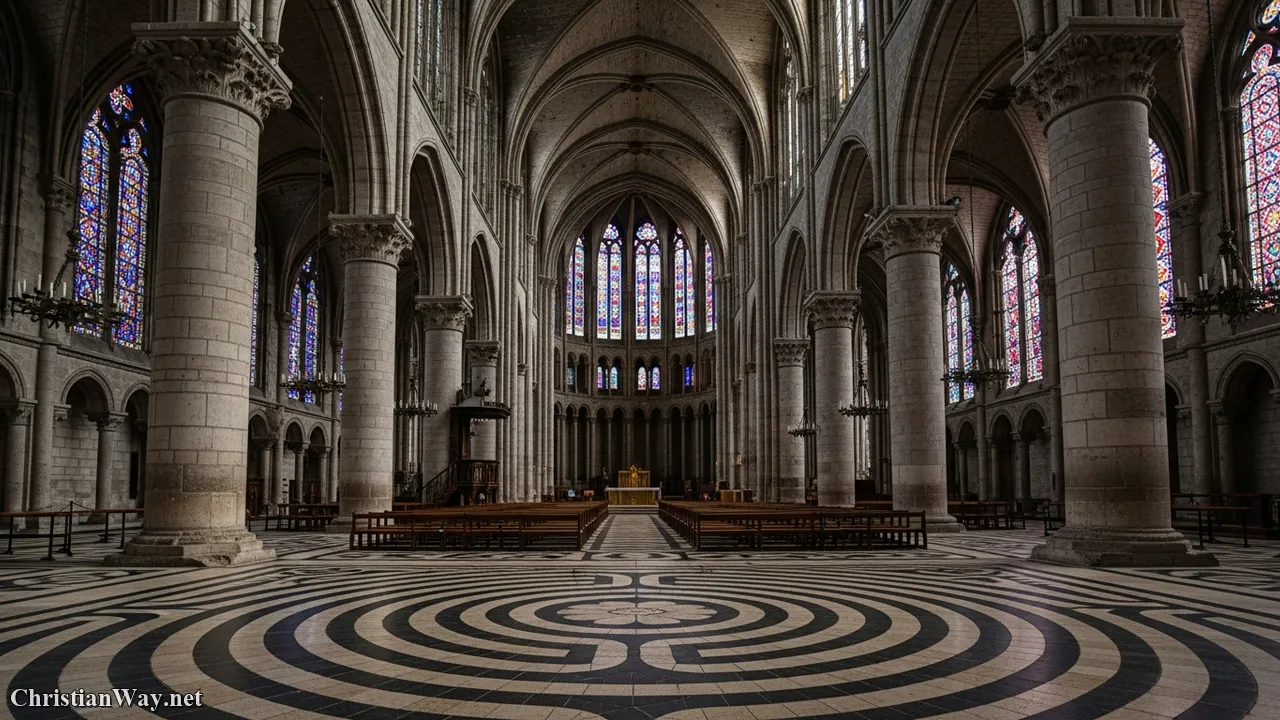
Chartres is famous for its “Chartres Blue” stained glass, a secret medieval recipe for a blue so deep and resonant it seems to vibrate with spiritual energy. The cathedral is a “Bible in stone and glass,” where an illiterate medieval pilgrim could learn the entirety of salvation history by walking around. On the floor of the nave lies the famous labyrinth. It is not a maze designed to confuse, but a single, winding path to the center, used by pilgrims as a penitential walk. Chartres embodies the complete medieval worldview: that everything in creation, from geometry to light, speaks of God.
Spiritual Highlights:
- The surviving 12th-century West Front (Royal Portal), with its serene, elongated statues of kings and queens of the Old Testament.
- The labyrinth on the nave floor, symbolizing the soul’s intricate journey toward God.
- It houses the *Sancta Camisia*, the tunic believed to have been worn by Mary at Christ’s birth.
Reflecting and Praying
My dear friends, we have traveled in spirit across Europe, from the sunlit spires of Spain to the vertical marvels of Germany. These ten cathedrals are more than museums of architectural history; they are living houses of prayer where the faithful have gathered for centuries to receive the Eucharist, to baptize their children, and to bury their dead.
They were built by ancestors who understood that we need physical spaces that pull us out of our self-absorption and orient us toward the transcendent. In an age of distraction, the Gothic cathedral stands as a monumental call to focus. May this journey inspire you not only to visit these places if God wills it, but to build an inner cathedral in your own heart—a place of silence, beauty, and upward-looking faith where the Holy Spirit may dwell.
Let us pray. Almighty God, who inspired Your servants in ages past to build temples of glorious stone to Your name: Grant that we, who are the living stones of Your Church, may be built up into a spiritual house, offering sacrifices acceptable to You through Jesus Christ our Lord. Amen.
— Fr. John Matthew, for Christian Way