The Holy Spirit moves through salvation history as God’s life-giving presence, preparing humanity for Christ and drawing creation home.
Dear friends in Christ,
When Christians speak of salvation history, we mean the long and merciful story of God’s dealings with humanity: the story that begins with creation, passes through covenant and promise, reaches its fullness in Jesus Christ, and continues in the life of the Church as we await the renewal of all things. It is the story of a God who does not abandon what He has made. Even when humanity wanders, rebels, forgets, and hides, God continues to seek, call, heal, and restore.
At every stage of this sacred history, the Holy Spirit is present.
Sometimes His activity is visible and dramatic, as when prophets speak with divine courage, Christ is conceived in the womb of the Virgin Mary, or tongues of fire rest upon the disciples at Pentecost. At other times, the Spirit works quietly, like breath entering the lungs, water nourishing roots beneath the soil, or light slowly breaking through the darkness before dawn.
The Spirit does not suddenly appear in the New Testament, as though He had been absent from everything that came before. He is present from the first words of Scripture. He gives life to creation, strengthens the servants of God, inspires the prophets, prepares Israel for the Messiah, rests upon Jesus Christ, raises Him from the dead, gives birth to the Church, and dwells within those who belong to Christ.
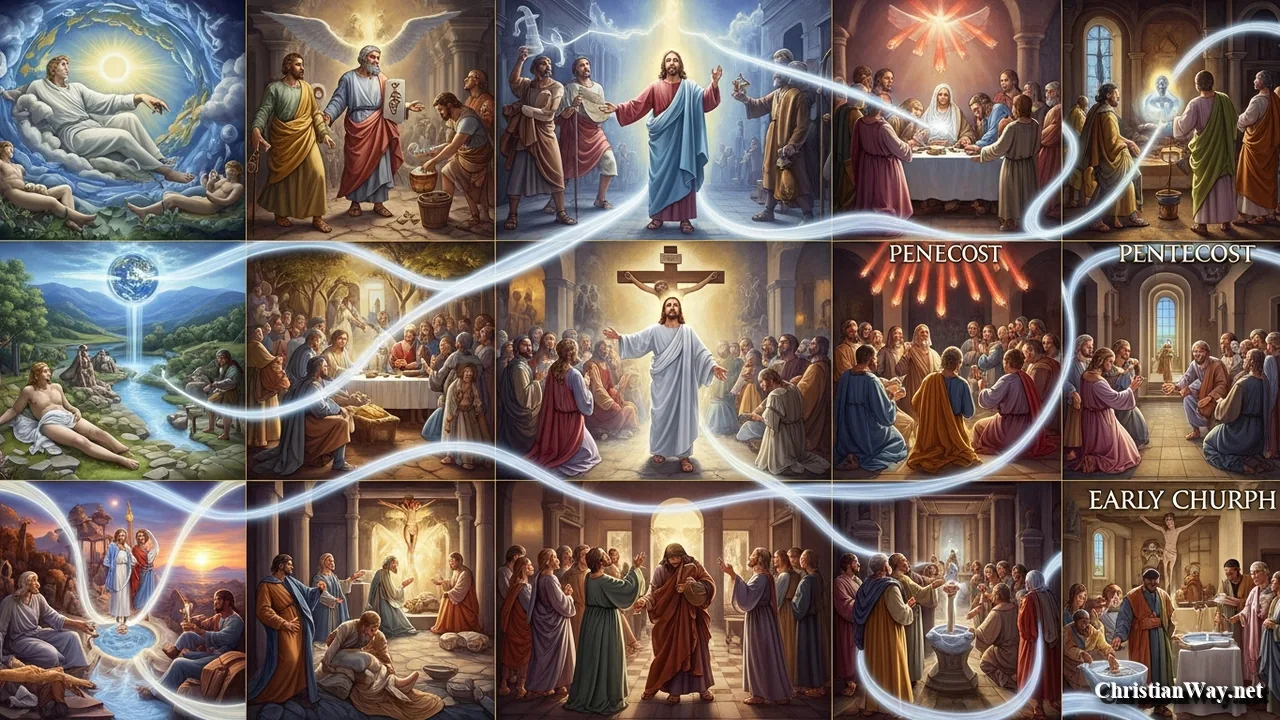
The Holy Spirit is not merely an influence, an emotion, or an impersonal force. He is the third Person of the Holy Trinity, eternally one with the Father and the Son. The Church confesses Him in the Nicene Creed as “the Lord, the giver of life.” He is God with us and God within us, carrying forward the saving work accomplished by Christ and drawing the whole creation toward its final fulfillment.
To ask, “How is the Spirit active throughout salvation history?” is therefore to ask how God gives life, reveals truth, prepares hearts, forms a people, and brings humanity into communion with Himself. It is to trace the quiet fire of divine love through every age, from the first morning of creation to the final promise of a new heaven and a new earth.
The Spirit at the Beginning of Creation
The first page of the Bible opens with mystery, darkness, and divine presence:
“The earth was without form and void, and darkness was over the face of the deep. And the Spirit of God was hovering over the face of the waters.”
— Genesis 1:2
Before the world takes shape, before the sun and moon appear, before living creatures fill the sea and the land, the Spirit of God is already there. He hovers over the waters, not as a distant observer, but as the active, life-giving presence of the Creator.
The Hebrew word used for spirit, ruach, can also mean breath or wind. This rich biblical word helps us understand something of the Spirit’s mysterious activity. Wind cannot be held in the hand, yet its movement can be seen. Breath is hidden, yet without it there is no life. In the same way, the Holy Spirit is invisible, but His work brings forth order, beauty, fruitfulness, and life.
Creation is not the work of one divine Person acting apart from the others. The Father creates through the eternal Word, the Son, and in the life-giving power of the Spirit. St. Irenaeus of Lyons described the Son and the Spirit as the “two hands” of the Father, not because the divine Persons are separate instruments, but because the one God acts in a Trinitarian communion of love.
The Spirit’s presence at creation tells us that the world is not spiritually empty. Matter is not opposed to God. The created order comes from God, is sustained by God, and is capable of revealing His wisdom and glory. The Spirit who hovered over the waters continues to sustain every living thing.
The psalmist prays:
“When you send forth your Spirit, they are created, and you renew the face of the ground.”
— Psalm 104:30
Every springtime, every newborn child, every seed that breaks open beneath the earth, and every breath taken by a living creature bears quiet witness to the generosity of God. Creation exists because God continually gives. The universe is not merely a machine that was started long ago and left to run on its own. It is held in being by divine love.
The Breath of Life Given to Humanity
The creation of the human person reveals the Spirit’s work with particular tenderness. Genesis describes God forming the human being from the dust of the ground and breathing into him the breath of life. Humanity is both earthly and God-breathed. We are made from the soil, yet called to communion with the Creator.
This biblical image teaches humility. We are dust. Our strength is limited, our days are fragile, and our lives depend upon a gift we did not create. Yet this same image also reveals our dignity. God breathes life into humanity. We are created in His image and likeness, capable of knowing Him, loving Him, and receiving His presence.
Sin wounds this communion, but it does not erase God’s purpose. The Spirit who gives life at creation will also be the Spirit who renews fallen humanity. Salvation is not God discarding creation and beginning again with something unrelated. Salvation is God healing, restoring, and transforming what He has lovingly made.
The first creation therefore points toward the new creation. The breath of God given in Genesis prepares us to understand the risen Christ breathing upon His disciples and saying:
“Receive the Holy Spirit.”
— John 20:22
The same Spirit who gives natural life will give supernatural life. The same divine breath that animates humanity will renew humanity in grace.
The Spirit Amid Humanity’s Sin and Longing
The early chapters of Genesis reveal how quickly human freedom becomes wounded by mistrust. Adam and Eve hide from God. Cain rises against Abel. Violence spreads. Pride grows. Humanity attempts to build a world without dependence upon the Creator.
Yet even in these dark passages, God does not withdraw His saving purpose. Judgment is never His final word. He protects, promises, calls, and preserves. The Spirit’s work may not always be named explicitly, but wherever God awakens faith, restrains evil, calls people to repentance, or preserves hope, the Spirit is active.
Noah responds to God’s warning and prepares the ark. Abraham hears the call to leave his homeland and begins a journey toward an unknown land. Sarah receives strength to believe that God’s promise is greater than human impossibility. These moments of obedience are not merely achievements of human willpower. Faith itself is awakened by grace.
The Spirit does not destroy human freedom. He heals and strengthens it. He moves within the human heart so that a person can truly respond to God. Divine grace and human obedience are not enemies. Grace makes faithful obedience possible.
This is important for our own spiritual lives. When a person begins to feel sorrow for sin, longing for truth, hunger for prayer, or desire for reconciliation, the Spirit may already be working before that person fully understands what is happening. God often comes near before we know how to name His presence.
The Spirit and the Formation of Israel
God’s covenant with Abraham becomes the beginning of a people through whom blessing will come to all nations. The history of Israel is not simply the history of one ancient community among many. It is the story of God patiently preparing the world for the coming of Christ.
Throughout this preparation, the Spirit forms leaders, gives wisdom, inspires worship, and raises up voices of truth.
The Spirit Gives Wisdom and Skill
The Spirit’s work is not limited to preaching or extraordinary religious experiences. In the book of Exodus, Bezalel is filled with the Spirit of God and given wisdom, understanding, knowledge, and artistic skill for the construction of the tabernacle.
This passage reveals that creativity, craftsmanship, and beauty can be touched by the Spirit. The making of sacred objects, the shaping of a place for worship, and the careful use of human ability all become part of God’s saving purpose.
The Spirit does not draw us away from responsible work. He can sanctify work. He can guide the hands of an artist, the judgment of a leader, the patience of a teacher, the compassion of a physician, and the faithful labor of a parent.
Wherever human gifts are offered in love and truth, they may become instruments of grace.
The Spirit Strengthens Judges and Leaders
During the period of the judges, Israel repeatedly turns away from God, suffers the consequences of its unfaithfulness, cries out for deliverance, and is rescued through leaders empowered by the Spirit.
The Spirit comes upon figures such as Othniel, Gideon, Jephthah, and Samson. Their stories are often complicated, for these servants of God remain deeply human. Some show courage and trust; others display weakness, anger, or pride.
Scripture does not pretend that those used by God are flawless. The Spirit’s presence does not automatically remove every defect of personality or guarantee that every decision a person makes is righteous. God can work through imperfect instruments while still calling them to conversion.
This remains true in the Church. A spiritual gift is not the same as holiness. Public usefulness is not the same as interior maturity. A person may speak eloquently, lead effectively, or accomplish remarkable things and still need humility, repentance, and healing.
The Spirit gives gifts for service, but He also seeks to form the whole person into the likeness of Christ.
The Spirit and the Kingship of Israel
When Saul is anointed king, the Spirit comes upon him. Later, David is anointed, and the Spirit rests upon him in a powerful way. The anointing of kings prepares biblical language that will eventually reach its fulfillment in Jesus, the Messiah.
The word Messiah means “anointed one.” In Greek, it becomes Christos, from which we receive the title Christ.
Israel’s kings were called to govern under God, defend the weak, uphold justice, and remain faithful to the covenant. Yet even the greatest kings failed. David loved God, composed psalms, and desired to serve Him, but he also committed grave sins. Solomon received wisdom but later allowed his heart to become divided. Many kings led the people away from faithfulness.
These failures deepened Israel’s longing for a different kind of king: one who would be perfectly faithful, filled without measure by the Spirit, and capable of bringing true justice and peace.
The Spirit Speaks Through the Prophets
One of the clearest ways the Spirit is active throughout salvation history is through the prophetic mission.
The prophets are not fortune-tellers who merely predict distant events. They are men and women called to speak the word of God into the actual wounds, injustices, idolatries, and hopes of their time. They remind Israel of the covenant, defend the poor, expose false worship, call for repentance, and announce the mercy of God.
The Holy Spirit gives them courage to say what powerful people do not want to hear. He also gives them tenderness to speak hope to those who believe all is lost.
The apostle Peter later explains:
“Men spoke from God as they were carried along by the Holy Spirit.”
— 2 Peter 1:21
The Spirit works through the real personalities, vocabulary, historical circumstances, and human intelligence of the biblical authors. Divine inspiration does not erase human authorship. Rather, the Spirit acts within it so that Scripture truly communicates what God desires for our salvation.
Christians differ in some aspects of how they describe biblical inspiration and interpret particular passages. Yet Catholic, Orthodox, Anglican, and Protestant traditions share the conviction that the Holy Spirit speaks through the Scriptures and uses them to lead the Church into truth.
When the Bible is read prayerfully, the same Spirit who inspired the sacred text opens our minds and hearts to receive it. Scripture is not merely a record of what God once said. Through the Spirit, it becomes a living word addressed to the Church today.
The Promise of a Spirit-Filled Messiah
The prophets gradually reveal that God’s saving plan will be fulfilled through a coming servant and king uniquely filled with the Spirit.
Isaiah announces:
“The Spirit of the Lord shall rest upon him, the Spirit of wisdom and understanding, the Spirit of counsel and might.”
— Isaiah 11:2
This promised figure will not govern through fear, manipulation, or violence. He will judge with righteousness, defend the poor, and establish a peace that reaches into creation itself.
Later, Isaiah speaks of one who declares:
“The Spirit of the Lord God is upon me, because the Lord has anointed me to bring good news to the poor.”
— Isaiah 61:1
Centuries later, Jesus will read this passage in the synagogue at Nazareth and announce that it is fulfilled in Him.
The Spirit is therefore active not only by inspiring prophecies but also by directing history toward the One in whom the prophecies will be fulfilled.
The Spirit in Exile and the Promise of Renewal
Some of the most beautiful promises concerning the Holy Spirit are given during times of national disaster.
Jerusalem falls. The temple is destroyed. Many of the people are taken into exile. Israel experiences grief, shame, displacement, and spiritual confusion. The people wonder whether their failures have ended the covenant forever.
It is precisely in this darkness that God speaks words of renewal.
Through the prophet Ezekiel, God promises:
“I will give you a new heart, and a new spirit I will put within you.”
— Ezekiel 36:26
The problem is deeper than political defeat. Humanity does not merely need improved circumstances. The human heart itself must be renewed. God promises to remove the heart of stone and give a heart of flesh. He promises to place His Spirit within His people so that obedience will arise from inward transformation rather than external pressure alone.
This promise points toward the new covenant. Salvation will involve forgiveness, but it will not stop there. God intends to dwell within His people, heal their desires, and make them capable of living in communion with Him.
The Valley of Dry Bones
Ezekiel’s vision of the valley of dry bones offers one of Scripture’s most powerful images of the Spirit’s renewing work.
The prophet sees a valley filled with bones, very dry and utterly lifeless. Humanly speaking, there is no hope. Yet God commands Ezekiel to prophesy. The bones come together, flesh covers them, and then breath enters them. What appeared beyond restoration becomes a living multitude.
This vision originally speaks hope to exiled Israel, but its meaning reaches further. It reveals the character of God’s saving action. The Spirit brings life where there is death, hope where there is despair, and communion where there has been scattering.
Many people know what it is to feel inwardly like a valley of dry bones. A marriage may seem beyond healing. A family may have been divided for years. Prayer may feel empty. Faith may appear lost. A person may carry shame so deeply that renewal seems impossible.
The vision does not deny the reality of death. The bones are truly dry. Yet it declares that death does not set the limit of God’s power.
The Holy Spirit can begin again.
The Spirit Prepares the Coming of Christ
The transition from the Old Testament to the New is not a movement from the absence of the Spirit to His presence. It is a movement from promise to fulfillment, from preparation to the fullness revealed in Jesus Christ.
At the opening of Luke’s Gospel, the Spirit is active everywhere.
John the Baptist is filled with the Holy Spirit even before his birth. Elizabeth is filled with the Spirit and recognizes the mother of her Lord. Zechariah is filled with the Spirit and prophesies. Simeon is guided by the Spirit to the temple, where he sees the infant Jesus and recognizes God’s salvation.
These humble figures represent faithful Israel waiting in hope. They are not powerful by worldly standards. They live through prayer, obedience, and expectation. The Spirit prepares them to recognize what many others overlook.
God often begins His greatest works in hidden places: an elderly couple’s home, a young woman’s prayer, a child in the womb, or an old man waiting quietly in the temple.
The Spirit and the Virgin Mary
The incarnation stands at the center of salvation history. The eternal Son of God becomes truly human, not by human power, but through the action of the Holy Spirit.
The angel tells Mary:
“The Holy Spirit will come upon you, and the power of the Most High will overshadow you.”
— Luke 1:35
The language of overshadowing recalls the divine presence over the tabernacle. Mary becomes the living dwelling place of God. Within her, by the Spirit, the Word becomes flesh.
This moment reveals the deeply Trinitarian character of salvation. The Father sends the Son. The Son takes human nature. The Holy Spirit brings about the conception in the womb of Mary. The one God acts in perfect unity.
Mary’s response also reveals how the Spirit works with human freedom. She is not treated as an object or passive instrument. She listens, asks, trusts, and gives her consent:
“Let it be to me according to your word.”
— Luke 1:38
Grace does not crush the human person. It enables a free and loving response. In Mary, we see what humanity is called to become: open to God, receptive to His word, and willing to bear Christ into the world.
Catholic and Orthodox Christians honor Mary with particular devotion, while many Protestant Christians emphasize her faith and obedience as a model for discipleship. Across these traditions, her place in the Gospel reminds us that the Spirit prepares a home for Christ within the human heart.
The Spirit Rests Upon Jesus Christ
Jesus is conceived by the Spirit, but the Spirit’s activity in His earthly life does not end there.
At His baptism in the Jordan, the heavens open, the Spirit descends upon Him like a dove, and the Father’s voice declares Him to be the beloved Son. This scene reveals the Holy Trinity: the Son stands in the water, the Spirit descends, and the Father speaks.
Jesus does not receive the Spirit because He was previously separated from God. He is eternally one with the Father and the Spirit. His baptism reveals and inaugurates His public mission as the Spirit-anointed Messiah.
Immediately afterward, the Spirit leads Jesus into the wilderness. This is important. The Spirit does not lead only into comfort. He may lead us into places of testing where false securities are exposed and trust becomes purified.
Jesus faces temptation not as a distant divine actor untouched by human weakness, but as the faithful Son who resists where Israel and humanity have failed. Filled with the Spirit, He rejects the temptation to use power for self-serving purposes. He refuses spectacle, domination, and compromise.
The Spirit Anoints Christ’s Mission
When Jesus returns to Nazareth, He reads from Isaiah:
“The Spirit of the Lord is upon me, because he has anointed me to proclaim good news to the poor.”
— Luke 4:18
His entire ministry unfolds in the power of the Spirit. He proclaims the kingdom of God, forgives sinners, heals the sick, confronts evil, restores the excluded, and announces liberty to those who are oppressed.
The miracles of Jesus are not entertainment or demonstrations performed to gain admiration. They are signs that the kingdom is breaking into a wounded world. They reveal what God desires for humanity: wholeness, freedom, reconciliation, and life.
Where Christ acts, the Spirit is active. The Spirit reveals the Son, and the Son leads us to the Father.
Jesus also rejoices in the Holy Spirit. His relationship with the Spirit is not merely functional, as though the Spirit were only power for ministry. It is personal, joyful, and rooted in the eternal communion of the Trinity.
This reminds us that Christian life is not merely a task to complete. It is participation in divine love.
The Spirit in the Death and Resurrection of Christ
The cross may appear to be a place of total defeat. Jesus is rejected, humiliated, and killed. Yet Christian faith sees the cross as the supreme act of obedient love through which sin and death are conquered.
The Letter to the Hebrews speaks of Christ offering Himself to God through the eternal Spirit. The Spirit is present in the self-offering of the Son. At Calvary, the saving love of the Trinity is revealed: the Father gives the Son, the Son freely offers Himself, and the Spirit unites this sacrifice in eternal love.
The cross is not the Father punishing an unwilling victim. It is the triune God acting for our salvation. The Son lays down His life freely. Divine justice and divine mercy meet in the self-giving love of Christ.
The Spirit is also active in the resurrection. Paul writes that Jesus was raised from the dead through the glory of the Father and speaks of the Spirit who raised Jesus dwelling in believers.
The resurrection is not simply the return of Jesus to ordinary earthly life. It is the beginning of the new creation. Christ rises with a glorified humanity, no longer subject to death.
The Spirit who hovered over the first creation is present at the dawn of the new creation.
The Risen Christ Breathes the Spirit
On the evening of the resurrection, Jesus appears to His frightened disciples. They have locked the doors. They are confused, ashamed, and afraid.
Jesus does not begin by condemning them. He says, “Peace be with you.” Then He breathes on them and says, “Receive the Holy Spirit.”
The gesture intentionally recalls Genesis. Just as God breathed life into the first human being, the risen Christ breathes new life into His disciples.
They are being recreated.
Their fear will not disappear in a single moment, but they are no longer alone. The Spirit will heal, strengthen, and send them.
This is how Christ continues to meet His Church. He enters locked rooms. He speaks peace to those burdened by failure. He breathes life into communities that have become fearful or weary.
Pentecost and the Birth of the Missionary Church
The public outpouring of the Spirit at Pentecost marks a decisive moment in salvation history.
The disciples are gathered in one place when a sound like a mighty wind fills the house. Tongues like fire rest upon them, and they begin to speak in other languages as the Spirit enables them.
The imagery of wind and fire recalls God’s presence throughout Scripture. Yet something new is happening. The Spirit is poured out upon the whole community for the sake of the whole world.
Peter explains the event through the prophet Joel:
“I will pour out my Spirit on all flesh.”
— Joel 2:28
The gift is no longer associated only with selected kings, prophets, judges, or craftsmen. Sons and daughters will prophesy. Young and old will receive the Spirit. The promise extends beyond social rank, age, and human distinction.
Pentecost reveals the universal scope of salvation.
The Healing of Babel
The story of the tower of Babel describes humanity divided by pride and unable to understand one another. At Pentecost, people from many lands hear the apostles speaking in their own languages.
The Spirit does not erase cultural difference. Everyone is not forced to speak a single human language. Rather, the one Gospel becomes understandable within many languages.
Unity in the Spirit is not uniformity. The Church is called to be one without destroying the richness of peoples, cultures, and legitimate traditions.
This has profound meaning for a divided world. Human beings often try to create unity through control, fear, or sameness. The Spirit creates communion through truth and love.
Christian unity does not require every community to have identical customs, music, architecture, or forms of devotion. Yet it does require a shared life in Christ, fidelity to the apostolic faith, and love that refuses contempt.
Catholic, Orthodox, Anglican, and Protestant Christians continue to experience painful divisions. These divisions should not be accepted with indifference. The Spirit who formed one Church at Pentecost continues to call Christians toward repentance, mutual understanding, and visible unity in the truth.
The Spirit Guides the Church’s Mission
After Pentecost, the Acts of the Apostles repeatedly shows the Spirit directing the mission of the Church.
The Spirit gives Peter courage to proclaim Christ. He fills the community with boldness during persecution. He guides Philip toward the Ethiopian traveler. He sends Paul and Barnabas on mission. He prevents certain journeys and opens others. He leads the apostles to welcome Gentiles into the people of God.
The Church does not invent its mission. Mission begins in the heart of God. The Father sends the Son, and the Father and the Son send the Spirit. The Spirit then sends the Church.
A truly missionary Church is therefore not driven merely by strategy, competition, or desire for institutional growth. She listens. She prays. She receives direction. She goes where the Spirit opens a door.
This does not make planning unnecessary. The apostles make decisions, appoint leaders, organize assistance for the poor, and resolve disputes. Yet their activity remains dependent upon prayer and the Spirit’s guidance.
At the Council of Jerusalem, the apostles write, “It seemed good to the Holy Spirit and to us.” This remarkable phrase shows both divine guidance and human responsibility. The Spirit leads the Church through prayerful discernment, communal conversation, apostolic authority, and humble attention to what God is doing.
The Spirit Makes Christ Present in the Church
The earthly ministry of Jesus is not repeated as though the incarnation must happen again. Christ has died, risen, and ascended. Yet He has not abandoned His people.
Through the Holy Spirit, the risen Christ remains present and active in the Church.
The Spirit forms the Church as the Body of Christ. He unites believers not merely through shared opinions or common interests, but through participation in the life of Jesus.
Paul writes:
“In one Spirit we were all baptized into one body.”
— 1 Corinthians 12:13
The Church is therefore more than an organization. She is a living communion created by the Spirit. Her human structures matter, but her deepest identity comes from God’s indwelling presence.
The Spirit in Baptism and New Life
Across the major Christian traditions, baptism is understood as foundational to Christian life, though Christians explain aspects of baptism in different ways.
Baptism is associated with cleansing, union with Christ, participation in His death and resurrection, entry into the covenant community, and the gift of the Spirit. It marks a beginning: the believer is called to walk in newness of life.
The Spirit does not merely improve the old life from the outside. He brings about a new birth.
Jesus tells Nicodemus that one must be born of water and the Spirit. The Christian life begins with grace, not self-invention. We do not save ourselves by becoming sufficiently religious. We receive a life we could never produce.
The Spirit in the Eucharistic Life of the Church
Catholic, Orthodox, Anglican, and many other Christians recognize the Holy Spirit’s activity in the Eucharistic worship of the Church, even where theological explanations differ.
In ancient Christian liturgies, the Church asks the Father to send the Holy Spirit upon the gifts and upon the gathered people. The Spirit makes the sacramental celebration a living participation in Christ’s saving mystery.
The Eucharist is not meant to become a private spiritual possession. Those who receive the Body of Christ are called to become more truly the Body of Christ in the world: reconciled, generous, self-giving, and attentive to the suffering.
The Spirit unites worship and life. He does not allow devotion to remain separated from mercy.
The Spirit Speaks Through Scripture
The Spirit who inspired Scripture continues to illuminate its meaning.
Without the Spirit, the Bible can be treated merely as a collection of ancient texts, a weapon in religious arguments, or a source of isolated phrases used to confirm what we already believe. With the Spirit, Scripture becomes a place of encounter, correction, consolation, and transformation.
The Spirit does not lead us into interpretations that contradict the character of Christ. He forms us to read with humility, within the communion of the Church, attentive to the whole witness of Scripture.
The purpose of biblical reading is not simply to acquire information. It is to hear God, know Christ, and be changed.
The Spirit Sanctifies the People of God
Salvation history does not end with events recorded in the Bible. The same Spirit continues His work within the lives of believers.
To be sanctified is to be made holy, not in the sense of becoming distant from ordinary human life, but in becoming fully alive in love. Holiness is participation in the life and character of God.
The Spirit gradually shapes believers into the likeness of Christ. Paul describes the fruit of the Spirit as love, joy, peace, patience, kindness, goodness, faithfulness, gentleness, and self-control.
These qualities are called fruit because they grow from an inner source of life. They cannot be produced merely by outward religious appearance.
A tree does not strain to decorate itself with artificial fruit. It receives life through its roots, and fruit grows in season. In the same way, Christian character grows through communion with God, faithful practice, repentance, suffering, prayer, and grace.
Growth can be slow. The Spirit is patient.
He may reveal anger we have hidden, pride we have justified, resentment we have carried, or fear that has governed our decisions. This revelation is not meant to shame us into despair. The Spirit exposes wounds in order to heal them.
The Spirit Helps Us Pray
Many believers experience seasons when prayer feels difficult. Words disappear. Attention wanders. God seems distant. Grief becomes too heavy to explain.
Paul assures us that the Spirit helps us in our weakness and intercedes with groanings too deep for words.
This means that prayer does not depend entirely upon our emotional strength or verbal ability. The Spirit prays within the believer. Even silence, tears, and longing can become prayer when offered to God.
A person sitting quietly before God, unable to say more than “Lord, have mercy,” may be closer to true prayer than someone speaking many impressive words.
The Spirit teaches the heart to cry, “Abba, Father.” He draws us into the relationship of the Son with the Father. Christian prayer is therefore participation in the life of the Trinity.
The Spirit Gives Diverse Gifts for the Common Good
The Holy Spirit gives gifts to the Church so that believers may serve one another and bear witness to Christ.
Some gifts are public and easily recognized: preaching, teaching, leadership, healing, evangelism, or music. Others are quiet but equally precious: encouragement, hospitality, administration, generosity, intercession, patient service, and care for those who are overlooked.
No gift is given for self-glorification. Paul teaches that the manifestation of the Spirit is given for the common good.
The Spirit’s gifts do not create a hierarchy of human worth. The person who speaks before thousands is not necessarily more important than the person who faithfully visits one lonely neighbor. God measures differently from the world.
The Spirit distributes gifts according to divine wisdom. This frees us from comparison. We do not need to imitate another person’s calling. We need to offer our own lives faithfully.
The Church becomes beautiful when different gifts work together in love. An eye cannot replace a hand. A teacher cannot replace a caregiver. A pastor cannot replace the whole people of God. Every member is needed.
The Spirit Calls the Church to Justice, Mercy, and Truth
The Spirit’s work is never confined to private religious feeling.
The prophets, Christ, and the apostles all reveal that life with God has consequences for how we treat the poor, the stranger, the vulnerable, and the oppressed. The Spirit forms a people who hunger for righteousness and embody the mercy of Christ.
A spirituality that ignores injustice is incomplete. Yet activism separated from prayer can also become harsh, proud, or exhausted. The Spirit holds truth and love together.
He gives courage to confront evil without becoming consumed by hatred. He teaches compassion without surrendering moral clarity. He calls the Church to defend human dignity while remembering that every person, including an enemy, remains someone for whom Christ died.
This work begins close to home. It appears in honest business practices, care for children and the elderly, reconciliation within families, protection of the vulnerable, hospitality toward strangers, and generosity toward those in need.
Salvation history moves toward the restoration of all things. Therefore, those who live by the Spirit cannot be indifferent to the wounds of the world.
The Spirit Sustains the Church Through Weakness and Persecution
The history of the Church includes great holiness and painful failure. There have been saints, martyrs, teachers, missionaries, healers, and servants of the poor. There have also been divisions, abuses of power, scandals, violence, and seasons of spiritual decline.
The continued existence of the Church cannot be explained by human faithfulness alone. The Spirit preserves the Gospel even when Christians fail to embody it fully.
This does not excuse sin within the Church. On the contrary, the Spirit calls the Church to continual repentance. Renewal often begins when God raises up men and women who return to Scripture, prayer, holiness, simplicity, and care for the poor.
The Spirit worked through the desert fathers and mothers, through monastic communities, through reformers, missionaries, theologians, pastors, and ordinary believers. Different Christian traditions remember different figures, yet all can recognize the pattern: when the Church becomes comfortable, compromised, or distracted, the Spirit calls her back to Christ.
The Church is always in need of renewal because every generation must receive the Gospel anew.
The Spirit and the Hope of Final Restoration
The activity of the Holy Spirit throughout salvation history moves toward a promised fulfillment.
Creation still groans. Human beings continue to suffer. Nations remain divided. Bodies become ill and die. Even believers experience weakness, temptation, and sorrow.
Yet the Spirit is given as the firstfruits of what is to come. His presence within us is a pledge that God will complete His work.
The final chapters of Revelation describe a renewed creation in which God dwells with humanity, death is overcome, tears are wiped away, and the curse is removed.
Near the end of Scripture, we hear this invitation:
“The Spirit and the Bride say, ‘Come.’”
— Revelation 22:17
The Spirit awakens the Church’s longing for Christ’s return. He keeps hope alive. Christian hope is not optimism based on favorable circumstances. It is confidence rooted in the resurrection of Jesus and the faithfulness of God.
The Spirit who raised Christ from the dead will give life to our mortal bodies. The Spirit who began the new creation will bring it to fulfillment.
Salvation history ends not with souls escaping from creation, but with creation renewed in Christ. God’s purpose is communion: humanity reconciled with God, with one another, and with the created world.
Recognizing the Spirit’s Activity in Our Lives
How is the Spirit active throughout salvation history? He creates, sustains, calls, inspires, anoints, reveals, renews, unites, sanctifies, and sends.
But this great history also reaches into the small details of our lives.
The Spirit may be active when we feel convicted after speaking harshly. He may be drawing us when we desire to return to prayer after years of distance. He may be strengthening us when we choose forgiveness though resentment feels easier.
He may speak through Scripture, through the wisdom of the Church, through a faithful friend, through silence, through suffering, or through an unexpected opportunity to serve.
Not every strong feeling is the voice of the Spirit. Discernment is necessary. The Spirit does not contradict the character of Christ, encourage sin, flatter pride, or lead us to despise others. His guidance produces truth, love, humility, courage, and peace, even when obedience is difficult.
The Spirit’s presence is not measured only by extraordinary experiences. Some believers receive powerful moments of consolation or charismatic gifts. Others experience the Spirit through steady faithfulness over many quiet years.
A mother caring patiently for her children, a worker choosing honesty, a grieving person continuing to trust, a young believer resisting temptation, or an elderly Christian praying faithfully for the Church may all be living deeply in the Spirit.
God’s greatest work is often hidden.
Living Within the Story of the Spirit
Salvation history is not merely a sequence of ancient events to be studied from a distance. Through Christ and the Spirit, we are brought into this story.
The Spirit who hovered over the waters now dwells within the people of God. The Spirit who spoke through the prophets opens Scripture to us. The Spirit who rested upon Christ forms Christ within us. The Spirit poured out at Pentecost sends us into the world.
We are not spectators. We are participants.
This gives meaning to daily faithfulness. Every act of love offered in Christ becomes part of God’s renewing work. Every prayer joins the prayer of the Church. Every act of repentance allows the new creation to take deeper root. Every witness to truth points toward the kingdom that is coming.
We may feel small, but the Spirit is not small.
A single flame can light another without losing its own brightness. In the same way, the Spirit spreads the light of Christ from heart to heart, household to household, and generation to generation.
The Gospel reached us because others received it, lived it, and passed it on. Now the same Spirit entrusts the light to us.
Reflect and Pray
Dear friends, the history of salvation is the history of God’s faithful love, and the Holy Spirit is present throughout it as the breath, fire, power, and tenderness of divine life.
He is there in the first creation, hovering over the waters. He gives life to humanity. He strengthens leaders, inspires prophets, and prepares Israel for the Messiah. He overshadows the Virgin Mary, rests upon Jesus, and empowers His mission. He is present in the offering of the cross and the victory of the resurrection. He descends at Pentecost, forms the Church, gives gifts, sanctifies believers, and carries the whole creation toward its renewal.
The Spirit has never ceased to work.
He is still breathing life into what seems dead. He is still awakening faith in hearts that feel far from God. He is still calling divided Christians toward unity. He is still strengthening the weak, comforting the sorrowful, convicting the sinful, and sending the Church to proclaim Christ.
Perhaps you are in a season when you cannot clearly see what God is doing. The ground may appear barren. Prayer may feel dry. The future may seem uncertain.
Remember the valley of dry bones. Remember the locked room where the risen Christ spoke peace. Remember the frightened disciples who became courageous witnesses.
The Holy Spirit is able to bring life where you see only loss.
Let us pray:
Holy Spirit, Lord and giver of life,
You hovered over creation and breathed life into humanity.
You spoke through the prophets and prepared the way of Christ.
You descended upon Jesus and raised Him from the dead.
You filled the Church at Pentecost and continue to dwell among Your people.
Breathe upon the dry and wounded places within us.
Purify what is sinful, strengthen what is weak, and heal what has been broken.
Teach us to recognize the voice of Christ, to receive the love of the Father, and to walk faithfully in Your presence.
Give unity to the Church, courage to those who suffer, wisdom to those who lead, and hope to all who feel forgotten. Make our lives instruments of Your peace, so that the world may see the light of Christ through our love.
Lead us through every season until the day when creation is renewed and all things are gathered into the glory of God.
May the grace of Jesus Christ, the love of the Father, and the fellowship of the Holy Spirit remain with you and strengthen you in every step of faith.
— Fr. John Matthew