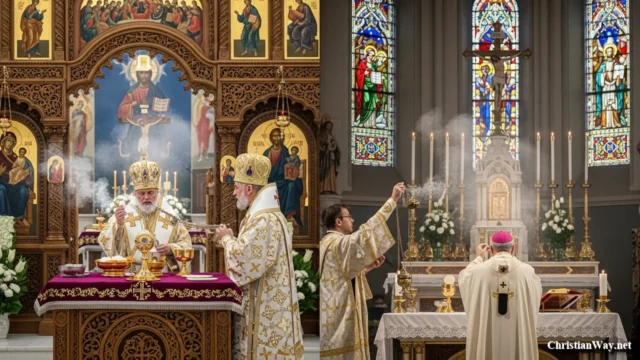
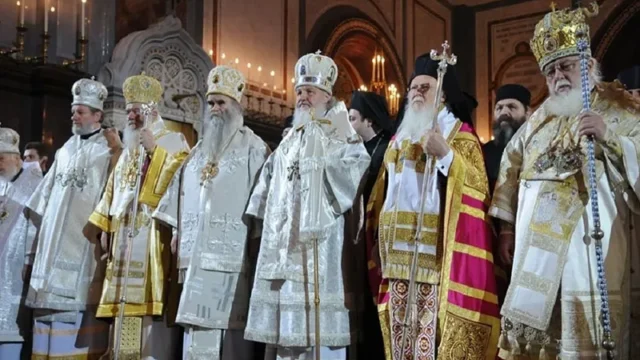
A gentle comparison of Greek and Russian Orthodoxy, their shared faith, distinct traditions, and enduring unity in Christ.
Dear friends in Christ,
When people first encounter Eastern Christianity, they often hear names such as Greek Orthodox, Russian Orthodox, Serbian Orthodox, Romanian Orthodox, Antiochian Orthodox, or Georgian Orthodox. These names can create the impression that Eastern Orthodoxy is divided into separate denominations, each with its own theology and understanding of the Christian faith. A person may naturally wonder whether the difference between Greek Orthodox and Russian Orthodox Christians is similar to the difference between Catholics and Protestants, or between Anglicans and Baptists.
The reality is very different.
Greek Orthodox and Russian Orthodox Christians belong to the same Eastern Orthodox Church. They confess the same essential faith, celebrate the same sacraments, receive the same ancient creeds, honor the same early Church Fathers, and understand themselves as members of the one holy, catholic, and apostolic Church established by Jesus Christ. Their differences are primarily differences of history, language, culture, liturgical expression, and church administration rather than differences concerning the central truths of Christianity.
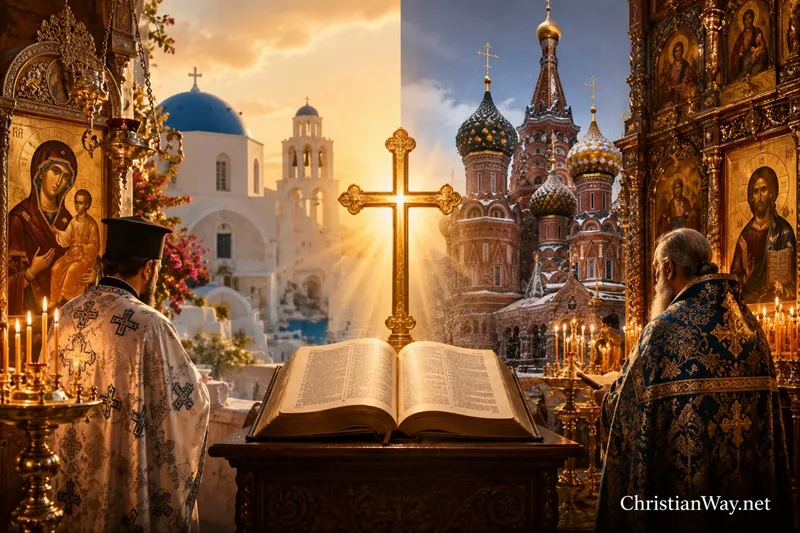
Yet these cultural differences are not insignificant. Christianity does not exist in an abstract world. The Gospel takes root in particular peoples, languages, landscapes, and historical experiences. The faith that flourished in the Greek-speaking world of the Byzantine Empire naturally developed certain patterns of worship, music, architecture, and spiritual expression. The same faith, planted centuries later among the Slavic peoples, entered a different cultural soil and produced its own beautiful forms.
To understand Greek Orthodox vs Russian Orthodox Christianity, therefore, we must begin not with division but with communion. We must first see the one faith they share before considering the traditions that distinguish them. When approached in this way, their differences do not need to appear as rival claims. They can be understood as two voices singing within the wider choir of Eastern Orthodoxy, each carrying a particular history while confessing the same Lord.
The Most Important Truth: Greek and Russian Orthodox Christians Share the Same Faith
The first and most important answer is simple: Greek Orthodox and Russian Orthodox Christians are both Eastern Orthodox Christians.
They believe in one God—the Father, the Son, and the Holy Spirit. They confess that Jesus Christ is fully divine and fully human, the eternal Son of God who became man for our salvation. They believe that Christ was crucified, truly died, rose bodily from the dead, ascended into heaven, and will come again in glory. They receive the Holy Scriptures as the inspired Word of God and read them within the living tradition of the Church.
Both Greek and Russian Orthodox Christians confess the Nicene-Constantinopolitan Creed in the form received by the ancient Eastern Church. Both celebrate Baptism, Chrismation, the Eucharist, Confession, Holy Matrimony, Ordination, and the Anointing of the Sick. Both honor the Virgin Mary as the Theotokos, a Greek title meaning “God-bearer” or “Mother of God.” Both venerate the saints, use holy icons in worship, pray for the departed, practice fasting, and understand salvation as a life of communion and transformation in Christ.
Saint Paul writes:
“There is one body, and one Spirit, even as ye are called in one hope of your calling; one Lord, one faith, one baptism, one God and Father of all.”
This vision from Ephesians 4:4–6 stands at the heart of Orthodox identity. The Orthodox Church is not understood merely as an association of independent congregations that happen to hold similar beliefs. It understands itself as one sacramental body, locally expressed through many self-governing churches united in the same apostolic faith.
A Greek Orthodox Christian may normally receive Holy Communion in a Russian Orthodox parish, and a Russian Orthodox Christian may normally receive Holy Communion in a Greek Orthodox parish, provided that the usual spiritual and sacramental preparation has been observed. Their bishops belong to the same Orthodox episcopal tradition, and their priests celebrate essentially the same Divine Liturgy.
This means that Greek Orthodoxy and Russian Orthodoxy are not two different religions. They are not competing versions of Christianity. Nor are they separate denominations in the common Protestant sense of that word. They are distinct cultural and administrative expressions of the same Eastern Orthodox faith.
What Does “Greek Orthodox” Mean?
The term “Greek Orthodox” can be used in several related ways.
Sometimes it refers specifically to the Church of Greece, the self-governing Orthodox Church whose territory includes much of the modern Greek nation. At other times, it is used more broadly for Greek-speaking Orthodox Christians connected with the Ecumenical Patriarchate of Constantinople, the Church of Cyprus, or the ancient patriarchates of Alexandria and Jerusalem.
In countries such as the United States, Canada, Australia, and the United Kingdom, “Greek Orthodox” usually describes parishes shaped by Greek liturgical, cultural, and historical traditions. These parishes may use Greek, English, or another local language. They may preserve Greek customs surrounding feast days, food, music, processions, family life, and parish festivals while remaining fully part of the worldwide Orthodox Church.
Greek Orthodoxy carries a particularly close relationship with the Byzantine Christian inheritance. The New Testament was written in Greek, and many of the earliest theological debates of the Church took place in the Greek-speaking world. Great teachers such as Saint Athanasius, Saint Basil the Great, Saint Gregory the Theologian, Saint John Chrysostom, and Saint Maximus the Confessor wrote in Greek and profoundly shaped the language through which Orthodox Christians speak about the Trinity, the Incarnation, grace, prayer, and salvation.
The word “Orthodox” itself comes from Greek roots that may be understood as “right belief” or “right worship.” Yet Greek Orthodox Christians do not believe that Orthodoxy belongs only to Greek people. The Greek language and Byzantine heritage have played an extraordinary role in preserving and expressing the faith, but the Church is universal. A person does not need to be ethnically Greek to become Greek Orthodox or to worship in a Greek Orthodox parish.
What Does “Russian Orthodox” Mean?
“Russian Orthodox” commonly refers to the Orthodox Christian tradition associated with the Russian Orthodox Church and the Patriarchate of Moscow. It may also be used more generally for Orthodox communities shaped by Russian liturgical, spiritual, artistic, and cultural customs.
Christianity was formally received by the people of Kievan Rus in the tenth century, when Prince Vladimir accepted the Byzantine Christian faith. Missionaries, clergy, books, icons, and liturgical practices came to the Slavic lands through the Christian world centered on Constantinople. In this sense, Russian Orthodoxy received the faith from the Byzantine, Greek-speaking Church.
Yet Russian Christianity did not remain merely an imitation of Greek Christianity. Over many centuries, it developed its own sacred art, hymnody, monastic traditions, architecture, theological literature, and models of holiness. Saints such as Sergius of Radonezh, Seraphim of Sarov, John of Kronstadt, Xenia of Saint Petersburg, and the spiritual elders of Optina became beloved far beyond the Russian world.
Russian Orthodoxy also passed through historical experiences very different from those of the Greek-speaking Church. It grew across an enormous territory, interacted with many peoples, endured periods of political control, and suffered severe persecution under atheistic communist rule. Countless bishops, priests, monks, nuns, and laypeople were imprisoned or killed for their faith during the twentieth century.
This history contributed to a Russian Orthodox spiritual character often associated with endurance, repentance, sacrifice, and hope amid suffering. However, these qualities should not be turned into rigid national stereotypes. Greek Christians have also suffered deeply, and Russian Orthodoxy contains joy, beauty, warmth, and celebration as surely as it contains solemnity.
As with Greek Orthodoxy, a person does not need to be ethnically Russian to enter the Russian Orthodox Church. Russian Orthodox parishes throughout the world include worshippers from many cultures and backgrounds.
Their Historical Paths Developed Differently
The differences between Greek Orthodox and Russian Orthodox traditions become clearer when we consider their historical development.
Greek Orthodoxy and the Byzantine Christian World
Greek Orthodoxy was formed within the eastern regions of the Roman Empire, later commonly called the Byzantine Empire. Constantinople became the imperial capital in the fourth century and gradually emerged as one of the most influential centers of Christianity.
The Byzantine world united theology, liturgy, sacred art, imperial life, monasticism, and public culture in ways that left a lasting mark on Eastern Orthodoxy. The great ecumenical councils that clarified Christian teaching about Christ and the Trinity were largely conducted in the eastern Mediterranean world. The liturgies of Saint John Chrysostom and Saint Basil the Great reached their mature forms within this environment.
Following the fall of Constantinople in 1453, Greek-speaking Orthodox Christians lived for centuries under Ottoman rule. During that period, the Ecumenical Patriarch of Constantinople held not only ecclesiastical responsibilities but also certain civil responsibilities for Orthodox Christians within the Ottoman system.
Greek Orthodoxy therefore carries the memory both of Byzantine Christian civilization and of faith preserved under foreign domination. Its identity is shaped by ancient continuity, theological learning, monastic prayer, national struggle, and a deep attachment to the liturgical inheritance of Constantinople.
Russian Orthodoxy and the Slavic Christian World
Russian Orthodoxy arose from the missionary expansion of Byzantine Christianity into the Slavic lands. According to the traditional story, representatives of Prince Vladimir visited several religious communities before encountering the Divine Liturgy in Constantinople. Overwhelmed by its beauty, they reported that they did not know whether they were in heaven or on earth.
Whether every detail of that account is taken literally or symbolically, it expresses an important Orthodox truth: beauty can become a doorway to faith. The splendor of the liturgy was not intended as empty spectacle. It revealed a vision of heaven and earth united in the worship of God.
After the Christianization of Rus, the Scriptures and liturgical texts were received in Church Slavonic, a sacred literary language related to the missionary work of Saints Cyril and Methodius and their disciples. Over time, Russian church life developed its own administrative centers, monasteries, theological schools, iconographic traditions, and patterns of popular devotion.
The Russian Church eventually became self-governing, and Moscow was raised to the status of a patriarchate. Russian Orthodoxy spread across Siberia and eventually reached parts of Asia and North America through missionary activity.
Its development was shaped by close and sometimes difficult relationships with political authority. The Church experienced periods of strong imperial support, periods of government control, and later brutal repression under Soviet atheism. These experiences left a profound spiritual and historical memory within Russian Orthodox Christianity.
A Comparison at a Glance
The following table summarizes several common distinctions while keeping their essential unity in view:
| Area | Greek Orthodox Tradition | Russian Orthodox Tradition |
|---|---|---|
| Christian family | Eastern Orthodox Church | Eastern Orthodox Church |
| Essential doctrine | Orthodox Christian faith | Orthodox Christian faith |
| Main historical influence | Byzantine and Greek-speaking Christianity | Byzantine Christianity received and developed in the Slavic world |
| Common liturgical language | Greek and local languages | Church Slavonic, Russian, and local languages |
| Main liturgy | Divine Liturgy of Saint John Chrysostom | Divine Liturgy of Saint John Chrysostom |
| Musical tradition | Byzantine chant, generally monophonic | Choral chant, often harmonized or polyphonic |
| Common calendar practice | Many churches use the Revised Julian calendar for fixed feasts | Commonly uses the older Julian calendar for fixed feasts |
| Christmas observance | Often December 25 | Commonly January 7 on the civil calendar |
| Pascha | Calculated according to the Orthodox Paschal tradition | Calculated according to the Orthodox Paschal tradition |
| Church architecture | Strong Byzantine and Mediterranean influence | Byzantine roots with distinctive Russian forms, including onion domes |
| Worship customs | May appear somewhat more concise in many diaspora parishes | Often includes longer services and more extensive devotional customs |
| Spiritual inheritance | Greek Fathers, Mount Athos, Byzantine hesychasm | Russian monastic elders, missionary saints, and new martyrs |
| Church government | Synodal and organized through several Greek-speaking jurisdictions | Synodal and commonly associated with the Moscow Patriarchate |
| Sacraments | Seven major sacramental mysteries within the Orthodox life | The same sacramental mysteries |
| View of salvation | Communion with God and transformation by grace | Communion with God and transformation by grace |
This table describes common patterns rather than absolute rules. Individual parishes may differ considerably depending on their country, bishop, priest, language, history, and local community.
Church Government: Unity Without a Single Earthly Supreme Bishop
Both Greek and Russian Orthodox Christians understand church authority through a synodal or conciliar model. Bishops share the same sacramental office, and major decisions are ideally made through councils or synods rather than through the universal jurisdiction of one bishop over the whole Church.
Eastern Orthodoxy has no figure directly equivalent to the pope as understood in the Roman Catholic Church. The Ecumenical Patriarch of Constantinople is traditionally honored as “first among equals” among Orthodox bishops. This gives him a significant place of honor and coordination, but Orthodox churches do not generally understand his position as universal monarchical authority over all other patriarchs and bishops.
Greek Orthodox Christians connected with the Ecumenical Patriarchate may naturally emphasize the historical and coordinating role of Constantinople. Russian Orthodox Christians may place greater practical emphasis on the authority of their own patriarch and Holy Synod. These differences can occasionally contribute to tensions concerning jurisdiction, territory, and the relationship between local church independence and wider Orthodox unity.
Yet the underlying system is shared. Both traditions believe that bishops must remain faithful to apostolic teaching and live in communion with the wider Church. Authority is not simply personal power. It is a ministry of guarding the faith, preserving unity, celebrating the sacraments, and shepherding the people of God.
The Divine Liturgy Is Fundamentally the Same
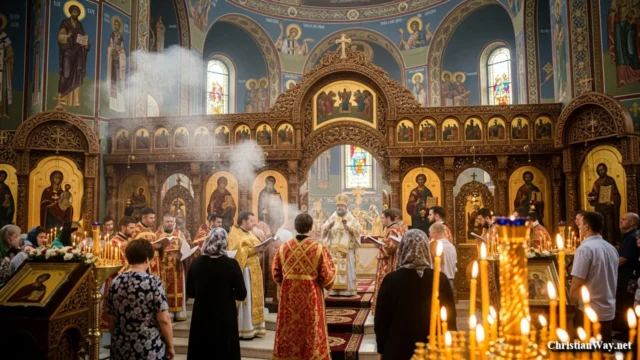
A visitor entering a Greek Orthodox church and then a Russian Orthodox church will recognize the same basic Divine Liturgy.
In both traditions, the priest and people gather around the mystery of Christ. The Scriptures are proclaimed. Litanies of prayer are offered. Bread and wine are brought to the altar. The Church gives thanks to the Father, invokes the Holy Spirit, remembers the saving work of Christ, and receives the Holy Eucharist as the true Body and Blood of the Lord.
Both traditions most commonly celebrate the Divine Liturgy of Saint John Chrysostom. On certain days, they celebrate the longer Divine Liturgy of Saint Basil the Great. The prayers, theological structure, and sacramental meaning are substantially the same.
A Greek Orthodox Christian attending a Russian Orthodox liturgy may not understand every word if the service is celebrated in Church Slavonic or Russian. A Russian Orthodox Christian visiting a Greek parish may experience the same difficulty with Greek. Yet beneath the language, the familiar shape of the liturgy remains.
The Church is gathered. The Kingdom is proclaimed. The Gospel is read. The gifts are offered. The Holy Spirit is invoked. Christ feeds His people.
This shared liturgy reveals more than any cultural comparison could express. Greek and Russian Orthodox Christians do not merely agree about certain ideas. They stand within the same ancient act of worship and receive life from the same Eucharistic mystery.
Language Creates an Immediate Difference
Language is one of the first differences a visitor will notice.
Greek Orthodox parishes may use ancient liturgical Greek, modern Greek, English, or a combination of languages. Russian Orthodox parishes may use Church Slavonic, modern Russian, English, or another local language.
Church Slavonic occupies a role in many Slavic Orthodox churches somewhat comparable to the role of traditional liturgical Greek in Greek Orthodoxy or Latin in the historical worship of Western Christianity. It is not identical to everyday Russian, though Russian speakers may recognize much of its vocabulary and structure.
Language can carry memory, beauty, and identity. Sacred words heard from childhood often become deeply rooted in the heart. A person may associate a particular chant, response, or prayer with parents, grandparents, feast days, weddings, funerals, and the whole spiritual atmosphere of home.
At the same time, Orthodox communities increasingly recognize the pastoral importance of celebrating in languages that worshippers can understand. Many Greek and Russian Orthodox parishes outside their ancestral homelands use the local language extensively. Some retain portions of Greek or Church Slavonic as a connection to their historical inheritance.
The use of a particular language does not change the faith of the liturgy. It changes its cultural sound and the degree to which visitors may immediately understand it.
Greek Byzantine Chant and Russian Choral Music
Music is among the most beautiful and noticeable differences in Greek Orthodox vs Russian Orthodox worship.
Traditional Greek Orthodox music is shaped by Byzantine chant. It is ordinarily sung without instruments and is primarily monophonic, meaning that the melody is carried as a single musical line. A sustained supporting tone, often called the ison, may accompany the main melody.
Byzantine chant can sound unfamiliar to Western ears. Its musical modes, ornamentation, and tonal movement belong to an ancient eastern Mediterranean tradition. At its best, the chant does not seek to entertain the congregation. It carries the sacred words, gathers the attention of the heart, and leads the community into prayer.
Russian Orthodox music is also unaccompanied, since instruments are generally not used in Orthodox liturgical worship. However, Russian churches commonly employ rich choral harmonies. Four-part or multi-part singing may create a full, resonant sound that many visitors experience as solemn and deeply moving.
Russian choral music developed under several historical influences while remaining rooted in Orthodox worship. Some compositions are simple and direct, while others are musically elaborate. The human voice becomes the instrument through which the whole church seems to breathe and pray.
Neither musical form is more Orthodox than the other. Byzantine chant and Russian choral harmony are different cultural garments placed around the same sacred texts and liturgical actions. One emphasizes the ancient modal line; the other often emphasizes the fullness of the gathered choir. Both seek to direct the heart toward God.
The Church Calendar Can Cause Different Christmas Dates
One practical difference concerns the calendar.
Many Greek Orthodox churches use the Revised Julian calendar for fixed feast days. At present, this calendar corresponds with the Gregorian civil calendar for celebrations such as Christmas. Therefore, many Greek Orthodox Christians celebrate the Nativity of Christ on December 25.
The Russian Orthodox Church generally continues to use the older Julian calendar for fixed feasts. December 25 on the Julian calendar currently corresponds to January 7 on the civil Gregorian calendar. For this reason, Russian Orthodox Christmas is commonly observed on January 7.
This does not mean that Russian Orthodox Christians believe Jesus was born on a different theological date. Both traditions celebrate December 25 according to the calendar they use. The civil date differs because the Julian and Gregorian calendars are not presently aligned.
The date of Pascha, or Easter, is another matter. Orthodox churches normally follow a common Paschal calculation rooted in the traditional Orthodox calendar system. As a result, Greek and Russian Orthodox Christians generally celebrate Pascha together, even when their fixed feast calendars differ.
There are exceptions and local variations. Not every parish associated with a particular ethnic tradition follows exactly the same calendar practice. Calendar differences should therefore be approached with patience rather than used as a test of spiritual authenticity.
The purpose of the liturgical calendar is not to create rivalry. It is to sanctify time by placing the life of the believer within the saving mysteries of Christ.
Architecture and Sacred Space
Greek and Russian Orthodox churches share the same fundamental understanding of sacred space. Both are centered on the altar, separated from the nave by an icon screen or iconostasis. Both display images of Christ, the Mother of God, the angels, and the saints. Both use candles, incense, processions, sacred vessels, and liturgical vestments.
Yet their architecture often reflects different environments and historical styles.
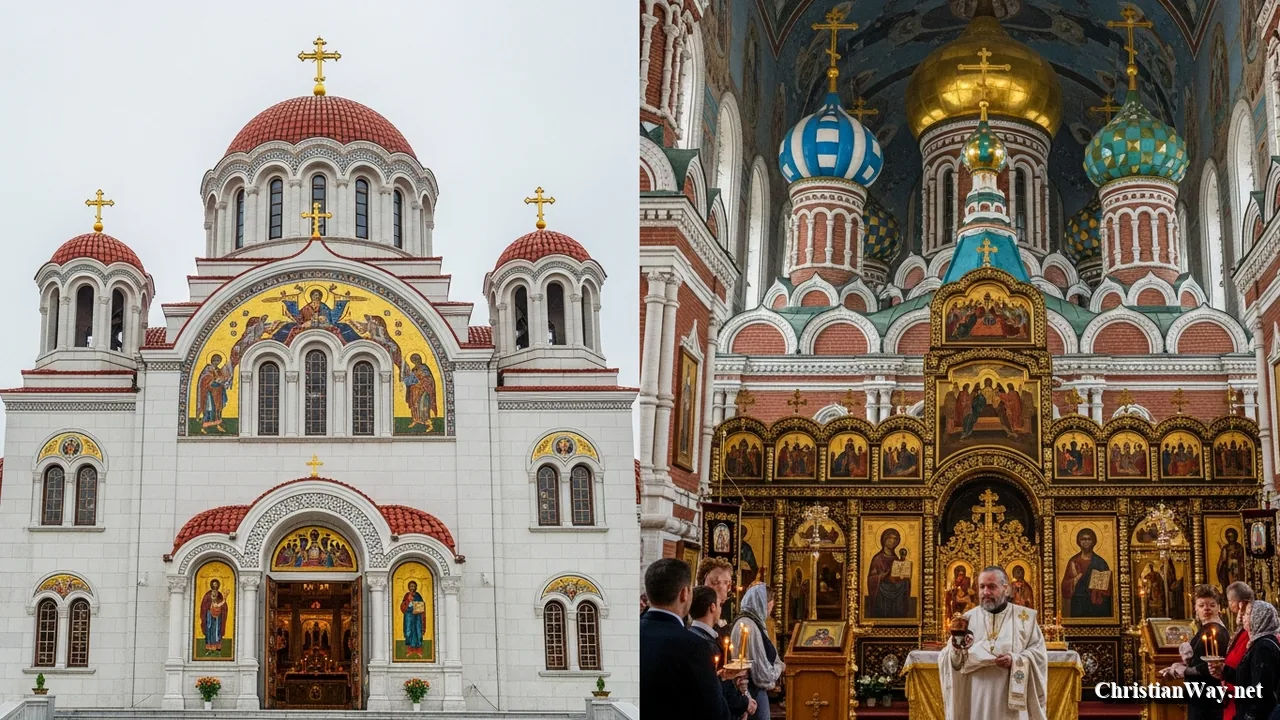
Greek Orthodox churches are frequently shaped by Byzantine architectural forms. Domes, arches, mosaics, and painted icons may create a sense of ordered harmony. In Mediterranean settings, the exterior may appear relatively simple, while the interior opens into a luminous world of gold, color, and sacred imagery.
Russian Orthodox churches also inherit Byzantine forms but developed distinctive architectural features. Onion-shaped domes became especially associated with Russian church buildings. Multiple domes may symbolize Christ and the evangelists, the Holy Trinity, or other sacred realities, though the symbolism can vary.
Russian interiors may feel especially dense with icons, hanging lamps, candles, embroidered coverings, and devotional objects. A tall iconostasis may create a powerful visual boundary between the sanctuary and the nave, while simultaneously revealing that the worship of the Church joins heaven and earth.
These differences are not merely artistic decoration. Orthodox architecture teaches theology. The dome suggests the heavens. The image of Christ Pantocrator proclaims the Lord who reigns over all creation. The iconostasis does not simply hide the altar; it presents the communion of Christ, His Mother, the angels, and the saints.
A church building becomes a proclamation that the Kingdom of God has drawn near.
Icons Share the Same Theology but Reflect Different Artistic Schools
Both Greek and Russian Orthodox Christians venerate icons. They do not worship wood, paint, or created matter. Honor given to the image passes to the person represented, just as respect shown toward a photograph may express love for the person portrayed.
The theology of icons is the same in both traditions. Because the Son of God truly became human, He can be depicted in His humanity. The icon bears witness to the Incarnation. Matter can serve the purposes of grace because God Himself entered the material world.
Greek iconography often preserves a strongly Byzantine visual language. Figures may appear restrained, luminous, and spiritually transfigured rather than naturally realistic. The goal is not to create an ordinary portrait but to reveal humanity transformed by divine grace.
Russian iconography received this Byzantine inheritance and developed its own schools and styles. The work associated with Saint Andrei Rublev is among the most cherished examples. Russian icons may employ distinctive colors, facial forms, compositions, and devotional emphases, while remaining within the shared canonical tradition.
In later centuries, some Russian sacred art absorbed elements of Western naturalism. Similar outside influences also appeared at times in Greek and other Orthodox lands. Modern Orthodox iconographers in both traditions have often sought to recover the spiritual principles of classical Byzantine iconography.
The differences between Greek and Russian icons are therefore differences within one theology of sacred images.
Worship Customs May Feel Different
Even when the liturgical text is the same, the experience of worship may differ from parish to parish.
Russian Orthodox services are sometimes perceived as longer and more physically demanding. Worshippers may stand for most or all of the service. There may be more frequent bows, prostrations, and opportunities to venerate icons. Vigil services on the evening before Sundays and major feasts can be extensive.
Greek Orthodox parishes, especially in Western countries, may have pews and may celebrate certain services in a somewhat more concise form. Congregational practices surrounding sitting, standing, and arriving during the service may also differ according to local custom.
Russian women may be more likely to wear head coverings in church, though this varies widely. Some Greek women also cover their heads, while many do not. Such customs should not be treated as universal laws or as measures of personal holiness.
In some Russian parishes, Holy Communion may be approached less frequently by certain worshippers, with strong emphasis placed on confession and detailed preparation. In many Greek parishes, frequent Communion may be encouraged when accompanied by prayer, fasting, repentance, and pastoral guidance. Yet this distinction is not absolute. Practices vary greatly among bishops, monasteries, priests, families, and local communities.
The spiritual principle is the same: the Eucharist is not casual food. It is the holy gift of Christ Himself. Believers are called to approach with faith, repentance, love, and the blessing of the Church.
Fasting Is Shared, Though Food and Custom Differ
Greek and Russian Orthodox Christians follow the same broad rhythm of fasting. They fast before Pascha, before Christmas, during the Apostles’ Fast, during the Dormition Fast, and on many Wednesdays and Fridays throughout the year.
Traditional fasting involves abstaining from meat, dairy products, and sometimes fish, wine, and oil, depending on the day and season. Yet fasting is always meant to be practiced with spiritual wisdom and pastoral care. Children, pregnant women, the elderly, the sick, travelers, and people with demanding circumstances may receive different guidance.
The foods prepared during fasting naturally differ by culture. Greek fasting meals may include olives, legumes, vegetables, bread, seafood, and dishes shaped by Mediterranean life. Russian fasting food may include potatoes, cabbage, mushrooms, grains, pickled vegetables, and dishes adapted to a colder climate.
The outer menu is not the heart of fasting. Saint John Chrysostom warned that a person may abstain from meat while spiritually devouring another through anger or slander. True fasting includes prayer, mercy, forgiveness, self-control, and care for the poor.
Whether the meal is Greek or Russian, the purpose is the same: to create space in the heart for God.
Greek Hesychasm and Russian Spiritual Eldership
Greek and Russian Orthodox spirituality drink from the same deep well.
One of the great treasures of Eastern Christianity is hesychasm, the tradition of inner stillness and continual prayer. The Jesus Prayer—“Lord Jesus Christ, Son of God, have mercy on me, a sinner”—holds an important place in both Greek and Russian spiritual life.
Greek-speaking monasticism, especially the tradition of Mount Athos, played a central role in preserving hesychastic prayer. Saints such as Gregory Palamas defended the Orthodox teaching that human beings can truly participate in the uncreated grace of God while never becoming God by nature.
Russian monasticism received this tradition and expressed it through its own saints, monasteries, and spiritual elders. The Russian word starets refers to a spiritually mature elder who guides others through prayer, wisdom, humility, and discernment. The elders of Optina Monastery became particularly influential in Russian spiritual life.
Saint Seraphim of Sarov expressed the purpose of Christian life as the acquisition of the Holy Spirit. His warmth, humility, and Paschal greeting—addressing visitors as “my joy”—reflect the tenderness that lies beneath the sometimes severe outward appearance of Russian asceticism.
Greek Orthodoxy may lead the mind toward Mount Athos, the Philokalia, and the theology of divine light. Russian Orthodoxy may bring to mind the holy elders, the spirituality of the heart, and faith refined through suffering. Yet these are not separate spiritual systems. They belong to the same Orthodox pursuit of theosis: the transformation of the human person by participation in the life of God.
Theosis Is Central to Both Traditions
Both Greek and Russian Orthodox Christians understand salvation as more than legal acquittal or the cancellation of punishment. Salvation includes forgiveness, but it also means healing, restoration, communion, and transformation.
The Orthodox tradition often uses the Greek word theosis, meaning participation in divine life. Human beings do not become God by nature or cease to be creatures. Rather, by grace they are united to Christ and gradually transformed into His likeness.
Saint Peter writes that believers are called to become “partakers of the divine nature.” This does not mean that the distinction between Creator and creation disappears. It means that the grace of God truly enters, heals, and transfigures human life.
Russian Orthodox theology expresses the same reality, sometimes using the Slavonic term corresponding to deification. Russian saints speak of acquiring the Holy Spirit, attaining purity of heart, and allowing the light of Christ to fill the whole person.
Thus, beneath differences of language and culture, Greek and Russian Orthodoxy proclaim the same hope: Christ did not come merely to change our external status. He came to make us alive in Him.
Parish Culture Can Be More Different Than Theology
For many visitors, the greatest difficulty is not theology but parish culture.
A Greek Orthodox parish may include Greek food festivals, Greek dancing, cultural schools, national commemorations, and strong family ties. A Russian Orthodox parish may preserve Russian language classes, Slavic customs, traditional foods, historical commemorations, and a strong consciousness of immigrant identity.
These cultural elements can help families preserve memory and community. They can also offer newcomers a rich encounter with a living Christian heritage. Yet they can sometimes make a visitor feel that ethnic belonging is required.
The Church must continually remember that the Gospel is for every nation. On the day of Pentecost, the apostles did not force all peoples to speak one earthly language. The Holy Spirit allowed each person to hear the mighty works of God in his or her own tongue.
A healthy Orthodox parish honors its ancestral inheritance without turning ethnicity into a wall. Greek customs can be offered as gifts rather than conditions of belonging. Russian customs can be cherished without suggesting that holiness has a nationality.
The deepest identity of the Christian is not Greek, Russian, American, Arab, Romanian, African, Asian, or European. In Baptism, the believer is clothed with Christ.
Are Greek and Russian Orthodox Sacraments the Same?
Yes. Greek and Russian Orthodox Christians share the same sacramental understanding.
Both baptize in the name of the Father, the Son, and the Holy Spirit. Both ordinarily administer Chrismation immediately after Baptism, including to infants. Both give Holy Communion to baptized and chrismated infants, recognizing that grace is a gift rather than an intellectual achievement.
Both believe that the bread and wine truly become the Body and Blood of Christ through the Eucharistic prayer and the action of the Holy Spirit. Both practice sacramental confession before a priest, who witnesses the repentance of the believer and pronounces the Church’s prayer of absolution.
Both permit married men to be ordained as parish priests when the marriage takes place before ordination. Bishops are chosen from the celibate clergy, commonly from monastic life. Priests do not marry after ordination.
Both understand Christian marriage as a holy mystery in which the couple is crowned for a life of sacrifice, fidelity, and communion in Christ. Both anoint the sick with oil for healing of soul and body.
The outward customs surrounding these sacraments may differ, but their theological meaning is shared.
Are They in Communion With Each Other?
Greek and Russian Orthodox churches belong to the same Eastern Orthodox communion and recognize one another’s apostolic succession, priesthood, sacraments, saints, and doctrinal inheritance.
At times, Orthodox jurisdictions have experienced serious disputes concerning authority, territory, political circumstances, or the recognition of church independence. Such conflicts can affect relationships between particular hierarchies and may sometimes create painful restrictions in certain contexts.
These difficulties should not be ignored, but neither should they be allowed to obscure the deeper unity of the faith. Administrative conflict is not the same as doctrinal separation. The Orthodox world has often lived through periods of tension while continuing to confess the same creed and celebrate the same sacramental tradition.
Christ prayed that His disciples “may all be one.” This prayer remains both a gift and a calling. Orthodox unity cannot be reduced to diplomatic agreement between church leaders. It must be lived in humility, truth, repentance, patience, and love.
Common Misunderstandings About Greek Orthodox vs Russian Orthodox Christianity
One common misunderstanding is that Greek Orthodox and Russian Orthodox Christians follow different religions. They do not. They belong to the same Christian communion.
Another misunderstanding is that Greek Orthodox Christians obey the Ecumenical Patriarch in exactly the same manner that Roman Catholics obey the pope. Orthodox church government is more decentralized and synodal. The Ecumenical Patriarch holds a primacy of honor, but the self-governing Orthodox churches retain their own synods and internal administration.
It is also incorrect to assume that all Greek Orthodox Christians are ethnically Greek or that all Russian Orthodox Christians are ethnically Russian. Orthodox parishes increasingly include converts and families from many backgrounds.
Some people imagine that Greek Orthodoxy is more intellectual while Russian Orthodoxy is more mystical. Such contrasts may reflect certain historical impressions, but they are too simplistic. Greek saints have embodied profound mystical prayer, and Russian theologians have displayed great intellectual depth. Both traditions unite the mind and heart.
Others assume that Russian services are always stricter and Greek services always more relaxed. Local practices do differ, but spiritual seriousness cannot be measured by service length, clothing style, musical form, or the number of prostrations.
God alone sees the heart.
Which Tradition Is More Ancient?
Greek Orthodoxy has a more direct historical connection to the Greek-speaking Christian communities of the apostolic and patristic eras. The New Testament was composed in Greek, and many foundational theological texts emerged from the Greek Christian world.
Russian Orthodoxy was received later through Byzantine missionary influence. In that historical sense, the Greek tradition is older.
Yet this does not mean that Russian Orthodox Christianity is a newer denomination or a less authentic form of the faith. When Rus received Orthodox Christianity, it entered the existing apostolic and sacramental life of the Church. Russian Orthodoxy is ancient not because every cultural expression began in the first century, but because it participates in the same apostolic faith transmitted through the centuries.
A branch grafted into a living tree receives the life of that tree. Over time, it bears fruit shaped by its own climate and place while remaining nourished by the same roots.
Which Tradition Is More Correct?
From an Orthodox perspective, the question should not be framed as though one tradition possesses the true faith and the other does not. Both Greek and Russian Orthodoxy confess the same essential doctrine.
One parish may preserve certain traditions more carefully than another. One bishop or priest may teach more clearly than another. Human weakness exists in every culture and institution. No national tradition is immune from pride, political pressure, formalism, or spiritual decline.
Likewise, every Orthodox tradition contains saints whose lives reveal the transforming grace of Christ.
The better question is not, “Which ethnic tradition is superior?” but, “Where is Christ being faithfully worshipped, where is the apostolic faith being taught, and where can I grow in repentance, prayer, love, and communion with God?”
Orthodoxy does not call us to become admirers of religious culture. It calls us to become saints.
Which Church Should a Newcomer Attend?
A person interested in Eastern Orthodoxy may visit either a Greek Orthodox or a Russian Orthodox parish. It is wise to consider the language of the services, the accessibility of the priest, the health of the parish community, the quality of teaching, and the practical distance from home.
Some people are drawn to Byzantine chant and Greek liturgical culture. Others are moved by Russian choral music and Slavic spirituality. These preferences are understandable, but they should not become the foundation of faith.
The beauty of Orthodoxy is meant to lead us to Christ, not merely to an aesthetic experience.
A newcomer should seek a parish where the Gospel is proclaimed faithfully, where worship is reverent, where questions are welcomed patiently, and where the priest offers responsible pastoral guidance. Entering the Church is not simply choosing a style of music or architecture. It is entering a life of prayer, repentance, sacramental communion, and love.
One should also resist the temptation to judge an entire tradition by a single parish visit. A cold welcome, an unfamiliar language, or a confusing custom may reflect a local situation rather than the heart of Orthodoxy itself.
Patience is necessary. So is prayer.
Cultural Difference Can Become a Gift
The Church has always lived among many peoples. The earliest Christian communities included Jews, Greeks, Romans, Syrians, Egyptians, Africans, and others. The Gospel did not erase their histories, but it purified and redirected them toward Christ.
Greek Orthodoxy offers the Church the enduring riches of the Byzantine tradition, the language of the early councils, the witness of the Greek Fathers, the discipline of ancient monasticism, and a liturgical world shaped by centuries of prayer.
Russian Orthodoxy offers the witness of a people who received that faith and allowed it to blossom in a vast new cultural world. Its saints, missionaries, iconographers, composers, martyrs, and spiritual elders have enriched the whole Christian family.
When culture becomes proud, it divides. When culture is offered to Christ, it becomes a gift.
The Greek and Russian traditions remind us that unity does not require sameness. The Church can speak in different languages, sing in different musical forms, build different kinds of domes, and preserve different customs while confessing one Lord.
The Deepest Difference Is Cultural, Not Doctrinal
When all the details are considered, the central conclusion becomes clear.
Greek Orthodox and Russian Orthodox Christians differ in language, national history, musical tradition, church architecture, calendar practice, devotional customs, and administrative organization. Their parishes may feel different. Their sacred music may sound different. Their Christmas celebrations may fall on different civil dates. Their spiritual literature may reflect different historical experiences.
But they share the same Orthodox doctrine, the same sacramental life, the same understanding of the Church, the same veneration of icons, the same apostolic ministry, the same call to holiness, and the same hope of salvation in Jesus Christ.
Their differences resemble the differences between two ancient families living within one household rather than the differences between two separate religions.
Both stand before the same altar.
Both proclaim the same Gospel.
Both confess the Father, the Son, and the Holy Spirit.
Both sing of the death and resurrection of Christ.
Both call the human heart to repentance.
Both look toward the resurrection of the dead and the life of the world to come.
Reflect and Pray
The question of Greek Orthodox vs Russian Orthodox Christianity invites us to look beyond visible differences and ask what truly creates unity in the Church.
Unity is not created by language, ethnicity, music, or political history. These things can enrich the Christian life, but they cannot replace its foundation. The unity of the Church comes from Christ, who gathers many peoples into His one Body.
There is beauty in the solemn harmonies of a Russian choir. There is beauty in the ancient movement of Byzantine chant. There is beauty in the golden mosaics of a Greek church and in the candlelit iconostasis of a Russian cathedral. Yet all this beauty points beyond itself.
The icon points to the person depicted. The chant carries the words of prayer. The incense rises as a sign of the heart lifted toward God. The dome opens the imagination toward heaven. The Eucharistic gifts reveal Christ giving Himself for the life of the world.
We should therefore receive these traditions with gratitude rather than rivalry. The question is not whether Greek or Russian culture can claim ownership of Orthodoxy. No nation owns Christ. The Lord belongs to no tribe, yet He gives Himself to every people.
May Greek and Russian Orthodox Christians, together with all who confess the apostolic faith, seek the unity for which Christ prayed. May historical wounds be healed by truth and humility. May cultural treasures be preserved without becoming barriers. May every parish become a home where the stranger is welcomed, the sinner is called to repentance, the suffering are comforted, and the risen Christ is made known.
Let us pray:
Lord Jesus Christ, Son of the living God, gather Your people in the unity of faith and the bond of peace. Preserve Your Church from pride, hostility, and every division that darkens our witness to Your Gospel. Teach us to honor the gifts You have planted among different peoples while remembering that we are one in You. Through the prayers of Your holy Mother and all the saints, lead us into repentance, communion, and the light of Your eternal Kingdom. Amen.
May the peace of Christ dwell richly in your heart, and may His love teach you to recognize unity beneath every faithful and beautiful expression of His Church.
— Fr. John Matthew