Dear friends in Christ,
There are mysteries of faith that a person can spend a lifetime contemplating without ever reaching the end of their beauty. The Holy Trinity is one of them. Catholics begin prayers in the name of the Father, and of the Son, and of the Holy Spirit. A child is baptized in this holy name. The Mass begins beneath this confession. The sign of the cross places the whole human person beneath it: mind, heart, body, work, suffering, joy, and hope.
Yet many people quietly wonder what the Trinity truly means.
Does Catholicism believe in one God or three? Is Jesus simply another name for the Father? Is the Holy Spirit merely a power, a feeling, or an influence? Why does the Church speak so carefully about words such as Person, nature, essence, generation, and procession? And what does this ancient doctrine have to do with a person trying to raise children, endure grief, forgive someone who caused pain, or find peace in a restless world?
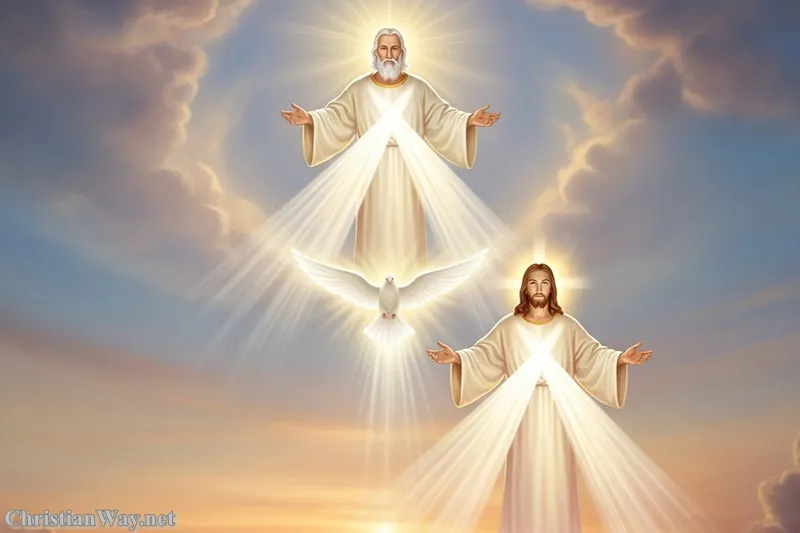
The Catholic answer begins with reverence. The Trinity is not a problem to solve as though God were an object placed before the human mind. It is the mystery of God’s own life, revealed because God desires to draw us near. The Church calls the Holy Trinity the central mystery of Christian faith and life: the source from which the other mysteries of faith receive their light.
The Trinity is not distant from the Gospel. It is the Gospel’s deepest horizon.
The Father sends the Son in love.
The Son becomes flesh for our salvation.
The Holy Spirit is poured into human hearts so that we may live as beloved children of God.
In the Trinity, Catholics see not a cold idea about God, but the eternal fountain of love from which creation, redemption, worship, mercy, and eternal life flow.
The God revealed by Jesus Christ is not lonely. Before the stars were formed, before oceans moved, before any human voice rose in prayer, God was already love: Father, Son, and Holy Spirit in perfect communion. The Bible says, “God is love” (1 John 4:8). This does not mean that God merely has loving feelings. It means that self-giving, holy, faithful love belongs to who God eternally is.
For the weary heart, this matters more than we may first realize.
If God were only power, we might fear Him.
If God were only law, we might hide from Him.
If God were only judgment, we might despair.
But the Trinity reveals a God who is holy without cruelty, just without coldness, and infinitely great without becoming distant from the smallest human sorrow.
The Trinity Is One God, Not Three Gods
Catholic doctrine begins firmly with the belief that there is only one God.
The faith of Israel stands at the foundation of Christian faith: “Hear, O Israel: The Lord our God is one Lord” (Deuteronomy 6:4). Christians do not abandon this confession when they speak of the Father, Son, and Holy Spirit. They do not believe in three gods standing beside one another. They worship one God.
The Father is God.
The Son is God.
The Holy Spirit is God.
Yet the Father is not the Son. The Son is not the Holy Spirit. The Holy Spirit is not the Father.
The Church uses careful language because both truths must be protected. God is truly one, and the three divine Persons are truly distinct. Catholic doctrine speaks of one divine nature or substance shared wholly and perfectly by the Father, Son, and Holy Spirit. Each Person is fully God, not one-third of God, and not a fragment of the divine life.
This is why Catholics do not say that the Trinity is like three separate human beings who happen to cooperate. The Father, Son, and Holy Spirit are not three independent centers of divinity. There is one divine being, one divine holiness, one divine will, one eternal life, and one perfect love.
At the same time, Catholics do not say that God is one Person who merely appears in three changing roles. The Father is not simply God acting as Creator for one moment, then becoming the Son in the Incarnation, then becoming the Holy Spirit in the Church. This would fail to honor the real relationships revealed in Scripture.
Jesus prays to the Father.
The Father speaks of the Son.
The Holy Spirit descends upon Christ.
The Son promises to send the Spirit.
These are not masks changing before the world. They reveal the eternal life of the one God.
The Catholic Church teaches that the three Persons are distinct by their relations of origin: the Father eternally generates the Son; the Son is eternally begotten of the Father; and the Holy Spirit proceeds eternally from the Father and the Son in the Latin Catholic expression of faith.
This language can feel difficult because it is trying to speak of realities beyond time. Human beings become parents at particular moments. Children are born after a period of waiting. But God does not live inside time as we do.
There was never a moment when the Father existed without the Son.
There was never a moment when the Son was absent from the Father.
There was never a moment when the Holy Spirit was not the Spirit of God.
The Father, Son, and Holy Spirit are eternal.
The Trinity is therefore not a mathematical puzzle. It is the Catholic confession that the one God is eternally a communion of love.
The Father: Creator, Source, and Loving Providence
When Catholics speak of God the Father, they are not imagining God as a larger version of a human father with human limitations. God is not male in the bodily and created sense. He is spirit. The Church teaches that God transcends the distinction between male and female, even while Scripture and Jesus Himself reveal God as Father.
The name Father tells us that God is the source of all life.
He is the Creator of heaven and earth.
He is the beginning of all that exists.
He is the One from whom the Son is eternally begotten.
He is the One who sends the Son into the world and gives the Holy Spirit to the Church.
Jesus teaches His disciples to pray, “Our Father which art in heaven” (Matthew 6:9). These words are familiar to many Catholics, perhaps so familiar that their wonder can be overlooked. Jesus invites human beings to call the Creator of all things “Father.”
This does not mean that God is casual or small. He remains holy, eternal, and beyond all human understanding. But it means that the One who created the universe is not indifferent to His children.
For some people, the word father brings comfort. It calls to mind protection, provision, patience, guidance, and a home where one is welcomed. For others, the word carries pain because earthly fathers can fail. Some people have known absence, harshness, fear, abandonment, or rejection.
The Father revealed by Jesus is not a projection of human failure.
He is the perfection toward which all true fatherhood points.
Jesus tells the parable of the prodigal son to reveal the Father’s heart. The younger son takes his inheritance, wastes it, reaches a place of desperation, and finally begins the long walk home. He expects judgment. He expects rejection. He expects to be treated as unworthy.
But the father sees him while he is still far off.
He runs toward him.
He embraces him.
He restores him.
This is not a story that says sin does not matter. The son must come to his senses. He must admit his failure. He must return. Yet the Father’s mercy is greater than the son’s shame.
Catholic doctrine never separates the Father from love. The Father is not the severe Person of the Trinity while Jesus is the gentle one who persuades Him to be merciful. The Father sends the Son because He loves the world. Jesus says, “For God so loved the world, that he gave his only begotten Son” (John 3:16).
The Father is not against the Son.
The Father and the Son are one in their saving love.
The Father does not turn away from the wounded heart. He receives it.
The Son: Jesus Christ, True God and True Man
The Son is Jesus Christ, the eternal Word made flesh.
Catholics confess that Jesus is not merely a prophet, moral teacher, spiritual guide, or holy person among many others. He is the eternal Son of God, truly God and truly human.
The Gospel of John begins with the words, “In the beginning was the Word, and the Word was with God, and the Word was God” (John 1:1). Then it gives the astonishing declaration that stands at the heart of Catholic faith: “And the Word was made flesh, and dwelt among us” (John 1:14).
The Son did not begin to exist at Bethlehem.
He did not become divine after His Baptism.
He did not become God only after the resurrection.
The Son is eternally begotten of the Father, sharing the same divine nature. The Council of Nicaea confessed that the Son is “consubstantial” with the Father: true God from true God, begotten and not made. Catholic doctrine continues to receive this confession as essential to the faith.
This truth is not an unnecessary theological detail. It is the foundation of Christian hope.
If Jesus were only a remarkable human teacher, He could inspire us but could not save us from sin and death.
If Jesus were not truly human, He could not fully enter the wounds of human life.
But because He is truly God and truly man, He reveals the Father perfectly and heals humanity from within.
Jesus knows hunger.
He knows exhaustion.
He knows friendship.
He knows betrayal.
He knows the sorrow of standing beside a tomb.
He knows the pain of being misunderstood.
He knows the loneliness of the cross.
In Jesus Christ, God does not remain at a safe distance from human suffering. He enters it.
This is why Catholics look upon Christ with such reverence in the Gospels.
When Jesus touches the leper, God draws near to the rejected.
When Jesus forgives the sinner, God speaks mercy into shame.
When Jesus welcomes children, God reveals tenderness.
When Jesus weeps at Lazarus’s tomb, God shows that human grief matters.
When Jesus washes the feet of His disciples, God reveals that true greatness serves.
When Jesus gives Himself upon the cross, God reveals love that does not abandon the world.
Jesus says, “He that hath seen me hath seen the Father” (John 14:9).
To look at Christ is to see the heart of the Father.
The Son does not compete with the Father. He reveals Him.
The Son does not turn humanity away from the Father. He brings humanity home.
The Holy Spirit: Lord, Giver of Life, and Sanctifier
The Holy Spirit is often the most misunderstood Person of the Trinity.
Some people think of the Spirit only as a powerful emotion during worship. Others think of the Spirit as an impersonal force, like energy, inspiration, or religious enthusiasm. Catholic doctrine speaks more deeply.
The Holy Spirit is not merely a feeling.
He is not merely an atmosphere.
He is not merely a symbol of God’s activity.
The Holy Spirit is God.
He is the third Person of the Trinity, equal in divinity with the Father and the Son. The Nicene Creed calls Him “the Lord, the giver of life,” worshipped and glorified with the Father and the Son.
The Holy Spirit is present from the beginning of Scripture. The Spirit moves over the waters of creation. The prophets speak by the Spirit. Mary conceives Jesus by the power of the Holy Spirit. At Christ’s Baptism, the Spirit descends upon Him. At Pentecost, the Spirit comes upon the apostles and transforms fear into witness.
The Holy Spirit is the One who brings the saving work of Christ into the lives of believers.
He awakens faith.
He strengthens conscience.
He convicts the heart of sin.
He gives courage to the frightened.
He helps the weary pray.
He brings consolation in grief.
He gives gifts for service.
He draws people into communion with Christ.
Saint Paul writes, “The Spirit itself helpeth our infirmities” (Romans 8:26). This is one of the tenderest promises of the Christian life.
There are seasons when a person does not know how to pray.
Words may feel too small.
The heart may feel tired.
Grief may silence every sentence.
Fear may make it difficult even to begin.
Yet the Holy Spirit is present in those places. The Spirit carries the sigh, receives the tears, and turns the longing of the heart toward God.
Catholics recognize the Holy Spirit especially in the life of the Church and the sacraments. At Baptism, the Spirit gives new life. In Confirmation, the Spirit strengthens the baptized for witness and service. In the Eucharist, the Spirit is invoked so that the offerings may become the sacramental gift of Christ and the faithful may be gathered into unity.
The Spirit does not make Christians identical. He gives different gifts to different people.
One person may have the gift of teaching.
Another may have the gift of mercy.
Another may have the courage to serve in difficult places.
Another may have the patience to care for a sick family member.
Another may quietly pray for people no one else notices.
These gifts are not given for pride. They are given for love.
The Trinity Revealed in Scripture
The word Trinity does not appear as a single verse in the Bible. Yet Catholic doctrine arises from the whole witness of Scripture.
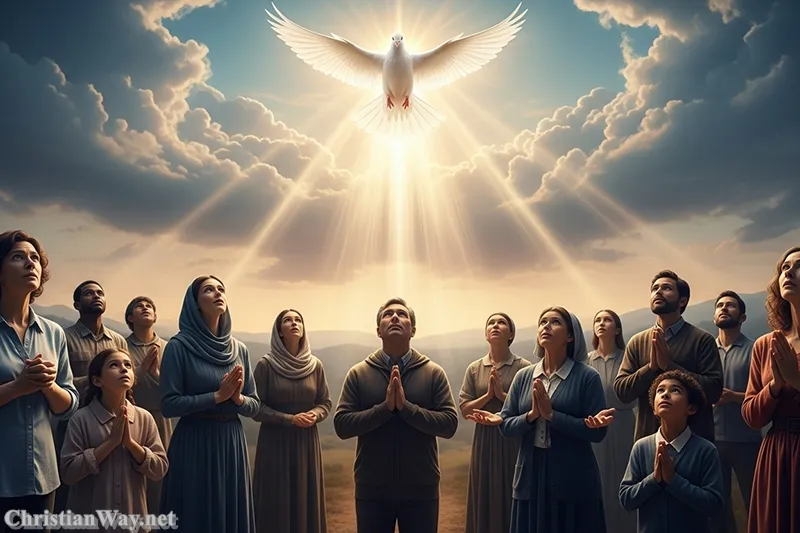
At the Baptism of Jesus, the Son stands in the waters of the Jordan. The Holy Spirit descends like a dove. The Father’s voice is heard: “This is my beloved Son, in whom I am well pleased” (Matthew 3:17).
The Father, Son, and Holy Spirit are revealed together.
At the end of Matthew’s Gospel, the risen Jesus commands His disciples to baptize “in the name of the Father, and of the Son, and of the Holy Ghost” (Matthew 28:19).
Jesus says “in the name,” not “in the names.” The Church hears in this one divine name the unity of the Father, Son, and Holy Spirit.
Saint Paul blesses the Church with words Catholics hear frequently in liturgy: “The grace of the Lord Jesus Christ, and the love of God, and the communion of the Holy Ghost” (2 Corinthians 13:14).
This blessing reveals the shape of Catholic life.
The love of the Father is the source.
The grace of Christ saves.
The communion of the Holy Spirit gathers, strengthens, and sanctifies.
Catholic teaching does not claim that human reason could have discovered the Trinity by studying the world alone. Creation bears traces of God’s wisdom and goodness, but the inner life of God is revealed fully through the Son and the Holy Spirit.
This is important because it keeps Christians humble.
The Trinity is not something we invented.
It is something God has revealed.
We do not stand above this mystery.
We receive it.
The Church’s Careful Language About the Trinity
The early Church had to speak carefully because false explanations of Jesus and the Holy Spirit could distort the Gospel itself.
Some claimed that Jesus was merely a created being, greater than others but not truly God.
Some claimed that the Father, Son, and Holy Spirit were only temporary roles played by one divine Person.
Others denied the true divinity of the Holy Spirit.
The Church responded through prayer, Scripture, theological reflection, and the teaching of councils.
At Nicaea in 325, the Church confessed that the Son is consubstantial with the Father.
At Constantinople in 381, the Church confessed the Holy Spirit as Lord and giver of life, worshipped and glorified with the Father and the Son.
These teachings are preserved in the Nicene Creed, which Catholics continue to profess in the Mass. The Church’s language of substance, nature, Person, relation, generation, and procession was developed not to make faith cold or complicated, but to protect the truth that salvation comes from the one God: Father, Son, and Holy Spirit.
Catholics use the word Person differently from the way people use it in ordinary speech.
In daily life, a person is an individual human being, separate from every other person. When Catholic doctrine speaks of the divine Persons, it does not mean three separate beings.
It means that within the one divine nature, the Father, Son, and Holy Spirit are truly distinct by their eternal relations.
The Father is Father because He eternally begets the Son.
The Son is Son because He is eternally begotten of the Father.
The Holy Spirit is Holy Spirit because He eternally proceeds.
The Persons are distinct, but never divided.
The Father is wholly in the Son and the Holy Spirit.
The Son is wholly in the Father and the Holy Spirit.
The Holy Spirit is wholly in the Father and the Son.
This is not something human language can fully contain. It is a mystery that leads the mind toward worship.
The Filioque and Catholic Teaching on the Holy Spirit
Catholics who pray the Nicene Creed in the Latin tradition say that the Holy Spirit “proceeds from the Father and the Son.” This phrase is often known by its Latin name, Filioque, meaning “and the Son.”
Catholic doctrine teaches that the Father remains the first origin of the divine life. The Son receives all that He has from the Father, except the property of being Father. The Holy Spirit proceeds eternally from the Father and the Son as one principle, not as though there were two separate divine sources.
This teaching has been a point of disagreement between Catholics and Eastern Orthodox Christians, who traditionally confess that the Holy Spirit proceeds from the Father. Catholics should approach this subject with care, truthfulness, and respect.
The Catholic Catechism itself recognizes that the Eastern and Western traditions emphasize different aspects of the same mystery. The East emphasizes the Father as the first origin of the Spirit. The West emphasizes the communion of the Father and the Son, confessing that the Spirit proceeds from the Father and the Son. The Catechism describes these approaches as complementary when they are not made rigid or hostile.
For ordinary Christian life, this doctrine should not become a weapon.
The Holy Spirit is not given to us so that believers may become proud of theological vocabulary. The Spirit is given so that people may know Christ, call God “Father,” live in holiness, forgive, serve, and become instruments of peace.
The Trinity and the Work of Salvation
Catholic doctrine teaches that the three Persons of the Trinity are inseparable in their work.
The Father, Son, and Holy Spirit do not act as three separate divine workers with separate plans. God has one saving will and one divine action.
Yet the Church also speaks of the distinct missions of the Son and the Holy Spirit.
The Father sends the Son into the world.
The Son becomes incarnate, dies, rises, and reconciles humanity with God.
The Father and the Son send the Holy Spirit to sanctify the Church and bring believers into communion with divine life.
The whole work of salvation is therefore Trinitarian.
Creation comes from the loving will of the Father, through the Son, in the Holy Spirit.
Redemption is accomplished through the incarnate Son.
Sanctification is given through the Holy Spirit.
Catholic doctrine teaches that all divine works are common to the three Persons, while each Person is revealed according to His distinct relation in the Trinity.
This may sound theological, but it is deeply personal.
When a person prays to the Father, he is not separated from the Son or the Spirit.
When a person calls upon Jesus, he is not leaving the Father behind.
When a person asks for the Holy Spirit’s help, he is not turning away from Christ.
The one God draws us into His life.
The Father welcomes.
The Son redeems.
The Holy Spirit renews.
The Trinity is not three doors leading to three different places. It is the one God opening His life to humanity through grace.
The Trinity in Baptism
Baptism is one of the clearest places where Catholic doctrine about the Trinity becomes visible.
A person is baptized “in the name of the Father, and of the Son, and of the Holy Spirit.” This is not a decorative formula. It is the beginning of the Christian life.
In Baptism, Catholics believe that a person is freed from sin, incorporated into Christ, received into the Church, and given a share in the divine life. The Catechism teaches that through Baptism in the Trinitarian name, believers are called to share in the life of the Blessed Trinity now in faith and ultimately in eternal glory.
This means that Baptism is not simply a public ceremony.
It is a gift.
It says to the baptized person: you belong to God.
You are not owned by fear.
You are not defined finally by failure.
You are not abandoned in the struggles of life.
You have been marked by the name of the Father, Son, and Holy Spirit.
For parents bringing a child to Baptism, this is a sacred responsibility. They promise to help the child grow in faith, prayer, love, truth, and service. The child is not merely given a religious identity. The child is entrusted to the life of God.
For an adult receiving Baptism, the moment can become a profound turning point. It is the beginning of a new life in Christ, a life that must continue through prayer, conversion, sacramental grace, and love.
The Trinity is not merely believed at Baptism. The Trinity becomes the home toward which the baptized person is drawn.
The Trinity in the Mass and Sacramental Life
The Catholic Mass is deeply Trinitarian.
The priest begins in the name of the Father, and of the Son, and of the Holy Spirit.
The Church gives thanks to the Father.
The Eucharistic Prayer is offered through Christ, with Christ, and in Christ.
The Holy Spirit is invoked over the gifts of bread and wine and over the gathered faithful.
The final doxology gives all glory and honor to the Father, through the Son, in the unity of the Holy Spirit.
This rhythm is not accidental. It expresses the heart of Catholic worship.
The Church does not worship a vague spiritual power. She worships the Father, through the Son, in the Holy Spirit.
The Eucharist is especially a gift of Trinitarian love. The Father gives the Son. The Son gives Himself for the life of the world. The Holy Spirit gathers believers into one body and sanctifies their offering.
In the Eucharist, Catholics are reminded that grace is received, not earned.
The bread and wine are gifts of creation.
The Body and Blood of Christ are gifts of redemption.
The unity of the Church is a gift of the Spirit.
Every sacrament carries this Trinitarian shape.
In Reconciliation, the Father receives the repentant sinner through the mercy of Christ, and the Spirit restores grace to the wounded heart.
In Confirmation, the Spirit strengthens the baptized for witness and service in Christ.
In Matrimony, husband and wife are called to reflect a love that gives itself faithfully and fruitfully.
In Anointing of the Sick, the Church entrusts the suffering person to Christ, asking for healing, strength, peace, and grace.
In Holy Orders, a man is ordained to serve Christ and His Church, not to seek power, but to become a servant of the Gospel and sacraments.
Catholic sacramental life is not a collection of separate religious acts. It is a path by which the Trinity draws human life into grace.
The Trinity and the Church
The Church herself is Trinitarian in her deepest identity.
She is called together by the Father.
She is the Body of Christ.
She is the temple of the Holy Spirit.
The Church is not merely a social organization, a building, or a gathering of people with similar opinions. She is a people brought into communion through the love of God.
The Father calls people from every nation.
The Son gives His life to gather them into one body.
The Holy Spirit gives unity while preserving the diverse gifts of each believer.
This vision challenges every form of pride, prejudice, and division.
A Christian cannot claim to worship the Trinity while treating other people as though they have no dignity.
A parish cannot celebrate the Eucharist faithfully while ignoring the poor, the sick, the lonely, or the wounded.
A Catholic cannot say “Our Father” sincerely while refusing every effort toward forgiveness.
The Trinity teaches that unity does not mean sameness.
The Father, Son, and Holy Spirit are distinct without division.
In a smaller and imperfect human way, the Church is called to honor the different gifts, cultures, vocations, languages, and lives of her members while remaining one in Christ.
The Church needs the quiet person who prays.
The Church needs the teacher who explains the faith.
The Church needs the parent who forms children with patience.
The Church needs the worker who brings honesty into a difficult workplace.
The Church needs the person who visits the sick.
The Church needs the young person who asks honest questions.
The Church needs the elderly believer whose hidden faithfulness has sustained a family for decades.
The Holy Spirit gives gifts not for self-importance, but for the building up of the Body of Christ.
The Trinity and the Christian Life of Love
The Trinity reveals that love is not an optional part of Christian life. Love belongs to the very heart of God.
This does not mean that love is only emotion. Christian love is patient, truthful, forgiving, courageous, and self-giving.
The Father gives the Son.
The Son gives Himself.
The Holy Spirit makes that love present in human hearts.
This Trinitarian love becomes the pattern for Catholic life.
A parent who wakes in the night to care for a child is learning something of self-giving love.
A husband and wife who remain faithful through difficulty are learning something of covenant love.
A person who forgives after being deeply hurt is learning something of merciful love.
A worker who refuses dishonesty, even at personal cost, is learning something of truthful love.
A parishioner who visits someone lonely or sick is learning something of compassionate love.
A young person who refuses cruelty when friends encourage it is learning something of courageous love.
The Trinity does not remove the hard realities of life. It gives a new way to live within them.
The Christian does not love because love is always easy.
The Christian loves because Christ has first loved us.
The Christian does not forgive because the wrong is unimportant.
The Christian forgives because mercy is stronger than resentment.
The Christian does not serve because service always receives praise.
The Christian serves because Christ washed the feet of His disciples.
The life of the Trinity is reflected whenever people choose communion over selfishness, mercy over revenge, truth over deception, and service over pride.
Common Misunderstandings Catholics Should Avoid
The mystery of the Trinity is often misunderstood, even by sincere believers.
One misunderstanding is to think Catholics believe in three gods. Catholic doctrine is clear: there is one God in three Persons.
Another misunderstanding is to think the Father, Son, and Holy Spirit are merely different names for one Person. Catholic doctrine rejects this because the distinctions between Father, Son, and Spirit are real.
Another misunderstanding is to think the Son is less divine than the Father. The Son is eternally begotten, not created. He is fully God.
Another misunderstanding is to think the Holy Spirit is less personal or less divine than the Father and Son. The Spirit is truly God, worshipped and glorified with the Father and the Son.
Another misunderstanding is to imagine that the Trinity is divided in its love or purpose.
The Father does not love while the Son judges.
The Son does not save while the Father remains distant.
The Spirit does not work while the Son becomes absent.
The Trinity is one in being and one in divine action.
Another misunderstanding is to treat the doctrine as though it were only for theologians.
The Trinity belongs to every baptized Catholic.
It is present in every sign of the cross.
It is spoken in every Baptism.
It shapes every Mass.
It is the source of Christian prayer.
It is the promise that God desires to make His dwelling within the human heart.
Living Before the Mystery of the Trinity
There are truths we do not master. We receive them with gratitude.
The Trinity is one of those truths.
A person may study the doctrine carefully, and this is good. The Church has given us beautiful theological language to protect the faith. But even the deepest study should lead to prayer.
When Catholics make the sign of the cross, they can do so slowly and consciously.
“In the name of the Father.”
I belong to the One who created me and knows me.
“And of the Son.”
I belong to Jesus Christ, who gave Himself for me.
“And of the Holy Spirit.”
I belong to the One who strengthens, comforts, and guides me.
This simple prayer can become a way of returning to God in every circumstance.
Before work begins.
Before a difficult conversation.
Before entering a hospital room.
Before sitting down to study.
Before sleep.
Before making a decision.
Before asking forgiveness.
Before beginning again.
The Trinity is not far from ordinary life.
The Father sees the burden you carry.
The Son walks with you in suffering.
The Holy Spirit strengthens you in weakness.
When life feels too heavy, the Christian may pray, “Father, hold me.”
When shame feels overwhelming, the Christian may pray, “Lord Jesus Christ, have mercy on me.”
When courage is needed, the Christian may pray, “Come, Holy Spirit.”
These are not three separate prayers to three separate gods. They are cries of faith to the one God who has revealed Himself as Father, Son, and Holy Spirit.
Reflect and Pray
The Holy Trinity in Catholic doctrine is the mystery of one God in three divine Persons: Father, Son, and Holy Spirit.
The Father is the source of all life and the loving Creator of the world.
The Son is Jesus Christ, the eternal Word made flesh, who reveals the Father and saves humanity through His death and resurrection.
The Holy Spirit is the Lord and giver of life, who sanctifies the Church, strengthens believers, and draws the human heart into communion with God.
The Trinity is not three gods.
It is not one God wearing three masks.
It is the one eternal God, living in perfect communion of love.
This mystery is greater than our understanding, but it is not distant from our lives.
The Father knows us.
The Son redeems us.
The Holy Spirit remains with us.
In joy, may we give thanks to the Father.
In sorrow, may we cling to Christ.
In weakness, may we ask the Holy Spirit for strength.
In every season, may we remember that we are invited into the love of the one God who created us, saved us, and calls us home.
Let us pray:
Most Holy Trinity,
Father, Son, and Holy Spirit,
draw us more deeply into Your life of love.
Teach us to trust the Father
when the path is uncertain,
to follow Jesus Christ
when the road is difficult,
and to welcome the Holy Spirit
when our hearts are weak.
Heal what is divided within us.
Forgive what is wounded by sin.
Make our homes, our work, and our communities
places of mercy, truth, and peace.
May the love of the Father guide us,
the grace of the Son save us,
and the fellowship of the Holy Spirit
remain with us always.
Amen.
— Fr. John Matthew