Dear friends, welcome. It is a profound joy to walk with you today as we reflect on one of the most beautiful attributes of our Creator: His infinite mercy. In a world that often values power, efficiency, and status, the call to compassion acts as a gentle, healing balm for the weary soul. When we speak of mercy, we are not merely speaking of a feeling of pity; we are speaking of a radical, self-giving love that chooses to enter into the chaos of another’s suffering.
The Lord Jesus instructed us in the Gospel of Luke, “Be merciful, just as your Father is merciful.” This is the heartbeat of the Christian life. It is the understanding that we, having received the unmerited grace of God, are compelled to pour that same grace out onto our neighbors—the poor, the sick, the forgotten, and the brokenhearted. History is filled with radiant lights, men and women who took this command not as a burden, but as a pathway to joy. They understood that to touch the wounds of the suffering is to touch the very wounds of Christ.
As we journey through this list of the Top 10 Saints of Mercy and Compassion, I invite you to read slowly. Do not rush. Let the stories of these spiritual giants wash over you. Let them challenge your heart and comfort your spirit. Here at Christian Way, our hope is that you find in these lives not just historical facts, but a mirror reflecting the possibilities of your own holiness. Let us open our hearts to the Holy Spirit and begin this pilgrimage of love together.
Table of The Top 10 Saints of Mercy and Compassion
| Rank | Saint Name | Era | Primary Witness of Mercy |
|---|---|---|---|
| 10 | St. Peter Claver | 17th Century | Compassion for the Enslaved |
| 9 | St. Elizabeth of Hungary | 13th Century | Royal Generosity to the Poor |
| 8 | St. Camillus de Lellis | 16th Century | Service to the Sick and Dying |
| 7 | St. Martin de Porres | 17th Century | Humility and Interracial Charity |
| 6 | St. Damien of Molokai | 19th Century | Solidarity with Lepers |
| 5 | St. Maximilian Kolbe | 20th Century | Sacrificial Love in Darkness |
| 4 | St. Vincent de Paul | 17th Century | Organization of Charity |
| 3 | St. Francis of Assisi | 13th Century | Universal Brotherhood |
| 2 | St. Faustina Kowalska | 20th Century | The Apostle of Divine Mercy |
| 1 | St. Teresa of Calcutta | 20th Century | Mercy to the Poorest of the Poor |
Top 10. St. Peter Claver (1580–1654)
We begin our journey on the docks of Cartagena, Colombia, a port city that witnessed the brutal reality of the slave trade. Here stands Peter Claver, a Jesuit priest who, upon seeing the slave ships arrive, did not turn away in horror or indifference. Instead, he ran toward them. Carrying a basket of fresh fruit, biscuits, and lemons, he boarded the filth-ridden holds of these ships, entering the darkness where frightened souls lay in chains. He did not speak their languages, yet his language was one of universal love—cleaning their wounds, feeding their bodies, and affirming their dignity as children of God.
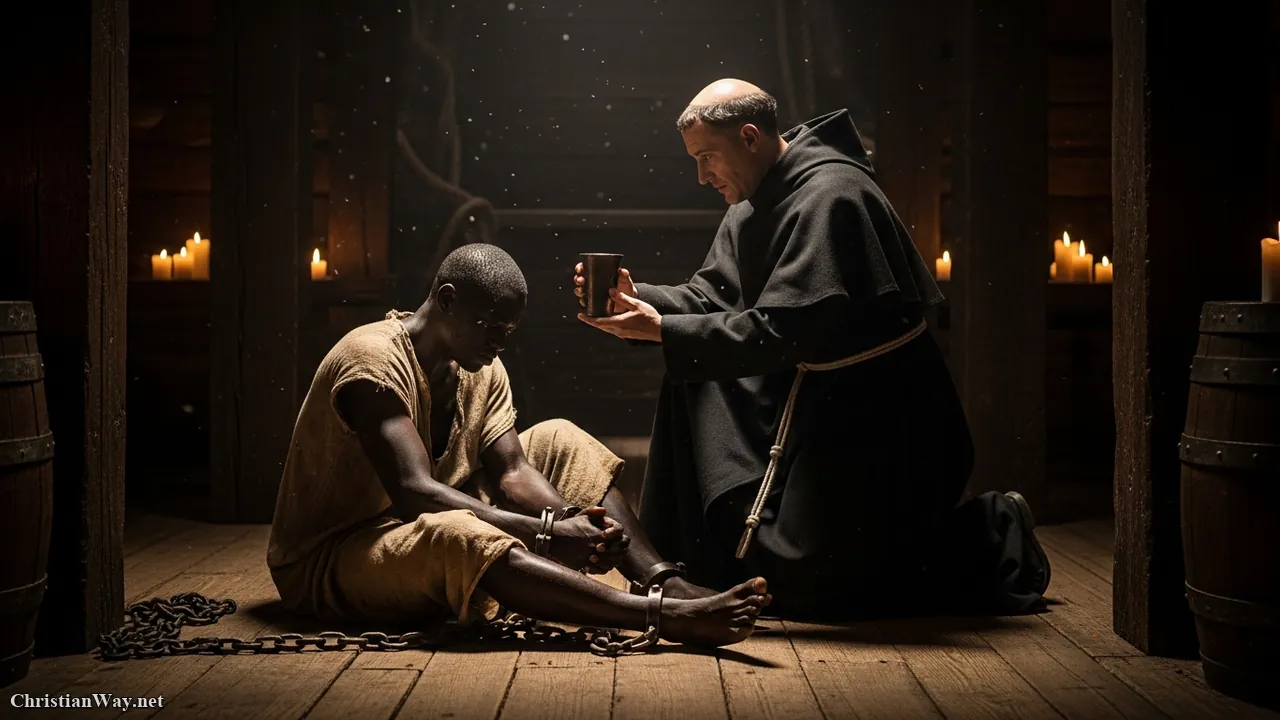
Theologically, St. Peter Claver embodies the Incarnational reality of mercy. Just as Christ emptied Himself to take the form of a servant, Claver declared himself “the slave of the slaves forever.” He recognized that the Gospel could not be preached with words alone to those in such agony; it had to be demonstrated through the washing of feet and the embrace of the outcast. He shows us that mercy is not afraid of the stench of suffering; rather, it seeks to purify it with the fragrance of Christ.
For us today, St. Peter Claver is a challenging reminder that we cannot remain comfortable while others are in chains—whether those are physical chains or the chains of poverty and injustice. He asks us: Who are the “invisible” people in your city, and are you willing to bring them the nourishment of your presence?
Spiritual Highlights:
- Vow of Servitude: He signed his final profession: “Petrus Claver, aethiopum semper servus” (Peter Claver, slave of the Africans forever).
- Scripture: “The Spirit of the Lord is on me, because he has anointed me to proclaim good news to the poor.” (Luke 4:18)
Top 9. St. Elizabeth of Hungary (1207–1231)
Imagine a young princess, adorned in the finery of the court, who finds the trappings of royalty heavy compared to the weight of the cross. St. Elizabeth of Hungary was a woman of immense privilege who understood that her crown was temporary, but the Kingdom of God is eternal. She famously smuggled bread from the castle to feed the starving poor who gathered at the gates. Legend tells us that when confronted by her husband (or in some versions, a skeptic), she opened her cloak to reveal not hidden loaves, but a miraculous bouquet of blooming roses. She built hospitals with her dowry and personally tended to the sick, defying the social norms that separated the nobility from the peasantry.
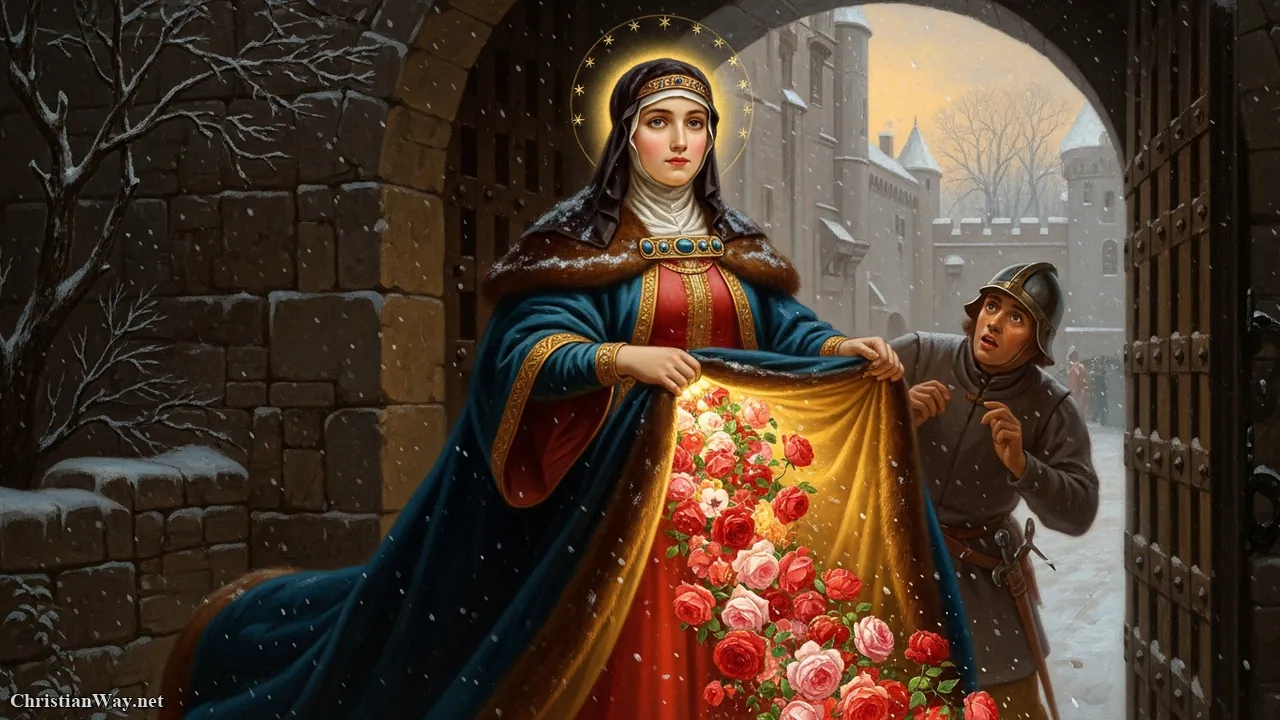
In St. Elizabeth, we see the theology of stewardship. She realized that everything she possessed was not truly hers, but entrusted to her by God for the good of His people. Her life is a testament to the Beatitude, “Blessed are the merciful, for they will receive mercy.” She did not dole out charity from a distance; she bridged the gap between the palace and the hovel, recognizing that in the face of the beggar, she was looking into the eyes of her King.
Her life comforts those of us who feel trapped by our station in life or our material abundance. She teaches us that no matter how much we have, the true treasure is what we give away. She invites us to turn our own resources—our time, our wealth, our talents—into roses of charity for a world hungry for love.
Spiritual Highlights:
- The Miracle of Roses: A sign that God delights in the generosity of His children.
- Scripture: “Give, and it will be given to you… For with the measure you use, it will be measured to you.” (Luke 6:38)
Top 8. St. Camillus de Lellis (1550–1614)
St. Camillus was not always a saint; he was a rough soldier with a gambling addiction and a temper. Yet, through his own physical suffering from an incurable leg wound, the Lord chiseled away his hardness of heart. He founded the Order of Ministers to the Sick (the Camillians), and his approach to healthcare was revolutionary. He insisted that his brothers treat the sick “with the same love that a mother has for her only sick child.” He introduced the red cross on the habit—a symbol of the blood of Christ—centuries before it became a secular symbol of aid.
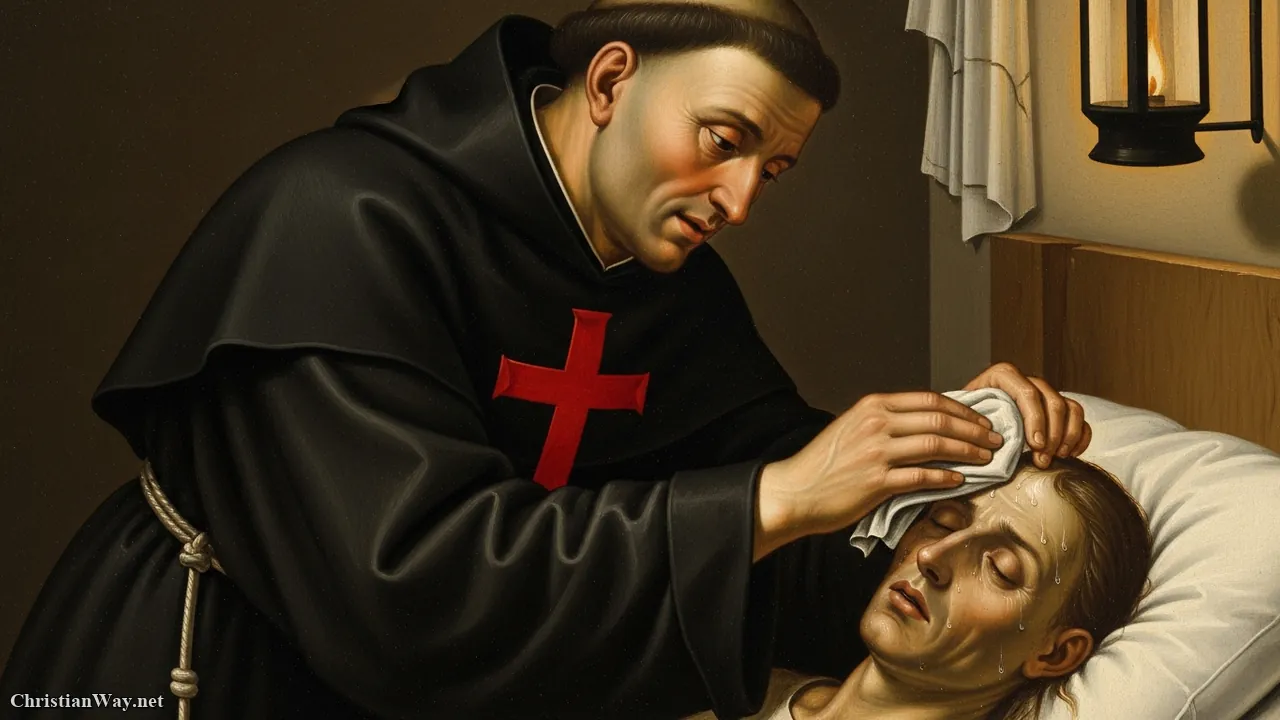
The theology of St. Camillus is rooted in the identification of the suffering body with the Body of Christ. He would often whisper to the sick, “My Lord, my soul,” believing that he was literally ministering to Jesus. This is the “sacrament of the brother” that the Fathers of the Church spoke of. Camillus understood that mercy requires attention to detail—making the bed correctly, speaking softly, and holding a hand during the final agony.
In our modern era of sterile hospitals and rapid medical procedures, St. Camillus calls us back to the humanity of healing. He reminds us that while medicine cures the body, it is compassion that heals the person. He encourages caregivers and medical professionals to see their work not as a career, but as a high liturgy of love.
Spiritual Highlights:
- Innovator of Care: He is considered a pioneer of modern nursing and the ambulance system.
- Scripture: “I was sick and you looked after me.” (Matthew 25:36)
Top 7. St. Martin de Porres (1579–1639)
In the bustling city of Lima, Peru, lived a humble lay brother of the Dominican Order, Martin de Porres. Born of a Spanish nobleman and a freed African slave, Martin faced the stinging rejection of racism and prejudice throughout his life. Yet, his response was not bitterness, but a profound, sweeping humility. He is often depicted holding a broom, for he found sanctity in the lowliest of tasks. Martin turned the friary into a hospital, caring for nobles, slaves, and indigenous people alike, often giving up his own bed to a suffering stranger.

St. Martin teaches us the theology of unity. In a society strictly divided by caste and color, Martin’s mercy knew no boundaries. He even extended his compassion to animals, famously feeding mice rather than killing them, recognizing the breath of the Creator in all living things. His life illustrates that true mercy stems from a heart that is completely emptied of ego. When we are nothing, God is everything, and His love flows through us unimpeded.
For those of us who feel marginalized, misunderstood, or tasked with “unimportant” work, St. Martin is a gentle companion. He shows us that the path to greatness in the Kingdom of Heaven is found in the quiet service of the kitchen, the laundry room, and the sickbed. He turns the broom into a scepter of grace.
Spiritual Highlights:
- Patronage: Patron saint of social justice, race relations, and barbers.
- Scripture: “The greatest among you will be your servant.” (Matthew 23:11)
Top 6. St. Damien of Molokai (1840–1889)
There are few stories in the history of the Church as moving as that of Father Damien. He volunteered to go to the Hawaiian island of Molokai, a quarantine colony for those suffering from Hansen’s disease (leprosy). It was a place of despair, lawlessness, and slow death. Damien did not just bring the Sacraments; he brought civilization and hope. He built houses, organized choirs, and dressed ulcers. For years he spoke to the congregation as “my dear brethren,” until one Sunday, having contracted the disease himself, he opened his homily with the words, “We lepers.”
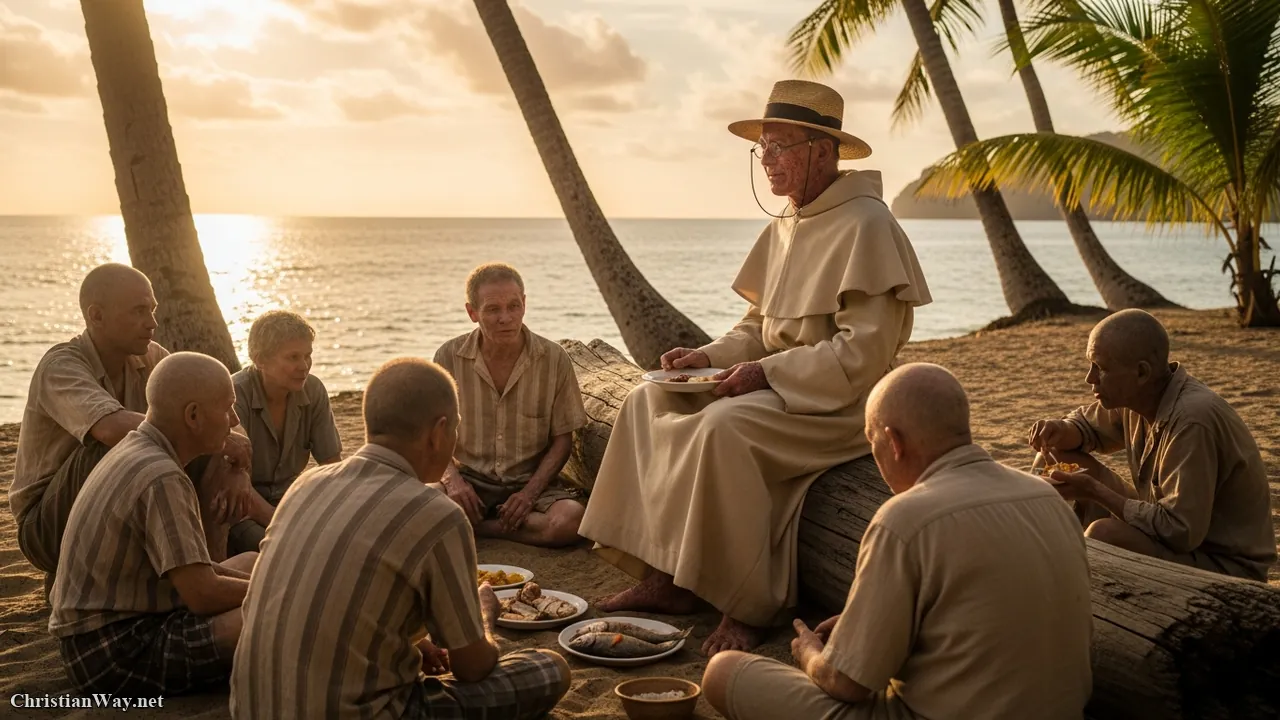
The theological depth here is staggering. This is total identification. Damien did not offer mercy from a pedestal; he descended into the pit to lift others up. He mirrors the Incarnation of Christ, who became sin for us so that we might become the righteousness of God. Damien found the face of Christ in faces that the world turned away from in disgust.
St. Damien challenges our modern aversion to discomfort. He asks us if our mercy is “safe”—donated from a distance—or if we are willing to risk something of ourselves. He teaches us that true compassion destroys the barrier between “us” and “them,” leaving only “us” in the presence of God.
Spiritual Highlights:
- Total Sacrifice: He died of the disease he fought to alleviate, becoming a martyr of charity.
- Scripture: “Greater love has no one than this: to lay down one’s life for one’s friends.” (John 15:13)
Top 5. St. Maximilian Kolbe (1894–1941)
The darkness of Auschwitz seems an unlikely place to find the light of mercy, yet it was there that St. Maximilian Kolbe shone brightest. A Franciscan priest arrested by the Nazis, he was a prisoner who offered hope amidst hell. When a prisoner escaped, the guards selected ten men to die in a starvation bunker as punishment. One man, Franciszek Gajowniczek, cried out for his wife and children. Father Kolbe silently stepped forward, looked the commander in the eye, and offered to take the man’s place. He was thrown into the bunker, where he led the dying men in songs and prayers until the very end.
St. Maximilian represents the theology of vicarious suffering. He literally took the death sentence of another upon himself, an icon of Jesus at Calvary. His mercy was not a soft sentiment; it was a steel determination to love in the face of absolute hatred. He proved that the light of Christ cannot be extinguished, even by the most brutal machinery of death mankind has ever devised.
We may never face a starvation bunker, but we face moments where we must choose between self-preservation and sacrificial love. St. Maximilian calls us to die to our selfishness daily so that others may live. He reminds us that love is the only force capable of conquering evil.
Spiritual Highlights:
- The Outcome: The man he saved survived the war and attended Kolbe’s canonization.
- Scripture: “Do not be overcome by evil, but overcome evil with good.” (Romans 12:21)
Top 4. St. Vincent de Paul (1581–1660)
St. Vincent de Paul is often called the “Apostle of Charity,” and rightly so. Living in France during a time of great disparity between the rich and the poor, Vincent realized that random acts of kindness were not enough; mercy needed to be organized to be effective. He founded the Ladies of Charity and the Congregation of the Mission (Vincentians), creating systemic ways to feed the hungry, clothe the naked, and care for foundlings. He famously told his sisters, “The poor are your masters; you are their servants.”
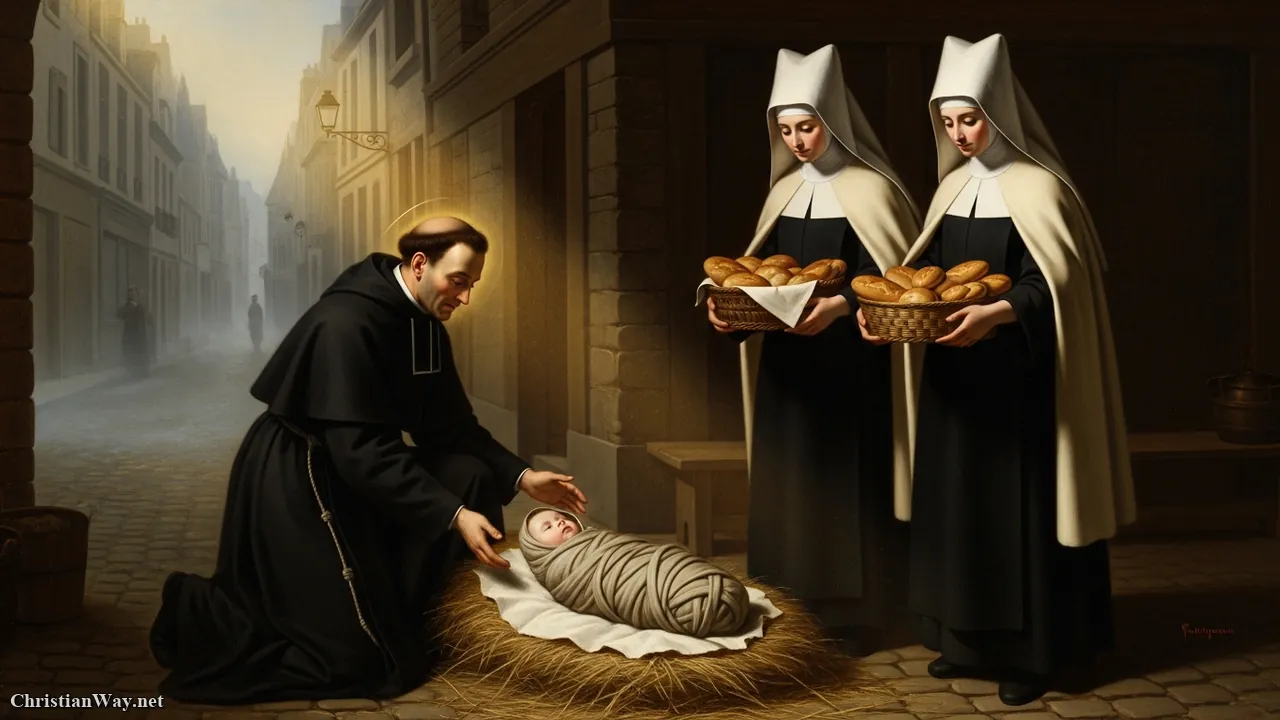
His theology was practical and demanding. He taught that we must see Christ in the poor, but also that we must serve them with humility, gentleness, and respect. He warned that the poor would only forgive us for giving them bread if we gave it with love. Vincent understood that physical poverty is often accompanied by spiritual poverty, and he sought to remedy both through the corporal and spiritual works of mercy.
St. Vincent de Paul guides us in our modern approach to philanthropy and service. He reminds us that efficiency must never replace empathy. He challenges us to look at the systems of our world and ask how we can organize our lives and our communities to better serve the “masters” who are the poor among us.
Spiritual Highlights:
- Legacy: The Society of St. Vincent de Paul continues his work in 150 countries today.
- Scripture: “Whatever you did for one of the least of these brothers and sisters of mine, you did for me.” (Matthew 25:40)
Top 3. St. Francis of Assisi (1181–1226)
The Poverello, the little poor man of Assisi, remains one of the most beloved figures in history. Yet, before he was a saint, he was a young man repulsed by the sight of lepers. His conversion pivoted on a single moment of grace: riding his horse, he encountered a leper on the road. Instead of fleeing, he dismounted and kissed the man’s hand. In that kiss, the bitterness of his life was turned into sweetness. Francis stripped himself of his wealth and prestige to wed “Lady Poverty,” seeing the entire world as a brotherhood reflecting the glory of God.
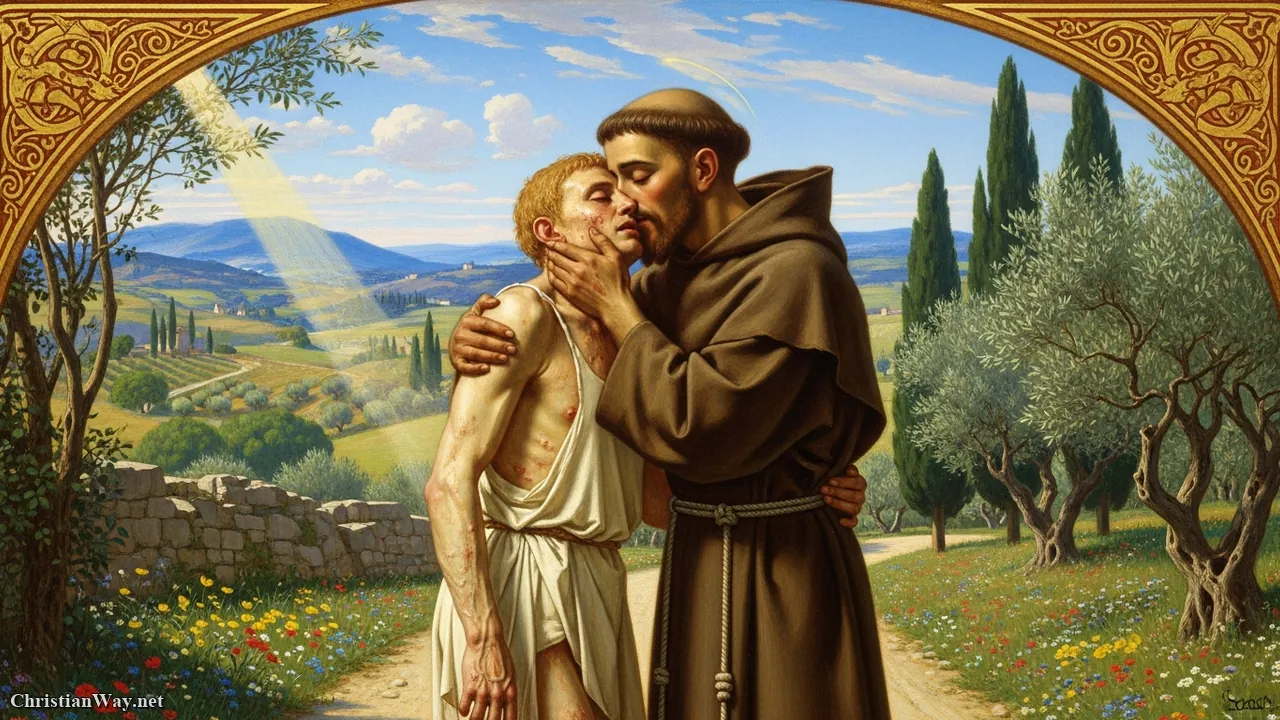
The theology of St. Francis is one of radical kinship. He did not just have mercy on people; he had compassion for the wolf, the bird, the sun, and the moon. He understood that the Incarnation sanctified all of creation. His mercy was a rejection of power and accumulation. He believed that to possess nothing was to possess everything in God.
St. Francis calls to the modern heart that is weary of consumerism and disconnected from nature. He invites us to a “minority”—to be small, to be humble, and to approach every person and every creature with a sense of wonder and fraternity. He teaches us that mercy is the key that unlocks the door to true joy.
Spiritual Highlights:
- Key Event: Receiving the Stigmata, physically bearing the wounds of Christ’s passion.
- Scripture: “Blessed are the poor in spirit, for theirs is the kingdom of heaven.” (Matthew 5:3)
Top 2. St. Faustina Kowalska (1905–1938)
In a quiet convent in Poland between the World Wars, a humble nun received revelations that would spark a global fire. St. Faustina Kowalska was chosen by Christ to be the Secretary of His Mercy. Through her diary, Divine Mercy in My Soul, she recorded Jesus’ urgent message: that His heart is overflowing with mercy for sinners, and He desires them to turn to Him before the day of justice arrives. The image of the Divine Mercy, with rays of red and pale light streaming from Christ’s heart, has become a universal symbol of hope.
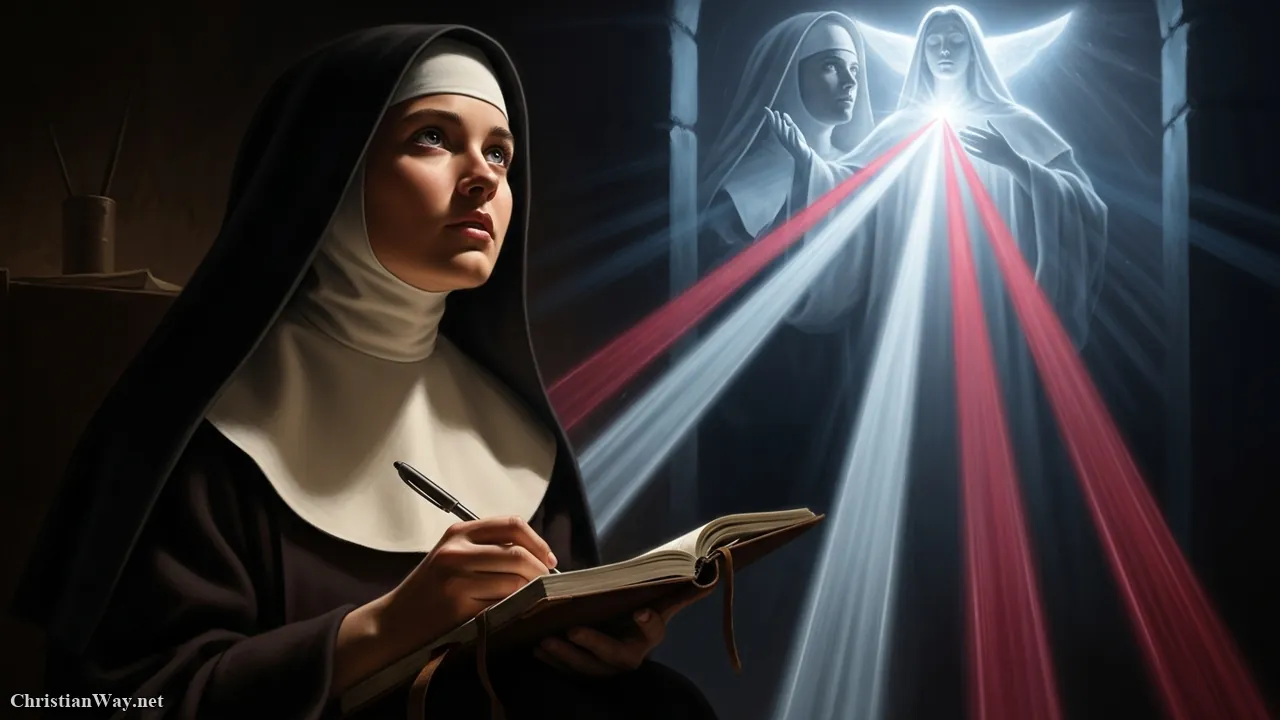
The theology here is pivotal for the modern age. At a time when the world was on the brink of terrible war and dehumanization, God sent a message of His unfathomable love. The core is the “ABC” of Mercy: Ask for His Mercy, Be merciful to others, and Completely trust in Jesus. St. Faustina reminds us that no sin is greater than God’s goodness, provided we approach Him with trust.
St. Faustina serves as a spiritual anchor for those drowning in guilt or despair. She assures us that the door to God’s heart is always open. Her life challenges us to recite the chaplet not just as a ritual, but as a plea for the whole world: “For the sake of His sorrowful passion, have mercy on us and on the whole world.”
Spiritual Highlights:
- The Feast: Her visions led to the establishment of Divine Mercy Sunday.
- Scripture: “Let us then approach God’s throne of grace with confidence, so that we may receive mercy.” (Hebrews 4:16)
Top 1. St. Teresa of Calcutta (1910–1997)
At the summit of our list stands a diminutive woman who cast a giant shadow of love across the 20th century. Mother Teresa, known now as St. Teresa of Calcutta, heard a “call within a call” to leave the safety of her convent teaching post and enter the slums. There, she picked up the dying from the gutters, comforted the abandoned, and held the unwanted infants. She famously said she was not a social worker, but a contemplative in the heart of the world. For her, the starving man was Christ in a “distressing disguise.”
Her theology was centered on the “Thirst” of Jesus. She believed that on the Cross, when Jesus said, “I thirst,” He was thirsting for the love of souls. Her acts of mercy were an attempt to satiate that divine thirst. She did not seek to solve poverty on a political level; she sought to solve the poverty of loneliness and being unloved, one person at a time.
St. Teresa is the ultimate icon of mercy for our times because she acted when others only analyzed. She teaches us that we can do no great things, “only small things with great love.” She challenges us to find our own “Calcutta”—in our own homes, our workplaces, and our neighborhoods—and to bring the light of Christ’s mercy to the dark corners of our daily lives.
Spiritual Highlights:
- Nobel Peace Prize: Accepted in 1979 in the name of the “unwanted, unloved, and uncared for.”
- Scripture: “I thirst.” (John 19:28)
Reflect and Pray
As we conclude this pilgrimage through the lives of these holy men and women, we are left with a stirring question: How will we respond? These saints were not super-humans; they were people of flesh and blood who allowed the Super-natural love of God to consume them. They show us that mercy is not a weakness, but the most powerful force in the universe.
Let us pray that we may have eyes to see the needs around us, hands willing to serve, and hearts that are open to the transforming grace of the Father. May their examples guide us on the Christian Way, leading us ever closer to the Sacred Heart of Jesus, the source of all mercy.
— Fr. John Matthew, for Christian Way