Dear friends in Christ,
There are certain expressions in the life of the Church that can sound distant when we first hear them. They seem to belong to old books, formal ceremonies, or the walls of Rome rather than to the quiet questions of an ordinary believer. “Vicar of Christ” may be one of those expressions. It is a title associated with the Pope, and it can naturally raise questions: Does it mean that the Pope takes the place of Jesus? Does it mean that Christ is somehow far away from His people? Why should the Bishop of Rome be given such a solemn name?
These questions matter because they lead us to the heart of Christian faith: Who is Jesus Christ? What is the Church? How does the risen Lord continue to care for His people? The answer begins not with the importance of any pope, but with the absolute and unchanging lordship of Jesus. He alone is the Savior of the world. He alone is the Head of the Church. He alone is the Good Shepherd who knows His sheep by name and lays down His life for them.
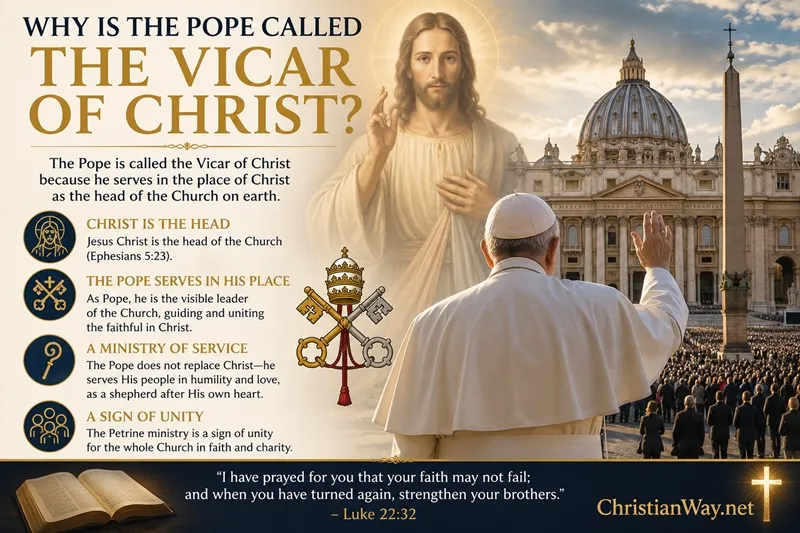
When Catholics call the Pope the Vicar of Christ, they are not saying that Christ has withdrawn from the Church or that a human being replaces Him. They are saying that Christ chooses to care for His people through human servants. The Pope, as Bishop of Rome and successor of Saint Peter, is entrusted with a particular responsibility: to strengthen the faith of his brothers and sisters, safeguard communion, and serve the unity of the Church. Properly understood, this title is not a crown of self-importance. It is a call to humility, fidelity, and love.
To understand it well, then, we must look not first to Rome, but to Galilee. We must look at Peter: a fisherman called by Christ, corrected by Christ, forgiven by Christ, and finally sent by Christ to care for His sheep. In Peter’s story we do not find the triumph of a perfect man. We find the mercy of a perfect Lord. And there, in the light of the Gospel, the meaning of the title begins to unfold.
The Title Begins with Christ, Not the Pope
The most important truth must be said plainly: Jesus Christ has no rival and no replacement. Saint Paul writes that Christ “is the head of the body, the church” (Colossians 1:18). The risen Lord is not merely the founder of Christianity who once walked the roads of Galilee and then left His followers to manage on their own. He is alive. He reigns. He speaks through His Word, nourishes His people in the sacraments, gathers them in prayer, and remains near to every soul that calls upon His name.
This means that every ministry in the Church exists to point beyond itself to Christ. A bishop is not the source of grace; he is a servant called to make Christ’s shepherding care visible in a local Church. A priest does not create forgiveness or invent the Gospel; he receives a ministry in which Christ acts for the good of His people. A parent who teaches a child to pray does not become the author of faith; that parent becomes an instrument through whom the love of God is made known. In every case, the servant is never the Savior.
The word vicar means one who acts on behalf of another. In ordinary life, a representative is not the person he represents. His task is to be faithful to that person’s mission, not to replace him or draw attention away from him. In the Church this meaning becomes even more serious. To be called Christ’s vicar is not to claim Christ’s place. It is to be judged by whether one has remained faithful to Christ’s heart, Christ’s teaching, and Christ’s way of service.
The Catholic understanding of the papacy begins with a confession, not an ambition: Jesus is Lord of the Church. The Pope is called the Vicar of Christ because the Catholic Church believes that the Bishop of Rome has a particular pastoral office under Christ, never above Christ. His role is meant to be a visible service of unity within the visible community of believers. The title has meaning only when it keeps the eyes of the Church fixed on the One whom Peter once confessed: “You are the Messiah, the Son of the living God” (Matthew 16:16).
A Title That Calls for Humility
It is easy to hear a high title and imagine privilege. The Gospel asks us to imagine responsibility. Jesus told His disciples, “Whoever wants to become great among you must be your servant, and whoever wants to be first must be slave of all” (Mark 10:43–44). These are not decorative words placed beside Christian leadership. They are its foundation.
For this reason, the deepest interpretation of “Vicar of Christ” is found in the basin and towel of the Last Supper. There Jesus, the Lord and Teacher, washed the feet of His disciples. He showed that authority in His name is never permission to dominate. It is a call to bend low, bear burdens, defend the vulnerable, speak truth with courage, and accept the cost of loving those entrusted to one’s care.
Every pope stands beneath this judgment of the Gospel. The title does not make him beyond correction, beyond prayer, or beyond the need for conversion. It makes his need for prayer more urgent. The world may see a public figure. Faith sees a baptized man, a bishop, and a servant who will answer to Christ for the way he has used the responsibility placed in his hands.
Peter’s Call to Strengthen His Brothers
The Catholic Church connects the Pope’s ministry to the apostle Peter because of the distinctive role Peter receives in the New Testament. This role is not a reward for Peter’s natural strength. Peter was generous, impulsive, brave in one moment and fearful in another. He walked toward Jesus on the water, then began to sink. He promised faithfulness at the Last Supper, then denied the Lord three times before dawn. He was deeply loved by Christ, but he was never allowed to pretend that he did not need mercy.
In the Gospel of Matthew, after Peter’s confession of faith, Jesus says, “You are Peter, and on this rock I will build my church, and the gates of Hades will not prevail against it. I will give you the keys of the kingdom of heaven” (Matthew 16:18–19). Catholics hear in these words a particular commission given to Peter for the good of the whole Church. The image of the rock speaks of stability in faith; the keys speak of a responsibility to guard, open, and serve the household of God. Yet Peter’s ministry cannot be separated from Peter’s confession. The strength of the rock is not Peter’s personality. It is the truth he has received from the Father: Jesus is the Christ.
The Gospel of Luke adds another tender dimension. Jesus tells Peter, “Simon, Simon, listen! Satan has obtained permission to sift all of you like wheat, but I have prayed for you that your own faith may not fail; and you, when once you have turned back, strengthen your brothers” (Luke 22:31–32). Notice the mercy in these words. Jesus knows that Peter will fall. He does not deny the gravity of failure. But He also speaks of Peter’s return. The one who will strengthen others is first the one who has been strengthened by forgiveness.
After the Resurrection, on the shore of the Sea of Galilee, the Lord asks Peter three times, “Do you love me?” Three times Peter answers, and three times Jesus entrusts to him the care of the flock: “Feed my lambs… Tend my sheep… Feed my sheep” (John 21:15–17). This scene transforms Peter’s threefold denial into a threefold confession of love. It teaches us that pastoral leadership is not first about administration or command. It is about loving Christ enough to care for those whom Christ loves.
Catholics call the Pope the Vicar of Christ because they see the Bishop of Rome as Peter’s successor in this particular mission: strengthening the brethren, helping to guard the apostolic faith, and serving the communion of the Churches. The office is not a private possession. It is a task received for the flock. The Pope belongs to Christ before he belongs to public expectation, and he belongs to the Church before he belongs to any political or cultural story.
The Rock Is Not a Monument to One Man
We should never speak about Peter in a way that makes us forget the other apostles. Christ did not build His Church upon an isolated hero. He called twelve. He sent them together. He gave the apostolic body the mission to proclaim the Gospel, baptize the nations, break the bread, forgive sins, and shepherd the people of God.
This matters because the Pope’s ministry is never meant to erase the ministry of bishops, priests, religious, or lay faithful. The Church is healthiest when each member receives and offers the gifts God has given: bishops teaching and shepherding, priests serving the sacraments, religious witnessing to the Kingdom, families living the Gospel in the ordinary holiness of home, and lay men and women carrying Christ into workplaces, neighborhoods, schools, and places of suffering.
The Pope’s distinctive role is best understood as a ministry of communion. The rock is not a monument erected to honor one man; it is a sign that Christ desires His people to remain one. The keys are not a weapon for excluding the wounded; they are a trust for opening the door of the Gospel. The command to feed the sheep is not a command to possess them. They remain Christ’s sheep, purchased by His love and known by name.
A Visible Ministry for a Visible Communion
Some people speak of faith as though it were only private: a secret relationship between the individual soul and God. Faith is personal; no one can repent or believe in our place. Yet the Gospel also makes clear that faith gathers people. Jesus forms a community. He teaches disciples to pray, “Our Father.” He gives them a shared table. He sends them out together. He prays that they may be one “so that the world may believe” (John 17:21).
The Church is therefore both spiritual and visible. She is spiritual because her deepest life comes from the Holy Spirit. She is visible because human beings need real communion: shared worship, recognizable teaching, pastoral care, sacramental life, and a bond of love that can endure across languages, nations, and generations. The Pope’s role, in Catholic understanding, belongs to this visible dimension of communion. He is called to be a visible servant of the Church’s unity, helping the faithful remain joined to the apostolic faith and to one another.
This does not mean that all Christians must look alike. The Church breathes through many languages, rites, cultures, devotions, forms of music, and spiritual traditions. A Christian in a small rural parish may pray in a different manner from a Christian in a great city. Eastern Catholic Churches preserve ancient liturgical traditions. Religious orders offer distinct charisms. Families live the Gospel amid different circumstances and burdens. Unity is not sameness. It is a deeper grace: a shared faith in Christ, a shared baptism, a shared hope, and a shared call to love.
The Pope’s ministry, at its best, protects that unity without crushing legitimate diversity. It calls the Church back to the Gospel when she becomes captive to ideology. It reminds prosperous communities not to forget the poor. It reminds local communities that they belong to something larger than themselves. It asks believers in every generation to receive the faith rather than remake it according to passing fashion. Such a ministry is difficult, because the Church lives within history and carries both divine promise and human weakness. That is exactly why Christians should answer it with prayer rather than cynicism.
The Second Vatican Council speaks of the Pope as a visible principle and foundation of unity for bishops and faithful. This does not make the Pope the source of salvation; Christ alone is that source. It speaks instead of a visible bond within the Church’s earthly pilgrimage. Just as a family needs more than affection in the abstract and must learn concrete habits of reconciliation and fidelity, the worldwide Church needs a ministry that continually summons her members toward communion.
Unity Is a Gift Before It Is a Structure
No office can manufacture the unity Jesus desires. Rules can set boundaries, but they cannot create charity. Administration can serve the Church, but it cannot heal a divided heart. The unity of the Church is first a gift of the Holy Spirit, poured out by the risen Christ. When Christians forgive one another, worship together, bear one another’s burdens, and confess the same Lord, the Spirit is already at work.
The Pope’s ministry therefore has meaning only within a larger work of grace. He may call the Church to unity, but every Christian must answer that call in ordinary life. A husband and wife who choose patience during a difficult season serve the unity of the Church. A parishioner who refuses gossip and instead prays for someone who has caused pain serves the unity of the Church. A young person who remains faithful when faith is mocked serves the unity of the Church. A Christian who treats another baptized believer with respect, even amid real disagreement, serves the unity for which Christ prayed.
Vicar Does Not Mean Substitute for the Savior
At the center of Christian faith stands a truth that must never be blurred: no one can take the place of Jesus Christ. No bishop, priest, preacher, saint, theologian, or pope can reconcile the world to God by his own power. No human leader can give eternal life. Christ alone is the Lamb of God who takes away the sin of the world. Christ alone is the eternal High Priest. Christ alone is the one Mediator who has opened the way to the Father.
The phrase “Vicar of Christ” must therefore be heard with reverence and care. It does not mean that the Pope is an alternative Christ or a replacement for the living Lord. It means that, in the Catholic understanding of the Church, he has a pastoral responsibility to act in Christ’s name and according to Christ’s mission for the good of the whole flock. His authority is real, but it is not independent. It is received. His teaching office is serious, but it is not free to invent a new Gospel. His governance has a purpose, but that purpose is the building up of God’s people, not the enlargement of personal power.
The Church teaches that her teaching office is not above the Word of God but its servant. This guards the faithful against a distorted view of the papacy. The Pope cannot make falsehood true, make sin holy, or rewrite the heart of the Gospel. He is bound to the faith handed down by the apostles. He must listen before he speaks, receive before he teaches, and kneel before he leads.
Nor does the title mean that Catholics are asked to place their conscience outside the presence of God or to treat the Pope as though he were incapable of human weakness. Church history contains saints and sinners, wise leaders and deeply flawed ones. Catholics do not believe that every private word, decision, interview, preference, or action of a pope carries the same weight. Christian faith is not faith in a personality. It is faith in Jesus Christ, who remains faithful even when His servants fall short.
The Good Shepherd Remains the True Shepherd
The most consoling image is the one Jesus gives us Himself: “I am the good shepherd. The good shepherd lays down his life for the sheep” (John 10:11). Every other shepherd in the Church, including the Pope, is accountable to this Good Shepherd. Every other voice must remain under His voice. Every act of authority must reflect His mercy and His truth.
This should bring peace to the heart. The Church does not rest upon the perfection of her human leaders. If she did, she would have fallen apart in the first generation. She rests upon the promise of Christ. Peter himself was weak, but Christ prayed for him. The apostles misunderstood, argued, and fled; still the risen Lord met them, forgave them, breathed the Holy Spirit upon them, and sent them into the world. The Church remains Christ’s Church because Christ remains faithful.
When Church leaders fail us, we do not have to pretend that the wound is small. We bring the pain to Christ. We pray for purification. We ask for wisdom. We seek the help of faithful Christians around us. Above all, we remember that the promise of the Lord is stronger than our disappointment. Christ has not surrendered His Church to sin, scandal, fashion, or fear. He continues to call His people to repentance and holiness.
The Pope and the Bishops: Communion, Not Isolation
The title Vicar of Christ can be misunderstood if we imagine the Pope as the only person through whom Christ cares for the Church. The Catholic vision is richer and more communal than that. Every bishop, as a successor of the apostles in his own local Church, is called to teach, sanctify, and shepherd in the name of Christ. Every bishop is responsible before the Lord for the people entrusted to him. The Pope does not cancel this responsibility; he serves the communion in which it is exercised.
This is why the Church speaks of the bishops as a college, united with the successor of Peter as its head. The image is not a solitary ruler surrounded by passive assistants. It is the image of brothers in apostolic ministry, each caring for a real community of believers and all remaining united in the one faith of the Church. The Pope has a distinctive ministry of unity, but he exercises it within the life of episcopal communion and for the good of the whole people of God.
For the ordinary believer, this means that love for the Pope should never become neglect of the local Church. Faith is lived in parishes, families, schools, hospitals, villages, cities, and communities where people know one another’s names. We receive the sacraments through local ministers. We learn to forgive through real encounters. We care for the poor who live near us. We learn the Gospel not only through great events in Rome, but through the quiet faithfulness of the people beside us in the pew.
The Church is most radiant when every vocation is honored: the grandmother who prays for her grandchildren, the catechist who patiently answers questions, the monk who keeps vigil at night, the nurse who sees Christ in the sick, the young adult who chooses honesty when no one is watching. The Pope is not the whole Church. Bishops, priests, religious, and lay faithful together form the Body of Christ. The Vicar of Christ exists to serve this Body by helping it remain faithful to its one Lord.
A Question That Touches Christian Unity
The title “Vicar of Christ” also touches one of the deepest wounds in Christian history: the divisions among those who confess Jesus as Lord. Catholics, Eastern Orthodox Christians, Anglicans, and Protestants share much more than the world sometimes sees. We share the Scriptures, the name of Jesus, the confession of the Triune God, baptism, prayer, the call to holiness, and the hope of resurrection. At the same time, Christians do not all understand the role of the Bishop of Rome in the same way.
For Catholics, the Pope’s ministry is a gift Christ has given to serve the visible unity of the Church. Other Christians may receive the history and biblical passages connected with Peter differently, and the precise nature of papal primacy remains a serious point of disagreement. This should be acknowledged honestly. Yet honesty must never become hostility. We do not honor Christ by misrepresenting our brothers and sisters, by speaking with contempt, or by treating theological differences as an excuse to forget the love we owe one another.
The prayer of Jesus remains before us: “That they may all be one” (John 17:21). This does not ask Christians to ignore truth or pretend that divisions do not matter. It invites us to seek unity through conversion, patience, repentance, theological clarity, and mutual charity. The work of unity begins in the heart. It begins when Catholics speak about the papacy without pride, and when all Christians speak about one another with the reverence due to people baptized into Christ.
The Catholic understanding of the Pope as Vicar of Christ should therefore produce humility, not triumphalism. If the Pope is called to serve unity, every Catholic should ask: Am I serving unity in my own words? Do I use the faith to make myself feel superior? Do I treat other Christians with suspicion before I have listened? Do I pray for reconciliation, or do I merely complain about division? The title becomes fruitful only when it turns us back toward the mind of Christ.
What This Title Can Teach Every Christian
The papacy may seem far from the ordinary rhythms of our lives, but the spiritual lesson of this title is close to every heart. Each of us, in some small way, represents Christ to others. A child learns something about God from the patience or impatience of a parent. A friend in grief may encounter Christ through a quiet presence that refuses to leave. A coworker may glimpse the Gospel through an act of honesty that costs us something. A stranger may be protected from despair by a word of kindness offered at the right moment.
None of us is Christ. Yet all of us are called to belong to Him so deeply that His love can pass through our lives. That is the Christian vocation. We are not called to draw attention to ourselves, but to become transparent to the grace of God. Saint Paul expresses this mystery when he says, “It is no longer I who live, but it is Christ who lives in me” (Galatians 2:20). The life of faith is a gradual surrender in which our fears, ambitions, wounds, and gifts are placed into the hands of Christ.
The title Vicar of Christ reminds us that spiritual authority must always be relational. The Pope is called to care for a worldwide family of faith. Parents are called to care for the souls entrusted to them. Teachers are called to shape minds without humiliating hearts. Employers and public leaders are called to exercise responsibility with justice. Older siblings, mentors, and friends often carry a quiet influence they do not fully recognize. In every sphere, Christian influence becomes holy only when it reflects the servant-love of Jesus.
There is also a lesson about fidelity. In an age that often celebrates reinvention, Christianity teaches us to receive what has been handed down. We are not owners of the Gospel. We are its servants. We do not create the truth of Christ; we are created anew by it. The Pope’s task of guarding the deposit of faith can remind every Christian to ask whether we are allowing the Gospel to correct us, or only choosing the parts that flatter us.
So perhaps the question, “Why is the Pope called the Vicar of Christ?” leads gently into another question: Whose presence do we make visible in the world? Do our words represent the patience of Jesus? Does our use of authority resemble His service? Does our desire for unity include the humility to confess our own faults? The Church becomes a more credible witness whenever these questions are answered with sincerity.
Reflect and Pray
Dear friends, the Pope is called the Vicar of Christ not because Jesus is absent, but because Jesus, who remains forever the Good Shepherd, chooses to care for His people through servants. In Catholic faith, the successor of Peter is entrusted with a particular ministry of strengthening the brethren, guarding communion, and serving the Church’s unity. Yet the title reaches its deepest meaning only when it is read through the humility of Peter, the mercy of the Resurrection, and the self-giving love of the Cross.
Let us never confuse any human office with the Lord Himself. Christ alone is our Savior. Christ alone is the Head of the Church. And yet, in His tenderness, He continues to give the Church shepherds, teachers, witnesses, and servants who can help lead us back to Him. May we pray for the Pope, for all bishops and priests, for every Christian community, and for the healing of the divisions that still wound the Body of Christ.
Lord Jesus Christ, Good Shepherd of Your people, keep Your Church faithful to Your truth and gentle in Your love. Strengthen the Pope in the service entrusted to him; give wisdom and courage to all pastors; heal the divisions among Christians; and make each of us a humble witness of Your mercy. May Your peace dwell richly in our hearts, and may Your love guide every step we take toward You.
— Fr. John Matthew