Dear friends in Christ,
There are some lives that seem to gather within themselves the questions of an entire age. The life of Saint Teresa Benedicta of the Cross—known before her entrance into Carmel as Edith Stein—is one of those lives. In her we meet a brilliant Jewish woman, a philosopher of rare discipline, a teacher, a daughter, a seeker, a Christian, a Carmelite nun, and finally a victim of the terrible hatred that darkened Europe in the Shoah. To look upon her life honestly is to stand before both beauty and sorrow: the beauty of a heart that would not cease looking for truth, and the sorrow of a world capable of denying the dignity of those whom God created and loves.
Many people carry questions like Edith’s quietly. They may have grown tired of shallow answers. They may have known faith in childhood yet later found themselves unable to pray. They may love their family deeply while following a path their family does not understand. They may long for God but fear that the intellect, with all its questions, is an enemy of faith. Edith Stein speaks gently into each of these places. She does not tell us to stop thinking. She shows us that thought itself can become a humble pilgrimage when it is joined to courage, reverence, and a willingness to be led beyond oneself.

Her story also asks Christians to remember with great seriousness the Jewish people and the incomparable wound of the Holocaust. Edith did not stop being a daughter of Israel when she became a Catholic Christian. Her life cannot be used to erase or diminish her Jewish roots, nor may her murder ever be treated as a merely symbolic event. She was deported and killed within a campaign of racial hatred that sought to exterminate the Jewish people. Her witness calls us not only to devotion, but to repentance, vigilance, and a deeper love for every person whose dignity is threatened.
As we walk with Saint Teresa Benedicta of the Cross, we do not walk through a story of easy certainty. We walk from questions toward faith, from reason toward adoration, from the cross of human suffering toward the crucified and risen Christ. And perhaps, by grace, we will discover that truth is not a cold possession of the mind, but a light that becomes love in the heart.
A Daughter of Israel Who Never Stopped Seeking
Edith Stein was born in Breslau on 12 October 1891, the youngest child of a Jewish family, on the day of Yom Kippur. Her mother was a woman of deep faith and formidable strength. Yet Edith, while still young, consciously ceased to pray and later gave herself with great seriousness to study. She did not become indifferent because she lacked intelligence or passion. Rather, she wanted what many earnest souls desire: something real, something that could bear the weight of a life. Her search led her into philosophy, particularly the study of the human person, consciousness, and empathy. She studied under Edmund Husserl, became a gifted scholar, and wrote with precision about how one person can, in some measure, enter into the lived experience of another.
This beginning matters. Faith does not ask us to despise the mind God has given us. The Lord who says, “Thou shalt love the Lord thy God with all thy heart,” also says that we are to love Him “with all thy mind” (Matthew 22:37). The Christian life is not an escape from reality into vague religious feeling. It is an opening of the whole person—mind, will, memory, body, and heart—to the God who is more real than all we can measure. Edith’s intellectual hunger was not a detour outside the reach of grace. It became, in God’s providence, one of the roads by which grace found her.
Truth Is More Than Information
We live in an age surrounded by information and yet often starved of wisdom. A person can read endless articles, hear endless opinions, and still feel more uncertain than before. We can confuse being informed with being formed. We can mistake loudness for truth, popularity for goodness, and personal preference for freedom. Edith Stein’s life gently challenges these habits. She was not searching merely for facts that would decorate her mind. She wanted to know what is true about the human person, what is true about suffering, what is true about love, and whether there is a truth that can hold us when everything familiar begins to shake.
Christ does not offer Himself as one idea among many. He says, “I am the way, the truth, and the life” (John 14:6). These words do not mean that Christians are invited to become proud or harsh. They mean that truth has a face. Truth is not finally an argument we win; it is the living Lord who calls us into communion with Him. To meet Jesus is not to abandon reason but to find reason lifted into a greater horizon, where the mind learns that it was created for more than self-sufficiency.
Edith’s path reminds us that the question “What is truth?” cannot remain abstract forever. Pilate asked it while Truth stood before him. Each of us must ask whether we are willing to let truth address us, correct us, and call us into a way of life we did not choose for ourselves. The heart that asks honestly may tremble, but it is already standing near a door of grace.
The Long Road From Questions to Christ
The turning of Edith Stein’s life did not come through a simple emotional impulse. It unfolded over years of study, friendship, sorrow, and encounter. She saw Christians whose faith was not a private ornament but a source of real strength. She was especially moved by the peace and faith of a woman who faced the death of her husband with a courage Edith could not explain apart from Christ. Later, while staying in the home of a friend, she read the autobiography of Saint Teresa of Ávila. When she finished it, she is remembered as saying, “This is the truth.” The book did not hand her a theory. It introduced her, through the witness of another soul, to the God who had been seeking her long before she knew how to seek Him.
This is often the way grace works. It does not always descend upon us with thunder. Sometimes it comes through a faithful friend, a hospital room, a page read late at night, a moment of suffering endured with peace, or a quiet recognition that another person has found the home for which our own heart has been searching. Saint Augustine wrote, “Thou hast made us for thyself, and our heart is restless until it rests in thee.” Edith’s restlessness was not wasted. Under the patient hand of God, it became a prayer she did not yet know she was praying.
Her baptism into the Catholic Church in 1922 was not an abandonment of seriousness but a surrender to the One who had become unmistakably real to her. The Church later described her as a young woman who sought truth and was, at last, “seized by it.” In Christ, she recognized not a philosophical conclusion, but the Word made flesh, the One in whom truth and love are never divided.
The Witness That Opens a Door
There is a lesson here for every Christian who wonders whether a faithful life can make any difference. We do not convert another person by pressure. We cannot argue a soul into the Kingdom of God. But we can become, by grace, a sign that Christ is alive. The patience we show in grief, the humility with which we admit our faults, the mercy we extend when no one expects it, the steadiness of prayer in a difficult season—these things may become doors through which another person begins to glimpse the reality of God.
This is not a call to perform holiness. It is a call to receive it. The world notices when a person is not ruled by bitterness. It notices when strength is gentle, when conviction is humble, and when love does not disappear at the first cost. Edith was moved not by coercion but by lives that bore the fragrance of Christ. In the same way, our homes, parishes, workplaces, and friendships can become places where those who have stopped praying may dare to ask again whether God is near.
“Let your light so shine before men,” Jesus says, “that they may see your good works, and glorify your Father which is in heaven” (Matthew 5:16). The light is not ours. We are simply asked not to hide it.
Baptism, Courage, and the Wound of Family Love
Conversion is sometimes described too neatly, as though the moment a person finds Christ every relationship becomes easy and every sorrow vanishes. Edith Stein knew otherwise. Her decision to become Catholic caused great pain in her relationship with her beloved mother. The pain was real because the love was real. She did not treat her family’s Jewish faith with contempt, and she did not cease to honor the people from whom she came. Yet she also could not deny the call she had received. She learned that obedience to God may at times place a cross within the very relationships we cherish most.
How many readers know something of this grief? Perhaps you love someone who does not understand your faith. Perhaps a spouse, parent, child, or friend thinks your prayer life has made you distant. Perhaps you carry the quiet ache of being misunderstood, not because you have wished to judge anyone, but because your heart has been claimed by Christ. Edith teaches us to carry this sorrow without anger. Faithfulness does not mean winning every argument. It means loving without manipulation, remaining patient, and trusting that the Lord sees all that we cannot repair.
Grace Does Not Erase the Past
When someone comes to Christ, grace does not destroy the true goods of their history. It heals, purifies, and brings them into a deeper fulfillment. Edith’s Christian faith did not cancel her identity as a daughter of Israel. Rather, she came to understand her Jewish heritage with an even more profound seriousness, recognizing the faithfulness of the God of Abraham, Isaac, and Jacob. The Church itself teaches that God’s gifts and calling are irrevocable, echoing Saint Paul’s words: “For the gifts and calling of God are without repentance” (Romans 11:29).
This is an especially important truth for Christians to hold with humility. The Jewish people must never be treated as a mere background to Christian history, nor may the horrors inflicted upon them be minimized, spiritualized, or forgotten. Edith Stein’s life stands at the meeting place of Jewish suffering and Christian confession. It calls us to reject antisemitism in every form, to repent of contempt wherever it has appeared among Christians, and to pray for a relationship between Jews and Christians marked by truth, reverence, and peace. The Church has explicitly honored Edith as a bridge of mutual understanding, while remembering that she was murdered because she was Jewish.
To honor her rightly is to hold both truths together: she was a Catholic Carmelite who loved Christ, and she was a Jewish woman who shared the fate imposed upon her people by Nazi hatred. The mystery of her life does not permit us to flatten either truth. It asks us to become more reverent before the suffering of others and more faithful in defending the dignity God has given every human being.
Carmel and the School of the Cross
For many years, Edith felt drawn to Carmel, the spiritual home of Saint Teresa of Ávila and Saint Thérèse of Lisieux. In 1933 she entered the Discalced Carmelite monastery at Cologne and received the name Teresa Benedicta of the Cross. Her new name was not poetic decoration. It became the shape of her vocation. In Carmel, she entered a life of prayer, silence, community, work, study, and hidden surrender. She did not flee the world because she despised it. She entered the cloister in order to give herself more completely to God for the life of the world.
There is something deeply needed in this witness. Our culture often imagines that what is hidden is unimportant. We measure value by visibility, audience, achievement, and public recognition. Carmel quietly contradicts this. A life of prayer may be unseen by nearly everyone and yet be full of spiritual fruit. A mother praying beside a sick child, an elderly believer offering loneliness to God, a worker whispering a prayer before a difficult meeting, a monk or nun keeping watch in the night—none of these acts may make news, but none is lost to the heart of God.
Edith continued to write and think. Her final great work, often called The Science of the Cross, reflected on the teaching of Saint John of the Cross and the meaning of suffering united to Christ. Yet the title can easily be misunderstood. The “science” of the cross is not a technique for making pain acceptable. It is not a demand that wounded people pretend their wounds do not hurt. It is the knowledge born when love remains faithful in suffering and discovers that Christ has entered the deepest darkness before us.
The Science of the Cross
Saint Paul writes, “For the preaching of the cross is to them that perish foolishness; but unto us which are saved it is the power of God” (1 Corinthians 1:18). The cross is not beautiful because suffering is beautiful. Suffering can be cruel, senseless, and devastating. The cross is holy because Jesus, the sinless Son of God, entered human suffering out of love and transformed it from within. He did not look at the wounded from a distance. He carried our griefs, bore rejection, endured violence, and opened even death to resurrection.
Teresa Benedicta learned this slowly. She did not romanticize hardship. Her faith gave her no illusion that the world was safe. But she came to see that the one who clings to Christ is never abandoned within suffering. “My God, my God, why hast thou forsaken me?” was prayed by Jesus from the cross (Matthew 27:46). Because He has prayed that prayer, even our most desolate cry can become prayer. Because He rose, no darkness has the final word.
This matters for those who are weary. Some carry crosses that cannot be explained away: illness, bereavement, injustice, betrayal, poverty, mental exhaustion, fear for a child, regret over the past. Saint Teresa Benedicta does not offer a quick answer. She points instead to the crucified Christ, who does not trivialize pain but stays with us inside it. To unite suffering to Christ is not to say, “This is good.” It is to say, “Lord, this is mine, and I place it in Your wounded hands. Do not let it be wasted.”
A Martyr in the Shadow of the Shoah
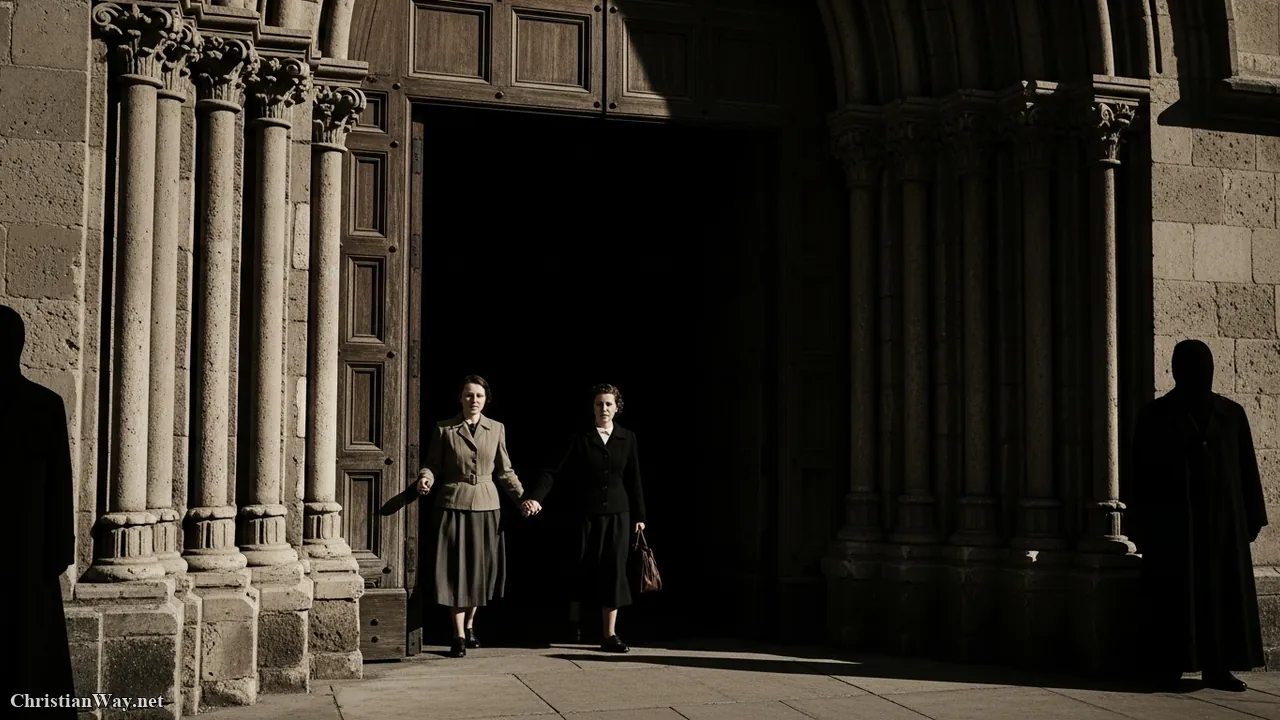
The final years of Edith’s earthly life unfolded under the terror of Nazi persecution. Because of her Jewish background, she was increasingly endangered even within religious life. She was moved from Cologne to the Carmelite monastery at Echt in the Netherlands in the hope that she might be safer there. But safety did not last. In August 1942, she and her sister Rosa, who had also become Catholic, were arrested with other Catholics of Jewish descent. They were deported to Auschwitz, where Edith Stein was killed. The Church venerates her as a martyr, while also remembering with grief the historical fact that the Nazi regime targeted her as a Jew in its genocidal campaign against the Jewish people.
We must speak about this with truthfulness. Auschwitz was not a place where suffering became harmless because a saint was present. It was a place of industrialized murder, a sign of how far human beings can fall when ideology denies the image of God in another person. No Christian devotion must soften that horror or make it into a comfortable religious story. We remember Edith beside the countless Jewish men, women, and children who were robbed of their names, homes, families, and lives. Her holiness does not remove her from them; it draws us into deeper mourning and deeper moral responsibility.
The Gospel calls us to remember the persecuted, to protect the vulnerable, and to resist every system that makes some lives seem less worthy than others. Jesus says, “Inasmuch as ye have done it unto one of the least of these my brethren, ye have done it unto me” (Matthew 25:40). When a people are demeaned because of race, ancestry, religion, or weakness, Christ Himself is insulted in His members. Saint Teresa Benedicta’s death is therefore not only a memory of the past. It is a warning for every generation.
Remembering the Jewish People With Reverence
Christians cannot contemplate the life of Edith Stein without remembering that Jesus, Mary, the apostles, and the first disciples were Jewish. The Scriptures of Israel are not foreign to Christian faith; they are part of the sacred history through which God prepared the world for the coming of Christ. Yet this truth has too often been obscured by contempt, violence, and false teaching. The witness of Edith Stein invites Christians to humble gratitude, not superiority.
To remember the Shoah is to reject all language that treats Jewish neighbors as enemies, all conspiracy, all mockery, all inherited prejudice, and all indifference to hatred. It is to recognize that theological words become empty when they do not lead us to defend human beings. Edith’s life calls us to stand against antisemitism not merely because it is socially unacceptable, but because it violates the truth about God and the truth about the human person.
The Church has held her up as a witness whose life can strengthen mutual understanding between Jews and Christians. That hope becomes real only when Christians choose humility, friendship, historical honesty, and a refusal to use another people’s suffering for our own religious comfort.
Truth and Love Belong Together
One of the most luminous lessons associated with Saint Teresa Benedicta of the Cross is her insistence that truth and love cannot be separated. “Do not accept anything as the truth if it lacks love,” she is remembered as saying, “and do not accept anything as love which lacks truth.” These words are urgently needed now. We often face a false choice. Some speak “truth” in a way that wounds, humiliates, and displays no patience. Others speak of “love” in a way that asks us never to name what is real, never to call anyone toward healing, never to believe that God’s mercy can transform us.
But Christian truth is not a weapon. It is Jesus Christ, who is full of grace and truth. Christian love is not mere approval. It is the steadfast willing of another person’s good, even when that good requires courage, repentance, forgiveness, or change. Saint Paul gathers these together in a simple phrase: “speaking the truth in love” (Ephesians 4:15). The order matters, and the unity matters. Truth without love becomes cold and often cruel. Love without truth becomes fragile and eventually dishonest.
A Word for a World of Noise
There is much noise in our lives. Our devices invite us to judge quickly, react immediately, and assume the worst about those who differ from us. We are tempted to make enemies of strangers and to reduce persons to positions. Edith’s intellectual discipline and spiritual maturity ask us to slow down. Before speaking, we might ask: Is this true? Is it necessary? Is it loving? Does it honor the image of God in the person before me? Am I trying to serve the truth, or merely to win?
This is especially important in families and churches. A parent may need to correct a child, but correction becomes fruitful when it carries tenderness. A believer may need to defend Christian teaching, but the defense becomes credible when it is free from contempt. A wounded person may need to name an injustice, but they need not surrender their soul to hatred in order to do so. Saint Teresa Benedicta did not confuse softness with love, nor did she confuse certainty with holiness. Her life was marked by a strength that had been softened by prayer.
In a world afraid of conviction, she encourages us to seek the truth. In a world that often uses conviction to harm, she teaches us to seek it with mercy. This is not weakness. It is the strength of Christ, who could face the cross without ceasing to love those who nailed Him there.
The Dignity of Every Human Person
Edith Stein’s philosophical work on empathy and the human person bears a remarkable harmony with the Gospel. She understood that another person is never merely an object in our field of vision. Each one has an interior life, a hidden history, joys and wounds that we cannot fully see. To recognize this is to begin to live with reverence. We may not be able to enter perfectly into another’s experience, but we are called to listen, to believe that their pain is real, and to refuse the selfish habit of making ourselves the center of every story.
This is one reason the Shoah remains such a terrible moral abyss. It was not only the murder of millions. It was also a systematic refusal to see persons as persons. Names became numbers. Families became categories. Neighbors became targets. The humanity of the other was denied in order to make cruelty possible. Every act of dehumanization begins somewhere smaller: in contemptuous speech, in stereotypes, in jokes that mock the vulnerable, in the ease with which we stop listening.
Empathy and the Nearness of Christ
Christians are called to more than vague sympathy. We are called to the compassion of Christ. “Rejoice with them that do rejoice, and weep with them that weep,” Saint Paul tells us (Romans 12:15). This command is not sentimental. It requires attention. It asks us to become less preoccupied with our own inconvenience and more willing to see the burdens carried by another.
Perhaps this begins at home. Notice the tiredness in a spouse’s face. Listen rather than interrupt when a child is troubled. Call the elderly relative who has become quiet. Treat the delivery worker, the cleaner, the stranger at the counter, and the person who disagrees with you online as someone whose life is known by God. The world may not see these small acts. Heaven does.
Edith’s life reminds us that the truth about the person is never merely theoretical. It is revealed in the way we speak, hire, forgive, welcome, serve, and protect. Wherever a person is treated as disposable, Christ calls His Church to stand near. Wherever fear urges us to turn away, love asks us to remain.
What Her Witness Asks of Us Today
Saint Teresa Benedicta of the Cross is not a saint for scholars alone, nor for Carmelites alone, nor for those who feel strong in faith. She is a companion for seekers. She is a patron for students who fear that questions will lead them away from God. She is a sister for those who carry misunderstanding within their family. She is a witness for Christians who want to unite intellectual integrity with prayer. She is an intercessor for all who long to resist hatred without becoming hateful themselves.
Her life asks us to take our questions to God instead of hiding them. A question offered in prayer is not an insult to faith. It can be an act of faith. “Lord, I believe; help thou mine unbelief” (Mark 9:24) is one of the most honest prayers in Scripture. Edith’s long journey teaches us that God is not threatened by our seriousness. He asks only that we remain open enough to receive an answer larger than the one we expected.
Her witness also asks us to make room for silence. The modern soul is rarely quiet long enough to hear its own hunger. Carmel teaches that silence is not emptiness. It can become a meeting place. Even five minutes each day, offered to God without a screen, can become a small beginning. Sit before a crucifix. Read a few verses from the Gospel. Say the name of Jesus slowly. Tell Him the truth about your fear, your anger, your confusion, your hope. Then remain still. Let God be God.
Finally, she asks us to choose courageous love. Love is not only a feeling granted to us in favorable circumstances. It is a decision, strengthened by grace, to seek the good of another person even when it costs us pride, comfort, or the illusion of control. The martyrs show us that love can endure beyond fear. We may not be called to their final sacrifice, but we are called to daily faithfulness: telling the truth without cruelty, forgiving when forgiveness feels impossible, standing with the marginalized, refusing the easy lie, and holding fast to Christ when the road grows dark.
Reflect and Pray
Dear friends, Saint Teresa Benedicta of the Cross teaches us that a heart searching for truth is not far from God. She teaches us that the mind can kneel, that prayer can be intelligent, that suffering can be entrusted to Christ without ever being called good in itself, and that love becomes most radiant when it is joined to truth. She also teaches us to remember: to remember the Jewish people, to remember the victims of the Shoah, to remember that every human being is made in the image of God, and to remember that silence in the face of hatred is never the way of Christ.
Perhaps tonight you carry a question that has no quick answer. Bring it to the Lord. Perhaps you are weary of trying to be strong. Rest beneath the cross. Perhaps you have grown fearful of a world that seems divided and hard. Ask Saint Teresa Benedicta to help you remain gentle without becoming passive, truthful without becoming proud, and loving without becoming false.
Let us pray.
Lord Jesus Christ, eternal Truth and merciful Love, You drew Saint Teresa Benedicta of the Cross from searching into adoration, from study into surrender, and from suffering into the hope of Your resurrection. Give us honest minds, humble hearts, and courage to defend the dignity of every person. Heal every seed of hatred within us. Teach us to remember the wounded, to honor the Jewish people, and to remain faithful when the cross comes near. May Your peace dwell richly in our hearts, and may Your love guide every step we take toward You. Amen.
— Fr. John Matthew