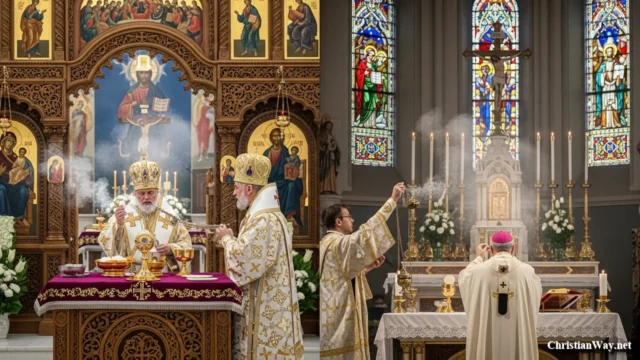
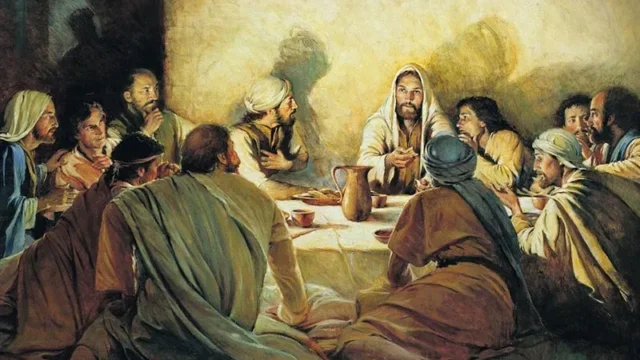
A pastoral reflection on how the Orthodox Church receives the Bible within worship, tradition, and the living Body of Christ.
Dear friends in Christ,
For many Christians, the Bible is the first place they turn when they seek to know God. Its words comfort the grieving, correct the wandering, strengthen the weary, and awaken hope in those who have nearly forgotten how to hope. Through its sacred pages, we hear the voices of prophets and apostles, encounter the prayers of Israel, walk beside Christ through Galilee, stand beneath His Cross, and rejoice before the empty tomb.
The Orthodox Church shares this profound love for Holy Scripture. The Bible is not considered an optional spiritual resource, a historical curiosity, or merely one religious book among many. It is received as the inspired Word of God, given for the salvation of the world and entrusted to the Church for proclamation, worship, teaching, and spiritual transformation.
Yet the Orthodox understanding of the Bible may initially seem unfamiliar to Christians formed in traditions that emphasize Scripture as an authority standing independently from the historic life of the Church. Orthodoxy does not separate the Bible from the community in which it was written, preserved, recognized, proclaimed, and interpreted. It sees Scripture as the heart of the Church’s Holy Tradition, not as a book placed outside or above the living communion of faith.
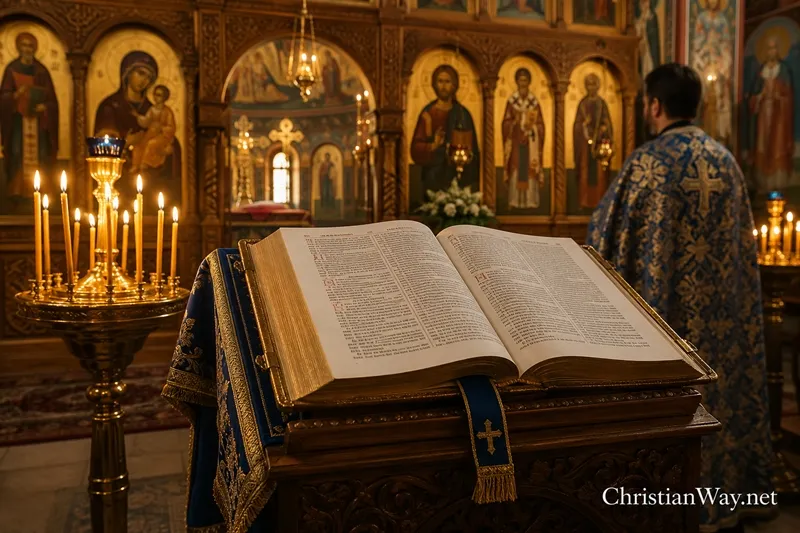
This does not diminish the Bible. On the contrary, it protects Scripture from being reduced to private opinion, ideological argument, or isolated proof texts. The Orthodox Church receives the Bible as a sacred gift meant to be heard in worship, interpreted through Christ, understood with the saints, and lived through repentance, prayer, and love.
To understand the Orthodox Church’s view of the Bible, we must therefore enter a larger vision. Scripture belongs to the life of God’s people. It is born from faith, proclaimed in faith, and understood most fully within the worshiping Body of Christ. The goal of reading is not simply to gain religious information. It is to encounter the Lord who speaks through the written word and calls every reader into communion with Him.
The Bible Is the Inspired Word of God
The Orthodox Church firmly confesses the divine inspiration of Holy Scripture. The apostle Paul writes:
“All Scripture is given by inspiration of God.”
This inspiration does not mean that the biblical writers became passive instruments without personality, culture, memory, vocabulary, or historical context. God did not erase their humanity. Rather, the Holy Spirit worked through it.
Moses wrote as Moses. David prayed as David. Isaiah spoke with the prophetic fire entrusted to him. Saint Luke wrote with the careful attention of an educated historian. Saint Paul’s letters reveal his pastoral urgency, theological depth, affection, sorrow, and occasional severity. Saint John speaks with a contemplative simplicity that opens into mysteries deeper than the sea.
The human and divine dimensions of Scripture are not enemies. Orthodox theology understands them in a way that resembles the mystery of the Incarnation. Jesus Christ is fully divine and fully human, without confusion and without division. In a corresponding, though not identical, way, Scripture is genuinely the word of God expressed through genuinely human words.
The Bible contains history, poetry, lament, genealogy, law, prophecy, parable, wisdom, letter, vision, and song. These forms should not all be read in precisely the same manner. A psalm uses poetic imagery differently from the historical narratives of the Gospels. A proverb expresses wisdom differently from an apostolic letter. The visions of Revelation communicate truth differently from the parables of Christ.
Recognizing these human literary forms does not deny inspiration. It enables us to receive Scripture according to the manner in which God chose to give it.
Inspiration Serves Salvation
The Orthodox Church does not approach biblical inspiration primarily as an abstract theory about the mechanics of composition. The deeper question is not merely, “How did God inspire these writings?” but “For what purpose were they given?”
Scripture was given to reveal God’s saving work and to lead humanity into life with Him.
The Bible tells the great story of creation, fall, covenant, promise, incarnation, redemption, resurrection, and the coming renewal of all things. Its center is not an idea but a Person. Jesus Christ is the fulfillment toward which the Law and the Prophets move, the Lord proclaimed by the apostles, and the living Word through whom the written word receives its unity.
The risen Christ taught His disciples to read Scripture in this way. Saint Luke tells us that, beginning with Moses and all the prophets, Jesus explained the things concerning Himself. The disciples had known the texts, but on the road to Emmaus they learned to see their deepest meaning in the light of Christ’s death and resurrection.
This Christ-centered reading remains essential to Orthodox Christianity. The Bible is not simply a collection of ancient writings bound together. It is the testimony of God’s long and patient preparation for the coming of His Son and of the new life that flows from Christ into the world.
The Bible Belongs Within Holy Tradition
One of the most important principles in Orthodox Christianity is that Scripture and Holy Tradition cannot be separated as though they were competing authorities.
The word “tradition” can create confusion. In ordinary speech, it may refer to customs, habits, cultural practices, or human rules passed from one generation to another. Some traditions are helpful, some are neutral, and some may need correction. This is not what the Orthodox Church means when it speaks of Holy Tradition.
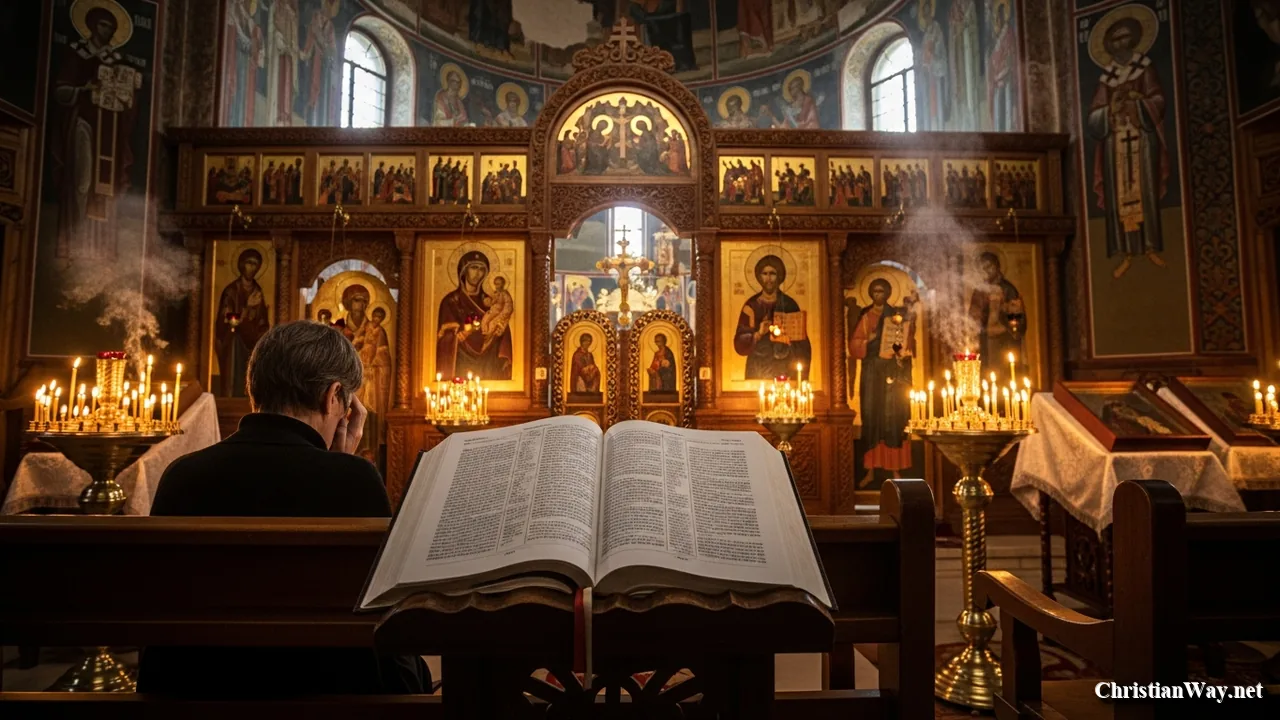
Holy Tradition is the living transmission of the apostolic faith through the power of the Holy Spirit. It includes the proclamation of the Gospel, the worship of the Church, the celebration of the sacraments, the decisions of the ecumenical councils, the witness of the saints, the teaching of the Fathers, the forms of prayer, and, at its very heart, Holy Scripture.
Tradition is not something added to the Bible. Scripture is itself the written and uniquely authoritative expression of the apostolic Tradition.
Saint Paul instructed the early Christians to hold firmly to what they had been taught, whether by word or by letter. Some apostolic teaching was written. Some was first communicated orally through preaching, worship, pastoral instruction, and the life of Christian communities.
Before the New Testament existed as a complete collection, the Church was already baptizing, celebrating the Eucharist, preaching Christ, appointing bishops and presbyters, caring for the poor, confronting false teachings, and suffering martyrdom. The Gospel was alive in the Church before all the New Testament books had been written, gathered, and universally recognized.
This historical reality is important. The Church did not begin with a finished Bible descending from heaven in a single volume. The biblical books arose within the covenant community and were recognized through the Church’s worshiping and apostolic life.
The Church Did Not Invent the Authority of Scripture
To say that the Church recognized the biblical canon does not mean that bishops arbitrarily gave authority to writings that previously possessed none. The Church did not manufacture inspiration.
Rather, guided by the Holy Spirit, the Christian community received certain writings as authentic witnesses to the apostolic faith. The Church discerned which texts had been read widely in worship, which were connected to the apostles, which faithfully proclaimed the Gospel, and which expressed the rule of faith handed down from the beginning.
This process occurred over time. Some books were universally accepted early, while others were debated in different regions. Eventually, a stable New Testament canon emerged through the common life and discernment of the Church.
The Orthodox conclusion is simple but profound: we know the Bible as the Bible because it was received, preserved, copied, read, and recognized within the historic Church.
For this reason, Orthodoxy does not imagine Scripture and the Church standing on opposite sides of a courtroom. Scripture is the Church’s book, though its message judges, corrects, purifies, and continually calls the Church to faithfulness.
The Church is not master over the Word of God. She is its servant, guardian, hearer, and witness.
Scripture Is the Heart of Tradition, Not One Tradition Among Many
Sometimes Orthodox teaching is misunderstood as though Scripture were placed on the same level as every later custom or statement made by a Christian writer. This is not accurate.
Holy Scripture occupies a unique and preeminent place within Holy Tradition. It is read publicly in the divine services, quoted throughout the liturgy, preached by the clergy, interpreted by the Fathers, and woven into nearly every major prayer of the Church.
The Nicene Creed summarizes biblical faith. The ecumenical councils defended the biblical truth about Christ and the Trinity. The writings of the saints continually return to Scripture. Orthodox hymnography is saturated with biblical language and imagery.
Tradition is trustworthy when it faithfully communicates the apostolic Gospel revealed in Scripture. A merely local custom, private opinion, or later practice cannot be treated as equal to the Bible simply because it is old.
The authentic Tradition of the Church does not compete with Scripture. It teaches Christians how to hear Scripture in communion with those who have faithfully followed Christ across the centuries.
A helpful image is that Scripture is the melody, while the Church’s living Tradition preserves the key in which that melody is sung. Without the melody, there is no song. Without the proper key, the song may become distorted beyond recognition.
The Orthodox Biblical Canon
The New Testament used by the Orthodox Church contains the same twenty-seven books found in Catholic and Protestant Bibles: the four Gospels, Acts, the apostolic letters, and Revelation.
The Old Testament presents more visible differences.
Orthodox Christianity traditionally receives the Old Testament largely through the Septuagint, the ancient Greek translation of the Hebrew Scriptures. The Septuagint was widely used among Greek-speaking Jews in the centuries before Christ and was the Bible commonly used by many early Christians.
The New Testament authors frequently quote Old Testament passages in forms closely corresponding to the Septuagint. The early Church therefore received this Greek collection not merely as a translation of historical interest but as the Scriptures through which many Christians heard the promises of God fulfilled in Christ.
Why the Orthodox Old Testament Is Larger
Orthodox Bibles ordinarily contain several books not included in most Protestant Old Testaments. These may include Tobit, Judith, the Wisdom of Solomon, the Wisdom of Sirach, Baruch, additional portions of Daniel and Esther, the books of the Maccabees, and Psalm 151.
The precise contents and arrangement may vary slightly among local Orthodox traditions and published editions. Some books may be printed in an appendix or treated differently in various jurisdictions. Nevertheless, the Orthodox Old Testament is generally broader than the Protestant canon because it follows the ancient Septuagint tradition rather than the later, shorter Hebrew collection used as the primary basis of Protestant Old Testaments.
These books are sometimes called deuterocanonical books, meaning books recognized within a secondary stage of canonical reception. In Orthodox settings, they may also be described as books appointed to be read.
Orthodoxy does not usually approach the canon through the sharply defined categories that developed in some later Western debates. The importance of a biblical book can also be seen through its liturgical use, its reception by the Fathers, and its place within the spiritual life of the Church.
The Orthodox Church reads these books because they formed part of the scriptural world of early Christianity and have nourished Christian faith for many centuries.
The Canon Was Received Through Worship
The biblical canon was not formed only through scholarly meetings or lists written on paper. Books became deeply rooted in the Church because they were read aloud in worship, used in teaching, quoted by faithful pastors, and recognized as bearing authentic apostolic truth.
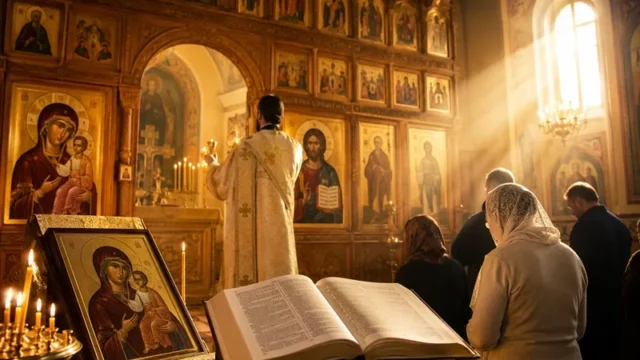
This helps explain why liturgy is so important for understanding the Orthodox view of the Bible. The Bible is not merely something analyzed in a classroom. It is something proclaimed in the assembly of God’s people.
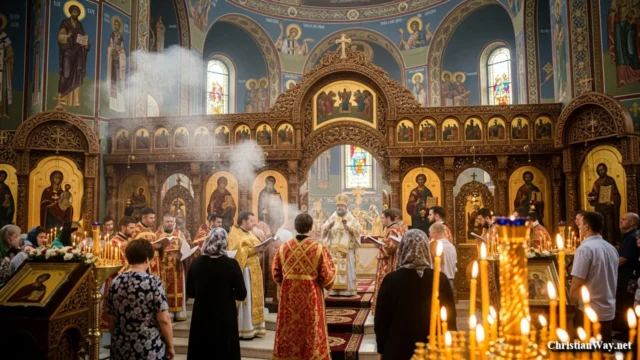
When the Gospel is carried in procession during the Divine Liturgy, the act expresses more than respect for a physical book. It symbolizes Christ coming among His people. The congregation stands. Candles are lit. Incense may be offered. The priest or deacon announces the reading with solemnity.
These gestures do not imply that paper and ink are worshiped. They express reverence for the Lord whose saving words are being proclaimed.
The Bible Lives in Orthodox Worship
A person attending an Orthodox service for the first time may not always notice how thoroughly biblical it is. Because many passages are sung, prayed, paraphrased, or woven into hymns, the scriptural content may not appear in the form of consecutive chapter readings alone.
Yet Orthodox worship is filled with the Bible.
The Psalms form the prayer book of the Church. They are chanted at Vespers, Matins, the Hours, funerals, memorials, monasteries, and countless other services. The Divine Liturgy contains biblical phrases from beginning to end. The Beatitudes are sung. The Lord’s Prayer is prayed. Apostolic epistles and Gospel passages are read. Hymns interpret the events of salvation through the language of prophets, psalmists, evangelists, and apostles.
During Holy Week, the faithful hear extensive portions of the Gospels recounting the Passion of Christ. At the Paschal celebration, the opening of Saint John’s Gospel is proclaimed: Christ is the eternal Word, the Light shining in the darkness.
The liturgical year also guides the Church through the mystery of Scripture. Christmas, Theophany, Lent, Palm Sunday, Pascha, Pentecost, and the feasts of Christ are not isolated commemorations. Together they allow the faithful to enter sacramentally into the biblical story of salvation.
Worship Teaches Christians How to Read
Orthodox worship does more than quote the Bible. It interprets the Bible.
The hymns for the feasts frequently bring Old and New Testament passages together. The crossing of the Red Sea may be connected with baptism. The burning bush may be contemplated as an image of the mystery of the Incarnation. Jonah’s three days in the great fish may be understood as foreshadowing Christ’s burial and resurrection. The Passover of Israel is fulfilled in Christ, the true Paschal Lamb.
Such interpretations are not arbitrary exercises of imagination. They arise from patterns already found in the New Testament. Saint Paul calls Christ our Passover. Saint Peter connects the flood with baptism. The letter to the Hebrews reads the tabernacle, priesthood, and sacrifices in light of Christ.
The Church’s worship continues this apostolic manner of reading. Events in the Old Testament are historically meaningful, but they also participate in a greater divine pattern whose fullness is revealed in Jesus.
The liturgy therefore becomes a school of Scripture. Through repeated worship, Christians gradually learn to see the unity of God’s saving work.
Christ Is the Key to the Scriptures
The Orthodox Church reads the Bible through Jesus Christ because Christ Himself is the living Word of God.
Christianity is not ultimately a religion centered on a text. It is centered on the incarnate Son of God. The Bible bears authoritative witness to Him, but the written words lead us toward communion with the living Lord.
Jesus said to those who studied the Scriptures yet resisted Him:
“These are they which testify of me.”
A person may know many biblical facts and still fail to recognize Christ. The religious leaders who opposed Jesus were not necessarily ignorant of Scripture. Their tragedy was that they read without allowing the Word to lead them into humility, repentance, and love.
For Orthodox spirituality, the true interpretation of Scripture is therefore inseparable from spiritual transformation. We cannot understand the Bible rightly while deliberately refusing the life it commands.
The proud heart can turn Scripture into a weapon. The angry heart can use it to condemn. The fearful heart can reduce it to rules. The ambitious heart can quote it in order to gain power.
But the repentant heart begins to hear Scripture as a personal summons: “Follow Me.” “Forgive.” “Love your enemies.” “Take up your cross.” “Abide in Me.”
Correct interpretation is not merely intellectual accuracy, though intellectual care matters. It is truth received in a life being healed by grace.
The Bible Is Read Within the Church
Orthodoxy encourages serious study, but it is cautious about the idea that every isolated reader can determine the full meaning of Scripture without accountability to the wider Christian community.
The Bible itself warns that some things are difficult to understand and can be distorted. The history of Christianity also demonstrates that sincere readers may reach radically different conclusions while appealing to the same texts.
Private interpretation becomes especially dangerous when a person assumes that personal confidence is evidence of divine certainty. A persuasive personality may gather followers around an interpretation unknown to the historic Church. A single verse may be removed from its context and made to support fear, manipulation, prejudice, wealth, or political power.
The Orthodox answer is not to forbid personal reading. It is to place personal reading within communion.
A Christian reads with the apostles, martyrs, bishops, monastics, theologians, families, and worshiping communities that have gone before. The faithful ask not only, “What does this passage mean to me?” but also, “How has the Church received this passage?”
This does not mean that every Father interpreted every passage identically. The patristic tradition contains rich diversity. Some writers emphasize historical meaning, others moral application, others symbolism or contemplation. Yet beneath this diversity lies a shared rule of faith centered on the Trinity, the Incarnation, the saving death and resurrection of Christ, and the life of the Church.
The Fathers Are Guides, Not Replacements for Scripture
The Fathers of the Church are deeply honored in Orthodoxy because they were faithful witnesses who helped defend and explain the apostolic faith. Figures such as Saint Athanasius, Saint Basil the Great, Saint Gregory the Theologian, Saint John Chrysostom, Saint Cyril of Alexandria, and many others devoted their lives to Scripture.
Their authority does not come merely from antiquity. It comes from their faithfulness to the Gospel, their holiness of life, their pastoral wisdom, and their reception by the Church.
Orthodox Christians do not believe that every sentence written by every Father is infallible. Individual Fathers could be limited by their historical circumstances, disagree with one another, or offer interpretations that did not become part of the Church’s common mind.
The Church listens especially for the harmony of the Fathers—the broad and enduring consensus that reflects the apostolic faith.
Patristic interpretation reminds modern readers that Scripture did not wait for the modern age to be understood. Christians prayed, suffered, preached, debated, and died for the biblical faith long before our own generation.
Humility therefore asks us to listen before assuming that the newest interpretation is necessarily the truest.
The Literal and Spiritual Meaning of Scripture
Orthodox interpretation does not reduce the Bible either to literalism or to uncontrolled symbolism.
The literal or historical meaning matters. Christianity is rooted in events. God called Abraham. Israel was delivered from slavery. Jesus was born under real historical circumstances. He suffered under Pontius Pilate. He was crucified, buried, and rose from the dead.
The resurrection is not merely a poetic symbol for hope. It is the decisive victory of God within history.
At the same time, Scripture possesses spiritual depths. Biblical events, persons, places, and objects may reveal patterns of salvation that reach beyond their immediate historical setting.
Jerusalem is a real city, yet it can also signify the people of God and the heavenly kingdom. Water is a physical reality, yet throughout Scripture it may signify cleansing, chaos, judgment, life, and baptismal renewal. Bread feeds the body, yet in the teaching of Christ it also points toward the Eucharistic mystery and the life given by the Son of God.
The Orthodox reader seeks neither to deny history nor to imprison Scripture within history. The Holy Spirit who acted in biblical events continues to reveal their saving meaning in Christ.
Not Every Passage Is Read in the Same Way
Biblical faithfulness requires sensitivity to genre, context, and purpose.
When the Psalms speak of trees clapping their hands, the Church does not imagine literal branches producing applause. The poetic image reveals creation rejoicing before God.
When Jesus tells a parable, the central question is not whether every character corresponds to a documented historical person. The question is what the story reveals about God, humanity, repentance, judgment, grace, or the kingdom.
When Scripture contains genealogies, laws, battle narratives, prophetic visions, or wisdom sayings, each form calls for patient interpretation.
Orthodoxy resists the idea that faith requires a simplistic reading. Reverence is not the enemy of careful scholarship. Historical knowledge, linguistic study, archaeology, and literary analysis can illuminate the biblical world.
Yet scholarship alone cannot exhaust Scripture. The Bible is not a lifeless object placed beneath the microscope. It is received in prayer as a word addressed to the Church by the Holy Spirit.
Does the Orthodox Church Believe in Sola Scriptura?
The Orthodox Church does not accept sola scriptura when the phrase means that the Bible is the only binding authority and should be interpreted independently of the Church’s apostolic Tradition.
Orthodox Christians may agree with Protestant brothers and sisters that Scripture is inspired, foundational, and supremely authoritative. They may also share the concern that human customs must never obscure the Gospel.
The difference lies in the relationship between Scripture, Tradition, and the Church.
Orthodoxy asks several questions. How do we know which books belong in the Bible? Who preserved these writings? How were disputed interpretations resolved in the early centuries? How can central Christian doctrines such as the Trinity be confessed faithfully when heretical groups have also quoted Scripture?
The ecumenical councils did not invent the Trinity or the divinity of Christ. They defended the apostolic reading of Scripture against interpretations that threatened the Gospel. Their teaching expressed the faith already present in baptism, worship, and Christian prayer.
For Orthodoxy, the authority of Scripture is not weakened when Scripture is read within the Church. It is made visible in its proper home.
Tradition Must Also Be Tested
Rejecting sola scriptura does not mean accepting every religious habit without discernment.
Christ Himself warned against human traditions that make void the commandment of God. Orthodox Christians must therefore distinguish Holy Tradition from customs that may be temporary, regional, imperfect, or even harmful.
A practice may be ancient without being universally binding. A popular belief may be widespread without being theologically sound. A member of the clergy may speak confidently without accurately representing the Church.
Authentic Tradition is recognized by its continuity with the apostolic faith, harmony with Scripture, reception in worship, witness of the saints, and fruit in holiness.
The true Tradition always leads toward Christ. It produces repentance rather than pride, communion rather than domination, mercy rather than cruelty, and holiness rather than superstition.
Is the Bible Considered Infallible?
Orthodox Christians confess that Scripture faithfully communicates the truth God intends for our salvation. They trust the Bible as the inspired witness to God’s revelation and saving work.
However, Orthodoxy has not always framed biblical authority using the same technical categories developed in later Western debates about inerrancy. Different Orthodox theologians may use terms such as “infallible” or “inerrant,” but they may explain them with different emphases.
The essential Orthodox concern is that Scripture is true in its divine purpose and trustworthy in leading the Church to Christ.
This does not require treating the biblical writers as though they used modern scientific, journalistic, or historiographical conventions. The Scriptures arose in ancient cultures and communicate through ancient forms of expression.
The Bible may describe the world as it appears to ordinary human experience. It may arrange events for theological emphasis. Parallel Gospel accounts may preserve different details or organize material differently. Such features need not be treated as threats to faith.
The truth of Scripture is not fragile. It does not depend on forcing every passage into a modern category foreign to the text itself.
A faithful reader asks what the inspired author is communicating, how the passage functions within the whole of Scripture, and how it bears witness to the saving work of God.
Difficult and Troubling Biblical Passages
Every serious reader eventually encounters passages that are difficult to understand. Some concern violence, judgment, warfare, slavery, the treatment of women, severe punishments, or commands that seem difficult to reconcile with the mercy revealed in Christ.
The Orthodox Church does not solve these questions by pretending they do not exist. Nor does it encourage careless answers that dismiss the pain such passages may cause.
Instead, difficult texts are read within the gradual unfolding of revelation and in the light of Jesus Christ.
God met humanity within real history, among cultures marked by violence, hierarchy, vengeance, fear, and spiritual blindness. The biblical story records not only the holiness of God but also the wounds of the human condition.
The full revelation of God’s character is seen in Christ, who forgives His enemies, touches the unclean, welcomes sinners, protects the vulnerable, and gives His life for the world.
Jesus teaches His followers not to repay evil with evil but to love their enemies and pray for those who persecute them. This does not erase the Old Testament. It reveals the goal toward which God was patiently leading His people.
The Spiritual Reading of Warfare
Some Fathers interpreted violent Old Testament narratives spiritually as images of the believer’s struggle against sin, temptation, and the passions.
The enemies to be destroyed are not human beings made in God’s image. They are pride, hatred, greed, lust, envy, despair, and the thoughts that enslave the heart.
This spiritual interpretation does not remove the historical and moral questions raised by the texts. But it prevents Christians from misusing ancient warfare narratives to justify hatred or violence against others.
The Christian battle is ultimately fought within the human heart. The weapons are prayer, fasting, truth, mercy, patience, repentance, and the Cross.
When a difficult passage troubles us, humility allows us to say, “I do not yet understand.” Faith does not require pretending that every question has an easy answer. Sometimes reverence means remaining before the text patiently, praying for light, consulting wise teachers, and refusing interpretations that contradict the face of God revealed in Jesus Christ.
Scripture and the Sacraments
In Orthodox Christianity, the Bible and the sacramental life are inseparable.
At baptism, the Church enters the biblical mystery of dying and rising with Christ. In the Eucharist, the Last Supper, the sacrifice of Christ, the manna in the wilderness, the bread of the Presence, and the heavenly banquet come together. In confession, the mercy proclaimed throughout Scripture becomes a personal reality. In marriage, the union of husband and wife is understood through Christ’s love for the Church.
The sacraments are not additions to biblical Christianity. They are the biblical Gospel enacted in the life of the Church.
The structure of the Divine Liturgy itself reflects this unity. The proclamation of the Word prepares the faithful for the Eucharistic mystery. Scripture is heard, preached, prayed, and then embodied in the sacramental communion of Christ’s people.
The Word calls the Church to the Table, and the Table opens the heart to hear the Word more deeply.
Orthodoxy therefore resists any opposition between biblical faith and sacramental faith. Christ speaks through Scripture and gives Himself in the sacramental life. The same Lord is encountered in both.
Personal Bible Reading in Orthodox Life
Because Orthodox worship is so deeply scriptural, some mistakenly assume that personal Bible reading is unimportant in Orthodoxy. It should be important.
The faithful are encouraged to read the Gospels, Psalms, apostolic letters, and the whole of Scripture with prayer and perseverance. Many spiritual teachers recommend beginning with the Gospels, because the face and voice of Christ provide the center from which the rest of the Bible is understood.
Personal reading, however, should not become merely an intellectual project. Before opening the Bible, the reader may pray for humility, attention, and obedience.
A simple prayer might be:
“Lord Jesus Christ, open the eyes of my heart. Help me to hear Your word, repent of my sins, and walk in Your truth.”
The question after reading should not only be, “What new fact have I learned?” It should also be, “What is Christ asking of me?”
Perhaps the passage calls us to forgive someone. Perhaps it reveals a hidden attachment. Perhaps it exposes our fear. Perhaps it comforts us in grief. Perhaps it challenges the way we speak, spend, work, judge, or pray.
The Bible becomes fruitful when it passes from the eyes into the heart and from the heart into life.
Read Slowly and Faithfully
Modern life trains us to consume words quickly. We scroll, skim, react, and move on. Scripture asks for a different rhythm.
A short Gospel passage read attentively may nourish the soul more deeply than several chapters read in haste. Repetition is not failure. The Church reads the same passages year after year because the human heart continually needs to hear them anew.
The same verse may speak differently during joy, illness, disappointment, parenthood, aging, temptation, or grief. Scripture does not change, but the reader is being changed.
It is also helpful to read within the rhythm of the Church. Daily lectionaries connect personal prayer with the wider worshiping community. Commentaries from trusted Orthodox teachers can provide context. Conversations with a priest or mature Christian may help when passages are confusing or spiritually troubling.
Personal reading and ecclesial reading strengthen one another.
The Bible Is Given for Transformation
The Orthodox Church understands salvation not merely as receiving a legal declaration but as being healed, renewed, and united with God by grace.
This lifelong transformation is often described as theosis, participation in the divine life. Human beings do not become God by nature. They remain creatures, but through Christ and the Holy Spirit they are brought into communion with God and transformed into His likeness.
Scripture serves this healing journey.
The Bible reveals our wounds, but it also reveals the Physician. It names sin, but it announces mercy. It exposes false gods, yet it leads us to the living God. It calls us away from self-centered existence and into the life of Christ.
Saint James compares the word of God to a mirror. We may look into it and see ourselves truthfully. Yet we must not walk away unchanged.
The purpose of biblical study is not to become proud of our knowledge. Knowledge without love can harden the heart. A person may memorize many verses yet remain unforgiving, harsh, dishonest, or indifferent to suffering.
The deepest evidence that Scripture has been received is not the number of passages we can quote. It is the degree to which our lives begin to resemble Jesus.
Do we become more merciful? More truthful? More patient? More willing to repent? More attentive to the poor? More faithful in prayer? More capable of loving those who cannot repay us?
The Word has not completed its work in us until it becomes flesh in our daily conduct.
Reading Scripture in a Divided Christian World
The Bible is shared across Catholic, Orthodox, Anglican, and Protestant traditions. Christians may differ about the canon, authority, interpretation, sacraments, and the relationship between Scripture and Tradition. Yet all historic Christian communities confess that the Bible bears witness to Jesus Christ.
This shared love for Scripture can become a place of encounter rather than accusation.
Orthodox Christians should speak about other traditions with truth and charity. It is possible to explain why Orthodoxy rejects private interpretation or sola scriptura without suggesting that Protestants do not love the Bible. Many Protestant believers read Scripture with deep devotion, courage, and sincerity. Many have preserved a strong culture of personal biblical study from which Orthodox Christians may be reminded not to neglect their own reading.
Likewise, Christians from other traditions may benefit from the Orthodox emphasis on worship, patristic interpretation, spiritual discipline, and the continuity of the apostolic Church.
Unity does not require pretending that real differences do not exist. It requires discussing those differences without contempt.
Scripture itself calls Christians to humility, patience, truthfulness, and love. If our defense of the Bible produces cruelty, mockery, or spiritual pride, we have contradicted the book we claim to defend.
Christ prayed that His followers would be one. Every conversation about biblical authority should therefore be conducted beneath that prayer.
What the Orthodox View Ultimately Protects
The Orthodox Church’s view of the Bible seeks to protect several inseparable truths.
It protects the divine inspiration and authority of Scripture. It protects the historical reality that the Bible emerged within the life of God’s people. It protects the apostolic faith from interpretations detached from the Church’s worship and memory. It protects the unity of the Old and New Testaments in Christ. It protects the reader from spiritual isolation. Above all, it protects the purpose of Scripture as a means of communion with God.
The Bible is not a weapon given so that Christians may defeat one another.
It is not a collection of secret codes meant to satisfy curiosity about every future event.
It is not a talisman whose mere physical presence guarantees blessing.
It is not a textbook that answers every scientific, political, or technical question.
It is the sacred witness to God’s covenant love, fulfilled in Jesus Christ and proclaimed for the salvation of the world.
The Church approaches Scripture as Moses approached the burning bush: with reverence, wonder, and the willingness to remove the sandals of pride.
We do not stand above the Bible as judges. We stand beneath its light, allowing it to judge the thoughts and intentions of our hearts.
Reflect and Pray
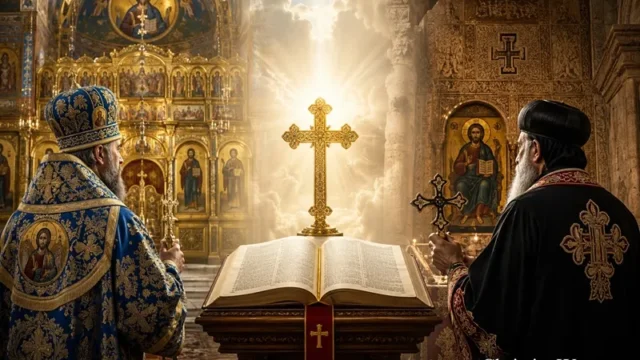
The Orthodox Church receives the Bible as the inspired Word of God within the living Tradition of the apostolic Church. It is proclaimed in worship, interpreted through Christ, read with the Fathers, embodied in the sacraments, and lived through repentance and love.
Yet this vision is not meant to remain an abstract explanation of Orthodox theology. It asks something personal of every reader.
Do we approach Scripture only when we need an argument, an answer, or a moment of comfort? Or do we allow it to become part of the steady rhythm of our lives?
Do we read in order to confirm what we already believe, or are we willing to be corrected?
Do we seek unusual interpretations that make us feel superior, or do we listen humbly with the whole Church?
Do we know many things about Christ while resisting His invitation to follow Him?
The Bible opens before us like a door, but we must walk through it. Beyond the words stands the living Lord, the One who called the fishermen, forgave the sinner, healed the broken, carried the Cross, conquered death, and breathed peace upon His disciples.
Every page ultimately leads toward Him.
When the Scriptures comfort us, it is Christ who draws near. When they correct us, it is Christ who calls us back. When they expose our sin, it is Christ who offers healing. When they awaken hope, it is Christ who reminds us that darkness will not have the final word.
Let us therefore read with reverence but not fear, with intelligence but not pride, with freedom but not isolation, and with faith that seeks transformation rather than information alone.
May the Holy Spirit open our minds as Christ opened the minds of His disciples. May the words of Scripture descend from our lips into our hearts. May they heal what is wounded, purify what is disordered, and strengthen what is weak.
And may the Bible never become for us merely a book we possess, but the sacred testimony through which we are continually led into the presence of the living Word, Jesus Christ our Lord.
Lord Jesus Christ, eternal Word of the Father, open our hearts to receive the Holy Scriptures with humility and faith. Guard us from pride, confusion, and hardness of heart. Teach us to hear Your voice in the words of the prophets and apostles, and give us strength to live what we read. Through Your Holy Spirit, make Your word a lamp to our feet, a light upon our path, and a seed of eternal life within us. Amen.
May the peace of Christ dwell richly in your heart, and may His Word guide every step you take toward the fullness of His light.
— Fr. John Matthew