Dear friends, it is a joy to walk with you through the threshold of history and faith. When we think of the Baroque era, we often think of gold, marble, and grandiosity. Yet, for the believer, these are not mere decorations. In the wake of the Reformation, the Church sought to create spaces that didn’t just house the faithful, but actively spoke to them—theatrical spaces where the line between Earth and Heaven became thin, and where every curve of stone was meant to draw the soul upward toward the Divine.
As we journey together through these magnificent structures, I invite you to look past the opulence. See instead the “theology of light” and the “movement of grace” that these master architects intended. These churches were designed as a foretaste of the Heavenly Banquet, a visual representation of the Triumph of Christ. They remind us that our God is not a God of static silence, but a God of dynamic, overflowing love that cannot be contained by straight lines or simple boxes.
In our modern world, where we are often surrounded by the grey and the utilitarian, visiting a Christian Way heritage site like these offers a necessary “Sabbath for the eyes.” These buildings challenge us to consider: if human hands can craft such beauty out of cold stone, how much more beautiful is the temple of the Holy Spirit that God is building within your own heart? Let us begin our pilgrimage of the senses and the spirit.
A Summary of Sacred Treasures
| Rank | Church Name | Location | Architectural Highlight |
|---|---|---|---|
| 10 | Melk Abbey Church | Melk, Austria | The Golden Altar and Monastic Grandeur |
| 9 | San Carlo alle Quattro Fontane | Rome, Italy | The Undulating Façade of Borromini |
| 8 | Wieskirche (Pilgrimage Church of Wies) | Steingaden, Germany | The Scourged Saviour and Rococo Light |
| 7 | Santa Maria della Salute | Venice, Italy | Votive Offering for Deliverance from Plague |
| 6 | Obradoiro Façade (Santiago de Compostela) | Galicia, Spain | The Peak of Spanish “Churrigueresque” |
| 5 | Sant’Ignazio di Loyola | Rome, Italy | The Famous Trompe-l’œil Illusion Dome |
| 4 | St. Paul’s Cathedral | London, United Kingdom | The Majestic English Baroque Dome |
| 3 | Karlskirche (St. Charles Church) | Vienna, Austria | The Synthesis of Imperial Faith and Art |
| 2 | Church of the Gesù | Rome, Italy | The Prototype of the Baroque Church |
| 1 | St. Peter’s Basilica | Vatican City | The Mother Church of Christendom |
Top 10. Melk Abbey Church: The Golden Beacon on the Danube
Perched high on a granite cliff overlooking the Danube River, Melk Abbey is a breathtaking witness to the Benedictine motto, Ora et Labora (Pray and Work). As you approach, the yellow ochre walls of the abbey seem to glow with a light of their own, but it is inside the church where the true transformation occurs. The interior is a symphony of gold leaf, reddish-brown marble, and frescoes that seem to spill out of the ceiling. It is a space designed to overwhelm the senses, forcing the pilgrim to stop, breathe, and acknowledge that they have entered a realm set apart for the King of Kings.
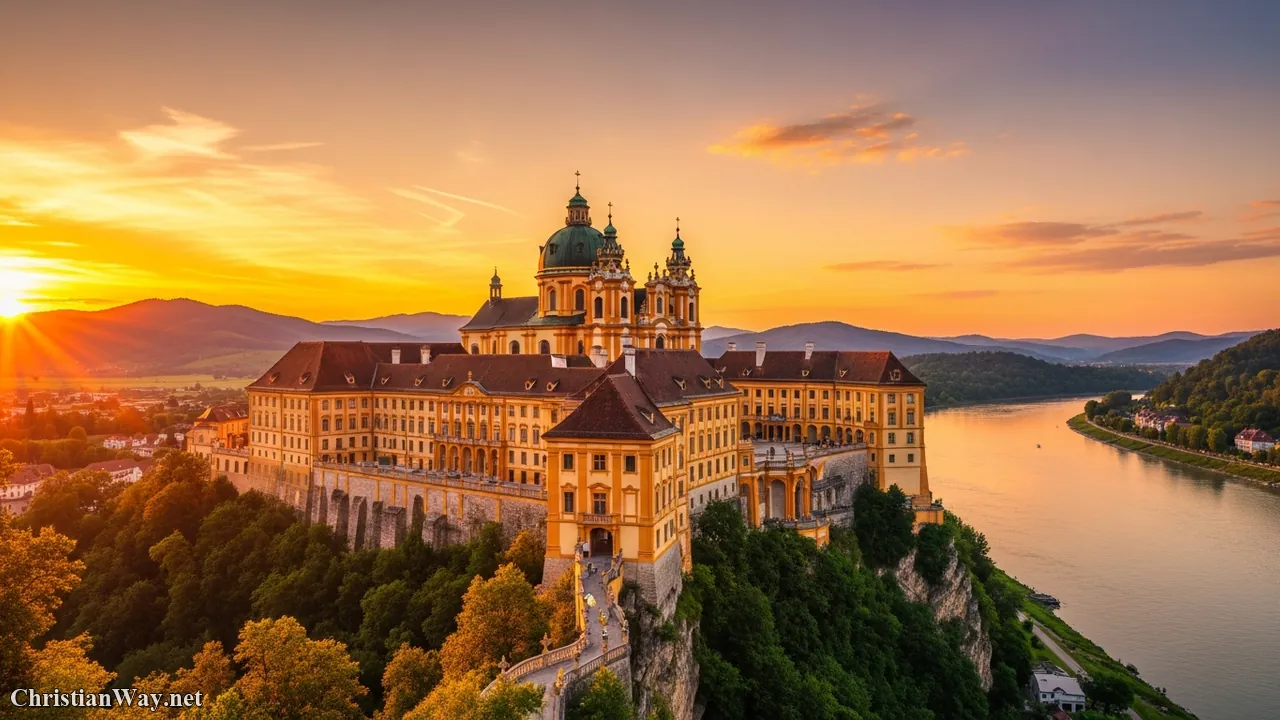
Theologically, Melk represents the monastic commitment to beauty as a form of worship. In the Baroque period, the Benedictines used this opulence to celebrate the triumph of the Church and the richness of the spiritual life. For the weary heart today, Melk offers a reminder that our faith is not one of scarcity, but of abundance. Just as the monastery provides a refuge from the rushing river below, so too does the life of prayer provide us a solid rock amidst the shifting currents of the world. It teaches us that giving our best—our finest art and our deepest focus—to God is a holy and necessary act.
Spiritual Highlights:
- The High Altar depicting the martyrdom of St. Peter and St. Paul.
- “The earth is the Lord’s, and everything in it.” — Psalm 24:1
Top 9. San Carlo alle Quattro Fontane: The Geometry of the Soul
In the bustling heart of Rome, Francesco Borromini squeezed a masterpiece onto a corner so small it is said the entire church could fit inside one of the pillars of St. Peter’s. Yet, “San Carlino,” as the Romans affectionately call it, is anything but small in spirit. The façade undulates like a wave, breaking the rigidity of traditional stone. Inside, the complex oval dome features a honeycomb of crosses, hexagons, and octagons that shrink as they rise toward the lantern, creating an illusion of infinite height. It is a quiet, rhythmic space where the math of the universe meets the mystery of the Creator.
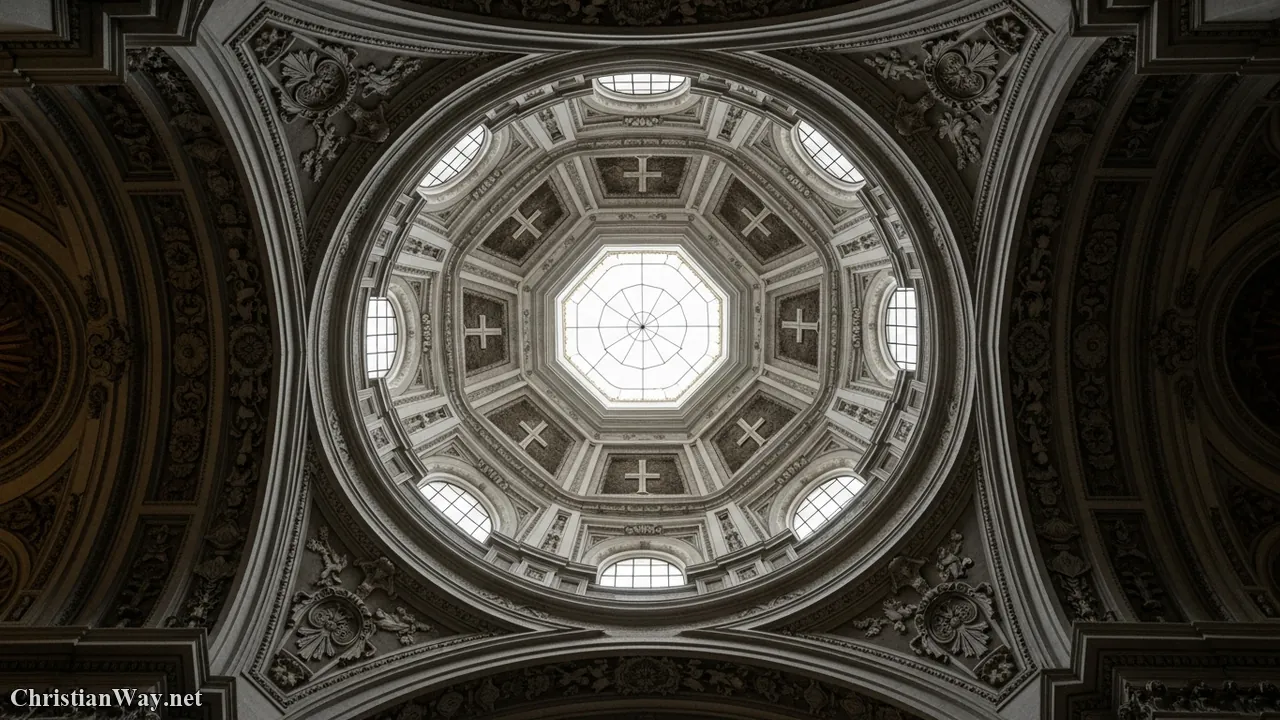
Borromini’s work here is a profound meditation on the “movement” of God’s grace. Nothing in this church is static; everything flows. This mirrors our own spiritual journey—rarely a straight line, often full of curves and unexpected turns, yet always held together by a divine geometry. When your life feels cramped or restricted, remember San Carlino. It proves that even in the smallest spaces, God can create something of infinite depth and beauty. It is a call to find the “vastness” within our own quiet moments of prayer.
Spiritual Highlights:
- The extraordinary oval dome with its receding geometric patterns.
- “In him we live and move and have our being.” — Acts 17:28
Top 8. Wieskirche: A Sanctuary of Tears and Joy
Nestled in a quiet Bavarian meadow, the “Church in the Meadow” (Wieskirche) was built to house a miraculous statue of the “Scourged Saviour.” While the exterior is modest, the interior is arguably the most beautiful example of the late-Baroque, or Rococo, style in the world. The light here is different—it is bright, airy, and festive. The frescoes by Johann Baptist Zimmermann depict the Risen Christ seated on a rainbow, signaling that the suffering of the Scourged Saviour has led to the eternal joy of the Resurrection.
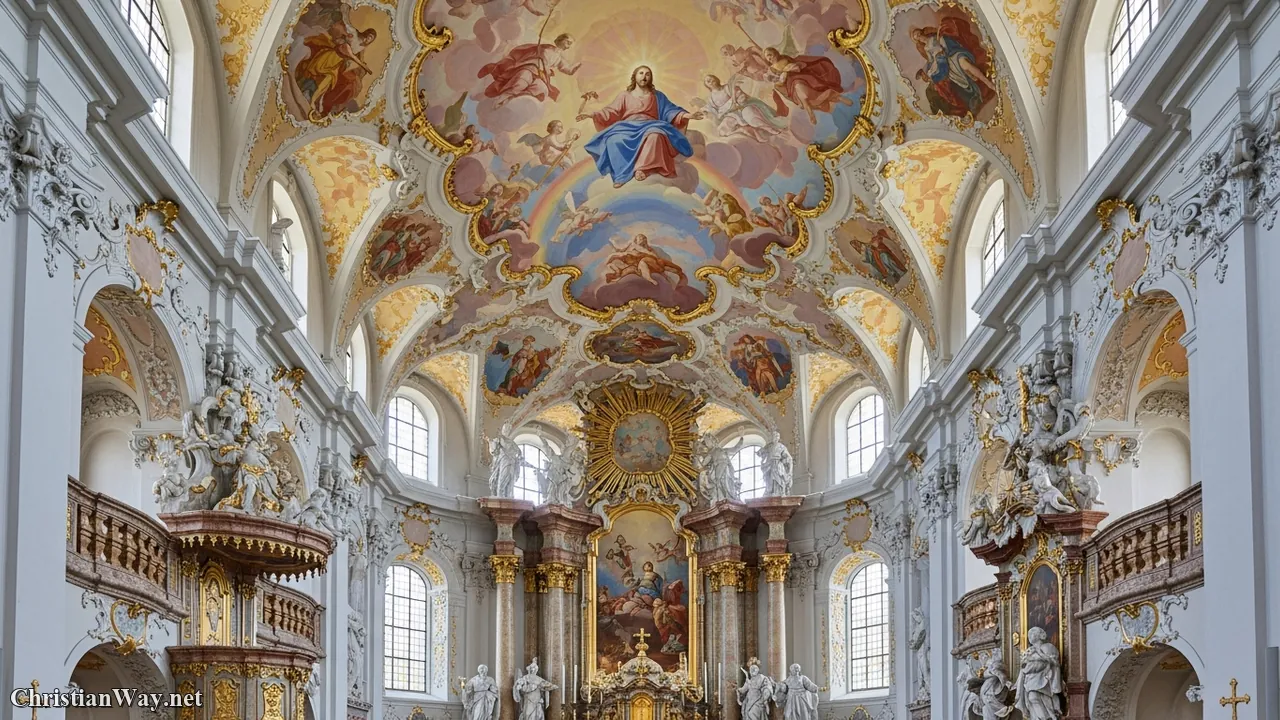
Pastoral care is at the very heart of this church’s history. It began with the tears of a simple farmer who saw the statue weep, and it became a place where thousands come to find healing for their own sorrows. The contrast between the image of the suffering Jesus and the jubilant, light-filled architecture is a powerful theological statement: our pain is real, but it is not the end of the story. In Christ, the “meadow” of our lives can bloom again. It is a place that invites us to bring our brokenness to the altar and exchange it for the light of hope.
Spiritual Highlights:
- The central statue of the Scourged Saviour, the heart of the pilgrimage.
- “He was pierced for our transgressions, he was crushed for our iniquities.” — Isaiah 53:5
Top 7. Santa Maria della Salute: The Crown of Venice
Standing at the entrance of the Grand Canal, “The Salute” is a massive octagonal votive church built in gratitude for Venice’s deliverance from a devastating plague in 1630. Designed by Baldassare Longhena, its great dome serves as a crown for the Virgin Mary, whom the Venetians invoked as their protector. The church is filled with Marian symbolism, and the floor is inlaid with concentric circles that lead the eye—and the heart—toward the High Altar, where a sculpture depicts Venice kneeling before the Madonna while the plague is driven away.
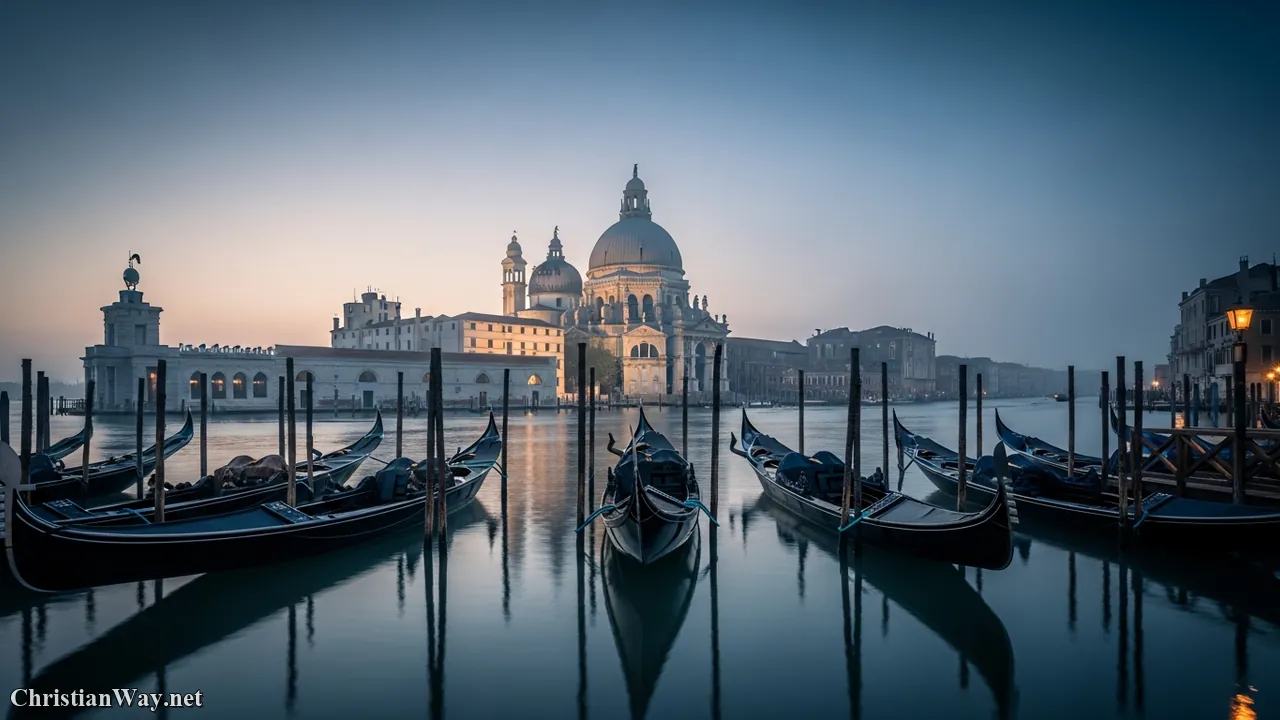
This church stands as a monumental “Thank You” note to God. In an age of sudden illness and uncertainty, the people of Venice didn’t just pray; they promised to build a monument of faith if they were spared. This teaches us the power of collective gratitude. How often do we ask God for help but forget to return to give thanks? The Salute reminds us that our faith is communal; we suffer together, and we find healing together under the mantle of Mary and the mercy of her Son. It is a beacon of hope for any community facing “plagues” of the modern era—fear, division, or despair.
Spiritual Highlights:
- The massive exterior scrolls (buttresses) known as “orecchioni” or big ears.
- “My soul glorifies the Lord and my spirit rejoices in God my Savior.” — Luke 1:46-47
Top 6. Obradoiro Façade of Santiago de Compostela: The Pilgrim’s Reward
After walking hundreds of miles on the Camino de Santiago, pilgrims finally arrive at the Plaza del Obradoiro to face the towering Baroque façade of the Cathedral. Added in the 18th century to protect the older Romanesque “Portico of the Glory,” this façade is the pinnacle of the Spanish Churrigueresque style—flamboyant, intensely detailed, and reaching toward the sky with exuberant energy. It is a “stone tapestry” that celebrates the arrival of the faithful at the tomb of St. James the Apostle.
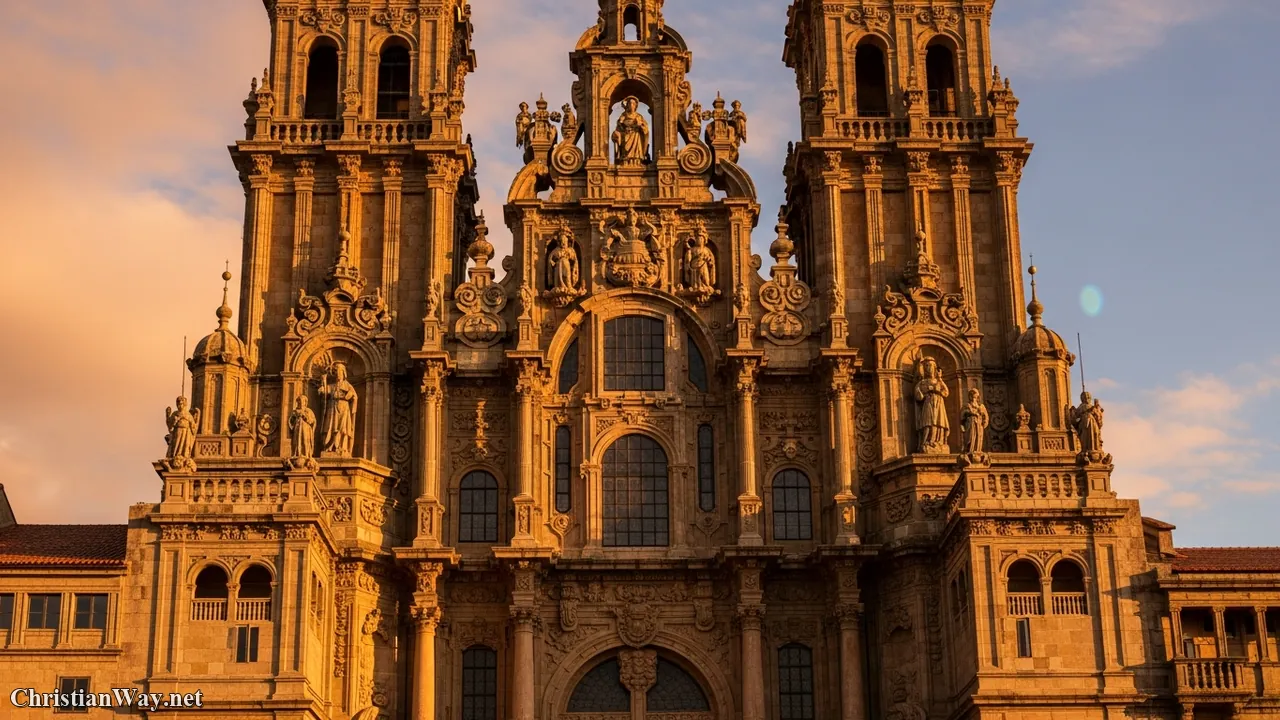
Theologically, this façade represents the “Triumphant Entry.” Just as Christ entered Jerusalem with palm branches, the pilgrim enters the presence of the Apostle with a heart full of stories. The ornate nature of the Baroque frontispiece says to the weary traveler: “Your journey mattered. Your sacrifice is seen.” It is a reminder that the Christian life is a pilgrimage, and while the road is often dusty and difficult, the destination is one of unimaginable glory. It encourages us to keep walking, knowing that the “façade” of Heaven is more beautiful than anything we can imagine on Earth.
Spiritual Highlights:
- The central statue of St. James dressed as a pilgrim.
- “I have fought the good fight, I have finished the race, I have kept the faith.” — 2 Timothy 4:7
Top 5. Sant’Ignazio di Loyola: The Heavens Opened
Walking into Sant’Ignazio in Rome, you might look up and see a magnificent dome—except the dome isn’t there. It is a flat canvas painted with such perfect perspective by the Jesuit brother Andrea Pozzo that it appears three-dimensional. Even more staggering is the central ceiling fresco, “The Apotheology of St. Ignatius,” where the saint is seen entering Heaven, while four continents are depicted below, representing the global mission of the Jesuits. It is a “total work of art” that erases the ceiling and makes you feel as though you are standing directly beneath the open gates of Paradise.
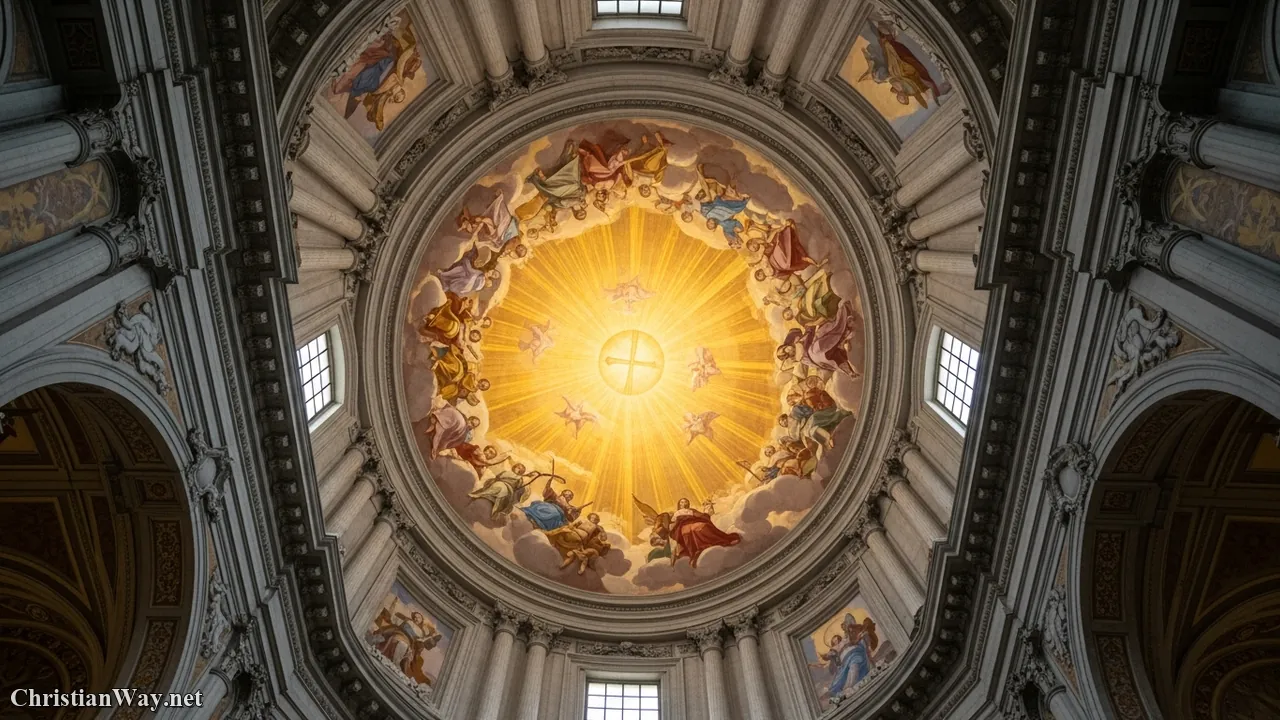
This church is a profound lesson in perspective. Just as Pozzo used art to trick the eye into seeing height where there was none, our faith helps us see the eternal reality behind our flat, earthly circumstances. The Jesuits taught that we can “find God in all things,” and Sant’Ignazio is the architectural embodiment of that truth. It challenges us to ask: Are we looking at the world with “flat” eyes, or are we allowing the Holy Spirit to give us a divine perspective? It is a call to live with an “open heaven” over our daily lives.
Spiritual Highlights:
- The incredible trompe-l’œil false dome painting.
- “See, I see the heavens opened and the Son of Man standing at the right hand of God.” — Acts 7:56
Top 4. St. Paul’s Cathedral: The Resurrection of London
Following the Great Fire of London in 1666, Sir Christopher Wren was tasked with rebuilding the city’s spiritual heart. St. Paul’s is a unique “English Baroque” masterpiece, combining classical restraint with Baroque drama. Its dome, inspired by St. Peter’s in Rome, became a symbol of London’s resilience and the enduring nature of the Church of England. The interior, with its vast whispering gallery and delicate mosaics, provides a sense of orderly grandeur—a space where the Word of God is proclaimed with clarity and dignity.
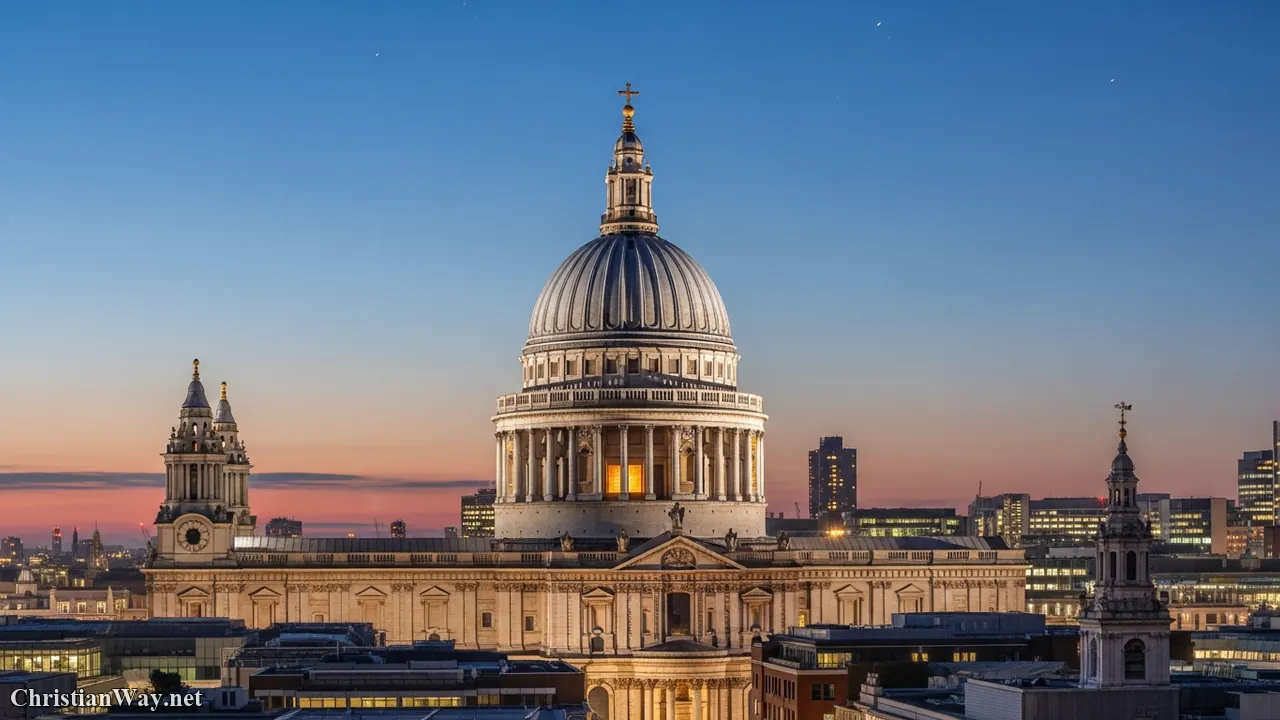
Theologically, St. Paul’s is a monument to the Resurrection. It rose from the ashes of a destroyed city, proving that God can bring life out of death. For the believer, it serves as a reminder that no “fire” in our life—be it loss, failure, or grief—is the final word. Wren’s motto, Resurgam (I shall rise), is carved into the south transept. It is a pastoral comfort to anyone who feels their life is in ruins: the Master Architect is still at work, and He can build something even more glorious from the wreckage of the past.
Spiritual Highlights:
- The famous Whispering Gallery inside the great dome.
- “He has caused us to be born again to a living hope through the resurrection of Jesus Christ.” — 1 Peter 1:3
Top 3. Karlskirche: A Vow Fulfilled
Vienna’s Karlskirche is a dramatic architectural dialogue. Commissioned by Emperor Charles VI after a plague, it features two massive columns flanking the entrance that resemble Trajan’s Column in Rome, but they are carved with scenes from the life of St. Charles Borromeo, the great saint of the Counter-Reformation. The church is a blend of Greek, Roman, and Baroque styles, all unified under a massive oval dome. It is a building that claims the glory of the past for the service of the Gospel.
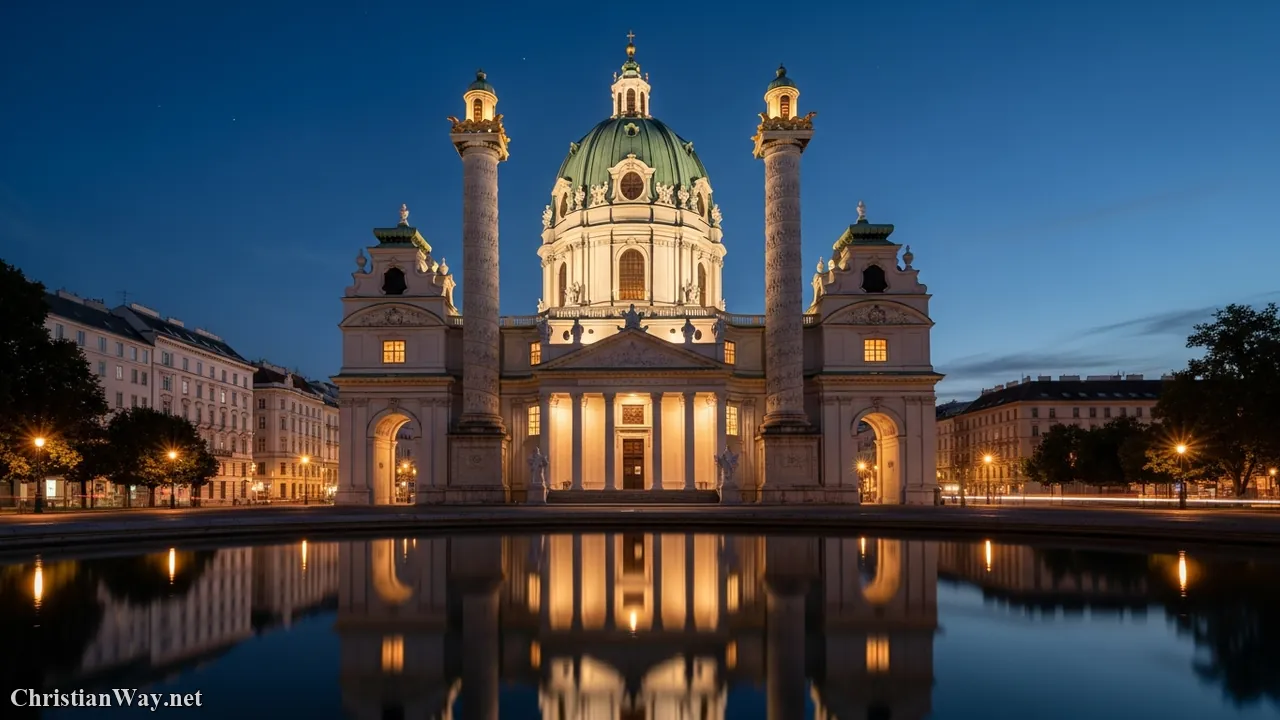
This church reminds us of the power of a “vow.” In our modern culture of fleeting commitments, Karlskirche stands as a 300-year-old promise kept. It honors St. Charles Borromeo, who was known for his tireless service to the sick. Pastorally, it asks us: To whom do we turn in our hour of need, and how do we honor the God who delivers us? It is a sanctuary that encourages us to lead lives of “noble purpose,” using our resources and our influence to point others toward the healing power of Christ.
Spiritual Highlights:
- The massive columns depicting the life of St. Charles Borromeo.
- “I will fulfill my vows to the Lord in the presence of all his people.” — Psalm 116:14
Top 2. Church of the Gesù: The Mother of the Baroque
If you want to understand the heart of the Baroque, you must come here. As the mother church of the Society of Jesus (the Jesuits), the Gesù set the template for hundreds of churches across the globe. Its wide nave, designed for preaching, and its lack of side aisles ensure that every eye is fixed on the High Altar. The ceiling fresco, “The Triumph of the Name of Jesus,” features a blinding light that seems to burst through the stone, while figures of the “fallen” seem to tumble out of the ceiling into the space of the church itself.
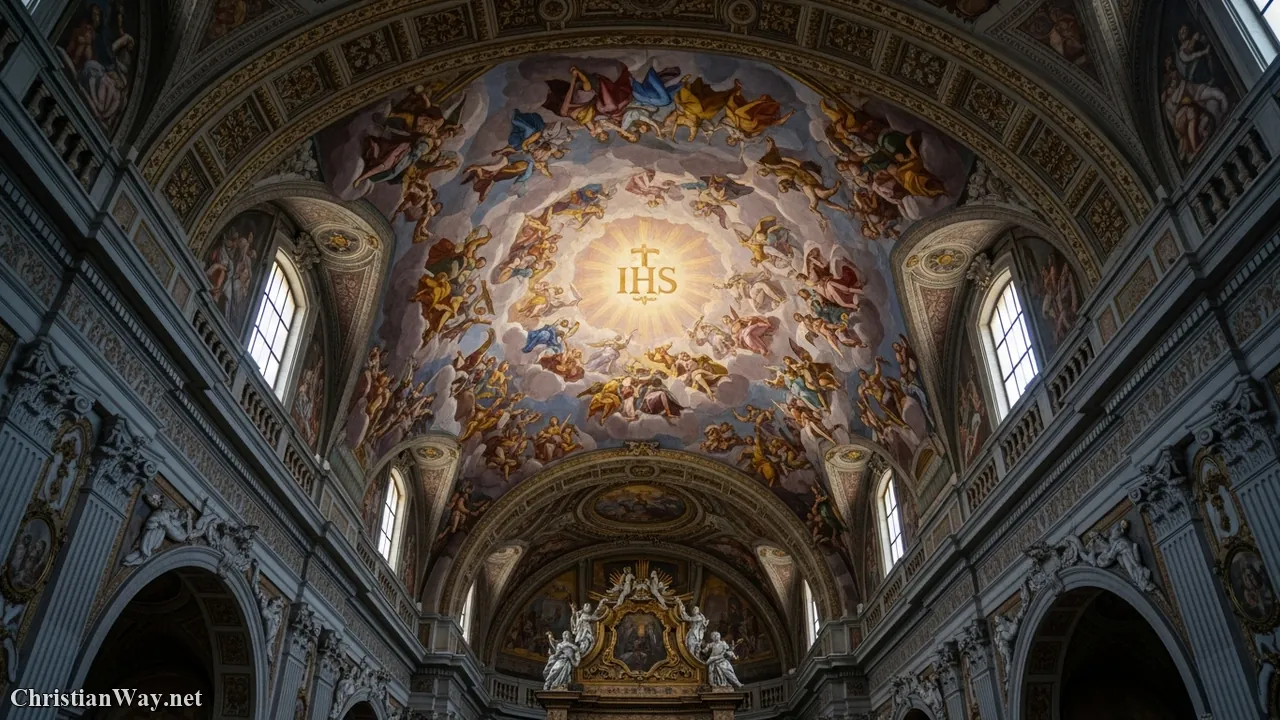
The Gesù is a church of “The Holy Name.” The monogram IHS (the first three letters of Jesus’ name in Greek) is everywhere. It reminds us that at the center of all our art, all our theology, and all our busyness must be the Person of Jesus Christ. The dramatic “tumble” of the figures on the ceiling is a visual warning and an invitation: we are either drawn into the light of His Name or we fall away into the shadows of our own pride. It is a place that calls for a decision—a place where the name of Jesus is not just a word, but a power that transforms the world.
Spiritual Highlights:
- The Altar of St. Ignatius, featuring the “Baroque Machine” that reveals the saint’s statue.
- “That at the name of Jesus every knee should bow.” — Philippians 2:10
Top 1. St. Peter’s Basilica: The Threshold of the Apostles
We arrive, finally, at the heart of the Christian world. While its foundations are older, St. Peter’s is the supreme achievement of the Baroque era, thanks largely to the genius of Gian Lorenzo Bernini. From the sweeping arms of the colonnade in the square—designed to embrace the world—to the massive bronze Baldacchino standing over the tomb of St. Peter, everything here is designed to proclaim the authority and the “largeness” of the Gospel. It is a space so vast it defies measurement, yet it is centered on a simple, humble reality: the grave of a fisherman who loved the Lord.
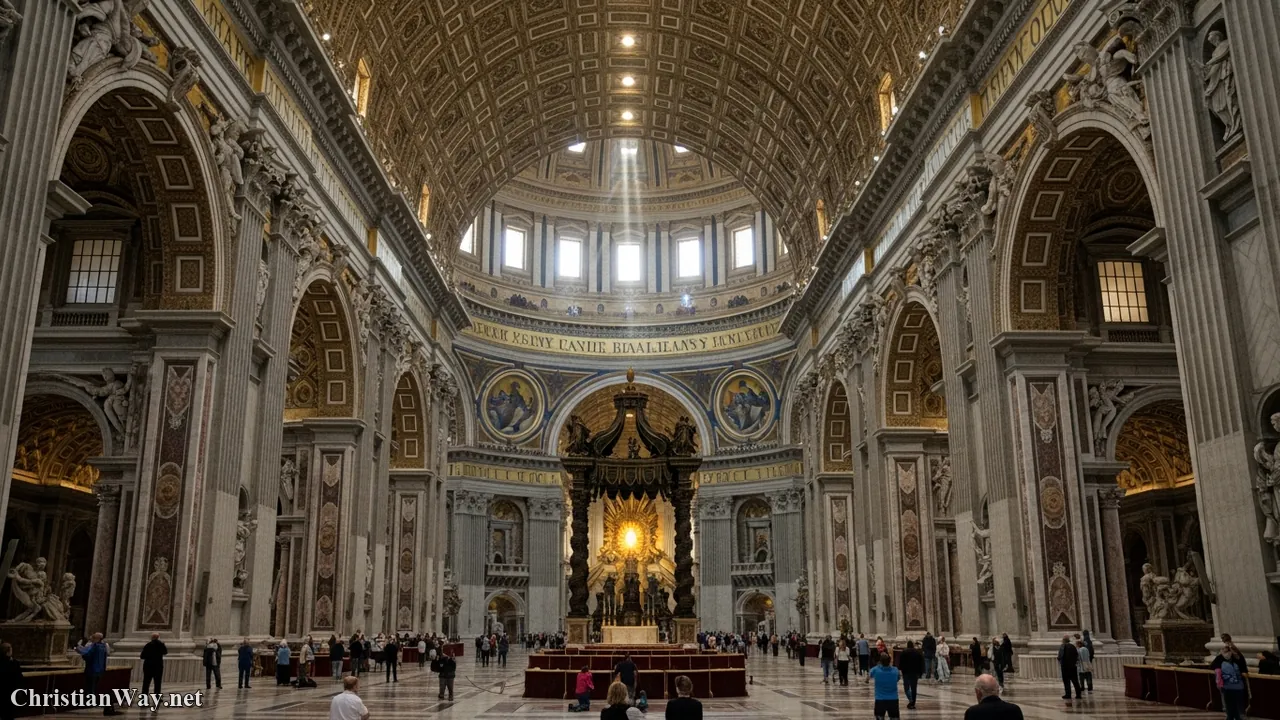
Theology in St. Peter’s is about “Mediated Grace.” The architecture leads you through the square, through the doors, and up the nave to the altar, and finally to the “Chair of St. Peter” (the Cathedra), which seems to float in a burst of golden light and angels. It tells us that we are part of a long, unbroken chain of faith that stretches back to the Apostles. For the pilgrim, it is an overwhelming embrace. It says: “You belong to a family that spans continents and centuries.” In its shadows and its splendors, we find the courage to say, like Peter, “Lord, you know that I love you.”
Spiritual Highlights:
- The Baldacchino with its twisting “Solomonic” columns.
- “And I tell you that you are Peter, and on this rock I will build my church.” — Matthew 16:18
Reflect and Pray
As we conclude our tour of these ten sacred spaces, let us take a moment to sit in the “inner chapel” of our own souls. The Baroque architects believed that beauty was a ladder to God. Today, may you find a “rung” on that ladder. Whether you are moved by the light of the Wieskirche or the geometry of San Carlino, remember that you are the most precious masterpiece God has ever created. He has fashioned you with more care than any marble statue, and He has illuminated your life with a light more brilliant than any gold leaf.
Lord, we thank You for the hands of the artists and the hearts of the faithful who built these sanctuaries. May they always serve as reminders that You are a God of beauty, order, and infinite love. Help us to build a “Baroque” interior—a life full of the movement of Your grace and the light of Your Truth. Amen.
— Fr. John Matthew, for Christian Way