A pastoral reflection on Protestant faith, its Reformation roots, biblical convictions, worship, diversity, and hope in Christ.
Dear friends in Christ,
When people ask, “What is Protestantism?” they are often expecting a simple definition. Yet Protestantism cannot be understood adequately as a single institution, one denomination, or a uniform set of customs. It is a broad family within Christianity, embracing many churches, traditions, spiritual movements, and forms of worship. Baptists, Lutherans, Anglicans, Methodists, Presbyterians, Reformed Christians, Pentecostals, Evangelicals, and many independent churches are commonly described as Protestant, though they do not agree on every theological question.
What holds these diverse communities together is not a common administrative structure or one universal earthly leader. Rather, Protestant Christianity is united by several foundational convictions: that Jesus Christ is the only Savior, that salvation is given by God’s grace and received through faith, that Holy Scripture possesses supreme authority for Christian belief and life, and that every believer is called to know, worship, and serve God personally within the fellowship of the Church.
To understand Protestantism, however, we must look beyond definitions. We must listen to the spiritual longing that gave birth to the Reformation, recognize the wounds and conflicts that followed, and appreciate the sincere desire of generations of Christians to return continually to the Gospel of Jesus Christ.
The history of Protestantism includes courage and failure, renewal and division, theological brilliance and human weakness. Like every Christian tradition, it bears both treasures and scars. Yet at its heart stands a simple and enduring proclamation: sinners are reconciled to God not because they have earned His favor, but because Jesus Christ has died and risen for them.
This is the center from which Protestant faith must be understood. It is not fundamentally a protest against other Christians. It is, at its best, a testimony to the sufficiency of Christ, the power of grace, and the living voice of God in Scripture.
Protestantism Is a Major Branch of Christianity
Protestantism is one of the three major historic branches of Christianity, alongside Roman Catholicism and Eastern Orthodoxy. It arose in Western Europe during the sixteenth-century Reformation, although many of its theological concerns had appeared earlier in Christian history.
Protestants confess the central truths of the historic Christian faith. They believe in one God—Father, Son, and Holy Spirit. They confess that Jesus Christ is truly divine and truly human, that He was born of the Virgin Mary, suffered under Pontius Pilate, was crucified, died, and rose bodily from the dead. They believe that Christ will come again, that the dead will be raised, and that God will bring His creation to its promised fulfillment.
Most Protestant churches accept the ancient Apostles’ Creed and Nicene Creed as faithful summaries of biblical teaching. They therefore stand within the broad stream of historic Trinitarian Christianity.
This point is important because Protestantism is sometimes misunderstood as an entirely new religion created in the sixteenth century. The Reformers themselves did not believe that they were inventing a new faith. They believed they were calling the Western Church back to the Gospel revealed in Scripture and confessed by the ancient Church.
Martin Luther, John Calvin, Ulrich Zwingli, Thomas Cranmer, and other Reformers disagreed among themselves on significant matters. Yet they shared the conviction that reform was necessary and that the Church must always be judged, renewed, and corrected by the Word of God.
Protestantism therefore arose not from a rejection of Christianity, but from a struggle over how Christianity should remain faithful to Christ.
The Meaning of the Word “Protestant”
The word “Protestant” is connected historically with the Protestation at Speyer in 1529. At that imperial assembly, several German princes and representatives of free cities objected to measures that would restrict the spread of Reformation teaching.
The word did not originally mean merely someone who complains or opposes authority. It carried the sense of making a solemn public testimony or confession. To “protest” could mean to declare openly what one believed to be true.
Over time, the term came to describe churches and Christians shaped by the Reformation. Today, however, some Christians who are historically Protestant do not frequently use the label. They may identify themselves more readily as Lutheran, Anglican, Baptist, Presbyterian, Methodist, Pentecostal, Evangelical, Reformed, or simply Christian.
The name is useful, but it must not hide the great variety found within Protestant Christianity.
The Historical Roots of the Protestant Reformation
The Protestant Reformation did not emerge in a single moment. It grew from many spiritual, theological, political, social, and cultural developments that had been unfolding for centuries.
By the late medieval period, the Western Church remained a powerful center of worship, education, charity, and cultural unity. Monasteries preserved learning, priests administered the sacraments, theologians reflected deeply on faith, and countless believers sought God with sincerity.
At the same time, serious abuses had developed. Some church offices were influenced by wealth and political ambition. Certain clergy were poorly educated or morally compromised. Financial practices connected with indulgences caused scandal. Many ordinary Christians lacked access to clear biblical teaching in their own language.
Calls for reform were not new. Figures such as John Wycliffe in England and Jan Hus in Bohemia had challenged aspects of Church practice before the sixteenth century. Humanist scholars such as Erasmus encouraged a return to the original languages of Scripture and criticized corruption among clergy.
The invention of the printing press also changed Europe profoundly. Books and pamphlets could now circulate more widely, allowing theological ideas to reach ordinary people with unprecedented speed.
Into this environment came Martin Luther, an Augustinian friar and professor of theology in Wittenberg.
Martin Luther and the Question of Grace
Luther’s spiritual struggle centered on a deeply personal question: How can a sinful human being stand righteous before a holy God?
He knew his own conscience. He recognized that even religious works could be mixed with pride, fear, or self-interest. The more he tried to make himself worthy of God, the more aware he became of his inability to do so.
While studying Scripture, especially the writings of Saint Paul, Luther came to understand the “righteousness of God” not merely as the standard by which God condemns sinners, but as the saving righteousness God gives through faith in Christ.
Saint Paul writes:
“Therefore being justified by faith, we have peace with God through our Lord Jesus Christ.”
— Romans 5:1
For Luther, this was not an abstract doctrine. It was the opening of a prison door. The sinner does not purchase forgiveness, climb toward God through merit, or make himself worthy of grace. God comes to the sinner in Jesus Christ. Christ bears sin, conquers death, and grants His righteousness as a gift.
In 1517, Luther published his Ninety-Five Theses, questioning particularly the preaching and sale of indulgences. The controversy quickly expanded beyond indulgences into deeper questions about authority, salvation, the sacraments, and the nature of the Church.
Luther did not initially intend to create a separate church. Yet conflict intensified, and reconciliation failed. He was excommunicated, political rulers became involved, and the Reformation spread through many parts of Europe.
Other Streams of the Reformation
The Reformation was never one unified movement.
In Switzerland, Ulrich Zwingli led reforms in Zurich, emphasizing biblical preaching and simplifying worship. John Calvin later developed a highly influential theological and ecclesiastical vision in Geneva. His writings shaped Reformed and Presbyterian churches throughout Europe and beyond.
In England, the Reformation followed a distinct path involving royal authority, political conflict, theological change, and gradual liturgical reform. The Church of England retained many ancient structures and forms of worship while embracing significant Reformation teachings.
The Radical Reformation included Anabaptists, who emphasized believers’ baptism, discipleship, voluntary church membership, nonviolence in many communities, and separation between Church and state. Some suffered persecution from both Catholic and Protestant authorities.
In later centuries, Protestantism continued to develop through Puritanism, Pietism, Methodism, the Great Awakenings, missionary movements, Pentecostalism, Evangelicalism, and many local renewal movements.
This history helps us see why Protestantism is so diverse. It did not begin from one institutional center, and it has never possessed a single worldwide governing body.
Scripture as the Supreme Authority
One of the most important principles associated with Protestantism is sola Scriptura, a Latin phrase meaning “Scripture alone.”
This phrase is sometimes misunderstood. It does not necessarily mean that Protestants reject all tradition, historical theology, creeds, teachers, or church authority. The Reformers frequently quoted the Church Fathers, defended the ancient creeds, and valued the wisdom of earlier Christians.
Rather, sola Scriptura means that the Bible is the highest and final authority by which all Christian doctrines, traditions, and practices must be tested. Church councils, theologians, pastors, and traditions may possess real authority, but they are not infallible in the same way that the inspired Word of God is authoritative.
Saint Paul writes:
“All scripture is given by inspiration of God, and is profitable for doctrine, for reproof, for correction, for instruction in righteousness.”
— 2 Timothy 3:16
Protestants therefore place great emphasis on reading, translating, teaching, and preaching the Bible. The Reformation encouraged the translation of Scripture into the languages of ordinary people. Christians were urged not only to hear biblical passages in worship but also to read them personally and within their families.
This emphasis has produced a rich heritage of biblical scholarship, preaching, devotional writing, and missionary translation.
Scripture Within the Community of Faith
Healthy Protestant theology does not treat the Bible as a private book whose meaning depends entirely on individual opinion. Scripture belongs to the whole Church. It should be read prayerfully, responsibly, and in conversation with the faithful across generations.
Yet Protestantism’s emphasis on personal access to Scripture has sometimes contributed to fragmentation. Individuals or groups may interpret difficult passages without sufficient attention to history, context, or the wider Christian tradition. This can lead to confusion, extremism, or the creation of new divisions.
The Protestant principle of biblical authority is therefore strongest when joined with humility.
The believer does not stand above Scripture as its master. Nor does the believer read alone, as though no Christian had ever read the Bible before. We receive Scripture as a gift within the Body of Christ, listening both to the Spirit and to the wisdom of the Christian community.
The Bible is not merely a collection of religious information. It is the written witness through which the Church hears the saving message of God. Through its pages, we encounter the story of creation, covenant, Israel, prophecy, incarnation, redemption, resurrection, and the coming kingdom of God.
Above all, Scripture leads us to Jesus Christ.
Christ Himself said:
“Search the scriptures; for in them ye think ye have eternal life: and they are they which testify of me.”
— John 5:39
For Protestant Christians, faithful Bible reading should never end in pride over possessing correct information. It should bring the reader into repentance, faith, worship, love, and obedience.
Salvation by Grace Through Faith
Another central Protestant conviction is often expressed through the phrase sola gratia: grace alone.
Grace means that salvation begins in the mercy of God rather than in human achievement. Humanity is wounded by sin and unable to restore fellowship with God through moral effort alone. We need more than instruction. We need redemption.
God does not save because we have earned His attention. He saves because He is love.
The Gospel announces that Jesus Christ has done for us what we could not do for ourselves. He entered human history, lived in perfect obedience to the Father, carried our sins upon the cross, and rose victorious over death.
Saint Paul writes:
“For by grace are ye saved through faith; and that not of yourselves: it is the gift of God: not of works, lest any man should boast.”
— Ephesians 2:8–9
This passage has held a central place in Protestant preaching. Salvation is a gift. Forgiveness cannot be purchased. Eternal life cannot be earned. No religious ceremony, charitable act, personal discipline, or moral accomplishment can place God in our debt.
We come before God with empty hands.
Yet these empty hands are not rejected. They are filled with Christ.
Justification by Faith
The doctrine of justification by faith is especially important in Lutheran and Reformed traditions, though it is affirmed in various forms throughout Protestant Christianity.
To be justified means to be declared righteous before God. Protestants teach that sinners are justified through faith in Jesus Christ rather than through the merit of their works.
Faith is not merely agreeing that God exists. It is trusting in Christ, receiving His promise, and resting in His saving work.
The Christian does not say, “God accepts me because I have prayed enough, served enough, suffered enough, or become good enough.” The Christian says, “God receives me because Christ has given Himself for me.”
This does not mean that good works are unimportant. Saint Paul continues immediately:
“For we are his workmanship, created in Christ Jesus unto good works.”
— Ephesians 2:10
Good works do not purchase salvation; they flow from salvation. They are not the price of grace but its fruit.
A tree does not become alive because it bears fruit. It bears fruit because it is alive. In the same way, acts of love, mercy, justice, prayer, and obedience arise from a heart renewed by God.
Protestants have sometimes summarized this truth by saying that we are saved by faith alone, but the faith that saves is never alone. Living faith produces love.
As Saint Paul declares, what matters is “faith which worketh by love” (Galatians 5:6).
Christ Alone Is the Center of Salvation
The Reformation principle solus Christus means “Christ alone.”
Jesus Christ is the one Mediator between God and humanity. His incarnation, death, resurrection, and continuing intercession are fully sufficient for salvation.
Saint Paul writes:
“For there is one God, and one mediator between God and men, the man Christ Jesus.”
— 1 Timothy 2:5
Protestant Christians therefore place strong emphasis on direct access to God through Christ. They do not believe that another human mediator must stand between the believer and the Savior.
This conviction shapes Protestant prayer. Most Protestants pray directly to God the Father, through the Son, in the power of the Holy Spirit. They generally do not invoke the intercession of Mary or the saints, even while many respect them as faithful witnesses.
Some Protestant traditions speak warmly of Mary as the mother of Jesus, the blessed Virgin, and an example of humble faith. They may honor the apostles, martyrs, Reformers, missionaries, and saints of Christian history. Yet they usually avoid practices that could appear to direct prayer or religious devotion toward them.
At its best, this emphasis on Christ alone brings profound freedom. The believer may come before God without terror, knowing that Christ has opened the way.
The Letter to the Hebrews declares:
“Let us therefore come boldly unto the throne of grace, that we may obtain mercy, and find grace to help in time of need.”
— Hebrews 4:16
This is not boldness rooted in human worthiness. It is confidence rooted in Christ.
The Priesthood of All Believers
Another important Protestant teaching is known as the priesthood of all believers.
Saint Peter writes to the Church:
“But ye are a chosen generation, a royal priesthood, an holy nation, a peculiar people.”
— 1 Peter 2:9
This teaching means that every baptized believer belongs to God’s priestly people. Every Christian is called to prayer, worship, witness, holiness, service, and spiritual sacrifice.
There is no spiritual class of Christians who alone may know God, read Scripture, or serve Him meaningfully. The mother caring patiently for her children, the worker acting honestly, the student seeking truth, the elderly believer praying quietly, and the pastor preaching the Gospel all share in the calling of God’s people.
The doctrine does not necessarily eliminate ordained ministry. Most Protestant churches appoint pastors, ministers, elders, bishops, or deacons. These leaders preach, teach, administer the sacraments or ordinances, provide pastoral care, and guide the community.
However, Protestant ministers are generally understood as servants within the priestly people of God rather than as belonging to a separate sacramental priesthood in the Catholic or Orthodox sense.
The priesthood of all believers also contributed to Protestant emphasis on vocation. Serving God is not limited to work done inside a church building.
Martin Luther taught that ordinary work may become a holy calling when it is performed faithfully in love for one’s neighbor. A farmer, teacher, carpenter, parent, physician, or public servant may glorify God through daily responsibilities.
This teaching restores dignity to the ordinary. Holiness is not found only in dramatic religious acts. It grows in patient love, honest labor, repentance, forgiveness, courage, and faithfulness.
Protestant Worship and the Centrality of Preaching
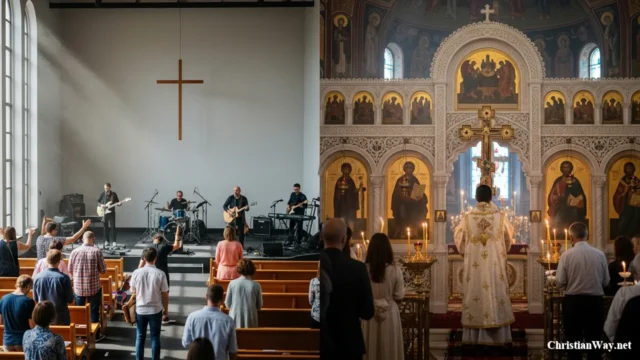
Protestant worship takes many forms.
A Lutheran service may include formal liturgy, ancient hymns, vestments, a church calendar, and weekly Holy Communion. An Anglican service may closely resemble Catholic worship in its prayers and sacramental life. A Presbyterian congregation may emphasize reverent simplicity and careful biblical preaching. A Baptist church may include congregational hymns, spontaneous prayer, testimony, and an extended sermon. A Pentecostal service may feature contemporary music, expressive prayer, spiritual gifts, and expectation of the Holy Spirit’s immediate work.
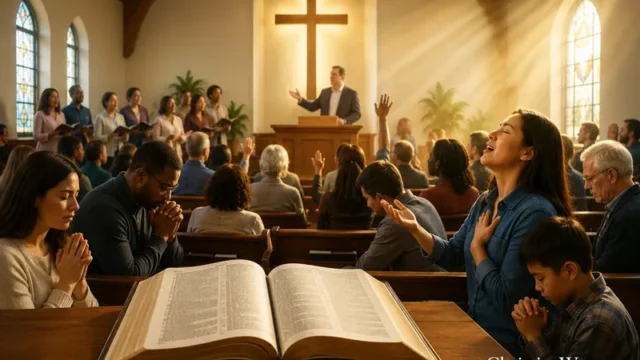
These differences can be striking. Yet several elements commonly appear across Protestant worship: the reading of Scripture, preaching, prayer, congregational singing, confession of faith, offerings, baptism, and the Lord’s Supper.
The Ministry of the Word
The sermon often occupies a prominent place in Protestant worship because the Church gathers to hear the Word of God proclaimed and applied.
A faithful sermon should do more than offer advice or religious motivation. It should reveal Christ, explain Scripture, call sinners to repentance, comfort the afflicted, challenge injustice, strengthen faith, and guide believers toward holy living.
The preacher is not meant to entertain an audience or display personal brilliance. The preacher stands under the authority of the same Word being proclaimed.
Saint Paul instructed Timothy:
“Preach the word; be instant in season, out of season; reprove, rebuke, exhort with all longsuffering and doctrine.”
— 2 Timothy 4:2
When preaching is faithful, listeners do not merely receive the opinions of a speaker. They hear the Gospel addressed to their present lives.
Yet Protestant churches must continually guard against reducing worship to a lecture. The Church does not gather only to acquire information. Christians gather to praise God, confess sin, receive grace, pray for the world, share fellowship, and be sent forth in mission.
The Word is not merely analyzed. It is heard, trusted, sung, prayed, and lived.
Congregational Singing
Music has played a powerful role in Protestant life.
Martin Luther valued congregational singing and wrote hymns so that ordinary believers could confess the faith together. Later movements produced rich traditions of psalms, hymns, spiritual songs, gospel music, and contemporary worship.
Charles Wesley wrote thousands of hymns that joined theological depth with heartfelt devotion. Songs such as “And Can It Be” and “Love Divine, All Loves Excelling” continue to express the wonder of grace.
In Protestant worship, the congregation is not meant to remain a passive audience. The gathered people become one voice, proclaiming the goodness of God.
Music can teach the faith, strengthen memory, unite a community, and give language to sorrow and hope. Yet every generation must discern carefully whether its worship directs attention toward God or merely creates an emotional experience.
True worship does not depend on an organ, a choir, a band, a cathedral, or a simple room. It depends on hearts turned toward the living God in spirit and truth.
Baptism and the Lord’s Supper
Most Protestant churches recognize two central rites instituted by Jesus Christ: baptism and the Lord’s Supper. Many call them sacraments, while others prefer the term ordinances.
The meaning and manner of these practices vary considerably.
Baptism
Lutherans, Anglicans, Methodists, Presbyterians, and many Reformed Christians baptize infants as well as adult converts. They often understand baptism as a sign and means of grace, a covenantal act through which a person is received into the visible Church.
Baptists, Pentecostals, Anabaptists, and many Evangelicals practice believers’ baptism. They teach that baptism should follow a personal confession of faith. Many perform baptism by full immersion, symbolizing union with Christ in His death, burial, and resurrection.
Despite these differences, Protestants generally agree that baptism is connected with discipleship, incorporation into the Christian community, and obedience to Christ’s command:
“Go ye therefore, and teach all nations, baptizing them in the name of the Father, and of the Son, and of the Holy Ghost.”
— Matthew 28:19
Baptism reminds the Church that Christian identity is not merely self-created. We belong to Christ and to His people.
The Lord’s Supper
Protestant views of Holy Communion also differ.
Lutherans strongly affirm Christ’s real presence in the sacrament, though they explain it differently from the Catholic doctrine of transubstantiation. Reformed Christians often speak of a real spiritual participation in Christ through the Holy Spirit. Many Anglicans maintain a sacramental understanding while allowing theological breadth. Baptists and other Evangelicals may emphasize the Lord’s Supper as a memorial act of obedience and proclamation.
Nearly all Protestants, however, recognize that the meal comes from Jesus Himself:
“This do in remembrance of me.”
— Luke 22:19
The Lord’s Supper directs the Church toward the cross. Bread is broken, and the cup is shared. The community remembers that its life comes from the self-giving love of Christ.
Even where theological explanations differ, the table calls Christians to gratitude, repentance, unity, and hope. Saint Paul teaches that whenever believers eat the bread and drink the cup, they proclaim the Lord’s death until He comes.
The meal therefore looks backward to Calvary, inward toward self-examination, outward toward the gathered body, and forward toward the coming kingdom.
The Church in Protestant Thought
Protestants believe in the Church, though they understand its structure and authority in different ways.
The Church is not merely a building or an organization. It is the people called by God, united to Christ, indwelt by the Holy Spirit, and sent into the world.
Many Protestants distinguish between the visible Church and the invisible Church. The visible Church includes local congregations, denominations, ministers, sacraments, preaching, and institutions. The invisible Church refers to all true believers known perfectly to God and united to Christ across nations, traditions, and centuries.
This distinction arose partly from the recognition that outward membership does not automatically equal inward faith. A person may attend church regularly while remaining spiritually distant from God. Conversely, true believers may sometimes be found in communities different from our own.
The concept can encourage humility. No denomination can claim that the kingdom of God belongs exclusively to itself.
Yet the doctrine should never be used to make the visible Church unimportant. Christians need community, teaching, correction, worship, accountability, and shared mission.
The Book of Acts describes the early believers as continuing steadfastly in the apostles’ teaching, fellowship, the breaking of bread, and prayer. Christian faith was personal, but it was never private.
A believer separated entirely from the Christian community becomes vulnerable to isolation and self-deception. We need brothers and sisters who will pray with us, challenge us, forgive us, and walk beside us.
The Diversity of Protestant Denominations
One of the first things people notice about Protestantism is the large number of denominations.
This diversity has many causes. Some divisions arose from theology, including disagreements about baptism, Communion, predestination, church government, spiritual gifts, or the relationship between Church and state.
Other divisions arose from national history, language, culture, migration, revival movements, racial injustice, political conflict, or personality disputes.
Not every difference should be treated as equally serious. Some denominations remain separated by profound theological convictions. Others share nearly identical beliefs but developed different structures or histories.
The existence of many Protestant denominations can provide flexibility. Churches may worship in local languages, adapt to different cultures, emphasize neglected aspects of discipleship, and organize ministry without waiting for a worldwide hierarchy.
Yet fragmentation is also one of Protestantism’s deepest wounds.
Christ prayed that His followers would be one. When Christians divide over pride, power, minor preferences, or personal ambition, their witness is weakened. Denominational competition can turn the Church into a marketplace in which congregations seek attention rather than faithfulness.
Protestants must therefore distinguish necessary reform from needless division.
There are times when conscience requires believers to stand firmly for truth. Yet separation should never be celebrated lightly. Every division within the Body of Christ should be carried with sorrow, prayer, and a longing for reconciliation.
Major Protestant Families
Lutheran churches descend from the Reformation associated with Martin Luther. They emphasize justification by faith, the authority of Scripture, liturgical worship, baptismal grace, and Christ’s real presence in Communion.
Reformed and Presbyterian churches were shaped especially by Calvin and other Swiss Reformers. They often emphasize God’s sovereignty, covenant theology, disciplined church order, and careful exposition of Scripture.
Anglicanism emerged from the English Reformation and often seeks a middle path between Protestant theology and ancient catholic tradition. Anglican churches vary from Evangelical to Anglo-Catholic in worship and doctrine.
Baptist churches emphasize believers’ baptism, congregational life, religious liberty, evangelism, and the authority of Scripture. They range from strongly Calvinistic to more Arminian and revivalist traditions.
Methodism grew from the ministry of John and Charles Wesley. It emphasizes God’s grace, personal conversion, holiness of heart and life, disciplined discipleship, and care for the poor.
Pentecostal and Charismatic churches emphasize the present work of the Holy Spirit, spiritual gifts, healing prayer, evangelism, and vibrant worship.
Evangelicalism crosses denominational boundaries. Evangelicals commonly emphasize the authority of Scripture, the necessity of personal conversion, the saving work of Christ, and active mission.
These descriptions are only broad outlines. Each family contains significant internal diversity.
Personal Conversion and a Living Relationship With Christ
Many Protestant traditions emphasize the necessity of personal conversion.
Christian faith cannot remain only an inherited identity, cultural tradition, or external membership. Each person is called to repent, believe the Gospel, and entrust his or her life to Jesus Christ.
Jesus told Nicodemus:
“Ye must be born again.”
— John 3:7
To be born again is not merely to experience a moment of emotion. It is to receive new life from God. The Holy Spirit awakens the heart, reveals sin, creates faith, and begins a lifelong work of transformation.
Some Christians can identify a precise moment when they turned to Christ. Others grew gradually into faith through family, worship, baptism, Scripture, and the quiet work of grace.
Protestant traditions differ in how they describe this experience, but they commonly insist that true Christianity involves more than outward religion. The believer is called to know Christ personally.
This language of a “personal relationship with Jesus” can be deeply meaningful, but it should not become individualistic. Christ does not save us into spiritual isolation. He brings us into His Body.
A relationship with Jesus includes prayer, Scripture, worship, obedience, love of neighbor, participation in the Church, and service to the suffering.
We cannot claim intimacy with Christ while ignoring the people He loves.
The Holy Spirit and Christian Transformation
Protestants confess the Holy Spirit as the third Person of the Trinity, fully divine with the Father and the Son.
The Holy Spirit inspired Scripture, convicts the world of sin, gives new birth, unites believers to Christ, distributes spiritual gifts, produces holiness, and empowers the Church for mission.
Some Protestant communities emphasize dramatic gifts such as tongues, prophecy, healing, and miracles. Others are cautious about such practices or believe certain gifts belonged primarily to the apostolic age.
Despite these disagreements, all historic Protestant traditions affirm that Christian life is impossible without the Holy Spirit.
The Spirit does not merely produce extraordinary experiences. He forms the character of Christ within ordinary believers.
Saint Paul describes the fruit of the Spirit as love, joy, peace, patience, kindness, goodness, faithfulness, gentleness, and self-control.
These qualities often grow quietly. A believer may long for a dramatic sign from God while overlooking the miracle of becoming more patient with a difficult family member, more honest in business, more forgiving toward an enemy, or more compassionate toward the lonely.
The Spirit leads us not into spiritual pride but into Christlike love.
Protestantism and Mission
Mission has played a major role in Protestant history.
The command of Christ to make disciples of all nations inspired missionaries to travel across continents, translate the Bible, establish schools, provide medical care, oppose certain forms of oppression, and plant churches.
Protestant Bible societies have translated and distributed Scripture in thousands of languages. Mission movements have contributed to the global growth of Christianity, especially in Africa, Asia, Latin America, and the Pacific.
This history also includes serious failures. At times, missionary work became entangled with colonial power, cultural superiority, or political interests. Some missionaries failed to distinguish the Gospel from European customs. Indigenous cultures were sometimes treated without sufficient respect.
These failures should be acknowledged honestly.
Yet many missionaries also served with remarkable humility and sacrifice. They learned local languages, defended vulnerable communities, cared for the sick, taught children, endured persecution, and sometimes gave their lives.
Today, Protestant Christianity is no longer centered primarily in Europe or North America. Some of the largest and most vibrant Protestant communities are found in the Global South.
Mission is also understood increasingly as partnership rather than one-directional expansion. Christians from Africa, Asia, and Latin America now send missionaries throughout the world, including to historically Christian nations experiencing secularization.
The Gospel belongs to no single culture. Christ gathers people from every tribe, language, people, and nation.
Protestantism in Daily Life
The deepest meaning of Protestantism is not found only in theological formulas or historical debates. It appears in the daily life of believers.
A Protestant Christian may begin the morning reading Scripture and praying for strength. A family may gather around the table to give thanks. A congregation may support a grieving widow, welcome a refugee, provide food for the poor, or encourage a person struggling with addiction.
A pastor may sit beside a hospital bed and speak the promises of God. A young believer may resist pressure to compromise integrity. An elderly Christian may continue praying faithfully even when illness prevents active service.
These quiet acts are where doctrine becomes flesh.
Grace teaches us to forgive because we have been forgiven. Faith teaches us to trust God when circumstances remain uncertain. Scripture gives language to our sorrow. The cross teaches us that love may require sacrifice. The resurrection assures us that suffering and death do not have the final word.
Modern life confronts believers with relentless distraction, loneliness, anxiety, ambition, and comparison. Protestant spirituality responds by calling Christians back to the Word of God, prayer, fellowship, simplicity, and trust in Christ.
Yet Protestants must guard against turning faith into constant activity. Bible studies, worship services, ministries, conferences, and online content can fill a schedule while leaving the heart spiritually exhausted.
The goal is not merely to do more religious things. The goal is communion with God.
Jesus says:
“Abide in me, and I in you.”
— John 15:4
To abide in Christ is to remain rooted in His love. From that union grows obedience, mission, endurance, and fruitfulness.
Common Misunderstandings About Protestantism
Some believe Protestants reject all history and tradition. This is not true of classical Protestantism. Lutherans, Anglicans, Methodists, Presbyterians, and many Evangelicals regularly draw from ancient creeds, early theologians, historic liturgies, and Christian writers across the centuries.
Others assume Protestants believe good works do not matter. Classical Protestant teaching insists that good works are necessary fruits of genuine faith, even though they are not the basis on which salvation is earned.
Some imagine Protestant worship is always informal or contemporary. In reality, Protestant worship ranges from ancient liturgical forms to highly spontaneous gatherings.
Others speak of Protestantism as if it were one denomination with one set of beliefs. Its diversity makes such generalization difficult.
Another misunderstanding is that Protestants do not value the Church. While some modern expressions have become highly individualistic, historic Protestant confessions speak strongly about the necessity of the Church, preaching, baptism, Communion, discipline, and Christian fellowship.
Finally, Protestantism should not be defined only by what it rejects. Its positive heart is the proclamation of God’s grace in Jesus Christ.
Protestantism, Catholicism, and Orthodoxy
Protestants share much with Catholic and Orthodox Christians.
All confess the Trinity, the divinity and humanity of Christ, His death and resurrection, the reality of sin, the need for grace, the importance of prayer, and the hope of eternal life.
Yet significant differences remain.
Protestants generally reject the universal jurisdiction of the pope and do not recognize Catholic teaching on papal infallibility. They understand the authority of Scripture and tradition differently. Most recognize only baptism and the Lord’s Supper as sacraments instituted directly by Christ, though some Anglican traditions speak of additional sacramental rites.
Protestants usually reject the invocation of saints, purgatory, indulgences, and specifically Catholic Marian dogmas. They also differ from Catholic and Orthodox Christians concerning ordained priesthood, apostolic succession, and the nature of the Eucharistic sacrifice.
These differences should not be ignored or treated as unimportant. Genuine unity cannot be built upon vague language that hides real disagreement.
At the same time, Christians should speak truth with love. Historical conflicts have too often produced caricature, hostility, and mutual condemnation.
Much ecumenical dialogue has shown that older controversies were sometimes intensified by misunderstandings, political conflict, and different uses of theological language. Important agreements have been reached, particularly concerning grace, faith, and the centrality of Christ, though full unity has not been restored.
Christians can recognize shared faith without pretending that all differences have disappeared.
The path toward unity begins with repentance, patient listening, accurate representation of one another’s beliefs, and prayer for the healing of Christ’s Body.
The Strengths and Challenges of Protestantism
Protestantism has offered the wider Church many gifts.
Its emphasis on Scripture has encouraged biblical literacy and translation. Its preaching has brought the Gospel to millions. Its teaching on grace has comforted troubled consciences. Its understanding of vocation has honored ordinary work. Its missionary movements have carried the name of Christ throughout the world.
Protestant churches have also contributed significantly to education, hymnody, social reform, humanitarian service, religious liberty, and movements against slavery and injustice.
Yet Protestantism faces serious challenges.
The absence of a universal governing authority can allow division to multiply. Individual interpretation may become detached from the wisdom of the historic Church. Celebrity culture can replace pastoral humility. Worship can become entertainment. Prosperity teaching can distort the Gospel into a promise of wealth and success.
Some churches become so closely aligned with political movements that the kingdom of God is confused with national or partisan goals. Others weaken biblical teaching in order to gain cultural approval. Still others defend doctrine without displaying love.
The answer to these weaknesses is not abandonment of Protestant convictions but deeper faithfulness to them.
If Scripture is truly authoritative, then Christians must submit to its warnings against pride, greed, hatred, falsehood, and injustice.
If salvation is truly by grace, then no believer has reason to boast.
If Christ alone is Lord, then no preacher, politician, nation, ideology, or institution may take His place.
If all glory belongs to God, then the Church must resist the temptation to glorify itself.
What Is Protestantism at Its Heart?
What is Protestantism when we move beyond labels, institutions, and historical conflicts?
At its heart, Protestantism is a confession that the Gospel is good news for sinners.
It declares that God has acted decisively in Jesus Christ. The burden of salvation does not rest upon our ability to make ourselves worthy. Christ has borne the burden.
It proclaims that Scripture is not silent, grace is not scarce, and Christ is not distant.
The sinner may repent. The weary may rest. The guilty may receive forgiveness. The fearful may find peace. The broken may be restored. The believer may approach God not because of personal perfection but because of the perfect faithfulness of Jesus.
This does not remove the call to discipleship. Grace is free, but it is never empty. Christ calls us to take up the cross, love our enemies, care for the poor, resist sin, seek justice, forgive one another, and follow Him wherever He leads.
Protestant faith is therefore not simply belief in a doctrine of salvation. It is life under the lordship of Christ.
The same grace that justifies also transforms. The same Gospel that comforts also confronts. The same Christ who says, “Come unto me,” also says, “Follow me.”
Reflect and Pray
Dear friends, Protestantism is a vast and diverse Christian family born from the longing to hear the Gospel clearly and to place the Church continually under the authority of God’s Word.
Its history contains moments of profound courage and painful division. Its churches contain great treasures and real weaknesses. Yet its central testimony remains precious: salvation is God’s gift, Jesus Christ is sufficient, and the Word of God continues to speak.
Perhaps you belong to a Protestant church and have known these truths since childhood. Receive them again, not as familiar slogans, but as living promises.
You are saved by grace. Therefore, you need not pretend to be stronger than you are.
Christ alone is your Savior. Therefore, you need not build your identity upon success, approval, or religious achievement.
Scripture is God’s Word. Therefore, you are not left without light in a confusing world.
You belong to the priestly people of God. Therefore, your daily life, work, suffering, and service can become an offering of love.
You are part of Christ’s Church. Therefore, you are not called to walk alone.
And perhaps you come from another Christian tradition. May this reflection help you see Protestant Christians not merely through the conflicts of history, but as brothers and sisters who desire to confess Jesus Christ as Lord.
We need not erase our differences in order to treat one another with honesty, humility, and love. The truth does not fear patient conversation. Christ is not glorified by caricature or contempt.
Let us pray that every Protestant church—and indeed every Christian community—may be renewed continually by the Gospel. May preachers proclaim Christ rather than themselves. May congregations value holiness more than popularity. May doctrine produce humility, worship produce obedience, and faith express itself through love.
Let us pray:
Lord Jesus Christ,
You are the living Word, the Savior of sinners,
and the one foundation of Your Church.
Teach us to trust not in our own goodness,
but in Your perfect grace.
Open our hearts to the Holy Scriptures.
Guard us from pride, division, and false teaching.
Make our faith sincere, our worship faithful,
and our lives fruitful in love.
Heal the wounds within Your divided Church.
Lead all who confess Your name
into deeper truth, humility, and charity.
May we seek neither our own glory
nor the triumph of our traditions,
but the honor of Your holy name.
Keep us near the cross,
strengthen us through Your resurrection,
and lead us by the Holy Spirit
until the day when Your people are gathered
in perfect unity before the throne of God.
May the grace of Christ steady your heart, the Word of God illumine your path, and the Holy Spirit form within you a faith that works through love.
— Fr. John Matthew