A pastoral reflection on Orthodox faith, worship, salvation, Scripture, tradition, and the life of communion with Christ.
Dear friends in Christ,
When someone asks, “What do Orthodox Christians believe?” the question may appear to call for a simple list of doctrines. We might begin with the Trinity, the divinity of Christ, the authority of Scripture, the sacraments, the veneration of icons, or the hope of resurrection. All of these belong to the answer. Yet Orthodox Christianity understands faith as something deeper than a collection of religious statements. Faith is not merely information about God. It is communion with God, participation in His life, and the gradual transformation of the human person through grace.
For Orthodox Christians, Christianity is not primarily a theory explaining the universe. It is the life given to humanity through Jesus Christ. It is the healing of the wounded image of God within us. It is the Holy Spirit drawing us into the love shared eternally by the Father, the Son, and the Holy Spirit. It is the Church gathering around the Eucharistic table, receiving the Body and Blood of Christ, praying for the living and the departed, caring for the poor, repenting of sin, and learning to love as Christ loves.
Orthodox Christianity often calls itself the ancient apostolic faith because it seeks to preserve the teaching, worship, and spiritual life received from Christ through the apostles. Yet this does not mean that Orthodox Christians are simply attempting to live in the past. The ancient faith is treasured because Christ is eternally alive. The Gospel proclaimed by the apostles is not an artifact from another age. It is the living word through which the risen Lord continues to call, forgive, heal, and renew His people.
To understand what Orthodox Christians believe, we must therefore approach Orthodoxy not only as a system of theology but as a way of seeing God, humanity, creation, suffering, worship, and salvation. Its doctrines are sung in prayer, painted in icons, proclaimed in Scripture, celebrated in the sacraments, and practiced through repentance, fasting, mercy, and love. Orthodox belief is meant to become Orthodox life: a life turned toward the Father, united to Christ, and filled with the Holy Spirit.
Orthodox Christianity Is a Life of Communion With God
The word “Orthodox” comes from Greek terms that can convey the ideas of right belief and right worship. These meanings belong together. For Orthodox Christians, one cannot fully separate what the Church believes from how the Church worships. Theology is not merely spoken in classrooms or written in books. It is expressed in the Divine Liturgy, in the hymns of the Church, in the rhythm of fasting and feasting, and in the prayers offered beside the sick, the grieving, the newly baptized, and the dying.
Orthodox Christianity begins with the conviction that God has revealed Himself. Human beings could not climb into heaven by intellectual effort and discover God through their own power. God came to us. He spoke through the prophets, entered human history in Jesus Christ, poured out the Holy Spirit upon the Church, and continues to make Himself known in the life of His people.
This divine revelation is not given merely so that human beings may possess correct ideas. Christ came so that we might have life. He did not say only, “Understand My teaching,” but also, “Follow Me.” He called disciples into a relationship of trust, obedience, love, and communion.
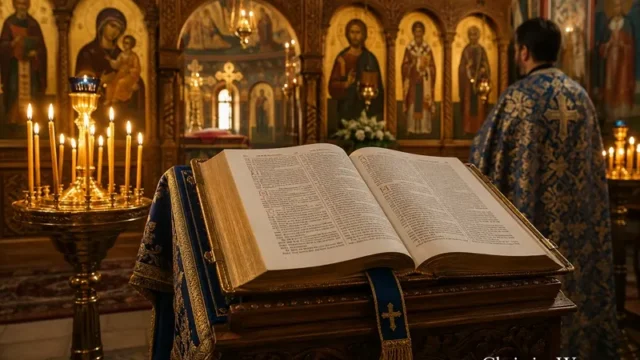
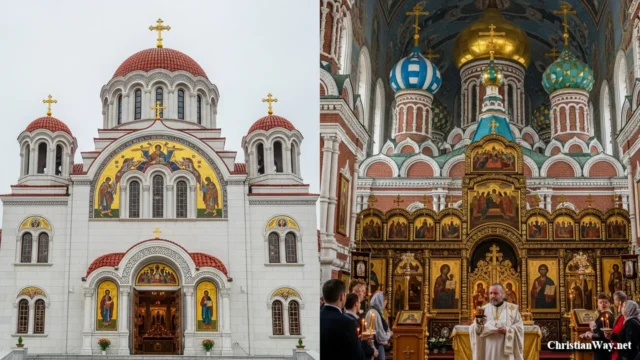
Orthodox faith therefore involves the whole person. The mind is enlightened, but the heart must also be purified. The body participates through bowing, fasting, baptism, anointing, receiving the Eucharist, and acts of mercy. The senses are drawn into worship through sacred images, candles, incense, chanting, and the beauty of the church building. Nothing truly human is excluded from redemption.
Orthodoxy sees salvation as the restoration of the entire human person. God does not save an invisible soul while abandoning the body, relationships, history, or creation. The Son of God assumed our complete humanity in order to heal it. Christian life is therefore a journey toward wholeness, in which every part of our existence is gradually brought into the light of Christ.
Belief in One God: Father, Son, and Holy Spirit
At the heart of Orthodox Christianity is faith in the Holy Trinity. Orthodox Christians believe in one God who eternally exists as three divine Persons: the Father, the Son, and the Holy Spirit. God is not three gods, nor is He one divine Person appearing under three temporary forms. The Father is truly God, the Son is truly God, and the Holy Spirit is truly God, yet there is only one divine nature and one God.
This mystery cannot be reduced to an earthly comparison. Every analogy eventually falls short because nothing in creation is exactly like the uncreated God. The Trinity is not a mathematical puzzle to be solved but the living mystery of divine love into which humanity is invited.
The Father is the eternal source within the life of the Trinity. The Son is eternally begotten of the Father, not created and not inferior. The Holy Spirit eternally proceeds from the Father and rests in the Son. The three divine Persons share one glory, one will, one power, and one divine life.
This faith was expressed with particular clarity at the early ecumenical councils, especially the Councils of Nicaea in 325 and Constantinople in 381. The Nicene-Constantinopolitan Creed, commonly called the Nicene Creed, remains central to Orthodox worship. It is normally recited or sung during every celebration of the Divine Liturgy.
The Trinity Reveals That God Is Love
The confession of the Trinity is not abstract speculation. It reveals that love belongs eternally to the being of God. Before anything was created, the Father loved the Son in the communion of the Holy Spirit. God did not create humanity because He was lonely or incomplete. He created freely, from the abundance of divine goodness.
Because God is love, human beings created in His image are made for communion. We do not become fully ourselves through isolation, selfishness, or domination. We become truly human by receiving love and giving ourselves in love. Sin fractures communion, while salvation restores it.
The Trinity also shapes Orthodox prayer. Christians pray to the Father, through the Son, in the Holy Spirit. Yet because the three divine Persons are one God, prayer offered to any Person of the Trinity is prayer offered to the one undivided God.
Many Orthodox prayers begin with words such as, “In the name of the Father, and of the Son, and of the Holy Spirit.” This is more than a formula. It reminds the believer that all of life belongs within the love of the Triune God.
Jesus Christ Is Fully God and Fully Human
Orthodox Christians believe that Jesus Christ is the eternal Son and Word of God who became truly human without ceasing to be divine. As the Gospel of John proclaims, “The Word became flesh and dwelt among us.” The incarnation is not the story of a human being gradually becoming divine. It is the mystery of the eternal Son of God assuming human nature.
Jesus Christ is one divine Person in two natures, divine and human. He is not half God and half man. He is fully God and fully human. His divinity and humanity are united without confusion, change, division, or separation.
This teaching was defended by the early Church because the truth of salvation depends upon it. Only God can save, yet what is not assumed is not healed. If Christ were not truly divine, He could not unite humanity to God. If He were not truly human, He could not heal human nature from within.
In Jesus, God entered the full reality of human existence. He experienced hunger, weariness, sorrow, friendship, rejection, suffering, and death. Yet He remained without sin. His humanity was not an appearance or disguise. The hands stretched upon the Cross were truly human hands, and the blood poured out was truly human blood—the blood of the incarnate Son of God.
The Incarnation Reveals the Dignity of Humanity
Because the Son of God became human, human life possesses an immeasurable dignity. The body is not evil. Material creation is not a prison from which the soul must escape. God took flesh, blessed matter, ate with His disciples, touched the sick, wept at the tomb of Lazarus, and rose bodily from the dead.
This is one reason Orthodox worship uses physical things so freely. Water is used in baptism. Oil is used in anointing. Bread and wine become the Eucharistic gifts. Incense rises before God. Icons bear witness to the incarnation. The material world can become a bearer of grace because the Word truly became flesh.
The incarnation also means that no ordinary aspect of life lies outside God’s concern. Family life, work, friendship, suffering, physical weakness, and the care of creation can all become places of communion with Christ.
The Cross and Resurrection Stand at the Center of Salvation
Orthodox Christians proclaim that Jesus Christ died upon the Cross for the salvation of the world and rose bodily from the dead on the third day. The Cross and Resurrection cannot be separated. The Cross reveals the depth of divine love, while the Resurrection reveals the victory of that love over sin, death, and the powers of darkness.
Orthodox theology recognizes that Scripture speaks about Christ’s saving work through many images. Christ is the sacrifice offered for sin. He is the Passover Lamb. He pays the price of redemption. He reconciles humanity to God. He defeats the devil. He heals corrupted human nature. He enters death in order to destroy death from within.
No single human analogy can contain the whole mystery. The Cross is not merely an example of courage, though it reveals perfect courage. It is not merely a legal transaction, though it brings forgiveness and reconciliation. It is the self-offering of the incarnate Son, who enters the deepest consequences of human sin and transforms death into the doorway of life.
On Holy Saturday, Orthodox hymns contemplate Christ descending into Hades and breaking the gates that held humanity captive. The icon of the Resurrection often portrays Christ standing victoriously over the shattered doors of death, taking Adam and Eve by the wrists and raising them from the tomb. This image expresses the deeply communal vision of salvation: Christ rises not for Himself alone but to raise the whole human family.
At Pascha, the Orthodox celebration of Easter, the Church repeatedly sings: “Christ is risen from the dead, trampling down death by death.” This hymn captures the heart of Orthodox hope. Death has not disappeared from human experience, but it no longer has the final word. Christ has entered the grave and filled even the place of darkness with His presence.
The Holy Spirit Gives Life to the Church
Orthodox Christians believe that the Holy Spirit is fully divine, the Lord and Giver of Life. The Spirit is not an impersonal force or religious emotion. He is the third Person of the Holy Trinity, eternally proceeding from the Father and sent into the world through the Son.
The Holy Spirit spoke through the prophets, descended upon Christ at His baptism, and was poured out upon the apostles at Pentecost. The same Spirit continues to dwell within the Church, guide her into truth, sanctify the faithful, and make Christ present in the sacraments.
In baptism and chrismation, the believer is united to Christ and receives the gift of the Holy Spirit. In the Eucharistic prayer, the Church asks the Father to send the Holy Spirit upon the bread and wine and upon the gathered people. In confession, ordination, marriage, healing, prayer, and every genuine act of Christian love, the Spirit is at work.
The purpose of the Christian life has sometimes been described in Orthodox spirituality as the acquisition of the Holy Spirit. This does not mean that the Spirit becomes an object that we possess. It means allowing the Holy Spirit to fill, purify, and transform us until our thoughts, desires, and actions become radiant with the life of Christ.
Salvation Is Participation in the Life of God
One of the most distinctive emphases of Orthodox Christianity is the teaching of theosis, often translated as deification or divinization. The word may sound strange at first, but it expresses an ancient Christian understanding of salvation.
Theosis does not mean that human beings become gods by nature or cease to be creatures. There is always an infinite distinction between the uncreated God and His creation. Rather, theosis means that human beings are invited by grace to participate in God’s life, holiness, love, and glory.
The Second Letter of Peter speaks of believers becoming “partakers of the divine nature.” Saint Athanasius famously summarized the mystery of the incarnation by teaching that the Son of God became human so that human beings might become godlike by grace.
Salvation is therefore more than the cancellation of guilt. Forgiveness is essential, but God desires not only to pardon us but also to heal and transform us. A person rescued from sin is called into communion with God. The image of God, darkened by sin, is cleansed and restored so that the likeness of God may shine more clearly.
Theosis Is Life in Christ
Theosis occurs through union with Jesus Christ. By baptism, believers are joined to His death and Resurrection. Through the Eucharist, they receive His life. Through prayer, repentance, fasting, and love, they learn to surrender their self-centered will and become receptive to divine grace.
This transformation is always a gift. No human being earns the divine life. Yet grace does not make human freedom unnecessary. Orthodox theology often speaks of synergy, meaning cooperation between divine grace and human freedom.
God always acts first. He creates, calls, forgives, strengthens, and sanctifies. The human person responds through faith, obedience, repentance, and love. Even our ability to respond is sustained by grace, yet God does not force communion upon us.
Saint Paul expresses this mystery when he tells Christians to work out their salvation because God is at work within them. Divine action and human response are not enemies. Grace frees human beings to become truly alive.
Sin Is Both Guilt and Spiritual Sickness
Orthodox Christians believe that sin is rebellion against God and a failure to live according to love. Sin carries moral responsibility, yet Orthodoxy frequently describes it in therapeutic language as sickness, corruption, slavery, or a wound.
Christ is therefore not only the Judge who forgives but also the Physician who heals. The Church is sometimes compared to a spiritual hospital in which wounded people receive the medicine of grace.
Orthodox Christianity often uses the term “ancestral sin” when speaking about humanity’s fallen condition. Through Adam and Eve, sin and death entered human experience. Human beings inherit mortality, corruption, and an inclination toward sin. They do not inherit personal blame for Adam’s individual act, but they are born into a world deeply marked by alienation from God.
Every person then adds personal sins to this inherited brokenness. We distort our desires, misuse our freedom, wound others, and turn inward upon ourselves. Sin is not merely the breaking of an external rule. It damages communion with God, neighbor, creation, and even our own true selves.
Repentance is therefore not humiliation for its own sake. It is the beginning of healing. The Greek word often translated as repentance, metanoia, suggests a change of mind, heart, and direction. To repent is to turn back toward the God who has never ceased to love us.
Scripture and Holy Tradition Belong Together
Orthodox Christians receive the Holy Bible as divinely inspired Scripture and the authoritative written witness to God’s saving revelation. The Bible is central to Orthodox worship, theology, preaching, and prayer.
During the Divine Liturgy, passages from the Epistles and the Gospels are proclaimed publicly. The Psalms fill the daily services. Orthodox hymns are woven from biblical language. Prayers echo the words of prophets, apostles, and evangelists. A person who attends Orthodox worship regularly encounters Scripture continually, even when the verses are not always announced by chapter and number.
Orthodox Christians do not view the Bible as isolated from the Church. The biblical books emerged within the worshiping community of God’s people, were preserved by the Church, and were recognized as Scripture through the Church’s life and discernment.
Holy Tradition is therefore not understood as a collection of merely human customs added to the Bible. Tradition is the living transmission of the apostolic faith in the Holy Spirit. Scripture is the heart of this Tradition, not its rival.
What Holy Tradition Includes
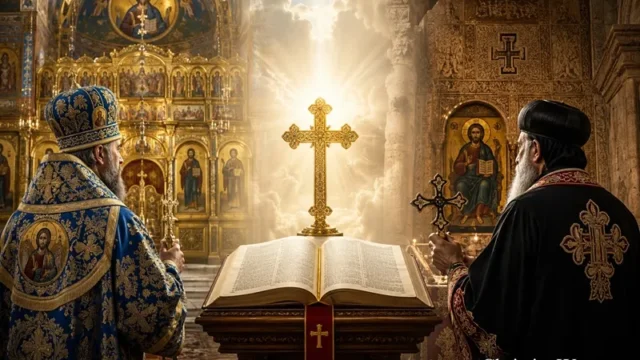
Holy Tradition includes the Scriptures, the ecumenical councils, the ancient creeds, the teaching of the Church Fathers, the Divine Liturgy, the sacraments, the lives of the saints, canonical order, sacred art, and the continuous life of prayer within the Church.
Not every custom possesses equal authority. Some practices are local, cultural, or changeable. The Church distinguishes between the apostolic Tradition that expresses the faith and traditions that belong to particular times or places.
The Fathers of the Church are honored not because every personal opinion they expressed was infallible, but because together they bear witness to the mind of the Church. Their writings help Christians interpret Scripture within the faith that produced, received, and preserved it.
Orthodox biblical interpretation is deeply Christ-centered. The Old Testament is read in the light of Christ, while the New Testament reveals the fulfillment of God’s covenantal work. The whole of Scripture is understood within the mystery of Christ’s death and Resurrection.
The Church Is the Body of Christ
Orthodox Christians confess belief in “one, holy, catholic, and apostolic Church.” The Church is not merely a voluntary association of people who share religious interests. She is the Body of Christ, the temple of the Holy Spirit, and the people of God gathered into communion.
Christ is the true Head of the Church. He remains present among His people through the Holy Spirit. The Church is both divine and human: divine because she receives her life from Christ, and human because her members remain weak, sinful, and in continual need of repentance.
The holiness of the Church does not mean that every Christian, priest, bishop, or institution always acts perfectly. Church history contains grievous failures, divisions, scandals, and sins. Yet Orthodox Christians believe that Christ remains faithful to His Body and that the Holy Spirit preserves the apostolic faith within the life of the Church.
Bishops and Apostolic Succession
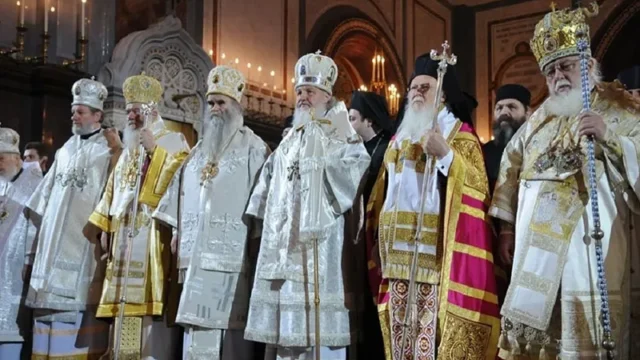
The Orthodox Church is episcopal, meaning that bishops hold a central pastoral and sacramental ministry. Bishops are understood as successors of the apostles, ordained through the laying on of hands within the continuous life of the Church.
A bishop is not an independent ruler. He is called to guard the apostolic faith, preside over the Eucharist, shepherd the people, ordain clergy, care for unity, and serve as an icon of Christ the Good Shepherd.
Priests serve under their bishop and ordinarily preside over local parish communities. Deacons assist in worship and service. All ordained ministry exists for the building up of the whole Body of Christ, not for personal privilege.
The laity are not passive spectators. Every baptized Christian shares in the life and mission of the Church. Laypeople pray, teach, serve, bear witness, raise families in faith, care for those in need, and help preserve the truth through their faithful participation.
A Communion of Local Churches
Eastern Orthodoxy is organized as a communion of self-governing, or autocephalous, churches. These include ancient patriarchates and national or regional churches. They share the same essential faith, sacraments, apostolic succession, and liturgical tradition, even though languages and cultural customs may differ.
Orthodox unity is expressed through communion rather than through a single bishop exercising direct jurisdiction over every Christian. The Ecumenical Patriarch of Constantinople holds a place of honor often described as “first among equals,” but Orthodoxy does not understand this role in the same way that Roman Catholicism understands the universal jurisdiction of the pope.
Councils are essential to Orthodox church life. Bishops gather to discern matters of doctrine, discipline, and pastoral care. The ideal is conciliarity: the whole Church seeking faithfulness to Christ through prayerful communion.
The Divine Liturgy Is the Heart of Orthodox Worship
Orthodox worship is centered upon the Divine Liturgy, especially the celebration of the Eucharist on Sundays and feast days. The Liturgy is not designed primarily as religious entertainment or as a lecture accompanied by music. It is the Church’s participation in the worship of heaven and in the saving work of Christ.
During the Liturgy, the faithful hear Scripture, offer prayers for the Church and the world, confess the Creed, bring bread and wine to the altar, give thanks to God, and receive Holy Communion.
Orthodox Christians believe that the consecrated bread and wine truly become the Body and Blood of Jesus Christ. The Eucharist is not considered a mere symbol or mental reminder. It is a real participation in Christ’s life, death, Resurrection, and heavenly kingdom.
The Church does not attempt to explain this mystery through curiosity or reduce it to a physical process. She receives Christ’s words with reverence: “This is My body” and “This is My blood.”
Worship Involves the Whole Person
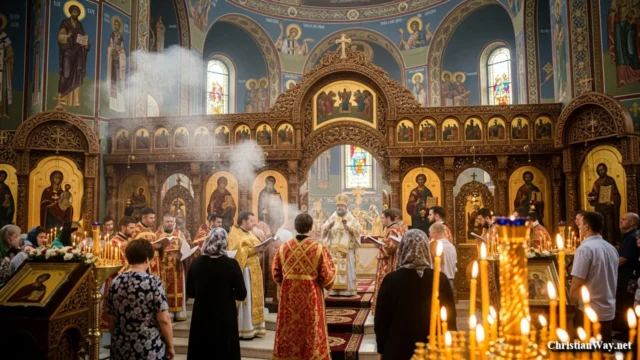
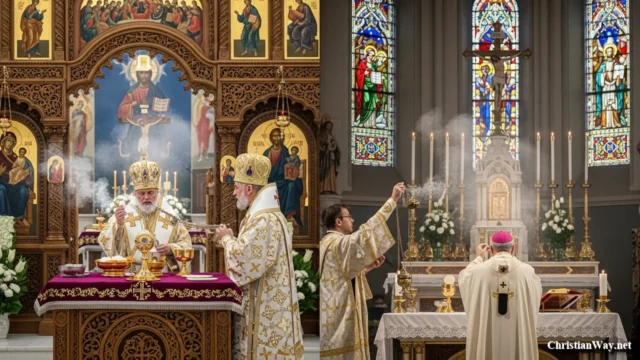
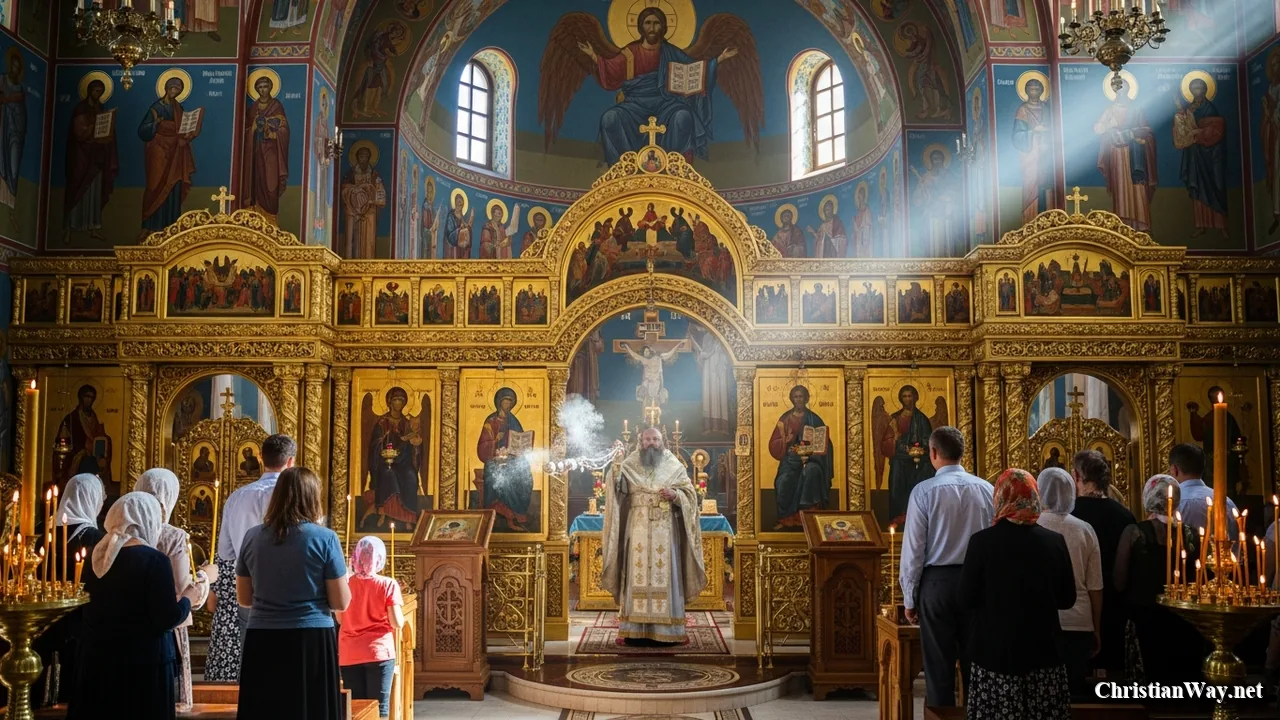
Orthodox services may initially feel unfamiliar to visitors. The faithful often stand for long periods, make the sign of the Cross, bow, light candles, kiss icons, hear repeated litanies, and breathe the fragrance of incense.
These actions are not meant to distract from spiritual worship. They express the conviction that human beings worship as embodied persons. The body is not left outside while the mind thinks about God. The whole person enters prayer.
Incense recalls the prayers of the saints rising before God. Candles represent Christ as the Light of the world and the believer’s offering of prayer. Processions express the Church’s journey toward the kingdom. Chant allows Scripture and prayer to be proclaimed with solemn beauty.
The Liturgy is filled with a sense of holy time. Earth and heaven meet around the altar. The living pray with the angels, apostles, martyrs, saints, and faithful departed. Worship becomes participation in a reality greater than what the physical eyes can see.
Orthodox Christians Receive the Holy Mysteries
What many Western Christians call sacraments are commonly called the Holy Mysteries in Orthodox Christianity. Orthodoxy often speaks of seven principal Mysteries: baptism, chrismation, Eucharist, confession, marriage, ordination, and holy unction.
However, the sacramental life of the Church is not always rigidly limited to seven. The blessing of water, monastic tonsure, burial, the consecration of a church, and many other acts reveal that all creation is called to be filled with grace.
Baptism, Chrismation, and Communion
Baptism unites a person to the death and Resurrection of Christ. It is commonly administered through threefold immersion in the name of the Father, the Son, and the Holy Spirit. Through baptism, sins are forgiven, the believer is incorporated into Christ, and a new life begins.
Chrismation normally follows immediately. The newly baptized person is anointed with holy chrism and receives the seal of the gift of the Holy Spirit. This corresponds to confirmation in some Western traditions, though in Orthodoxy it is ordinarily given even to infants.
The newly baptized and chrismated person then receives Holy Communion. Orthodox infants are therefore fully initiated into the sacramental life of the Church and continue to receive the Eucharist as they grow.
Confession as Reconciliation and Healing
In confession, Christians acknowledge their sins before God in the presence of a priest. The priest is not the source of forgiveness; Christ forgives. The priest serves as a witness, spiritual physician, and pastoral guide.
Confession is not intended to produce terror or shame. It brings hidden wounds into the light so that grace may heal them. The priest may offer counsel or a spiritual discipline, not as punishment in a merely legal sense, but as medicine suited to the person’s healing.
Marriage, Ordination, and Holy Unction
In Orthodox marriage, a man and woman are crowned as they enter a shared life of self-giving love. Marriage is understood as a path of salvation, sacrifice, fidelity, hospitality, and growth in holiness.
In ordination, the Holy Spirit sets apart bishops, priests, and deacons for service within the Church. Ordination does not make a person spiritually superior. It gives a particular responsibility to teach, sanctify, shepherd, and serve.
Holy unction involves anointing with oil and prayer for healing. It is not limited to the final moments before death. The Church prays for the healing of body and soul while entrusting the outcome to God’s wisdom.
Icons Bear Witness to the Incarnation
Orthodox churches and homes are often filled with icons of Christ, the Virgin Mary, angels, biblical events, and saints. To someone unfamiliar with Orthodox worship, the kissing or bowing before icons may appear to be idolatry. Orthodox Christians firmly reject that interpretation.
Worship belongs to God alone. Icons are venerated, not worshiped. The honor shown to an icon passes to the person represented. A Christian who kisses an icon of Christ does not love wood and paint as a god. The gesture expresses love for Jesus Christ.
Icons are possible because of the incarnation. Before the Son of God became human, God could not be portrayed according to His invisible divine nature. But the eternal Word became visible in human flesh. The apostles saw His face, touched His hands, and witnessed His earthly life.
To paint Christ is therefore to confess that He truly became human. The icon does not claim to capture His divine essence. It bears witness to the historical reality of the incarnation.
Icons are sometimes called theology in color. Their purpose is not merely decoration or realistic portraiture. Through disciplined forms, gestures, and symbols, they proclaim the transfigured world of the kingdom of God.
Mary Is Honored as the Theotokos
Orthodox Christians hold the Virgin Mary in profound honor and commonly call her the Theotokos, a Greek title meaning “God-bearer” or “Mother of God.” This title does not mean that Mary created the divine nature or existed before God. It protects the truth about Jesus Christ.
The one born from Mary is the eternal Son of God in human flesh. She is therefore rightly called the Mother of God because she is the mother of the divine Person who became human.
Mary is honored for her unique role in salvation history and for her free, faithful response to God. At the Annunciation she receives the angelic message with humility: “Let it be to me according to your word.” Her obedience stands in contrast to the disobedience that wounded humanity.
Orthodox Christians see Mary as the highest example of what divine grace can accomplish in a human life. She does not replace Christ or compete with Him. Everything she is comes from God. Her greatness lies in receiving Christ, bearing Him, following Him, and directing others toward Him.
Orthodoxy traditionally teaches that Mary remained ever-virgin and that she was taken into heavenly glory at the completion of her earthly life, commemorated in the Feast of the Dormition. The Orthodox Church does not define every detail of her life in exactly the same manner as later Western dogmatic formulations, but her holiness and closeness to Christ hold a central place in Orthodox devotion.
The Saints Are Alive in Christ
Orthodox Christians honor the saints as members of Christ’s Body who have been transformed by grace. The saints are not spiritual celebrities or alternative saviors. They are witnesses to what Christ can accomplish in human beings who surrender themselves to Him.
The New Testament describes the Church as surrounded by a “great cloud of witnesses.” Because Christ has conquered death, the communion of believers is not destroyed by physical death. Those who have died in Christ remain alive in Him.
Orthodox Christians therefore ask the saints to pray for them, just as Christians on earth ask one another for prayer. All prayer is ultimately answered through the mercy and power of God. The saints do not possess independent divine power.
The veneration of saints also teaches that holiness takes many forms. Among the saints are apostles, martyrs, bishops, monastics, rulers, physicians, married couples, soldiers, teachers, children, and ordinary believers. Their lives show that the Gospel can be lived in every age and circumstance.
Relics are honored because the body participates in holiness. A saint’s body was baptized, received the Eucharist, endured suffering, performed acts of mercy, and became a temple of the Holy Spirit. Reverence for relics therefore expresses both the incarnation and the hope of bodily resurrection.
Prayer, Fasting, and Almsgiving Shape Orthodox Life
Orthodox belief is inseparable from spiritual practice. Prayer, fasting, and almsgiving form a threefold discipline through which Christians turn toward God, gain freedom from disordered desires, and grow in love for their neighbors.
Prayer is communion with God. It includes praise, thanksgiving, repentance, intercession, silence, and attentive listening. Orthodox Christians use both established prayers and spontaneous words. The Church’s written prayers help believers pray beyond the limits of their present emotions and unite personal prayer with the faith of generations.
Many Orthodox Christians maintain a prayer corner at home with icons, a Bible, a cross, and a lamp or candle. Morning and evening prayers establish a rhythm in which daily life is offered to God.
The Jesus Prayer
One of the best-known Orthodox prayers is the Jesus Prayer: “Lord Jesus Christ, Son of God, have mercy on me, a sinner.”
This brief prayer contains a confession of Christ’s identity, an acknowledgment of personal need, and an appeal to divine mercy. It may be repeated quietly with attention and humility throughout the day.
The purpose is not mechanical repetition or an attempt to control God. It is to gather the wandering mind into the heart and remember the presence of Christ. Over time, prayer may become more continuous, fulfilling Saint Paul’s exhortation to “pray without ceasing.”
Fasting as Freedom
Orthodox fasting normally involves abstaining from certain foods during appointed seasons and days. The details vary according to health, age, pastoral guidance, and personal circumstances.
Fasting is not a way to earn God’s love, punish the body, or demonstrate religious superiority. Its purpose is freedom. By voluntarily limiting legitimate desires, Christians learn that appetite need not rule the heart.
True fasting must be accompanied by prayer, repentance, and mercy. To avoid certain foods while devouring another person through gossip or cruelty would contradict the purpose of fasting. The prophets repeatedly teach that the fast pleasing to God includes justice, generosity, and care for the oppressed.
Almsgiving as Love Made Visible
Almsgiving directs spiritual life outward. The poor are not interruptions to religious devotion. Christ identifies Himself with the hungry, the stranger, the sick, the imprisoned, and the vulnerable.
Orthodox Christianity teaches that possessions are gifts entrusted to us for loving stewardship. Generosity loosens the grip of selfishness and restores communion. Even a small gift, offered sincerely, can become a participation in divine love.
Orthodox Moral Teaching Is a Call to Healing
Orthodox Christianity has moral teachings concerning marriage, sexuality, family life, the dignity of human life, justice, honesty, forgiveness, care for creation, and responsibility toward the poor. Yet morality is not meant to be reduced to external rule-keeping.
The commandments reveal the shape of a healed human life. They show what love looks like when embodied in choices and relationships. Sinful behavior matters because it wounds persons and damages communion.
Orthodox moral guidance is normally practiced pastorally. A spiritual father or mother seeks to understand the individual person, not merely categorize an offense. The same truth applies to everyone, but its pastoral application may require patience, wisdom, and mercy.
The aim is not moral perfectionism. Christians fall, repent, receive forgiveness, and begin again. The spiritual life often involves slow growth rather than dramatic success. God’s mercy does not excuse sin, but neither does human weakness exhaust His compassion.
In family life, the workplace, the parish, and society, Orthodox Christians are called to embody the Beatitudes: humility, mercy, purity of heart, peacemaking, hunger for righteousness, and faithful endurance.
Death, Judgment, and the Resurrection of the Dead
Orthodox Christians believe that human life continues beyond physical death, that every person will stand before God, and that Christ will return in glory to judge the living and the dead.
The final Christian hope is not the permanent escape of the soul from the body. It is the resurrection of the dead and the renewal of creation. Christ rose bodily, and those united to Him will also be raised.
At death, the soul enters an intermediate state while awaiting the general resurrection. Orthodox Christians pray for the departed, entrusting them to God’s mercy. These prayers express love and the conviction that the Church’s communion transcends death.
Orthodoxy tends to speak with reverent restraint about the precise details of the afterlife. Heaven is communion with God, while hell is the tragic rejection and painful experience of divine love by a heart closed against it. God does not cease to be love, yet His presence is experienced differently according to the condition of the person.
The Last Judgment reveals the truth of every life. Nothing hidden will remain concealed. Yet the Judge is the crucified and risen Christ, who has shown the immeasurable depth of His mercy.
Christian hope rests not in human merit but in Christ’s victory. As Saint Paul declares, Christ has been raised as the firstfruits of those who have fallen asleep.
Orthodox Christians Await the Renewal of All Creation
Salvation has cosmic dimensions. Human sin affects creation, while human redemption anticipates creation’s renewal. Saint Paul writes that creation itself groans as it waits for liberation from corruption.
The Orthodox vision is not that God will discard the material world as a failed experiment. The biblical hope is a new heaven and a new earth, creation transfigured by divine glory.
This belief gives spiritual meaning to the care of the natural world. Environmental responsibility is not separate from faith. The earth belongs to God, and humanity is called to serve as a priestly steward, receiving creation with thanksgiving and offering it back in love.
The Eucharist reveals this calling. Bread and wine—fruits of the earth and human labor—are offered to God and received as communion. The created world is shown to be capable of bearing grace and praise.
Orthodoxy and Other Christian Traditions
Orthodox Christians share with Roman Catholics, Protestants, Anglicans, Oriental Orthodox Christians, and other followers of Jesus many foundational convictions: belief in the Triune God, the divine and human natures of Christ, His saving death and Resurrection, the authority of Scripture, the need for grace, and the hope of eternal life.
Yet important differences remain. Orthodoxy does not accept later claims of universal papal jurisdiction and infallibility as defined by the Roman Catholic Church. It preserves the original form of the Nicene Creed without the later Western addition known as the Filioque. It understands inherited sin, salvation, ecclesial authority, and certain Marian teachings in ways that differ from common Western formulations.
In relation to many Protestant traditions, Orthodoxy places greater emphasis on apostolic succession, sacramental worship, Holy Tradition, the intercession of saints, the veneration of icons, and salvation as lifelong transformation.
These differences should be discussed honestly but without hostility. Christian truth does not require contempt. Orthodox Christians are called to bear witness with humility, remembering that correct doctrine without love becomes a contradiction.
The prayer of Christ that His disciples may be one remains a wound and a summons. Genuine unity cannot be built by pretending that serious differences do not exist, but neither can it be served through caricature, pride, or bitterness.
What Orthodox Christians Believe Must Become How They Live
The deepest test of Orthodox faith is not whether someone can explain every doctrine perfectly. It is whether the life of Christ is becoming visible within the person.
A Christian may know the Creed, understand the councils, fast according to the calendar, and attend every service, yet remain proud, harsh, or indifferent. Such outward faithfulness has not yet borne its intended fruit.
Orthodox tradition repeatedly warns against judging others. The more clearly a person sees the holiness of God, the more deeply that person becomes aware of personal sin and the need for mercy.
True Orthodoxy produces humility. It softens the heart toward the suffering. It teaches a person to forgive enemies, restrain anger, speak truth without cruelty, remain faithful in hidden duties, and give thanks even in hardship.
This transformation is rarely immediate. The Christian life is a long pilgrimage of falling and rising. There are seasons of consolation and seasons when God seems silent. There are prayers filled with joy and prayers spoken through tears. There are moments of clarity and long periods of patient endurance.
Through all these experiences, Christ remains faithful. The Church does not offer a technique for avoiding suffering. She offers communion with the crucified and risen Lord, who enters suffering and transforms it from within.
To ask what Orthodox Christians believe is ultimately to ask what kind of life they believe humanity was created to receive. The Orthodox answer is a life of communion: communion with the Father through the Son in the Holy Spirit, communion with the Church, communion with the saints, communion with our neighbors, and communion with a creation destined for glory.
Orthodox Christianity believes that the human person is wounded but not worthless, fallen but still loved, mortal but called to resurrection. It believes that Christ has entered the darkness and that the darkness cannot overcome Him. It believes that holiness is possible because grace is real.
The Church therefore continues to proclaim the same Paschal hope in every generation: Christ is risen. Death has been defeated. Forgiveness is offered. The Holy Spirit has been given. The kingdom of God has drawn near.
In the Light of Christ
Dear friends, the Orthodox faith is ancient, but it is not lifeless. It is carried in the prayers of elderly believers standing quietly before an icon, in the baptism of a child, in the repentance of someone returning after many years, in the bread offered at the altar, and in the whispered Jesus Prayer of a soul seeking mercy.
Its doctrines point toward encounter. Its worship opens toward communion. Its disciplines seek the healing of the heart. Its icons reveal humanity filled with divine light. Its saints show that Christ can transform real people in the midst of real weakness.
Perhaps the most important question is therefore not only, “What do Orthodox Christians believe?” but also, “What does this faith reveal about the God who seeks us?”
It reveals the Father who creates and welcomes, the Son who descends into suffering and death to raise us, and the Holy Spirit who enters the hidden chambers of the human heart. It reveals a God who does not save from a distance but draws near, assumes our nature, bears our wounds, and calls us into His eternal life.
May we receive this mystery not merely as knowledge but as grace. May the Lord purify our hearts, heal our divisions, and teach us to see His image in every person. May He give courage to those who are afraid, comfort to those who mourn, repentance to those who have wandered, and hope to those who feel trapped in darkness.
Lord Jesus Christ, eternal Son of the Father, draw us into the life of Your kingdom. Forgive our sins, heal the wounds we carry, and fill us with Your Holy Spirit. Teach us to pray with humility, to serve with compassion, and to love without counting the cost. Through the prayers of the Mother of God and all the saints, keep us faithful until we behold the light of Your Resurrection.
May the peace of Christ dwell richly in your heart, and may His love guide every step you take toward Him.
— Fr. John Matthew