Dear friends, peace be with you as we embark on this sacred journey.
In our modern world, we are often tempted to measure value by novelty. We chase the newest trends, the latest technologies, and the freshest ideas. Yet, the human soul possesses a deep, often unspoken, craving for continuity. We long to know that we are not drifting aimlessly in time, but are anchored to something—or Someone—eternal. This is the spiritual gift offered by the oldest Catholic churches in the world. These are not merely architectural feats; they are the “living stones” of history, witnesses to the endurance of the Gospel through empires, plagues, wars, and schisms.
When we approach these holy sites, we must do so with the heart of a pilgrim, not a tourist. A tourist looks at a building and asks, “How old is this?” A pilgrim looks at the same stones and asks, “Who has prayed here before me?” To step into these sanctuaries is to breathe the same air as St. Augustine, St. Helena, and countless anonymous saints who knelt on these floors to offer their brokenness to God. It is to realize that the Church is a vast, vertical communion stretching back to the Upper Room.
In this guide, we have taken great care to honor both historical archaeology and the continuity of faith. We have included sites that are purely ancient, and sites—like St. Peter’s in the Vatican—where the original foundations (c. 320 AD) support a newer structure, proving that while the “outer garment” of the Church may change, the apostolic foundation remains immovable. These places remind us here at Christian Way that the gates of hell shall not prevail.
Let us turn our hearts to these sacred treasures.
Table of The Top 10 Oldest Catholic Churches in the World
| Rank | Name | Location | Founding Date | Spiritual Essence |
|---|---|---|---|---|
| 10 | Monastery of Saint Anthony | Egypt | 356 AD | The desert cradle of monastic silence and prayer. |
| 9 | Cathedral of Trier | Germany | 340 AD | The oldest cathedral in Germany; symbol of unity. |
| 8 | Santa Maria in Trastevere | Rome, Italy | 340 AD | One of the first public celebrations of the Virgin Mary. |
| 7 | Church of the Holy Sepulchre | Jerusalem | 335 AD | The site of the Crucifixion and the Resurrection. |
| 6 | Church of the Nativity | Bethlehem | 326 AD | The sacred grotto of the Incarnation. |
| 5 | Panagia Ekatontapiliani | Paros, Greece | 326 AD | St. Helena’s vow; the “Church of 100 Doors.” |
| 4 | Archbasilica of St. John Lateran | Rome, Italy | 324 AD | The Mother and Head of all Churches. |
| 3 | St. Peter’s Basilica (Vatican) | Vatican City | c. 320 AD | Built over the tomb of Peter; the center of unity. |
| 2 | Etchmiadzin Cathedral | Armenia | 301 AD | The first cathedral of the first Christian nation. |
| 1 | Dura-Europos House Church | Syria | c. 233 AD | The earliest identified house church; the seed. |
Top 10. Monastery of Saint Anthony (Egypt) — Est. 356 AD
Our journey begins far from the comforts of civilization, deep in the Red Sea mountains of Egypt. Here lies the Monastery of Saint Anthony, established in 356 AD by the followers of the first great Desert Father. St. Anthony did not seek to build a building; he sought to build a life of total communion with God. He fled the noise of the city to fight the demons of the self in the silence of the wilderness. The monastery that grew around his cave is a testament to the fact that holiness attracts. Even when you run away from the world to be with Jesus, the world will eventually beat a path to your door seeking that same light.
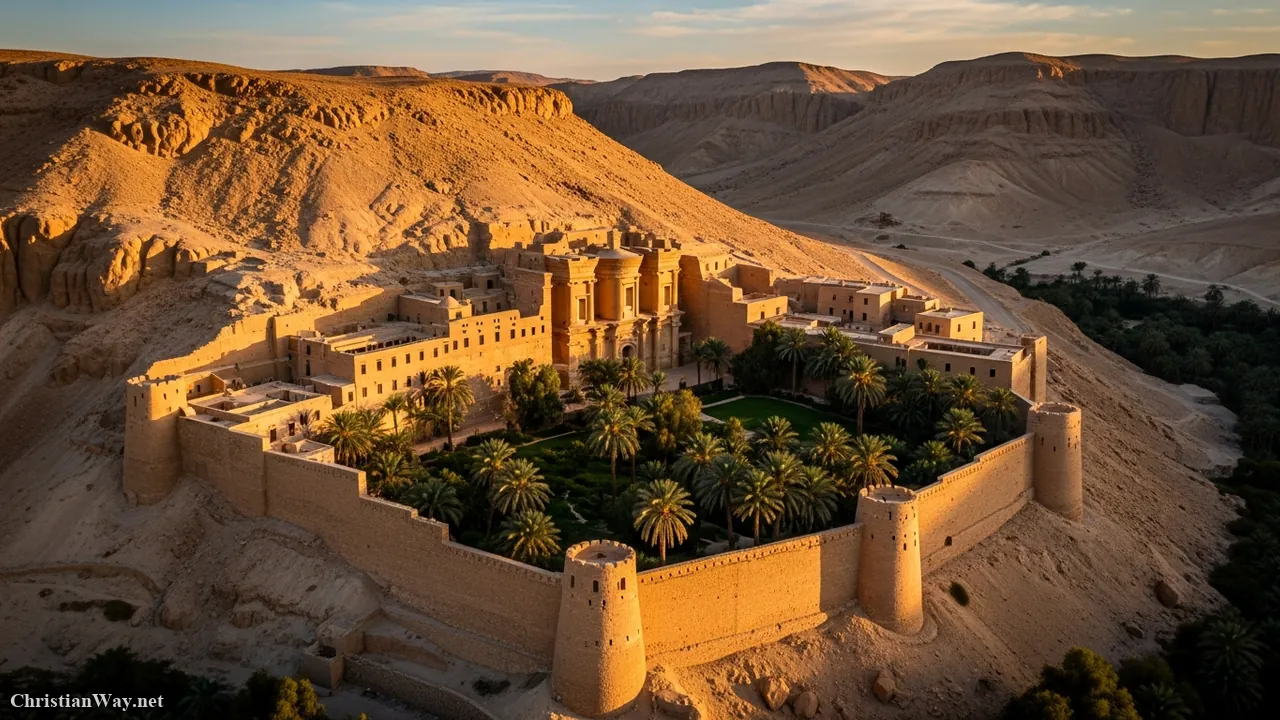
The theology of this place is the theology of “The Desert.” In Scripture, the desert is the place of testing, but also the place of espousal where God speaks to the heart of Israel. For over 1,600 years, Coptic monks have maintained a rhythm of prayer here that has never ceased. It reminds us that the Church does not rely on political power or social relevance, but on the hidden engine of prayer. Without the prayer of the contemplative, the active work of the Church would run out of fuel.
For us today, drowning in a sea of digital notifications and constant noise, St. Anthony’s offers a stark challenge. We are terrified of silence because in silence, we must face ourselves. But this ancient monastery invites us to unplug, even for ten minutes a day, to enter the “inner cell” of our hearts. It assures us that if we seek God in the silence, we will find Him waiting there with love.
Spiritual Highlights:
- The Spring: An ancient spring flows within the monastery walls, a miracle of life in a dead land.
- Scripture: “In returning and rest you shall be saved; in quietness and in trust shall be your strength.” (Isaiah 30:15)
Top 9. Cathedral of Trier (Germany) — Est. 340 AD
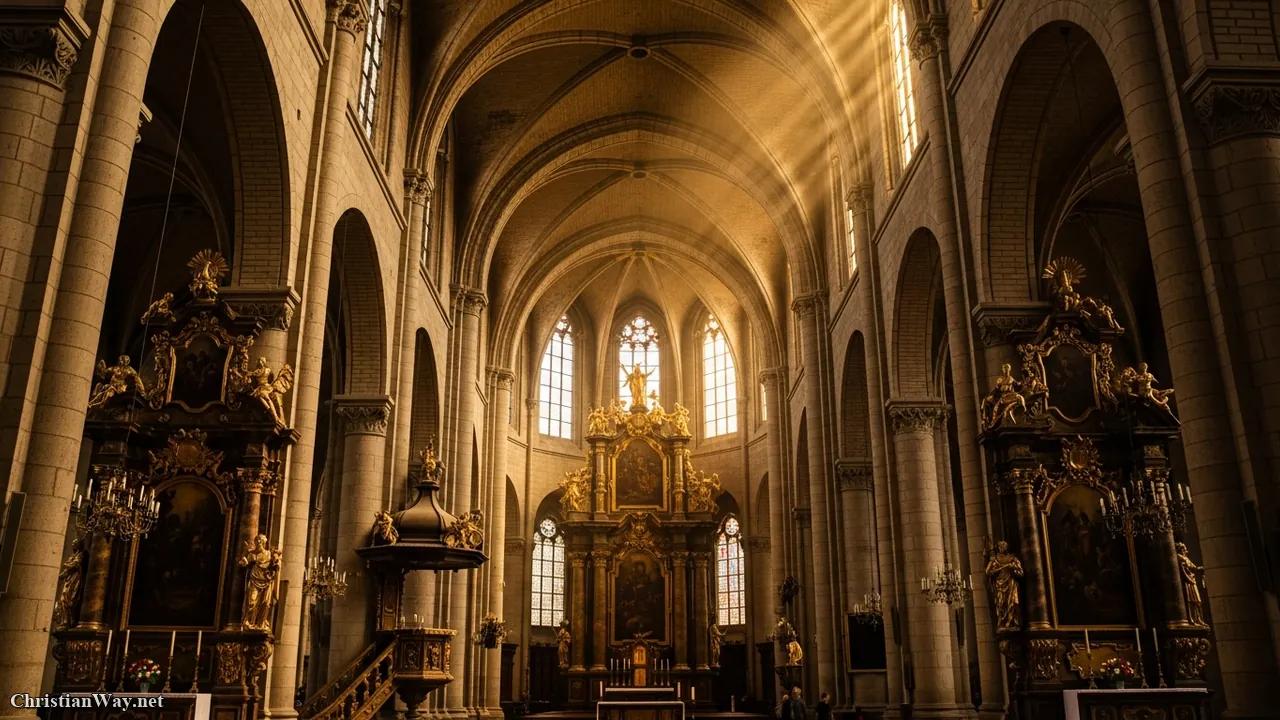
We travel north to the oldest city in Germany, where the Roman Empire left an indelible mark. The Cathedral of Trier (Dom St. Peter) was commissioned by Emperor Constantine and his devout mother, St. Helena. The structure is a visible timeline of Church history: you can see the Roman brickwork of the 4th century, the Romanesque additions of the 11th century, and the Baroque stucco of the 18th century. It is a building that has grown organically, just like the Body of Christ, adapting to the ages while remaining rooted in the same foundation.
The spiritual heart of Trier is the “Holy Robe,” traditionally believed to be the seamless tunic of Jesus for which the Roman soldiers cast lots. The theology here is profound: the seamless garment represents the indivisible unity of the Church. Heresy and schism tear at the Body of Christ, but the robe remains whole. It is a powerful symbol that unity is not something we create by negotiation, but a gift from Christ that we must preserve.
In a time of polarization, both in the world and within the Church, Trier stands as a fortress of unity. It asks us a difficult question: Are we “weavers” who mend relationships, or are we “tearers” who pull at the loose threads of our community? When we visit Trier in spirit, we are asked to pray for the fulfillment of Jesus’ High Priestly prayer: “That they may all be one.”
Spiritual Highlights:
- The Relic: The Seamless Robe of Jesus, rarely displayed but constantly venerated.
- The Architecture: A visual lesson that the Church is ever-ancient and ever-new.
Top 8. Santa Maria in Trastevere (Rome, Italy) — Est. 340 AD
Crossing the Tiber River in Rome, we enter the neighborhood of Trastevere. Here stands a basilica that radiates a uniquely maternal warmth. While Christians gathered at this site (the Titulus Callixti) as early as 220 AD, the grand structure we recognize as a church was raised in 340 AD by Pope Julius I. It holds the honor of being one of the first churches in Rome—and perhaps the world—dedicated openly to the Blessed Virgin Mary.
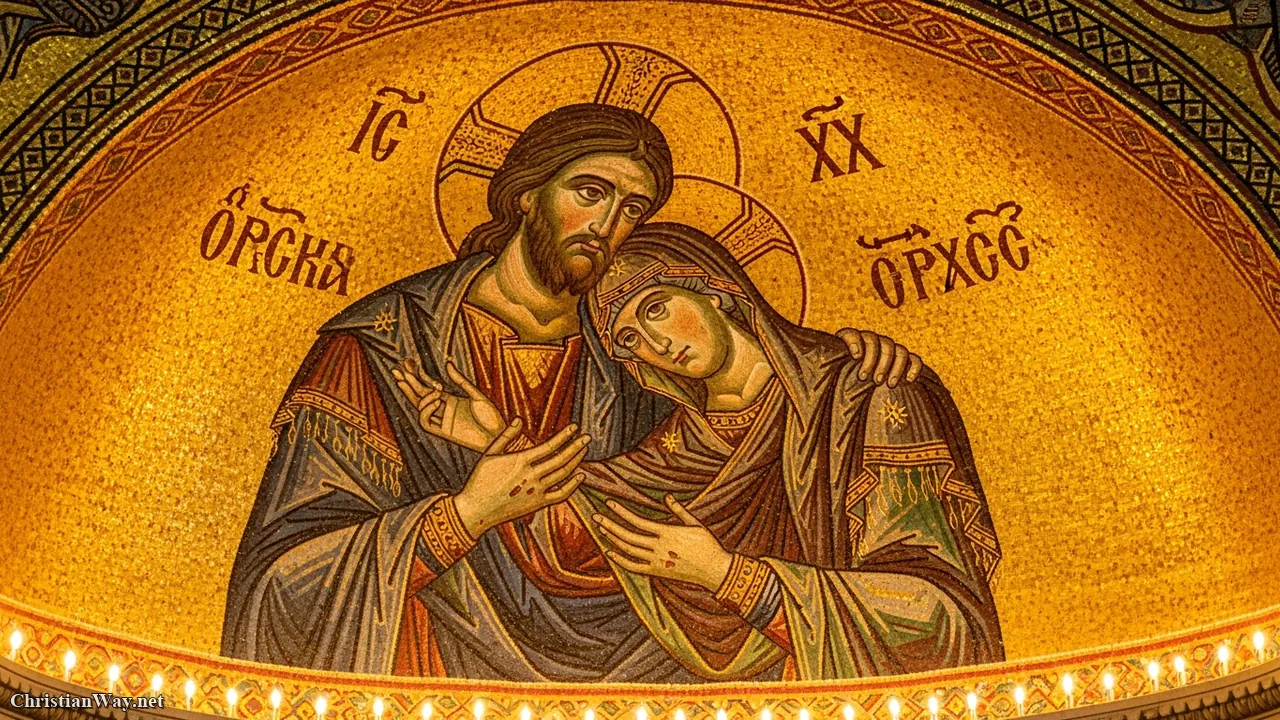
The apse mosaics here are a theological masterpiece. They depict Christ and Mary seated on the same throne. Unusually, Jesus has his arm affectionately around his mother’s shoulder. It is an image of divine intimacy. It teaches us that the Queen of Heaven is not a distant figure, but the beloved of the King. The gold tiles catch the light in a way that makes the whole church shimmer, reminding us that Mary is the “Mirror of Justice” who reflects the light of her Son.
This church has always been a refuge for the poor of Rome, and the Community of Sant’Egidio continues that work today. It reminds us that true devotion to Mary must lead us to serve the vulnerable. If we love the Mother, we must love the children she cherishes—the poor, the lonely, and the outcast. Santa Maria in Trastevere is a home for those who feel they have no home.
Spiritual Highlights:
- The Legend: The Fons Olei (Fount of Oil) that sprang up here, interpreted by Christians as a sign of the coming Grace of Christ.
- Scripture: “My soul magnifies the Lord, and my spirit rejoices in God my Savior.” (Luke 1:46-47)
Top 7. Church of the Holy Sepulchre (Jerusalem) — Est. 335 AD
We arrive now at the axis of the Christian world. The Church of the Holy Sepulchre is not a neat and tidy cathedral; it is a sprawling, chaotic, smoky complex that encloses the two most important sites in history: Golgotha, where Christ died, and the Tomb, where He rose. Consecrated in 335 AD, it has been destroyed, rebuilt, and divided among six Christian denominations, yet it remains the most powerful witness to the Paschal Mystery.
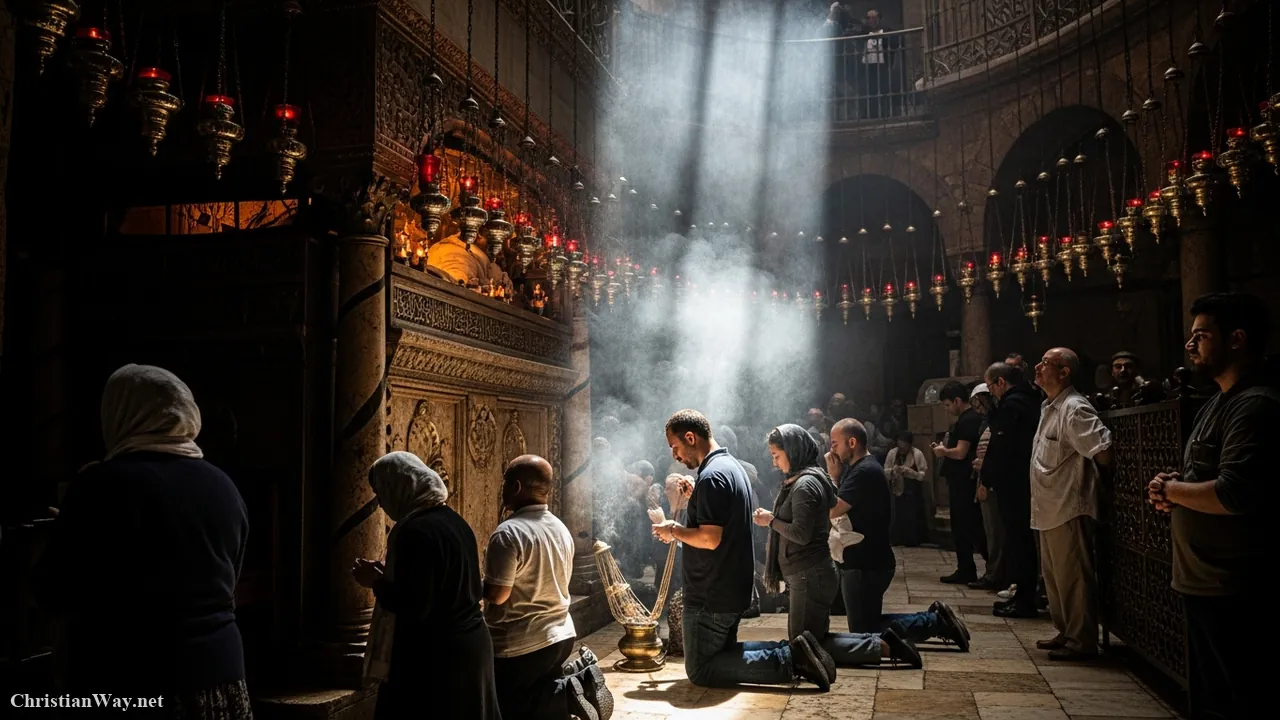
The theology here is visceral. To enter, you must climb the steep stairs to Calvary to touch the rock of the Crucifixion, and then descend to the Aedicule to touch the stone of the Resurrection. It forces us to physically enact the truth that there is no Easter Sunday without Good Friday. The church itself is a lesson in the complexity of the Body of Christ—different liturgies, different languages, and historical tensions all sharing the same roof, united by the empty tomb.
For the weary believer, the Holy Sepulchre is the ultimate sign of hope. We all have “tombs” in our lives—places where hope seems dead, where addiction, failure, or grief has rolled a stone over our hearts. This ancient church stands as a defiance of despair. It proclaims that God specializes in rolling away stones. It invites us to bring our dead things to Jesus, trusting that He is the God of the living.
Spiritual Highlights:
- The Stone of Anointing: A slab of reddish stone where pilgrims weep and anoint the spot where tradition says Christ’s body was prepared.
- The Immovable Ladder: A ladder on a window ledge that has remained in place since the 18th century due to the “Status Quo” agreement—a symbol of our human stubbornness amidst divine grace.
Top 6. Church of the Nativity (Bethlehem) — Est. 326 AD
Just a few miles from Jerusalem, in the occupied West Bank, stands the Church of the Nativity. Commissioned by Constantine, it protects the grotto believed to be the birthplace of Christ. It is unique among the churches of the Holy Land because it was spared destruction by the Persian invaders in 614 AD. Legend says they saw the mosaics of the Three Magi dressed in Persian clothing and, out of respect for their ancestors, left the church standing.
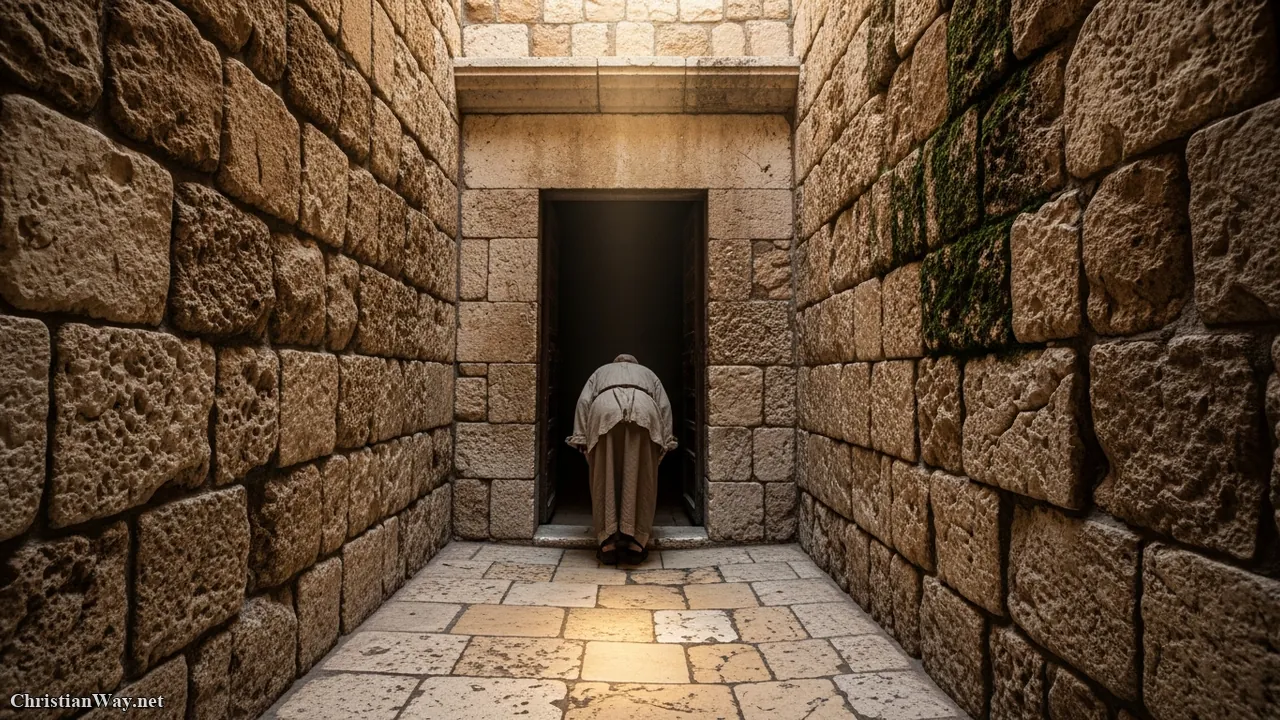
The entrance to this massive basilica is a tiny, rectangular opening less than four feet high, known as the “Door of Humility.” Originally resized to prevent looters from riding horses inside, it now serves a perfect theological purpose: you cannot enter the presence of the Christ Child without bowing. It is a physical lesson in spiritual posture. God lowered Himself from heaven to earth; we must lower ourselves to meet Him.
In a world that celebrates pride, power, and self-promotion, Bethlehem is a quiet rebuke. It reminds us that God is found in the small, the vulnerable, and the ordinary. As we contemplate this ancient site, we must ask ourselves: What pride do I need to shed to fit through the door of God’s grace? Are we willing to become small so that He can increase?
Spiritual Highlights:
- The Silver Star: Embedded in the floor with the Latin inscription: Hic de Virgine Maria Jesus Christus natus est (Here Jesus Christ was born of the Virgin Mary).
- Scripture: “And the Word became flesh and dwelt among us.” (John 1:14)
Top 5. Panagia Ekatontapiliani (Paros, Greece) — Est. 326 AD
On the Greek island of Paros, surrounded by the turquoise Aegean Sea, stands the Panagia Ekatontapiliani, or “The Church of a Hundred Doors.” Tradition holds that St. Helena, the mother of Constantine, stopped here during a storm while on her way to Jerusalem to find the True Cross. She made a vow: if she completed her journey safely, she would build a magnificent church to the Virgin Mary. Her son fulfilled that promise.
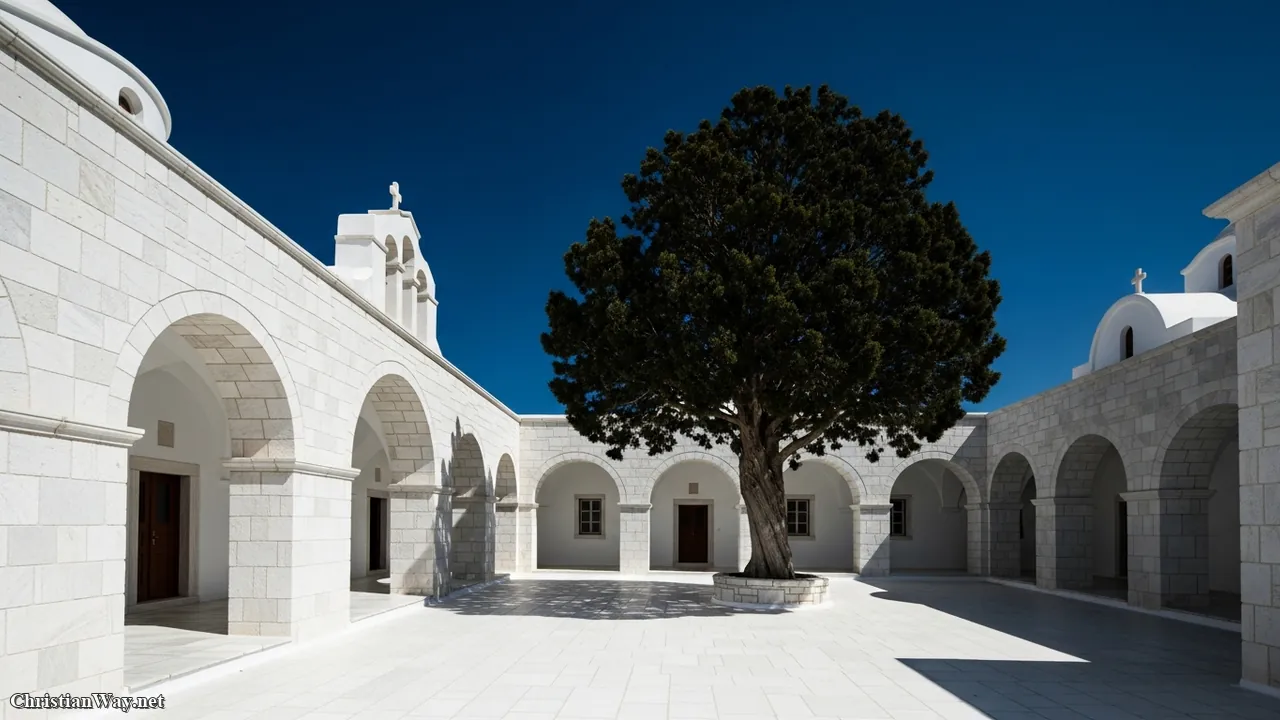
This church is a stunning example of a “votive” offering—a physical manifestation of gratitude. The theology here is one of Providence and Thanksgiving. It reminds us that our relationship with God is a dialogue. We ask for help in the storms of life, but do we remember to return and give thanks when the waters calm? St. Helena’s stones are still standing 1,700 years later as a “Thank You” note to Heaven.
The church is also a bridge between East and West, reflecting the time before the Great Schism when the Church breathed with both lungs. It invites us to pray for the reunion of all Christians. It stands as a beacon of light, reminding us that even the storms of life can lead to the construction of something beautiful if we trust in God’s navigation.
Spiritual Highlights:
- The Baptistery: It houses a rare, ancient cruciform baptismal font used for full immersion, showing the seriousness of early Christian initiation.
- The Name: Legend says only 99 doors have been found; the 100th will appear when Constantinople returns to Christian hands.
Top 4. Archbasilica of St. John Lateran (Rome, Italy) — Est. 324 AD
Many Catholics mistakenly believe St. Peter’s is the most important church in Rome, but the Archbasilica of St. John Lateran holds the true primacy. It is the Cathedral of the Pope (as Bishop of Rome) and bears the inscription: “Mother and Head of all Churches in the City and the World.” Dedicated in 324 AD, it was the first monumental church built after the legalization of Christianity.
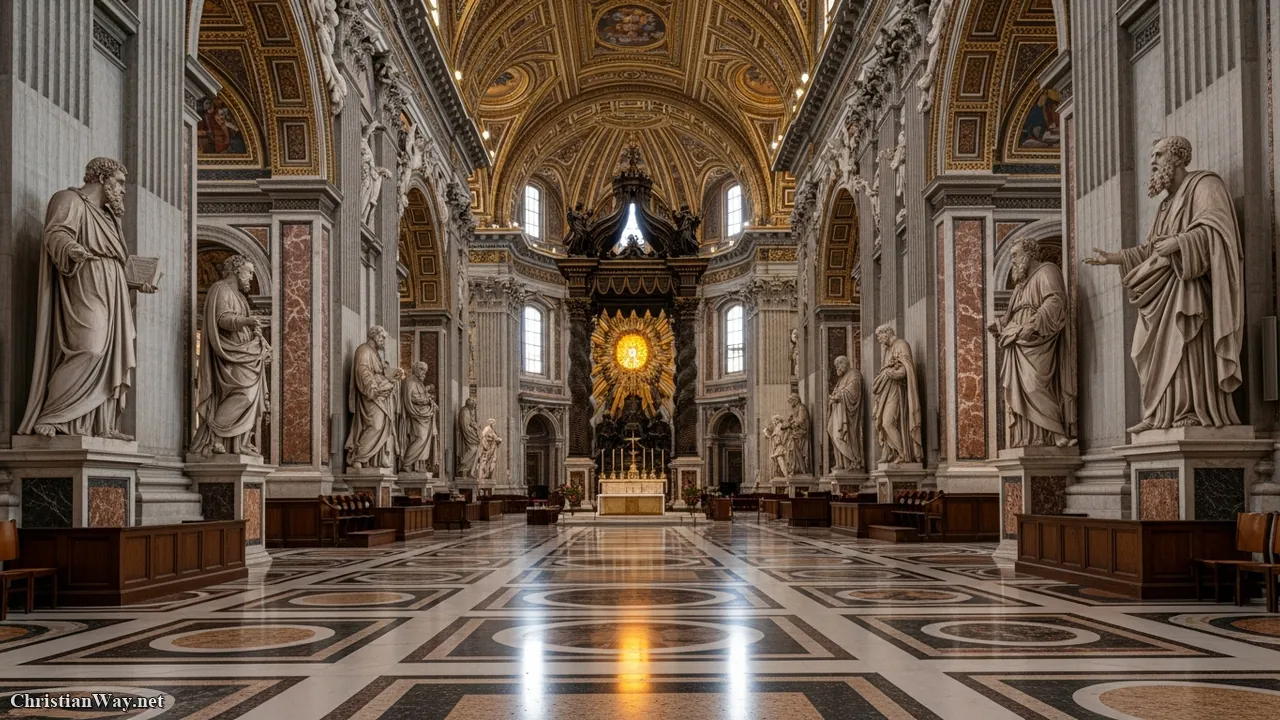
The theology of the Lateran is “Ecclesia Publica”—the Church made public. For centuries, Christians worshiped in catacombs and hidden rooms, whispering their prayers. At the Lateran, the doors were thrown open. It symbolizes the Kingship of Christ over civil society and history. The colossal statues of the Apostles that line the nave remind us that the Church is built on the foundation of the Apostles, sent out to teach all nations.
This basilica challenges us to live our faith out loud. We are not called to be secret Christians. Just as the Lateran dominates the Roman skyline, our charity, kindness, and witness should be visible to all. It reminds us that we have a visible shepherd in the Pope, and a visible home in the Church. It is a place of belonging.
Spiritual Highlights:
- The Papal Cathedra: The literal chair where the Pope sits as Bishop of Rome.
- The Relics: Tradition holds that the heads of St. Peter and St. Paul are venerated here, linking the hierarchy to the martyrdom of the Apostles.
Top 3. St. Peter’s Basilica (Vatican City) — Founded c. 320 AD
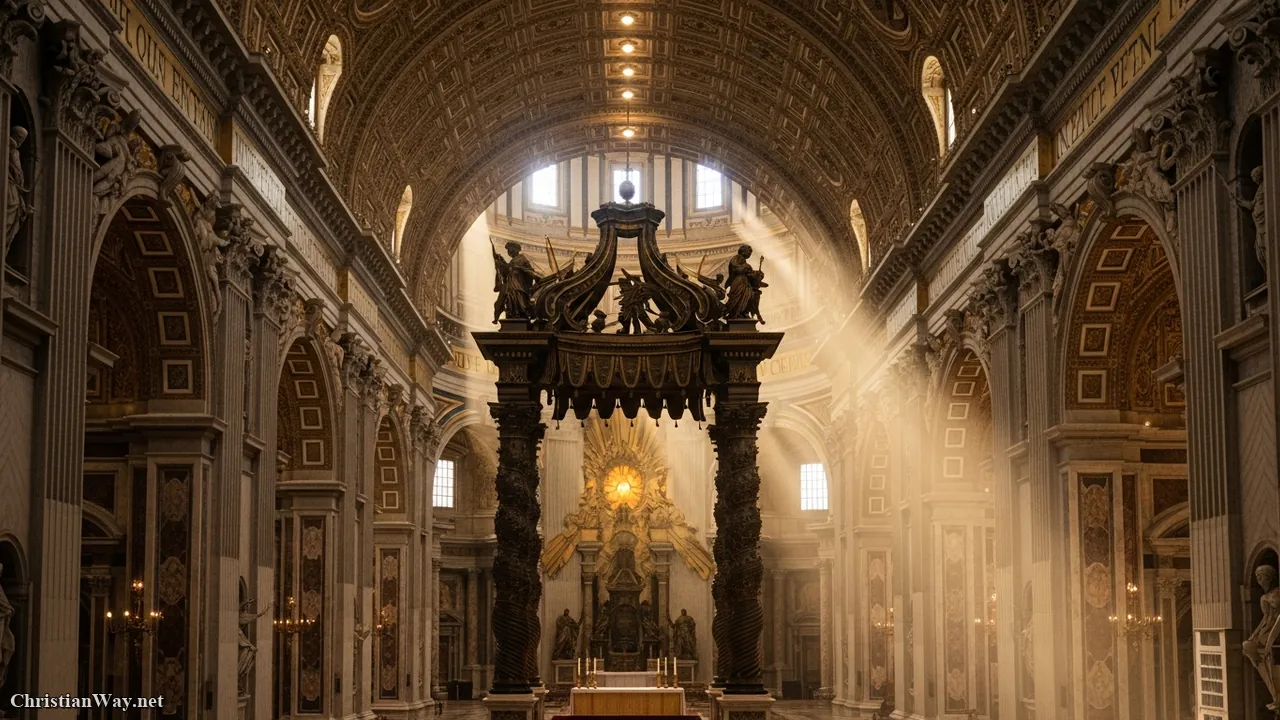
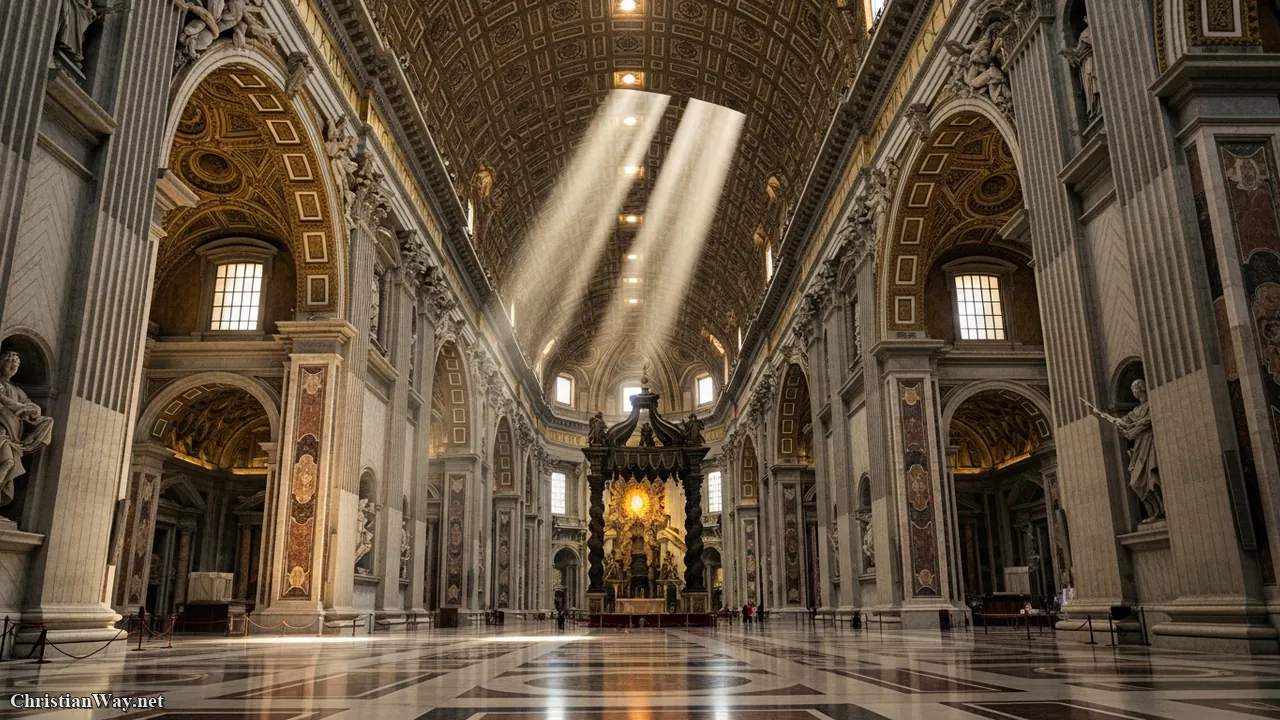
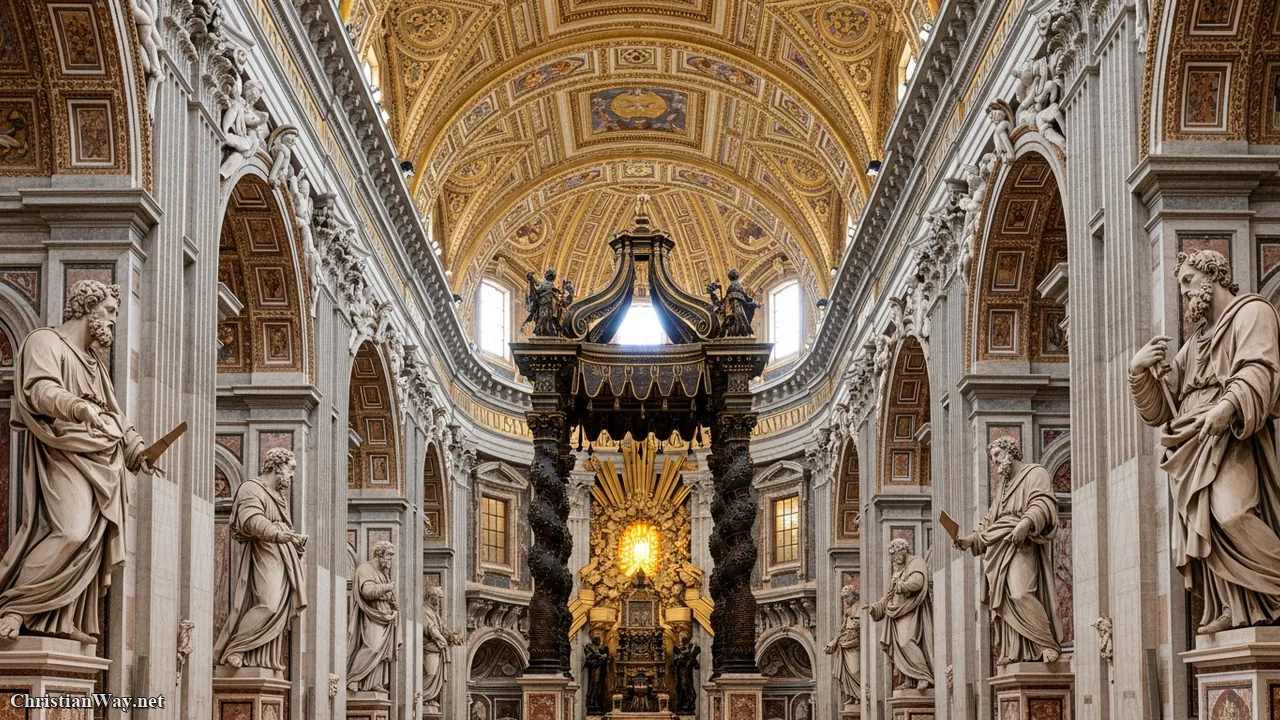
We include St. Peter’s Basilica at this high rank with a crucial historical distinction. The magnificent Renaissance building you see today, with Michelangelo’s dome, was built between 1506 and 1626. However, the church itself—the sacred location and foundation—dates back to c. 320 AD. Emperor Constantine went to great lengths (literally slicing off the side of the Vatican Hill) to ensure the High Altar was placed vertically directly above the humble earthen grave of St. Peter.
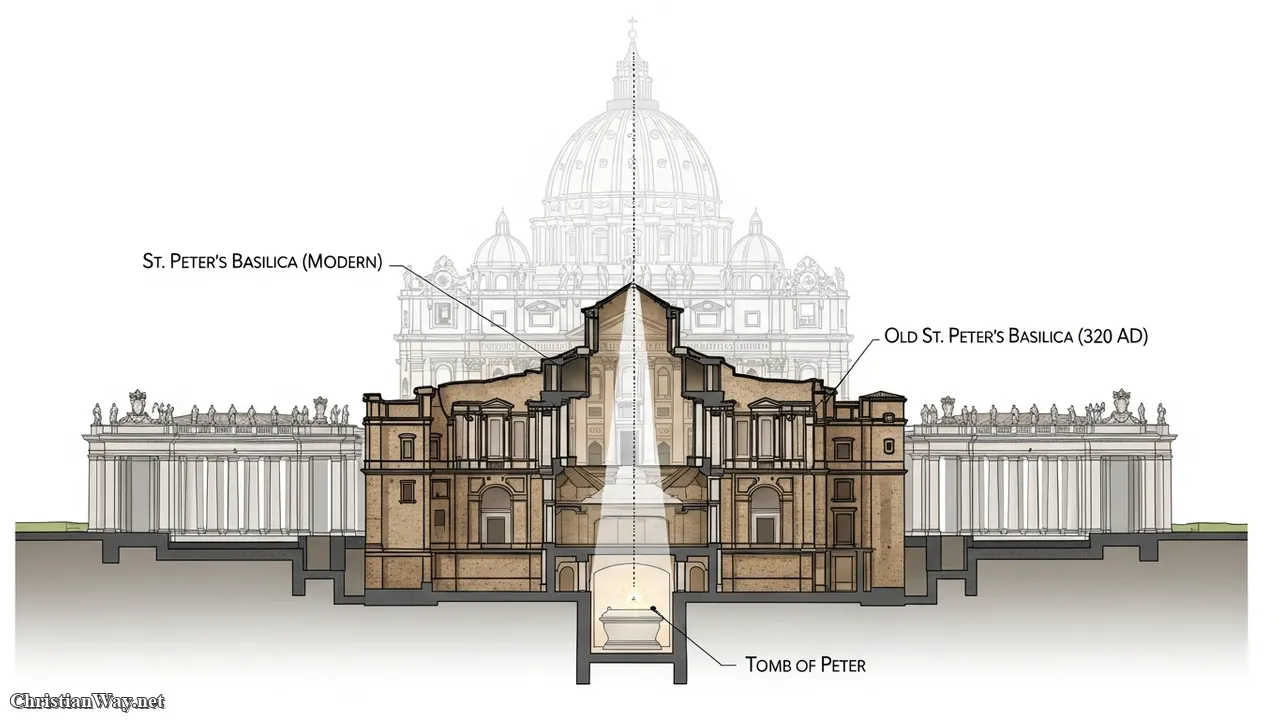
This provides a profound theological lesson: The Foundation is the Person. The architectural style changed completely—from an ancient timber-roofed basilica to a marble masterpiece—but the “Rock” (Petrus) remained exactly where Christ placed him. This speaks to the indefectibility of the Church. Styles change, cultures shift, and buildings are renovated, but the Deposit of Faith and the Apostolic Succession remain constant.
When we look at St. Peter’s, we are not just admiring art; we are looking at a 1,700-year-old commitment to the promise of Jesus: “You are Peter, and on this rock I will build my church.” It challenges us to look beneath the surface of our own faith. Is our faith built on the shifting sands of emotion, or on the solid rock of dogmatic truth and apostolic tradition?
Spiritual Highlights:
- The Necropolis: Deep beneath the floor lies the pagan cemetery where Peter was buried in a pauper’s grave.
- The Continuity: Worship has happened on this exact spot, over those exact bones, for nearly two millennia.
- Scripture: “And the gates of the netherworld shall not prevail against it.” (Matthew 16:18)
Top 2. Etchmiadzin Cathedral (Armenia) — Est. 301 AD
Before Rome stopped persecuting Christians, the Kingdom of Armenia had already embraced the Cross. In 301 AD, St. Gregory the Illuminator converted King Tiridates III, making Armenia the first Christian nation. The Cathedral of Etchmiadzin was built soon after, on the site of a pagan temple. Its name means “The Descent of the Only-Begotten,” referencing a vision where Christ struck the earth with a golden hammer to designate the holy site.
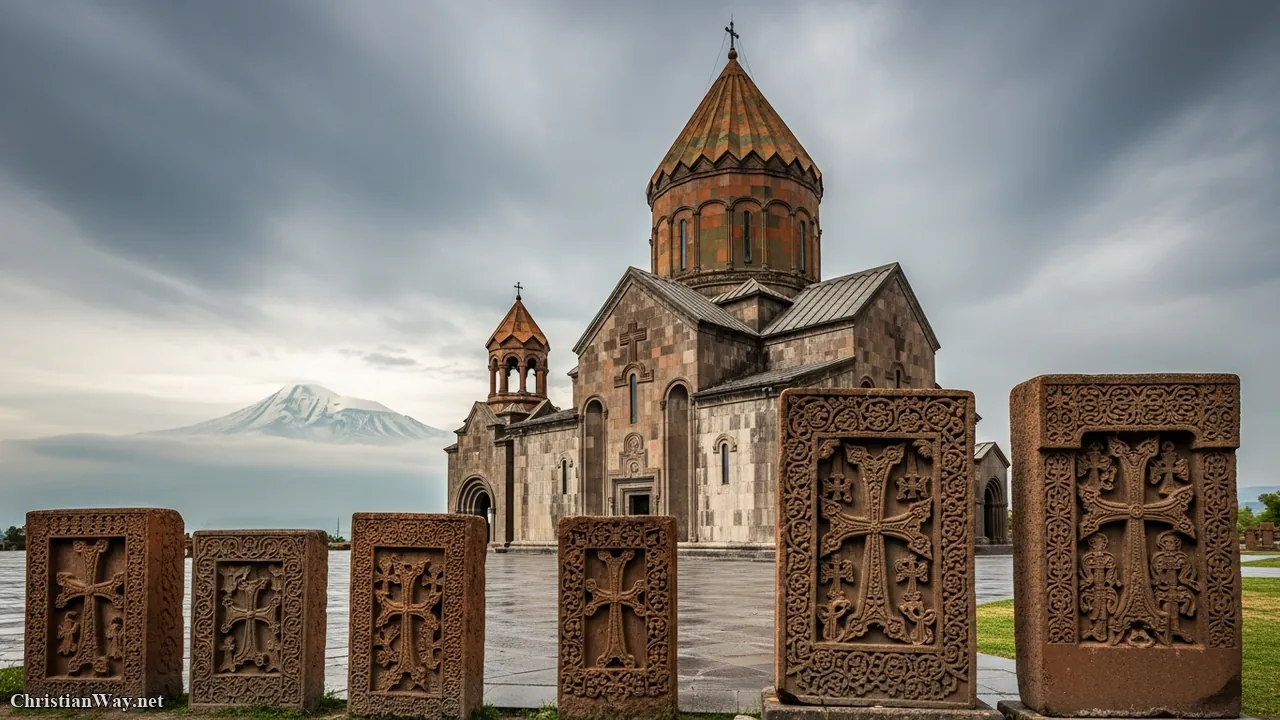
Etchmiadzin is a testament to the “Suffering Church.” The Armenian people have endured invasions, oppression, and the horrific genocide of the 20th century. Yet, like this cathedral, they are still standing. The architecture is sturdy, heavy, and resilient—much like the faith of the people. It reminds us that Christianity is not a guarantee of safety, but a guarantee of God’s presence within the suffering.
This site invites us to deep ecumenical solidarity. Though the Armenian Apostolic Church is distinct in its rites, it is a lung of the Body of Christ that breathes with ancient fervor. To look upon these stones is to see the tenacity of the Resurrection. If you feel your faith is weak or under attack, look to Armenia. Their stones still cry out, “He is Risen.”
Spiritual Highlights:
- The Holy Lance: The cathedral museum houses the spear point said to have pierced the side of Christ.
- The Antiquity: It is widely cited by UNESCO and scholars as the oldest cathedral (seat of a bishop) in the world.
Top 1. Dura-Europos House Church (Syria) — c. 233 AD
We end our countdown—or rather, we arrive at the beginning—in the ruins of Dura-Europos in modern-day Syria. This is not a cathedral of gold, but a humble private home converted into a place of worship around 233 AD. It was preserved by a fluke of history: the defenders of the city filled the building with sand to reinforce the city wall against a siege, inadvertently creating a time capsule.
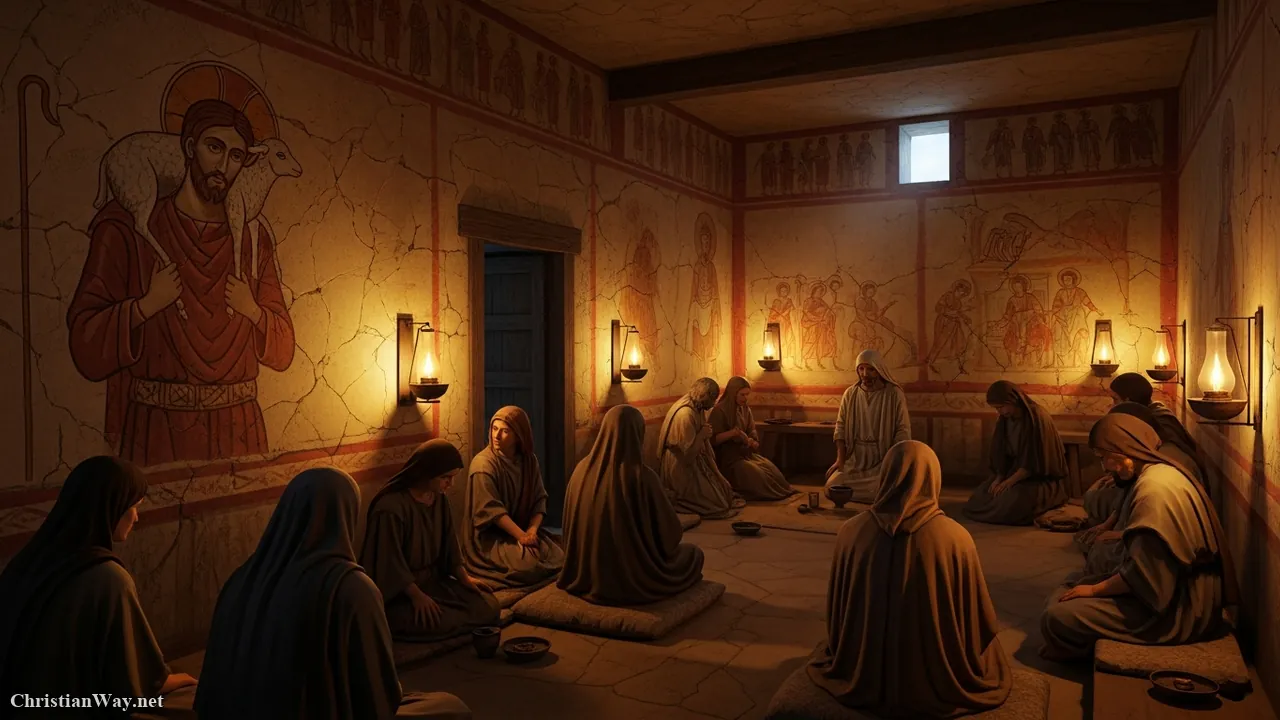
Here, we see the Church in its infancy. There is no dome, no organ, no marble. There is simply a room for the Eucharist and a room for Baptism. The walls bear the earliest known artistic depictions of Jesus—as the Good Shepherd carrying a sheep. The theology is breathtakingly simple: The Shepherd loves His flock. Before there were councils or canon law, there was this simple, domestic love.
Dura-Europos is the ultimate pastoral embrace. It reminds us that the Church does not require a building; it requires a people. In times of persecution or pandemic, when we cannot access our great basilicas, we return to the spirit of Dura-Europos. We return to the “domestic church”—the family, the small group, the quiet heart. This ruin tells us that even if every stone of the Vatican were to fall, the Church would remain, for the Church is us, living in Christ.
Spiritual Highlights:
- The Baptistery Frescoes: Images of Adam and Eve, David and Goliath, and the Healing of the Paralytic.
- The Reality Check: It proves that the earliest Christians were sacramental—focused on Baptism and the Eucharist from the very start.
Reflect and Pray
My dear brothers and sisters, we have traveled through time, from the domestic intimacy of Syria to the imperial grandeur of Rome. What do these stones say to us today?
They tell us that we are not alone. We are part of an immense procession of souls who have sought the face of God. These oldest Catholic churches in the world are not museums for the dead; they are nurseries for the living. They invite us to build our own lives on the rock of Christ.
I encourage you to choose one of these sites today for your prayer. Close your eyes, place yourself within its ancient walls, and ask the Lord to make your heart a sanctuary as enduring as these stones.
— Fr. John Matthew, for Christian Way