Dear friends in Christ,
Some saints are remembered for a single moment that seems to gather their whole life into one image. Saint Francis of Assisi is seen embracing poverty for Christ. Saint Thérèse of Lisieux is remembered for her little way of love. Saint Maximilian Kolbe stands before us in the starvation cell of Auschwitz, offering his life for another. Saint Paul VI is often remembered as a pilgrim pope: a quiet yet courageous shepherd who left the safety of familiar places, carried the Church through a difficult age, and tried to build bridges where fear and division had created distance.
Yet to call him a pilgrim pope is not only to remember the journeys he made across borders. It is to remember the inward journey he asked the Church to make: from fear toward trust, from isolation toward encounter, from self-protection toward mission, and from vague religious language toward a deeper love for Christ and for every human person.

Giovanni Battista Montini was elected pope on June 21, 1963, taking the name Paul VI. He inherited the unfinished work of the Second Vatican Council and guided its final three sessions to their conclusion in 1965. He then faced the far more difficult task of helping the Church receive the Council not as a memory, but as a living call to faith, renewal, communion, and mission.
This was not an easy mission.
Paul VI lived at a time when the modern world was changing quickly. Nations were emerging from colonial rule. New technologies were reshaping communication. Families faced social and economic pressures. The Church itself was experiencing hope, conflict, questions, criticism, and uncertainty. Some wanted rapid change without roots. Others wanted to preserve everything familiar without facing the needs of a changing world. Between these opposing pressures stood Paul VI, often misunderstood, sometimes criticized from many directions, yet determined to remain faithful to Christ.
Saint Paul VI: The Pilgrim Pope of Dialogue and the Defender of Life is therefore not simply a historical portrait of a pope. It is a meditation on what it means to remain faithful when the road ahead is unclear. It is a reflection for parents trying to raise children in a confusing world, for Christians who feel torn between truth and compassion, for those who seek peace amid division, and for every heart that longs to know how faith can remain strong without becoming hard.
Paul VI teaches us that dialogue does not mean abandoning conviction. He teaches us that defending life does not mean speaking without tenderness. He teaches us that the Church must never become afraid of the world, because Christ has already entered the world, loved the world, died for the world, and risen for the salvation of the world.
A Shepherd Called to Carry an Unfinished Work
When Pope John XXIII opened the Second Vatican Council in 1962, he invited the Church to look again at her mission in the modern age. He did not call the Council because the Gospel had become outdated. The Gospel does not grow old. Jesus Christ remains “the same yesterday, and today, and for ever” (Hebrews 13:8). The Council was called because the Church must continually ask how she can proclaim the unchanging love of Christ in the changing circumstances of human history.
When John XXIII died in 1963, the Council was still unfinished. Paul VI was elected into a task that required patience, courage, theological depth, pastoral sensitivity, and a willingness to bear criticism. He did not simply continue meetings already planned. He carried a great spiritual responsibility: helping bishops from across the world listen to one another, pray together, discern together, and seek the guidance of the Holy Spirit.
On December 7, 1965, Paul VI formally concluded the Council. In his closing address, he spoke of a Church gathered in faith, charity, prayer, and service, seeking to offer herself like Christ “for the life of the Church and for the salvation of the world.”
This vision remains important today.
The Church is not a private club for people who already have every answer. She is the Body of Christ, formed by grace, called to holiness, and sent into the world with the Gospel. She is called to be faithful to the truth she has received, but also humble enough to recognize that her members continually need conversion. She is called to preserve the faith of the apostles, but also to speak that faith in ways that reach the lonely, the poor, the searching, the skeptical, the wounded, and the forgotten.
Paul VI understood that renewal begins not with changing everything around us, but with allowing Christ to renew the heart.
A Council That Needed More Than Applause
It is easy to admire a great event from a distance. It is much harder to live through the consequences of that event faithfully.
After the Council ended, many Catholics hoped for quick answers to every question. Some imagined that renewal meant leaving behind difficult teachings. Others feared that every change would weaken the faith. In many places, ordinary believers felt confused. Priests, religious, parents, teachers, and young people all faced questions about worship, authority, morality, culture, mission, and the future of the Church.
Paul VI knew that the Church could not simply become a reflection of whatever the world found fashionable. But he also knew that the Church could not speak to the world with fear, contempt, or closed doors.
This required a rare kind of courage.
There is courage in speaking loudly. There is also courage in carrying responsibility quietly. There is courage in making a dramatic decision. There is also courage in remaining faithful through years of misunderstanding.
Paul VI was not a saint because everyone agreed with him. He was a saint because he tried to remain obedient to Christ when agreement was impossible.
This speaks deeply to us.
Many people today feel pressure to choose a side before they have prayed. We are encouraged to react quickly, speak harshly, and treat every disagreement as proof that another person is our enemy. But the life of Paul VI asks something more difficult: Can we love truth without becoming proud? Can we seek unity without pretending that truth does not matter? Can we remain calm when others demand that we become angry?
Jesus said, “Blessed are the peacemakers: for they shall be called the children of God” (Matthew 5:9).
A peacemaker is not someone who avoids every difficult conversation. A peacemaker is someone who carries Christ into difficult conversations. He or she refuses lies, but also refuses hatred. He or she seeks justice, but does not surrender the heart to bitterness. He or she remembers that the person across from us is not merely an opponent, but someone created and loved by God.
A Pilgrim Pope Who Chose Encounter
Paul VI became known as a pilgrim pope because he began a new practice of apostolic journeys, beginning with his pilgrimage to the Holy Land in 1964. During that journey, he met Ecumenical Patriarch Athenagoras of Constantinople, an encounter remembered as an important moment in the relationship between the Catholic and Orthodox Churches.
This meeting was not merely ceremonial.
For centuries, Christians had carried the pain of division. Catholics and Orthodox Christians shared the ancient faith of the apostles, the Scriptures, the sacraments, the creeds, and reverence for the saints, yet remained separated by historical wounds and theological disagreements. Paul VI did not imagine that one meeting could erase every difficulty. But he understood that unity begins when Christians are willing to see one another not as strangers, but as brothers and sisters who belong to Christ.
The Gospel of John tells us that Jesus prayed for His followers “that they all may be one” (John 17:21). This prayer is not a call for shallow agreement. Christian unity cannot be built by ignoring truth. But it must be built by love, prayer, humility, repentance, and a willingness to listen.
Paul VI’s meeting with Athenagoras gave the Church an image of hope: two shepherds, carrying the weight of history, choosing to meet not with accusation but with reverence.
How much our world needs this spirit.
Families need it when old hurts have created distance.
Churches need it when believers speak about one another with suspicion.
Communities need it when political differences become personal hatred.
Nations need it when fear makes people forget the dignity of those who are different.
A pilgrimage is not only a journey across land. It is also a journey of the heart. It is the movement from resentment toward forgiveness, from fear toward trust, and from pride toward humility.
Dialogue Is Not the Same as Compromise
Paul VI’s call to dialogue is sometimes misunderstood. Some people hear the word “dialogue” and imagine that truth must become uncertain. They fear that listening to others means surrendering conviction. Others hear “dialogue” and imagine a polite conversation in which no one is ever allowed to say that something is right or wrong.
But Paul VI understood dialogue differently.
In his first encyclical, Ecclesiam Suam, he wrote of the Church’s relationship with the modern world as a “dialogue of salvation.” He did not begin with the idea that the Church should simply accept every idea around her. He called the Church first to deeper self-awareness, renewal, and faithfulness to Christ. Then, from that rootedness, he called her to meet the world with humility, respect, and love.
True dialogue begins when we know who we are before God.
A person who does not know what they believe may become easily controlled by the loudest voice in the room. But a person who is rooted in Christ can listen without fear. He can hear another person’s pain without abandoning truth. She can admit that she does not understand everything without pretending that God has not spoken.
This is especially important in families.
Sometimes parents and children stop listening to one another because each side is afraid of being dismissed. Sometimes husbands and wives argue not because they do not love each other, but because they no longer know how to speak without wounding. Sometimes friends drift apart because nobody wants to take the risk of honest conversation.
Dialogue asks us to speak truthfully, but also gently.
Saint Paul writes, “Let your speech be alway with grace” (Colossians 4:6).
Grace does not mean weakness. Grace means that even when we must disagree, we do not forget that Christ calls us to love.
The Defender of Life in a Confused Age
The name of Saint Paul VI is closely associated with his 1968 encyclical Humanae Vitae, a document on married love and the regulation of birth. This document has often been discussed, praised, criticized, misunderstood, and used in arguments that forget the real human lives involved: husbands and wives, mothers and fathers, children, families under pressure, and people carrying fears that may be known only to God.
To understand Paul VI’s witness, we must begin with tenderness.
He did not speak about marriage and human life as though they were abstract ideas. He wrote about the dignity of married love, the faithfulness of husband and wife, the gift of children, and the serious responsibility parents carry as they discern their family life before God. He described responsible parenthood as involving physical, economic, psychological, social, and moral realities, all held within a conscience seeking God’s will.
This is important.
The Church’s teaching on life is not a command to ignore hardship. It is not a refusal to recognize the real burdens carried by families. Paul VI explicitly acknowledged that married couples may face serious reasons for spacing births or not having additional children. Yet he insisted that the transmission of life should never be reduced to convenience, power, fear, or human control alone.
He believed that married love is both unitive and life-giving.
A husband and wife are not merely individuals making private decisions beside one another. They are called into a covenant of faithful love. Their bodies, their promises, their hopes, their fears, and their future belong within that covenant. In Catholic teaching, the openness of marriage to life is not an extra burden placed upon love. It is part of the meaning of love itself.
Children are not products.
They are not rewards for successful planning.
They are not interruptions to a life that matters more.
They are gifts entrusted to human care.
This does not mean every pregnancy is easy. It does not mean every family has the same circumstances. It does not mean that Christians should speak without compassion to mothers who are afraid, couples struggling with illness, families facing poverty, or those grieving infertility, miscarriage, or loss.
Saint Paul VI calls the Church to do more than speak about life. He calls the Church to become a community that supports life.
Love Must Be Accompanied by Mercy
There are women who carry the burden of pregnancy in silence. There are mothers overwhelmed by exhaustion. There are fathers frightened by financial uncertainty. There are couples who long for children and cannot conceive. There are families caring for children with illness or disability. There are parents who grieve choices they regret. There are people whose past makes them afraid to hope again.
The Church must not meet these hearts with coldness.
Christ never looked upon suffering people as problems to be solved from a distance. He saw the widow of Nain grieving for her son. He touched the leper whom others avoided. He welcomed children. He forgave the sinner. He wept beside the tomb of Lazarus.
To defend life means to stand near people when life feels fragile.
It means supporting mothers in need.
It means encouraging fathers to accept responsibility with love.
It means protecting children from violence, neglect, exploitation, and abandonment.
It means honoring the elderly who fear becoming burdens.
It means caring for the sick, the disabled, the poor, the refugee, and the person the world has decided is inconvenient.
It means remembering that every human life carries a dignity that does not disappear because someone is weak.
This is why Paul VI remains a defender of life. His witness was not only about one moral teaching. It was rooted in a wider vision of the human person: created by God, called to love, entrusted with freedom, and never to be treated as an object.
The Courage to Be Misunderstood
Some teachings are difficult because they challenge our habits. Others are difficult because they ask us to trust God when the world tells us that we should trust only ourselves.
Paul VI knew that Humanae Vitae would be controversial. He knew that many people would disagree. He knew that the Church would be criticized. Yet he believed that a pope must not simply say what will be welcomed. He must seek to serve the truth entrusted to him.
This kind of courage is rare.
Most of us are tempted to measure every decision by the approval it brings. We want people to understand us. We want our choices to be praised. We want to avoid being seen as difficult, old-fashioned, foolish, or different.
But faithfulness often requires us to make choices that others may not understand.
A worker may refuse dishonesty even when it costs money.
A student may refuse to join in cruelty even when friends mock them.
A parent may set wise boundaries for a child even when the child feels angry.
A husband or wife may choose forgiveness when resentment would feel easier.
A Christian may remain faithful to prayer and worship even when the world treats faith as unimportant.
Paul VI reminds us that conscience cannot be formed by popularity.
At the same time, he reminds us that truth must never become a weapon. Christians are called to speak clearly, but also humbly. Catholics hold the teaching of Humanae Vitae as part of the Church’s moral vision for marriage and human life. Other Christian communities may express these questions differently. Yet all Christians are called to cherish the dignity of marriage, to honor faithful love, to protect the vulnerable, and to remember that human life is never merely a matter of convenience.
Peace, Justice, and the Development of Peoples
Saint Paul VI did not defend life only by speaking about marriage and family. He also spoke about hunger, poverty, injustice, peace, development, and the responsibilities nations carry toward one another.
In Populorum Progressio, published in 1967, he reflected on the development of peoples and insisted that true development must be more than economic growth. A society may become wealthier while leaving the poor behind. It may build impressive cities while families remain hungry. It may speak of progress while workers are treated without dignity. It may possess advanced technology while the human heart becomes more lonely, more fearful, and less compassionate.
This is not true development.
A person needs food, work, shelter, education, health care, safety, and the opportunity to live with dignity. But a person also needs community, faith, hope, beauty, freedom, and the knowledge that his or her life matters.
Paul VI understood that peace is never only the absence of war.
Peace requires justice.
Peace requires truth.
Peace requires nations to see one another not simply as competitors, but as members of one human family.
His concern for peace also led him to establish the World Day of Peace, inviting Catholics and people of goodwill to begin each new year by praying and working for peace.
This is a beautiful vision.
The first day of the year often becomes a day of resolutions. People promise to work harder, earn more, become healthier, or change habits. These are not bad desires. But Paul VI invited the world to begin the year with a greater question: How can peace grow among us?
Peace begins in the human heart.
It begins when we stop speaking about others with contempt.
It begins when we refuse to let anger become our identity.
It begins when we protect the weak.
It begins when families learn how to apologize.
It begins when nations recognize the humanity of people beyond their borders.
It begins when Christians pray not only for their own comfort, but for those who suffer.
A Love That Refuses Indifference
The Gospel never allows us to say, “That suffering has nothing to do with me.”
When Jesus tells the parable of the Good Samaritan, He shows us a wounded man lying beside the road. Religious people pass by. They may have had reasons. They may have been busy. They may have been afraid. But the Samaritan stops.
He sees.
He draws near.
He cares.
He pays a cost.
This is Christian love.
Saint Paul VI understood that the Church must not become indifferent to the wounded people of the world. The Church must preach eternal life, but she must also care about human life here and now. She must proclaim Christ, but she must also serve those who are hungry, displaced, sick, forgotten, and crushed by injustice.
A Christian cannot solve every global crisis. None of us can carry the whole world alone. But we can refuse to close our hearts.
We can pray for those living in war.
We can support trustworthy works of mercy.
We can treat workers, neighbors, strangers, and migrants with dignity.
We can teach children to see the poor not as burdens, but as brothers and sisters.
We can let the suffering of others interrupt our comfort.
This is part of the defense of life.
Evangelization Begins With a Changed Heart
One of Paul VI’s most influential writings was Evangelii Nuntiandi, published in 1975. In it, he spoke about the Church’s mission to bring the Good News of Jesus Christ into every part of human life. He did not imagine evangelization as mere advertising. He did not reduce it to arguments, slogans, or public speeches.
He understood that the Gospel must first change the person who proclaims it.
Paul VI wrote that “Modern man listens more willingly to witnesses than to teachers.” He added that people listen to teachers when those teachers are also witnesses.
These words remain deeply true.
People may listen to what we say about faith. But they are also watching how we live.
Do we speak about forgiveness but refuse to forgive?
Do we speak about peace but carry anger everywhere?
Do we speak about the dignity of life but treat difficult people with contempt?
Do we speak about prayer but never make time for God?
Do we speak about love but ignore the lonely person near us?
The world needs Christian teachers. It needs preachers, theologians, parents, catechists, writers, musicians, and missionaries. But it also needs witnesses.
It needs people whose lives make others wonder where their peace comes from.
It needs fathers and mothers who pray with their children.
It needs young people who choose purity, honesty, and kindness.
It needs workers who do not surrender integrity for profit.
It needs Christians who can disagree without becoming cruel.
It needs believers who remain close to the poor.
It needs communities where people can be honest about their wounds without being shamed.
The Church Must First Be Evangelized
Paul VI understood something that can easily be forgotten: before the Church evangelizes the world, she herself must continually be evangelized.
This does not mean that the Church has no truth to offer. She has received the Gospel from Christ. She has been entrusted with the Scriptures, the sacraments, the apostolic faith, and the promise of the Holy Spirit.
But the members of the Church must continually return to the Gospel.
We need to hear again that Jesus loves sinners.
We need to hear again that mercy is greater than shame.
We need to hear again that the Cross is not defeat.
We need to hear again that the poor are not invisible.
We need to hear again that prayer is not optional decoration, but the breath of the soul.
We need to hear again that we are called not merely to attend church, but to become the Church through faith, hope, charity, and mission.
Paul VI helped establish the Synod of Bishops in 1965 as a permanent institution through which bishops from different parts of the world could assist the pope in discerning pastoral questions for the good of the universal Church.
This was not merely an administrative decision. It reflected his conviction that the Church must walk together, listen together, pray together, and seek the Spirit’s guidance together.
The word “synod” means “journeying together.”
How beautiful that image is.
No Christian walks alone.
We walk with the saints.
We walk with the Scriptures.
We walk with the Church.
We walk with those who have gone before us in faith.
We walk with those who are struggling beside us.
And above all, we walk with Christ.
A Saint for the Wounded Church
Paul VI knew that the Church is holy because Christ is holy, yet wounded because her members are human. He did not ask Christians to pretend that everything was easy. He knew that the Church could be criticized, misunderstood, divided, and troubled. He knew that leaders could fail and that believers could become discouraged.
But he did not abandon the Church.
He loved her because he loved Christ.
This matters today.
Some people see the weaknesses of Christians and decide that faith must be false. Others see wounds in the Church and become tempted to leave without prayer. Others become angry and begin to speak about fellow believers with the same cruelty they condemn in the world.
The wounds of the Church are real. They must be faced truthfully. People who have been harmed deserve justice, protection, healing, and honest accountability. The Church must never use pious words to hide sin or avoid responsibility.
Yet Christ has not abandoned His Body.
The Church is not saved by the perfection of her members. She is saved by the mercy of Christ.
Paul VI teaches us to remain faithful without becoming naïve.
We can love the Church and still call her to repentance.
We can honor her teachings and still recognize the need for humility.
We can defend truth and still weep for those who have been wounded.
We can pray for renewal without treating one another as enemies.
This is the difficult love of a mature Christian.
The Cross Is Carried in Hope
Every generation faces the temptation to despair.
Perhaps you look at the world and see too much violence.
Perhaps you look at your family and see wounds you do not know how to heal.
Perhaps you look at your own heart and feel tired of struggling.
Perhaps you look at the Church and wonder whether renewal is possible.
Saint Paul VI invites us to look again at Christ.
The Church was born from the wounded side of Christ.
The apostles began as frightened men and women behind locked doors.
Peter denied Jesus.
Thomas doubted.
Paul persecuted Christians before becoming an apostle.
Yet Christ did not abandon them.
He breathed the Holy Spirit upon them.
He sent them into the world.
He gave them courage to proclaim the Gospel.
The Resurrection does not erase the Cross. It reveals that the Cross is not the final word.
This is why hope is possible.
Hope is not pretending that pain is small. Hope is believing that God is greater than pain.
Hope is not ignoring sin. Hope is believing that mercy can bring repentance and new life.
Hope is not waiting for the world to become perfect before we love. Hope is choosing love now, because Christ is already at work.
The Pilgrim Pope and the Journey of Every Christian
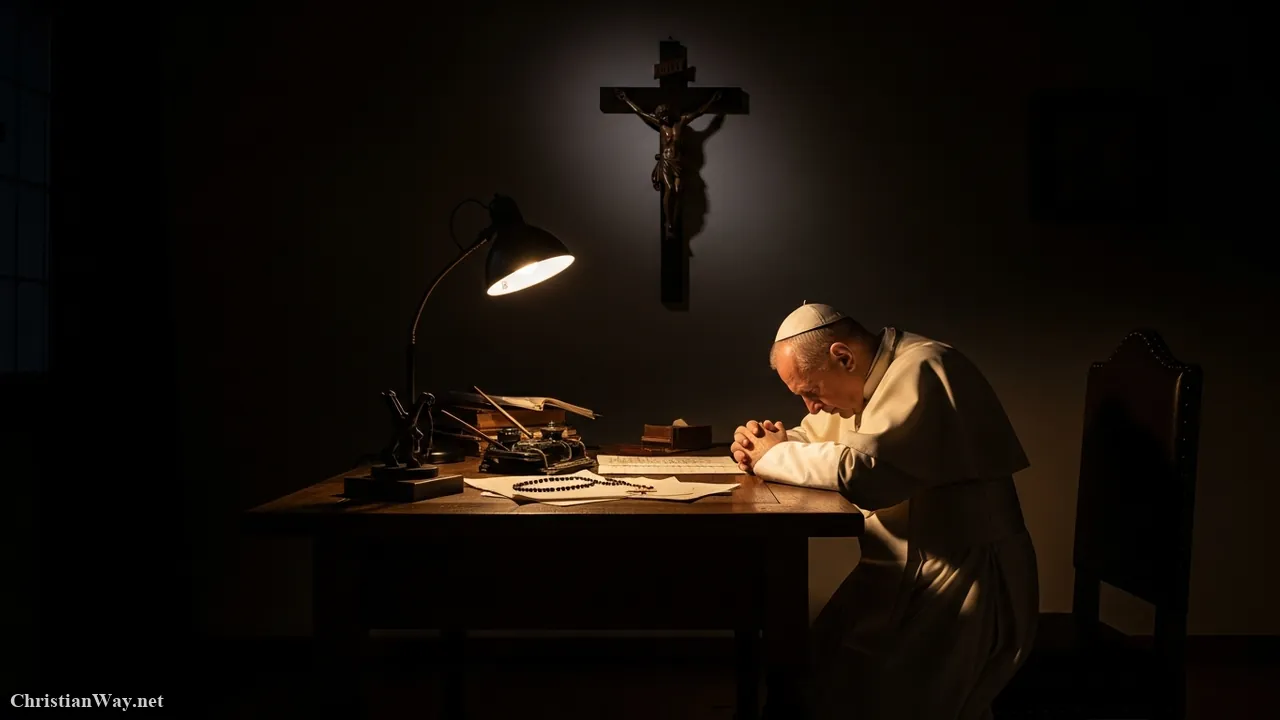
Saint Paul VI died on August 6, 1978, after fifteen years as pope. He was canonized in 2018, and the Church now remembers him not only as a leader during a dramatic period of change, but as a saint who remained faithful in the tension between courage and gentleness, dialogue and conviction, mission and contemplation.
His life reminds us that every Christian is a pilgrim.
We may not travel to the Holy Land.
We may not meet leaders of other churches.
We may not write encyclicals or guide a council.
But we are still on a journey.
We journey from fear toward trust.
We journey from selfishness toward love.
We journey from distraction toward prayer.
We journey from resentment toward forgiveness.
We journey from confusion toward wisdom.
We journey from protecting our own comfort toward serving others.
Some days, the journey feels beautiful. We sense God’s nearness. We feel grateful. We know what we must do.
Other days, the journey feels hidden. We do not know why certain doors have closed. We do not know how a conflict will be resolved. We do not know whether our children will be safe, whether our work will be stable, whether our health will improve, or whether our prayers are being heard.
In those moments, Saint Paul VI teaches us to keep walking.
Not because we are strong enough by ourselves.
But because Christ walks with us.
Jesus said, “I am the way, the truth, and the life” (John 14:6).
He is the way when we do not know where to go.
He is the truth when voices around us become confusing.
He is the life when our hearts grow tired.
The pilgrim pope reminds us that faith is not a demand to know every step in advance. Faith is the willingness to place the next step in the hands of God.
Reflect and Pray
Dear friends, Saint Paul VI invites us to become Christians who are rooted in truth and open in love. He teaches us that dialogue is not weakness, that conscience is not stubbornness, that peace is not avoidance, and that defending life must always be joined to tenderness.
Perhaps you are facing a difficult conversation. Perhaps you feel caught between people who disagree. Perhaps you are carrying worries about your family, your children, your future, or the state of the world. Perhaps you are tired of seeing division and do not know how to become an instrument of peace.
Do not lose heart.
Christ is still leading His Church.
He is still calling sinners into mercy.
He is still healing wounded hearts.
He is still raising up people who speak truth with gentleness.
He is still inviting us to walk forward, not in fear, but in faith.
Saint Paul VI, pilgrim pope of dialogue and defender of life, pray for us. Teach us to remain faithful when truth is difficult, humble when we are praised, patient when we are misunderstood, and courageous when love asks something costly of us. Pray for families, for children, for mothers and fathers, for the poor, for the sick, for those who feel forgotten, and for all who long for peace.
Lord Jesus Christ,
You are the Way, the Truth, and the Life.
Through the prayers of Saint Paul VI,
make our hearts faithful and compassionate.
Teach us to speak truth with love,
to defend life with tenderness,
to seek peace with courage,
and to serve Your Church with humility.
When we are confused, guide us.
When we are afraid, strengthen us.
When we are divided, draw us back to Your heart.
May Your Holy Spirit make us witnesses
of Your mercy in every place where we are sent. Amen.
May the witness of Saint Paul VI lead you to walk faithfully with Christ, to love every human life with reverence, and to become a quiet instrument of truth, dialogue, and peace.
— Fr. John Matthew