A gentle reflection on Christianity as life in Christ, rooted in grace, truth, worship, hope, and love for the world today.
Dear friends in Christ,
Every human heart carries questions that cannot be answered by success, comfort, knowledge, or pleasure alone. Who am I? Why am I here? Is there a God who knows me? Does my life have a purpose? What happens when I suffer? Can guilt be forgiven? Is death the end? Is there a love strong enough to hold me when everything else falls away?
Christianity speaks to these questions not first with a philosophy, a moral system, or a collection of religious customs, but with a person: Jesus Christ.
At the center of Christianity stands the conviction that God has not remained distant from the human story. The eternal God has drawn near. In Jesus of Nazareth, Christians believe that God entered human history, took upon Himself our frailty, revealed the face of divine love, suffered for our salvation, rose from the dead, and opened the way to everlasting life.
Christianity is therefore more than believing certain ideas about God. It is a life of communion with God through Jesus Christ. It is the receiving of grace, the healing of the heart, the forgiveness of sin, the renewal of the mind, and the gradual transformation of a human being into someone capable of loving God and neighbor with freedom and truth.
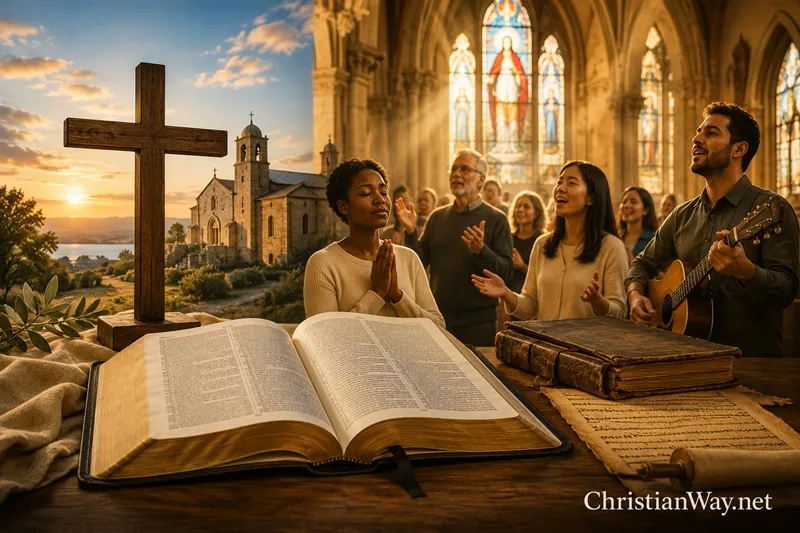
To ask, “What is Christianity?” is to ask about a faith that has shaped civilizations, inspired saints, sustained martyrs, comforted the grieving, challenged the powerful, founded communities of mercy, and accompanied countless ordinary people through the hidden joys and sorrows of daily life. Yet Christianity cannot be understood only by studying its historical influence. Its deepest meaning is found in the living encounter between Christ and the human soul.
Christianity begins when we hear the voice of Jesus saying, “Follow me,” and when, even with trembling faith, we begin to walk with Him.
Christianity Is Faith in the Living God
Christianity teaches that there is one God, the Creator of heaven and earth, the source of all that exists. The universe is not understood as an accident without meaning, nor is human life seen as a brief and meaningless appearance between birth and death. Creation comes from the wisdom and love of God.
The opening words of Scripture declare, “In the beginning God created the heaven and the earth” (Genesis 1:1). These words do not merely explain that the world had a beginning. They proclaim that existence is a gift. The heavens, the earth, the seas, the living creatures, and every human being receive life from God.
Because creation comes from God, it possesses meaning, order, and goodness. The material world is not evil. The human body is not a prison from which the soul must escape. Work, family life, friendship, creativity, food, rest, and the beauty of nature can all become places where divine grace is received with gratitude.
Christian faith also teaches that God is not an impersonal force. God knows, speaks, loves, wills, creates, judges, forgives, and calls. He is infinitely greater than creation, yet He is also intimately present to it. The God who formed the stars is attentive to the prayer whispered by a frightened child. The God who sustains the universe knows every hidden sorrow of the human heart.
The psalmist marvels at this mystery: “What is man, that thou art mindful of him?” (Psalm 8:4). Christianity answers that humanity matters because every person is created in the image and likeness of God.
Created in the Image of God
The Christian understanding of human dignity begins with creation. Human worth does not depend upon intelligence, productivity, wealth, health, nationality, social status, or usefulness. Every human life is sacred because it bears the image of the Creator.
To be made in God’s image means that human beings are created for relationship, truth, freedom, goodness, and love. We can know something of our Creator, respond to Him, care for one another, cultivate the earth, create beauty, seek justice, and offer ourselves in love.
Sin has wounded the image of God within us, but it has not destroyed it. Even the person who has wandered far from goodness remains someone whom God desires to redeem. Christianity therefore refuses to divide humanity into those who possess dignity and those who do not. The unborn child, the elderly person, the prisoner, the refugee, the disabled person, the poor, the forgotten, and even the enemy remain human beings made in God’s image.
This truth gives Christianity its deep concern for mercy and justice. To love God while despising another human being is a contradiction. As the First Letter of John teaches, the person who claims to love God while hating a brother or sister does not live in the truth.
Christianity Is Centered on Jesus Christ
The name Christianity comes from Christ. Without Jesus Christ there is no Christianity. He is not merely one religious teacher among many, nor only a moral example, prophet, reformer, or spiritual guide. Christians confess Him as the eternal Son of God who became truly human for our salvation.
The Gospel of John begins with a profound declaration: “In the beginning was the Word, and the Word was with God, and the Word was God.” It later announces that this eternal Word “was made flesh” and lived among us (John 1:1, 14).
These words express the mystery Christians call the Incarnation. The Son of God did not merely appear to be human. He truly entered our condition. He was born, grew, learned, worked, prayed, felt compassion, experienced weariness, wept at the grave of a friend, suffered rejection, and endured death.
At the same time, Jesus was not simply a holy man who later became divine. Christian faith proclaims that the eternal Son assumed human nature while remaining truly God. In Him, divinity and humanity are united without confusion or separation.
This belief lies at the heart of Christian worship. Christians do not merely admire Jesus; they worship Him. They call Him Lord. They entrust their sins to Him. They believe that He reveals the Father and gives the Holy Spirit.
Jesus Reveals the Heart of God
Many people imagine God as distant, angry, indifferent, or impossible to please. Jesus corrects these distorted images. He reveals the holiness of God, but He also reveals divine tenderness.
Jesus welcomed children. He touched lepers whom society feared. He ate with sinners. He spoke with those others avoided. He defended the dignity of women. He wept with the grieving. He forgave those who came to Him with repentant hearts. He challenged hypocrisy but treated the wounded with gentleness.
When one of His disciples asked to see the Father, Jesus replied, “He that hath seen me hath seen the Father” (John 14:9). To look upon Christ is to see that divine power is not cruel domination. God’s power is the power of holy love—the power that creates, heals, serves, forgives, and gives itself completely.
This does not mean that Jesus ignored sin or treated evil as unimportant. His mercy was never sentimental. He called people to conversion. He exposed pride, greed, injustice, lust, unbelief, and religious hypocrisy. Yet His call to repentance was always a call home.
The holiness of Christ does not crush the sinner who approaches Him honestly. It reveals what we were created to become.
Christianity Proclaims the Holy Trinity
Christians believe in one God who eternally exists as Father, Son, and Holy Spirit. This teaching is known as the doctrine of the Trinity.
The Trinity does not mean that Christians worship three gods. Nor does it mean that one God simply appears in three temporary roles. The Father is God, the Son is God, and the Holy Spirit is God; yet God is one.
This mystery exceeds the limits of human understanding, but it is not meaningless. Christians confess the Trinity because this is how God has revealed Himself in the history of salvation.
At the baptism of Jesus, the Son stands in the Jordan River, the Spirit descends like a dove, and the voice of the Father is heard from heaven. Before His Ascension, Jesus commands His disciples to baptize “in the name of the Father, and of the Son, and of the Holy Ghost” (Matthew 28:19).
The doctrine of the Trinity tells us that love is not something God began to do after creating the world. God is eternally love. The Father loves the Son; the Son loves the Father; the Holy Spirit is inseparably present in this divine communion.
Creation flows from the generosity of this love. Salvation restores us to participation in it. The Christian life is an invitation to live in communion with the Father, through the Son, in the Holy Spirit.
The Father, Son, and Holy Spirit in Christian Life
Christians pray to the Father because Jesus taught His disciples to say, “Our Father.” They come to the Father through the Son, who reconciles humanity to God. They pray in the Holy Spirit, who awakens faith and dwells within believers.
The Father is the source of life and the One who lovingly calls His children home. The Son is the Word made flesh, the Savior who enters our brokenness and carries us into communion with God. The Holy Spirit is the giver of life, the Comforter who sanctifies, guides, strengthens, and transforms the Church.
The Trinity is not an abstract puzzle reserved for theologians. It is the living reality into which Christians are baptized. Every act of Christian prayer, worship, love, and holiness is ultimately a participation in the life of the Triune God.
Christianity Faces the Reality of Sin
Christianity teaches that creation is good, but it also looks honestly at the brokenness of the world. Human beings were created for communion with God, yet humanity turned away from its Creator.
The biblical account of Adam and Eve describes this turning through the language of disobedience. The temptation in the garden was not merely about eating forbidden fruit. It was the desire to define good and evil apart from God—to receive life while rejecting the One who gives it.
Sin is therefore more than breaking an external rule. It is the rupture of love. It disorders our relationship with God, with others, with creation, and even with ourselves.
We see the consequences everywhere. Pride divides families. Greed exploits the vulnerable. Envy poisons friendship. Lust reduces persons to objects. Fear produces cruelty. Resentment hardens the heart. Lies weaken trust. Violence passes from one generation to the next.
Christianity teaches that sin is both personal and communal. Individuals make sinful choices, but sin can also become embedded within cultures, institutions, and systems. Injustice may be normalized until people no longer recognize it as evil.
The doctrine of sin is not intended to humiliate humanity. It explains why education, technology, wealth, and political reform—though valuable—cannot by themselves heal the deepest disorder of the heart. We need more than improvement. We need redemption.
Sin as Bondage
A person may know what is good and still feel unable to choose it consistently. Saint Paul describes this painful struggle: “For the good that I would I do not” (Romans 7:19).
Many people recognize this experience. We promise not to speak harshly, yet anger rises again. We decide to forgive, yet resentment returns. We seek purity, but old habits pull us backward. We long for peace, but anxiety rules our thoughts. We want to pray, yet distraction consumes us.
Sin can become a form of slavery. What begins as a choice may eventually feel like a chain. Christianity announces that Christ has come not merely to excuse our captivity, but to set us free.
Christianity Proclaims Salvation by Grace
The good news of Christianity is that God has acted to save humanity. Salvation is not humanity’s attempt to climb upward toward God. It is God’s merciful descent toward humanity.
“For God so loved the world, that he gave his only begotten Son,” Jesus declares in John 3:16. The motive of salvation is love. God does not rescue us reluctantly. He does not wait for us to make ourselves worthy. He comes while we are still wounded and lost.
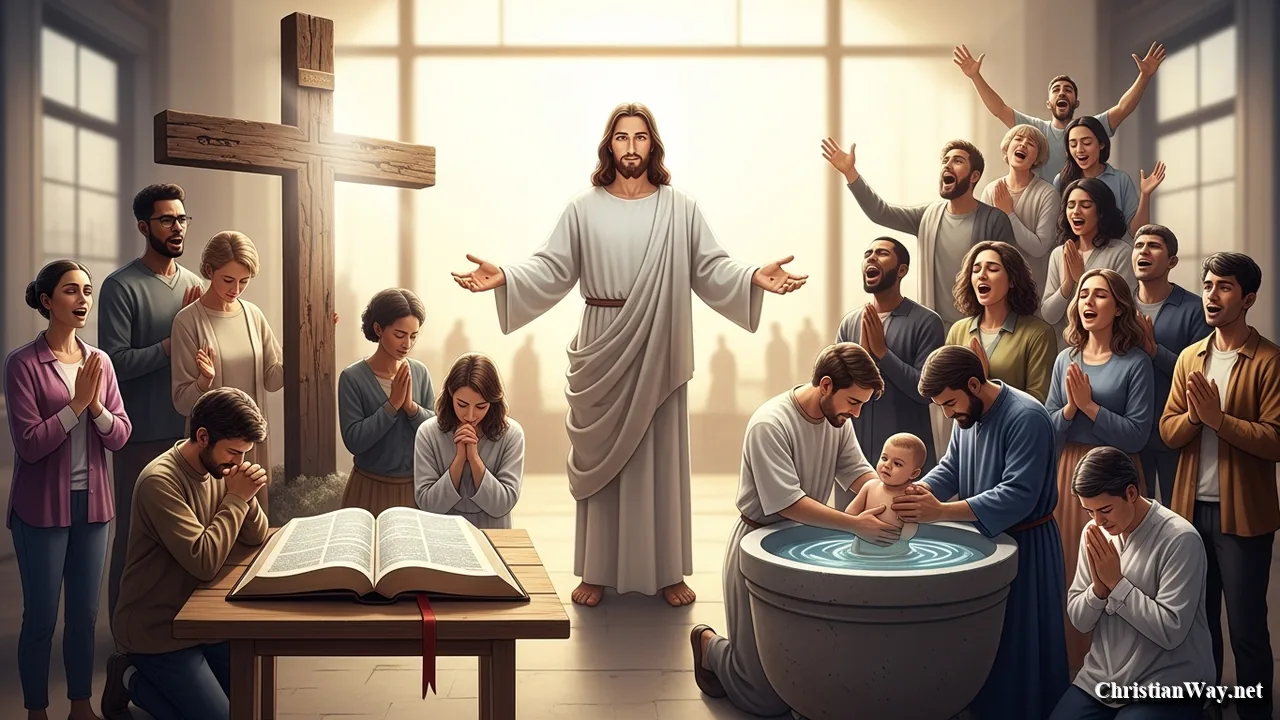
Grace is God’s free and undeserved gift. It awakens faith, forgives sin, renews the heart, and enables a person to live in communion with Him. Christians do not save themselves by moral effort, religious achievement, or intellectual knowledge.
At the same time, grace does not leave us unchanged. The grace that forgives also transforms. It teaches us to reject sin, practice mercy, seek justice, and grow in holiness.
Different Christian traditions sometimes use different language when describing the relationship between faith, grace, obedience, and good works. Yet historic Christianity broadly confesses that salvation originates in God’s mercy, is accomplished through Jesus Christ, is received in faith, and produces a life of love.
The Cross of Jesus Christ
The Cross stands at the center of the Christian message. Jesus was betrayed, condemned, mocked, scourged, and crucified under Roman authority. To many observers, His death appeared to be a tragic defeat. Christian faith sees within it the mystery of salvation.
Jesus freely offered Himself in love. He entered the full depth of human suffering and bore the consequences of sin. The innocent One suffered for the guilty. The obedient Son went where disobedient humanity had gone, even into death, in order to bring humanity back to the Father.
Christian traditions have described the saving meaning of the Cross in several complementary ways. Christ is the sacrificial Lamb who takes away sin. He is the victorious King who defeats death and the powers of evil. He is the new Adam whose obedience heals Adam’s disobedience. He is the reconciler who restores peace between God and humanity. He is the loving Lord who reveals the true nature of divine self-giving.
No single human explanation can exhaust the mystery. At the Cross, justice and mercy meet. Evil is taken with complete seriousness, yet sinners are offered forgiveness. God does not observe human suffering from a safe distance; He enters it.
The Cross assures every suffering person that God is not absent from the place of pain. Christ has known abandonment, humiliation, violence, grief, and death. When we suffer, we do not pray to One who is unfamiliar with tears.
The Resurrection of Jesus
Christianity does not end at the tomb. On the third day, Christians believe, Jesus rose bodily from the dead.
The Resurrection is not merely a symbol that His teachings continued to inspire His followers. The earliest Christian proclamation was that the crucified Jesus had truly been raised and had appeared to His disciples.
Saint Paul wrote that if Christ had not been raised, Christian faith would be empty. The Resurrection is therefore not an optional detail. It is the foundation of Christian hope.
By rising from the dead, Christ conquered death. The grave no longer has the final word. The powers of sin, violence, and despair do not possess ultimate authority. A new creation has begun.
Christ’s Resurrection also gives meaning to the human body. Christian hope is not simply that an immortal soul will escape the physical world. Christians confess “the resurrection of the body” and “the life everlasting.” God intends to renew the whole person and ultimately to restore creation.
This hope does not remove grief. Christians still weep when loved ones die. Jesus Himself wept at the tomb of Lazarus. But Christian grief is held within a greater promise: death is real, yet death has been defeated.
Christianity Invites a Personal Response
The Gospel is proclaimed to everyone, but it calls for a response. Jesus began His public ministry with the words, “Repent ye, and believe the gospel” (Mark 1:15).
Repentance means more than feeling guilty. It means turning around, changing direction, and returning to God. It involves honest recognition of sin, trust in divine mercy, and willingness to begin a new life.
Faith is not simply agreeing that God exists. Biblical faith is trust. It is entrusting oneself to Christ, receiving His word, and following Him even when the road is difficult.
A person may begin with weak faith. One father in the Gospel cried out, “Lord, I believe; help thou mine unbelief” (Mark 9:24). Christ did not reject this imperfect prayer. He met the man in his need.
Many people imagine that they must resolve every doubt before approaching God. Yet faith often grows through the act of coming. We pray before we fully understand prayer. We read Scripture while still carrying questions. We enter worship with a divided heart. We take one step toward Christ and gradually discover that He has already been drawing us.
Becoming a Christian
Across Christian traditions, becoming a Christian is closely associated with faith, repentance, baptism, and incorporation into the Church.
Baptism is the sacramental sign of dying and rising with Christ. Water represents cleansing, burial, birth, and new life. In baptism, a person is received into the covenant community and marked as belonging to Christ.
Catholic, Orthodox, Anglican, Lutheran, Reformed, Baptist, Pentecostal, and other Christian traditions differ in their understanding of baptism’s precise operation and in whether infants should be baptized. Nevertheless, Christians broadly recognize baptism as a central act commanded by Christ and practiced from the earliest days of the Church.
The Christian journey does not end at baptism or at a first profession of faith. Conversion is both a decisive turning and a lifelong process. Every day, the believer learns again to say yes to grace and no to sin.
Christianity Is Life in the Church
Christianity is personal, but it is never merely private. Jesus did not gather isolated spiritual seekers. He called disciples and formed a community.
The New Testament describes the Church as the people of God, the body of Christ, the temple of the Holy Spirit, the flock of the Good Shepherd, and the bride of Christ. Each image reveals something essential.
As the body of Christ, the Church has many members with different gifts. No Christian is complete alone. One teaches, another serves, another encourages, another offers hospitality, another cares for the poor, another prays in hidden faithfulness. All depend upon Christ, the Head.
The Church is holy because Christ is holy and because the Holy Spirit dwells within her. Yet the Church is also made up of sinners who remain in need of purification. Christian history contains luminous holiness and painful failure. It includes saints who gave their lives for others and leaders who betrayed the Gospel they professed.
The sins of Christians do not disprove the teachings of Jesus, but they do wound the credibility of Christian witness. The proper response is neither denial nor despair. It is repentance, accountability, reform, and renewed fidelity to Christ.
Why Christian Denominations Exist
Over two thousand years, Christianity has developed into several major traditions. The Catholic Church, the Eastern Orthodox Churches, the Oriental Orthodox Churches, the ancient Church of the East, Anglican churches, Lutheran churches, Reformed churches, Baptist communities, Methodist churches, Pentecostal movements, and many other Christian bodies share significant beliefs while differing on questions of authority, sacraments, ministry, worship, and doctrine.
These divisions arose through complex historical, cultural, political, and theological developments. Some disagreements concern serious matters and should not be dismissed. Yet Christians across many traditions confess together that there is one God, that Jesus Christ is Lord, that He died and rose for our salvation, that Scripture is sacred, and that humanity is called to repentance, faith, holiness, and love.
Christian unity does not require pretending that differences do not exist. True unity requires truth, humility, prayer, and charity. Christians are called to speak honestly about disagreement while refusing contempt and hostility.
Jesus prayed that His followers might be one. Every sincere movement toward reconciliation, mutual understanding, and shared witness honors that prayer.
Christianity Is Rooted in the Bible
The Bible is the sacred Scripture of Christianity. It is a collection of writings composed across many centuries, yet Christians receive it as a unified testimony to God’s work in creation, covenant, redemption, and new creation.
The Bible consists of the Old Testament and the New Testament. The Old Testament tells of creation, humanity’s fall, God’s covenant with Israel, the law, the prophets, worship, wisdom, exile, restoration, and the growing hope for redemption.
The New Testament presents the life, death, and Resurrection of Jesus, the birth of the Church, the apostolic proclamation, and the hope of Christ’s return.
Christians believe Scripture is inspired by God. Different traditions explain inspiration and biblical authority with different emphases, but all historic Christian communities treat Scripture as foundational for faith and life.
The Bible should not be read merely as a collection of isolated quotations. It is a great story whose center is Jesus Christ. The Old Testament prepares for Him; the Gospels reveal Him; the apostles proclaim Him; and the final pages of Revelation look toward His complete victory.
Reading Scripture as a Disciple
The purpose of reading Scripture is not simply to acquire religious information. We read in order to hear God, know Christ, receive correction, grow in wisdom, and be transformed.
Some passages comfort us. Others disturb our complacency. Some are immediately clear. Others require patience, historical understanding, prayer, and guidance from the wider Christian community.
A mature Christian does not force every passage into a simplistic answer. Scripture contains poetry, law, history, wisdom, prophecy, parable, letters, and apocalyptic imagery. Each form should be read with attention to its purpose.
The Bible can be misused when verses are removed from context to justify prejudice, manipulation, violence, or personal ambition. To read Scripture faithfully is to read it in the light of Christ, whose life reveals perfect love of God and neighbor.
Christianity Is a Life of Worship and Prayer
Christian worship is the response of the whole person to the goodness and glory of God. It includes praise, thanksgiving, repentance, listening, intercession, offering, sacrament, silence, and service.
From the earliest centuries, Christians gathered on Sunday, the day of the Resurrection, to hear Scripture, pray, sing, confess faith, and share the sacred meal instituted by Jesus.
Different traditions worship in different ways. An Orthodox Divine Liturgy may be filled with icons, incense, chant, and ancient prayers. A Catholic Mass centers upon Scripture and the Eucharistic sacrifice. An Anglican service may unite liturgical order with biblical preaching. A Reformed congregation may emphasize the proclamation of the Word. A Pentecostal community may express praise through spontaneous prayer and song.
Styles differ, but true Christian worship is directed toward the Triune God and shaped by the Gospel of Jesus Christ.
The Lord’s Supper
On the night before His crucifixion, Jesus took bread and wine and gave them to His disciples, identifying them with His body and blood and commanding His followers to continue this sacred action in remembrance of Him.
Christians call this mystery the Eucharist, Holy Communion, the Lord’s Supper, or the breaking of bread. Although Christian traditions disagree about how Christ is present and how the sacrament should be understood, all recognize its connection to His death, His covenant, and the unity of His people.
At the Lord’s Table, Christianity becomes tangible. Bread is broken. A cup is shared. Christ’s saving love is remembered and proclaimed. Believers receive spiritual nourishment and are reminded that they belong not only to Christ but also to one another.
Prayer as Relationship
Christian prayer is not a technique for controlling God. It is relationship with God.
Jesus taught His disciples to pray to the Father, to ask for daily bread, to seek forgiveness, to forgive others, to resist temptation, and to desire God’s kingdom.
Prayer may take many forms. We praise God for who He is. We thank Him for His gifts. We confess our sins. We ask for help. We intercede for others. We sit silently in His presence. We pray with Scripture when our own words are insufficient.
Sometimes prayer brings consolation. At other times it feels dry or unanswered. Christian faith does not teach that sincere prayer always produces immediate emotional peace or the outcome we desire. Even Jesus prayed in Gethsemane with sorrow.
Prayer slowly aligns the heart with God. It teaches us to trust His wisdom, receive His strength, and remain faithful even when His purposes are hidden.
Christianity Calls Us to Love God and Neighbor
When Jesus was asked about the greatest commandment, He joined together love of God and love of neighbor. The Christian life cannot separate the two.
Love of God involves worship, obedience, trust, gratitude, and the surrender of the heart. Love of neighbor includes patience, truthfulness, generosity, forgiveness, justice, compassion, and practical care.
Christian love is not merely an emotion. It is the willing of another person’s good. At times it is warm and joyful. At other times it is costly.
Jesus gave the Cross as the measure of love: “Greater love hath no man than this, that a man lay down his life for his friends” (John 15:13). He then went beyond even this, giving His life for sinners and praying for those who crucified Him.
Loving Enemies
One of the most demanding teachings of Christianity is the command to love enemies. This does not mean approving evil, remaining in danger, refusing justice, or pretending that wounds do not exist.
To love an enemy means refusing to let hatred become lord of the heart. It means desiring repentance rather than destruction, refusing revenge, praying for those who have done wrong, and leaving final judgment to God.
Forgiveness is often a process. Deep wounds may require time, truth, boundaries, professional help, and accountability. Christianity should never be used to pressure victims into silence or unsafe reconciliation.
Yet the Gospel insists that hatred cannot heal hatred. The person who clings permanently to vengeance remains tied to the one who caused the wound. Christ opens a path toward freedom—not by denying justice, but by refusing to allow evil to reproduce itself within us.
Christianity Calls Us to Holiness
Holiness is not reserved for priests, monks, missionaries, or a small group of exceptional believers. Every Christian is called to holiness.
To be holy means to belong to God and gradually to reflect His character. Holiness includes prayer and worship, but it also appears in ordinary faithfulness: a parent caring patiently for a child, a worker refusing dishonesty, a young person choosing purity, a neighbor caring for the lonely, a business owner treating employees justly, or a believer speaking truth without cruelty.
The Holy Spirit produces what Saint Paul calls the fruit of the Spirit: love, joy, peace, patience, kindness, goodness, faithfulness, gentleness, and self-control.
These qualities do not grow instantly. Christian maturity is often slow. God works through daily obedience, repentance after failure, sacramental life, Scripture, community, suffering, and service.
A mature Christian is not one who imagines that he has become sinless. It is one who becomes more honest about weakness, more dependent on grace, more willing to repent, and more compassionate toward others.
Faith and Good Works
Christianity teaches that good works do not purchase God’s love. We love because God first loved us.
Yet genuine faith bears fruit. A faith that produces no mercy, justice, obedience, or concern for others is spiritually dead. Jesus warned that religious words alone are insufficient. A tree is known by its fruit.
Good works are not a way of placing God in our debt. They are our response to grace and the work of grace within us.
The Christian serves the hungry, visits the sick, welcomes the stranger, protects the vulnerable, and cares for the poor not to earn salvation, but because Christ has identified Himself with those who suffer.
Christianity Gives Meaning to Suffering
Christianity does not offer an easy explanation for every form of suffering. The Bible contains lament, protest, grief, and unanswered questions. Job cries out in confusion. The psalms ask why God seems absent. Jesus Himself prays from the Cross with words drawn from a psalm of abandonment.
Christianity therefore does not require believers to pretend that pain is painless. Tears are not a failure of faith. Grief is not unbelief. The Christian may ask, “Why?” while still holding on to God.
The Gospel does not teach that every tragedy was individually sent by God as punishment or lesson. Much suffering comes from human sin, natural frailty, injustice, disease, and a creation that still groans for redemption.
What Christianity proclaims is that God can enter suffering, sustain us within it, and bring forth good that evil did not intend. The Cross reveals that apparent defeat can become the place of salvation. The Resurrection promises that suffering will not have the last word.
God’s Presence in Darkness
There are seasons when God’s presence is felt with warmth. There are also nights when prayer seems empty and heaven appears silent.
In such moments, Christianity invites us to hold onto what Christ has revealed rather than judging God’s love by our changing emotions. The God who seems hidden is still the God who gave Himself upon the Cross.
Often, Christ comes through the presence of another person: a friend who listens, a congregation that prays, a doctor who serves with compassion, a stranger who offers kindness, or a family member who remains when words have failed.
Christians are called to become signs of God’s nearness to one another. Sometimes the most faithful answer to suffering is not an explanation but a presence.
Christianity Brings Hope for Eternal Life
Human beings naturally resist death because we were created for life. Christianity takes death seriously, yet it proclaims that death is not the final destiny of those who belong to Christ.
Jesus said, “I am the resurrection, and the life” (John 11:25). Christian hope is centered not in vague optimism but in Him.
Eternal life is more than existence without end. It is communion with God. It begins now through faith and grace, though it will be fulfilled beyond death.
Christian teaching also speaks of judgment. Human choices matter. Love matters. Truth matters. Evil will not be eternally ignored, and injustice will not be permitted to define the final meaning of history.
Judgment should awaken seriousness, but the Christian looks to Christ with hope. The Judge is also the Savior who gave His life for sinners. We are called not to presumption, as though repentance were unnecessary, nor to despair, as though mercy were unavailable, but to humble trust.
The final Christian hope is the renewal of all things: a new heaven and a new earth, the resurrection of the body, the defeat of death, the healing of creation, and the full presence of God among His people.
Christianity in Everyday Life
For most Christians, following Jesus unfolds not in dramatic moments but within ordinary days.
Christianity is lived when we choose honesty though a lie would be easier. It is lived when we put down the phone and listen attentively to someone who needs us. It is lived when we refuse gossip, apologize sincerely, care for aging parents, remain faithful in marriage, raise children with tenderness, perform unnoticed work well, or give generously without seeking praise.
It is lived in hospitals, classrooms, offices, kitchens, farms, factories, churches, prisons, monasteries, and crowded city streets.
The Christian life does not remove us from the world. It sends us into the world as witnesses of God’s kingdom. Christians are called to be salt and light, preserving what is good and illuminating what has been hidden in darkness.
Faith in an Age of Distraction
Modern life offers constant noise. Notifications, entertainment, advertising, outrage, and endless comparison can scatter the mind and weaken the soul.
Christianity calls us back to attentiveness. Prayer teaches us to become present before God. Scripture teaches us to listen. Sabbath rest reminds us that our worth is not measured by productivity. Worship reorders our desires around what is eternal.
The Christian may use technology with gratitude, but should not allow technology to become master of the heart. Silence, stillness, and unhurried prayer are not wasted time. They are ways of remembering who we are.
Faith in an Age of Loneliness
Many people are surrounded by communication yet feel profoundly alone. Christianity answers loneliness with communion.
The Church at its best is not merely a place people attend. It is a family in which burdens are shared, the forgotten are noticed, and strangers become brothers and sisters.
Christian communities do not always embody this calling perfectly. Some people have experienced exclusion, disappointment, or spiritual injury within churches. Such wounds should be acknowledged with compassion.
Yet the failures of community do not erase our need for community. Healing often requires finding mature believers and healthy congregations where truth and mercy are held together.
What Christianity Is Not
Christianity is not simply being born in a historically Christian country. It is not merely possessing a Christian name, wearing a cross, celebrating Christmas, or attending church occasionally.
Christianity is not a political ideology, though it has implications for public life. No party, nation, or earthly movement can fully represent the kingdom of God.
Christianity is not the belief that Christians are morally superior to everyone else. The Gospel begins with the confession that all have sinned and need grace.
Christianity is not a guarantee of wealth, comfort, health, or freedom from hardship. Jesus promised His disciples the presence of God, but He also warned them that faithfulness could involve sacrifice.
Christianity is not hatred toward people of other religions or toward those who profess no religion. Christians are called to bear witness to their faith with conviction and humility, respecting the dignity and freedom of every person.
Christianity is not merely rule-keeping. Moral commandments matter, but they are meant to shape a life of love. Obedience separated from relationship can become legalism. Spiritual experience separated from truth can become deception. Christian discipleship holds faith, worship, morality, love, and community together in Christ.
Why Christianity Still Matters
Christianity matters because the deepest human needs have not disappeared. We still long to be known and loved. We still struggle with guilt, fear, injustice, suffering, and death. We still seek meaning beyond consumption and achievement.
The Christian message remains radical: the Creator knows us; our sins can be forgiven; no person is beyond redemption; suffering can be transformed; love is stronger than hatred; death has been defeated; and history is moving toward the kingdom of God.
Christianity also matters because it gives us a vision of the human person that resists both despair and pride. Humanity is glorious because it bears God’s image, yet wounded because of sin. We are capable of beauty and cruelty, sacrifice and selfishness. We need both dignity and redemption.
The Gospel does not flatter us, but neither does it abandon us. It tells the truth about our sin and an even greater truth about God’s grace.
How to Begin Seeking Christ
Someone who is beginning to consider Christianity does not need to understand everything at once.
Begin with Jesus. Read one of the Gospels slowly, perhaps the Gospel of Luke or John. Pay attention to His words, His actions, His compassion, and His authority. Ask not only, “What did Jesus teach?” but also, “Who does He reveal Himself to be?”
Speak to God honestly. A beginning prayer may be very simple:
“God, if You are there, lead me into truth. Help me to know Jesus. Forgive what is wrong in me and teach me how to follow You.”
Seek a faithful Christian community where Christ is honored, Scripture is taken seriously, prayer is practiced, and people are treated with dignity. Speak with a mature pastor, priest, or Christian believer who is willing to listen without manipulation.
Do not be discouraged by questions. Honest questions can become doors through which deeper faith enters. Christianity does not ask us to abandon reason. It asks us to allow reason, conscience, experience, and revelation to lead us toward the truth of God.
At the same time, faith is more than observation from a safe distance. Eventually, the question becomes personal: Will I trust Christ? Will I repent? Will I allow Him to become Lord of my life?
Reflect and Pray
What is Christianity?
Christianity is the good news that God has come near in Jesus Christ.
It is the confession that the world was created in love, that humanity has been wounded by sin, that Christ died and rose for our salvation, and that the Holy Spirit is making all things new.
It is the life of those who have heard Christ’s call and chosen to follow, often imperfectly, but with hope.
It is forgiveness for the guilty, freedom for the captive, dignity for the forgotten, companionship for the lonely, courage for the fearful, and resurrection hope for those who stand before death.
Christianity is not a path by which the strong prove their worth. It is the way by which sinners receive grace. It is not a monument to human religious achievement. It is the testimony of divine mercy.
Perhaps you have known Christianity since childhood. Perhaps you are returning after many years. Perhaps you have been wounded by Christians and are unsure whether you can trust the Church again. Perhaps you stand at the edge of faith, drawn toward Christ but still carrying questions.
Wherever you are, begin by looking toward Jesus.
See Him receiving the weary, forgiving the repentant, touching the untouchable, speaking truth to the proud, weeping with the grieving, carrying the Cross, and rising from the tomb.
Christianity lives wherever human hearts hear His voice and answer, “Lord, I will follow You.”
Let us pray:
Lord Jesus Christ,
You are the light of the world and the hope of every searching heart. Draw near to those who long to know You. Forgive our sins, heal our wounds, and free us from everything that keeps us from Your love. Give us faith when we doubt, courage when we are afraid, and compassion for those who suffer. Lead us into the fellowship of Your Church, teach us to hear Your Word, and form within us the life of Your Holy Spirit. May we follow You faithfully in this world and rejoice in Your presence forever. Amen.
May the grace of Jesus Christ awaken your heart, strengthen your faith, and lead you gently into the peace and freedom of life with God.
— Fr. John Matthew