Dear friends in Christ,
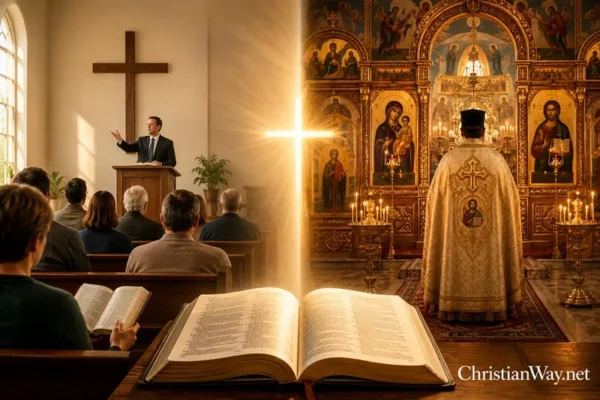
Few comparisons within Christianity are discussed more often, or misunderstood more easily, than Protestantism vs Catholicism. Some people speak as though Catholics and Protestants belong to entirely different religions. Others assume the differences are only about worship style, buildings, music, or whether a church has a Pope. Still others carry memories of painful arguments, family divisions, or harsh words that have made this subject feel less like a question of faith and more like a wound.
Yet we begin with a truth that should not be forgotten: Catholics and Protestants are Christians. They confess faith in the God revealed as Father, Son, and Holy Spirit. They proclaim Jesus Christ as Lord and Savior. They read the Holy Scriptures, pray the Lord’s Prayer, remember Christ’s death upon the cross, and place their hope in His resurrection. The Catholic Church itself recognizes the reality of this shared Christian confession among those who invoke the Triune God and confess Jesus Christ as Lord and Savior.
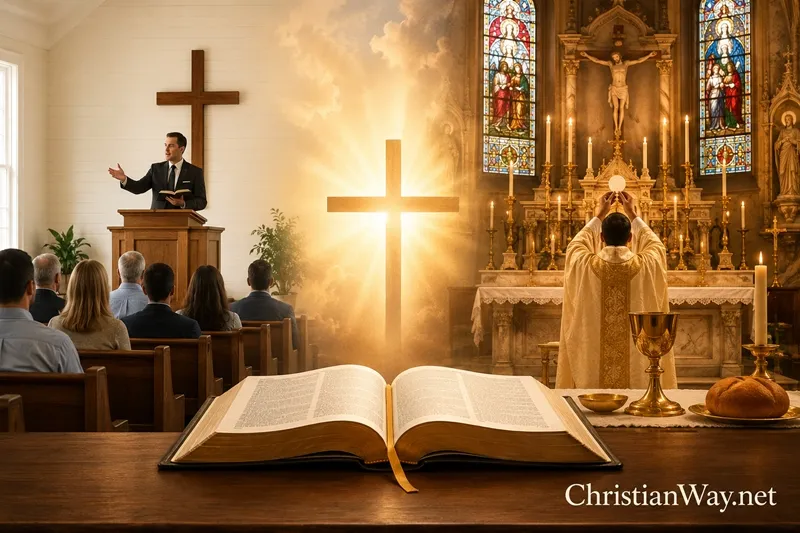
At the same time, the differences are real. They touch questions that matter deeply: Where does Christian authority rest? How should the Bible be read? What is the role of Church tradition? How is a person made right with God? What happens in Baptism and Holy Communion? What is the purpose of the Pope? How should Christians pray? What place do Mary and the saints have in the life of faith?
These questions cannot be answered with slogans. A Protestant cannot fairly describe Catholicism as salvation by works. A Catholic cannot fairly describe Protestantism as a faith without sacraments, history, discipline, or reverence. Both caricatures fail to see the real spiritual depth found in the other tradition.
Protestantism itself is not one church with one exact theology. It includes Lutheran, Reformed, Presbyterian, Anglican, Methodist, Baptist, Pentecostal, Evangelical, Anabaptist, and many other Christian communities. Some Protestant churches baptize infants; others baptize only professing believers. Some celebrate Holy Communion weekly with liturgy and vestments; others gather more simply around preaching, prayer, and congregational worship. Some strongly affirm Christ’s real presence in Communion, while others emphasize remembrance and thanksgiving.
Catholicism also contains great diversity. The Latin Church is the largest part of the Catholic Church, but Eastern Catholic churches preserve ancient Byzantine, Syriac, Armenian, Coptic, and other traditions of worship while remaining in communion with the Bishop of Rome.
For this reason, Protestantism vs Catholicism is not a comparison between two perfectly uniform groups. It is a comparison between a worldwide Catholic communion and a broad family of Protestant traditions, each carrying particular histories, convictions, gifts, and struggles.
Still, beyond the many differences stands Jesus Christ.
He is the One who entered human history, took flesh, preached the Kingdom of God, welcomed the weary, forgave sinners, carried the cross, rose from the dead, and called His people to love one another. Every Christian tradition must be measured not only by what it says about itself, but by whether it leads hearts more faithfully toward Him.
Protestantism and Catholicism Belong to One Christian Story
Catholicism and Protestantism are not separate from Christianity. Both belong within the larger Christian story that began with Jesus Christ and the witness of the apostles.
Christians believe that Jesus is not merely a moral teacher or an inspiring figure from the past. He is the eternal Son of God, truly God and truly human. The Gospel of John says, “And the Word was made flesh, and dwelt among us” (John 1:14). This confession lies at the heart of both Catholic and Protestant faith.
Both believe that God created the world in love. Both believe that every human person has dignity because each person is made in the image of God. Both believe that sin has wounded the human heart and broken humanity’s relationship with God and neighbor. Both believe that Christ came to reconcile the world to God.
The Apostle Paul writes, “God commendeth his love toward us, in that, while we were yet sinners, Christ died for us” (Romans 5:8). Catholics and Protestants may explain some aspects of salvation differently, but both proclaim that Christ’s death and resurrection are central to Christian hope.
Both traditions also confess the great truths of the ancient creeds. They believe in God the Father Almighty, in Jesus Christ His Son, and in the Holy Spirit. They believe that Christ was born of the Virgin Mary, suffered, died, rose again, ascended into heaven, and will come again in glory.
Both believe that prayer matters. Both believe that Christians are called to repent, forgive, care for the poor, resist evil, serve their neighbors, and live with hope in the resurrection.
The divisions between Christians are therefore painful precisely because the faith they share is so deep. Division is not something to celebrate. It should lead believers toward humility, honest conversation, repentance, and prayer for unity.
How the Protestant Reformation Began
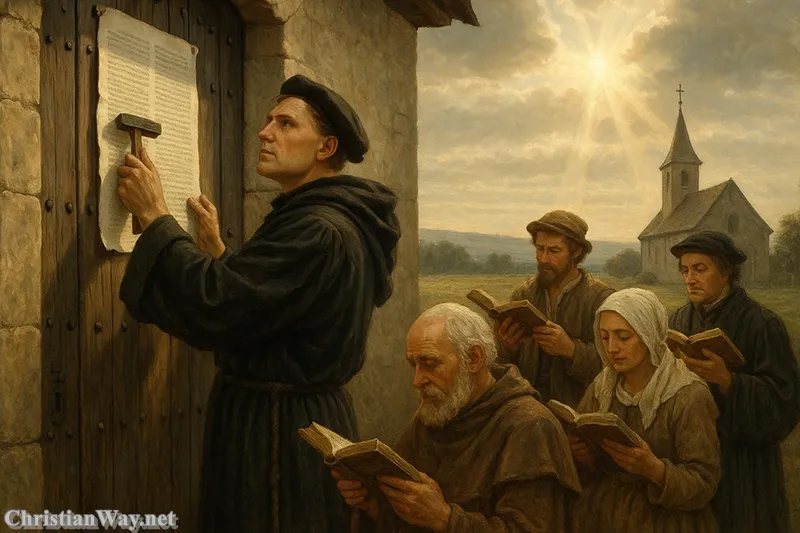
The Protestant Reformation began in Western Europe during the sixteenth century. It arose in a time when many Christians were concerned about abuses in Church life, confusion about salvation, the misuse of spiritual authority, and the limited access ordinary people had to the Bible in their own language.
Martin Luther became one of the most influential reformers. He was deeply concerned that people might come to believe forgiveness could be purchased, earned, or controlled through human religious effort. He insisted that sinners are saved because of God’s grace in Jesus Christ, received through faith.
Other reformers, including Ulrich Zwingli, John Calvin, Thomas Cranmer, and many others, also shaped Protestant history. Their traditions developed differently, but they shared a desire to call the Church back to the Gospel, to Scripture, to Christ, and to the grace of God.
The English Reformation gave rise to Anglicanism, a Protestant tradition that retained bishops, liturgical worship, the Book of Common Prayer, and a strong sense of continuity with the ancient Church. The Church of England’s historic Thirty-Nine Articles, agreed in 1562, remain an important example of Reformation-era Anglican teaching.
The Reformation was not simple, peaceful, or free from failure. Christians argued, divided, and at times persecuted one another. There were political struggles, personal ambitions, national conflicts, and genuine theological disagreements. It would be wrong to present the Reformation as though every Protestant reformer was pure in motive or every Catholic leader was blind to the need for reform.
Yet the central spiritual questions remain important: How is a sinner saved? What authority guides the Church? How should the Bible shape Christian life? How can the Church remain faithful to Christ in every age?
These questions continue to shape Protestantism vs Catholicism today.
Scripture and Tradition: Different Ways of Understanding Authority
One of the most important differences between Catholics and Protestants concerns the relationship between Holy Scripture and Christian Tradition.
Catholics deeply honor the Bible as the inspired Word of God. Scripture is proclaimed at Mass, read in personal prayer, studied in parishes, and heard throughout the Church year. Catholics do not see the Bible as a secondary part of faith. They receive it as sacred and essential.
At the same time, Catholics believe that Sacred Scripture and Sacred Tradition belong together. Tradition, in this sense, does not simply mean old customs, cultural habits, or human preferences. It refers to the living faith handed down from the apostles through the worship, teaching, councils, creeds, saints, and pastoral life of the Church. The Catholic Catechism teaches that Scripture and Tradition are closely bound together and flow from the same divine source.
Catholics believe that the Church serves the Word of God by preserving, teaching, and interpreting the faith received from the apostles. The Bible was written, received, proclaimed, and recognized within the worshipping life of the early Church. For Catholics, this means Scripture should not be separated from the Church that has carried it through the centuries.
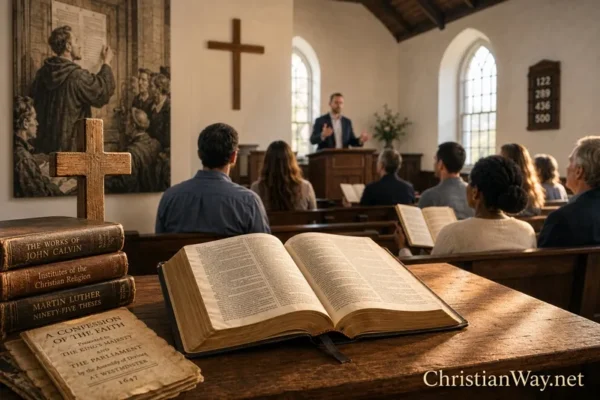
Most Protestants agree that Church history, creeds, pastors, teachers, and earlier Christian wisdom can be valuable. Many Protestants deeply appreciate the Apostles’ Creed, the Nicene Creed, the Church Fathers, and historic confessions of faith.
Yet Protestants generally insist that Holy Scripture is the final authority for Christian faith and practice. This conviction is often summarized in the phrase Sola Scriptura, meaning “Scripture alone.”
This does not mean that every Protestant believes Christians should interpret the Bible in complete isolation. Protestant churches have pastors, Bible teachers, elders, theological schools, confessions, and communities of faith. But they hold that every tradition, leader, teaching, and practice must be tested by Scripture.
A Protestant may say, “The Church is called to hear and obey the Bible.” A Catholic may say, “The Bible must be read within the living faith of the Church.” Both statements seek to protect something precious.
Protestants fear that human traditions can slowly gain authority that belongs to God’s Word alone. Catholics fear that separating Scripture from the Church’s historic faith can lead to endless individual interpretations and division.
Neither concern should be dismissed lightly. The Bible should never be reduced to private opinion. Yet human tradition should never become a shield against the truth God speaks through Scripture.
Salvation: Grace, Faith, and the Christian Life
Perhaps no topic has been more important in Protestantism vs Catholicism than salvation.
Both Catholics and Protestants believe that salvation begins with God’s grace. No one earns God’s love by being clever, wealthy, religiously impressive, charitable, or morally successful. Human beings cannot save themselves.
The Apostle Paul writes, “For by grace are ye saved through faith; and that not of yourselves: it is the gift of God” (Ephesians 2:8).
Protestants often place particular emphasis on justification by faith. They teach that a sinner is made right with God through faith in Jesus Christ, not through earning acceptance by religious works. Christ alone saves. His righteousness, mercy, death, and resurrection are the foundation of Christian hope.
This does not mean Protestants believe good works are unimportant. A living faith should bear fruit. It should lead to forgiveness, honesty, compassion, service, generosity, courage, and obedience. But Protestants insist that good works are the fruit of salvation, not the price of salvation.
Catholics also believe that salvation is a free gift of grace. They do not teach that a person can purchase heaven through good deeds. Catholic theology, however, often speaks more strongly about salvation as a lifelong journey in which believers receive grace, respond in faith, grow in holiness, repent after sin, receive the sacraments, and cooperate with God’s transforming work.
Catholics emphasize that faith must become love. Saint James writes, “Faith without works is dead” (James 2:26). A person who has received mercy is called to become merciful. A person who has been forgiven is called to forgive. A person who trusts Christ is called to live in a way that reflects Christ.
These differences have historically caused serious disagreement. Yet the situation is more hopeful than many people realize.
In 1999, the Catholic Church and the Lutheran World Federation signed the Joint Declaration on the Doctrine of Justification. It stated that Catholics and Lutherans had reached consensus on basic truths about justification as a free gift of God’s grace. The agreement was later affirmed by Methodist, Anglican, and Reformed bodies, though it did not erase every remaining difference between Catholic and Protestant theology.
This is important because it shows that Christian disagreement does not need to remain trapped in old misunderstandings. Catholics and Protestants can speak honestly about their differences while also recognizing their shared confession that salvation is a gift from God through Jesus Christ.
The Church and the Role of the Pope
Another major difference concerns the nature and authority of the Church.
Catholics believe that Christ founded a visible Church, entrusted to the apostles and continued through bishops who serve as successors of the apostles. They believe that the Church is one, holy, catholic, and apostolic.
Catholics also believe that the Bishop of Rome, known as the Pope, is the successor of Saint Peter and has a unique ministry of unity in the universal Church. They look to Jesus’ words, “Thou art Peter, and upon this rock I will build my church” (Matthew 16:18), as part of the foundation for this belief.
Catholic teaching sees the Pope as a visible principle of unity among bishops and believers throughout the world. The Pope is not another Christ, nor is he a replacement for Jesus. Christ alone is the head of the Church. Catholic doctrine understands the Pope’s ministry as service to the unity of faith and communion.
Protestants generally do not accept papal authority. They may respect the Pope as an important Christian leader, but they do not believe that one bishop has universal jurisdiction over the whole Church.
Different Protestant traditions organize themselves in different ways. Anglican and Methodist churches may have bishops. Presbyterian churches are governed through elders and councils. Baptist and many independent churches are often governed locally by the congregation and its appointed leaders. Lutheran churches have several forms of church government depending on their national or regional context.
Many Protestants emphasize the priesthood of all believers. This does not mean pastors, teachers, or church leaders are unnecessary. It means that every baptized Christian has direct access to God through Jesus Christ and is called to pray, serve, study Scripture, share the Gospel, and take part in the mission of the Church.
The Apostle Peter writes, “Ye are a chosen generation, a royal priesthood, an holy nation” (1 Peter 2:9).
Catholics also believe every baptized Christian has a calling. A parent teaching a child to pray, a nurse caring for a patient, a worker acting honestly, or a believer visiting the lonely is serving Christ. The difference lies not in whether ordinary Christians matter, but in how Catholics and Protestants understand the ordained ministry, apostolic succession, and the visible structure of the Church.
Sacraments: Seven Sacraments and Protestant Diversity
Catholic life is deeply shaped by the sacraments.
The Catholic Church recognizes seven sacraments: Baptism, Confirmation, Eucharist, Penance or Reconciliation, Anointing of the Sick, Holy Orders, and Matrimony. Catholics understand these as sacred signs through which Christ gives grace to His people.
Baptism welcomes a person into the Church and unites that person with Christ. Confirmation strengthens the baptized believer through prayer for the Holy Spirit. The Eucharist nourishes the faithful with Christ’s Body and Blood. Reconciliation offers forgiveness and healing after sin. Anointing of the Sick brings comfort and grace in illness. Holy Orders sets apart bishops, priests, and deacons for ministry. Matrimony blesses the covenant of marriage.
Most Protestants recognize Baptism and Holy Communion as the two principal practices instituted by Christ. Some call them sacraments; others call them ordinances. The word ordinance emphasizes that Jesus commanded His followers to observe them.
Lutherans, Anglicans, Methodists, and Reformed Christians often speak of Baptism and Communion as means of grace. Baptist and many Evangelical churches frequently emphasize public obedience, remembrance, testimony, and the believer’s response of faith.
For example, the Reformed and Presbyterian tradition recognizes Baptism and the Lord’s Supper as sacraments instituted by Christ and understands them as visible signs of God’s grace.
The difference is not that Catholics value grace while Protestants value obedience. Both grace and obedience matter. The difference is in how the traditions understand the way Christ acts through the sacraments and how many sacramental rites should be recognized.
Baptism: Infants, Believers, and Belonging to Christ
Catholics baptize infants and adults.
When an infant is baptized, parents and godparents promise to raise the child in the Christian faith. Catholics believe that Baptism is first a gift of God’s grace, not merely a public declaration made by the individual.
Many Protestant traditions, including Lutheran, Anglican, Methodist, Presbyterian, and Reformed churches, also baptize infants. They understand Baptism as a sign of God’s covenant love and the Church’s promise to nurture the child in faith.
Other Protestant traditions, including Baptists, many Pentecostals, and many independent churches, practice believers’ baptism. They baptize people who have personally confessed faith in Jesus Christ and are prepared to follow Him consciously.
Both views seek to honor Baptism. Both see it as connected to new life in Christ. Both are rooted in the command of Jesus to baptize “in the name of the Father, and of the Son, and of the Holy Ghost” (Matthew 28:19).
Even where Christian communities remain divided, Baptism is an important sign of shared belonging to Christ. Catholic teaching itself describes Baptism as the foundation of communion among Christians, including those not yet in full communion with the Catholic Church.
Holy Communion: Mass, the Lord’s Supper, and Christ’s Presence
Holy Communion is another central area of difference.
For Catholics, the Eucharist is the heart of the Mass. Catholics believe that through the power of the Holy Spirit and Christ’s promise, the bread and wine become the true Body and Blood of Christ. This teaching is often explained through the word transubstantiation.
Catholics do not see the Mass as a repetition of Christ’s sacrifice. Christ died once for all upon the cross. In the Mass, Catholics believe the Church enters sacramentally into that one saving sacrifice and receives its grace.
For many Protestants, Holy Communion is also sacred, but it is understood in different ways.
Lutherans strongly affirm Christ’s real presence in the Lord’s Supper. Reformed Christians speak of real spiritual nourishment in Christ through faith and the work of the Holy Spirit. Anglicans include a wide range of views, from evangelical understandings to deeply sacramental and Anglo-Catholic expressions. Methodists often describe Communion as a means of grace. Baptists and many Evangelical churches emphasize remembrance, thanksgiving, fellowship, and proclamation of Christ’s death.
The Apostle Paul writes, “For as often as ye eat this bread, and drink this cup, ye do shew the Lord’s death till he come” (1 Corinthians 11:26).
Every Christian tradition hears these words. Every tradition is called to approach the Lord’s table with humility, gratitude, repentance, and concern for others.
The differences are real, especially concerning Christ’s presence and the relationship of Communion to ordained ministry and Church unity. Yet the deepest purpose remains the same: to remember Christ, receive His grace, give thanks for His sacrifice, and be drawn into love for God and neighbor.
Mary, the Saints, and Prayer
Catholics honor Mary, the mother of Jesus, and the saints.
Catholics worship God alone: Father, Son, and Holy Spirit. Mary and the saints are not worshipped as gods. Mary is honored because she is the mother of Jesus Christ, the Son of God made flesh.
Catholics call Mary the Mother of God because the child she bore was truly God and truly human. Her words to the angel Gabriel, “Be it unto me according to thy word” (Luke 1:38), are seen as an example of humble faith.
Catholics also ask Mary and the saints to pray for them. They understand this in a way similar to asking a Christian friend or family member to pray. They believe that those who have died in Christ remain alive in Him and belong to the communion of saints.
Most Protestants honor Mary as the mother of Jesus and respect the witness of biblical and historical saints. Yet they do not generally ask Mary or the saints for intercession. Protestants emphasize direct prayer to God through Jesus Christ.
This difference is connected to the Protestant conviction that Christ is the one mediator between God and humanity. Catholics agree that Christ alone is the Savior and the unique mediator in the fullest sense, but they believe Christians can pray for one another as members of one body, including those who now rest in Christ.
This topic should be approached with care. Protestants should not accuse Catholics of worshipping Mary. Catholics should not accuse Protestants of dishonoring her simply because they do not practice Marian devotion.
Both can agree that Mary’s deepest purpose is to point toward Christ. At Cana, she says, “Whatsoever he saith unto you, do it” (John 2:5).
Confession, Forgiveness, and the Healing of Sin
Catholics often receive the Sacrament of Reconciliation, commonly called Confession.
In Confession, a Catholic speaks honestly about sin before a priest, receives pastoral guidance, performs an act of penance, and hears absolution pronounced in the name of Christ.
Catholics do not believe the priest replaces Jesus. They believe the priest serves as an instrument of Christ’s mercy and a visible sign that sin affects not only the individual but also the whole Church.
Many Protestants confess their sins directly to God in prayer. They may confess privately, in public worship, or with a trusted pastor, elder, counselor, or Christian friend. Some Lutheran and Anglican traditions also retain forms of private confession and absolution.
Both Catholics and Protestants agree that repentance matters. Sin cannot be healed by denial. The heart must turn toward God.
The Christian message is not that people should hide their failures or pretend they are strong enough to save themselves. It is that Christ receives those who come in humility.
The story of the prodigal son remains precious to every Christian tradition. The son returns in shame, expecting only rejection. Yet the father runs to meet him. This is the heart of the Gospel: God does not delight in keeping sinners far away. He rejoices when they return.
Worship: The Mass and Protestant Forms of Gathering
Catholic worship is centered on the Mass.
At Mass, Catholics hear Scripture, confess sin, pray for the Church and the world, offer thanksgiving, and receive Holy Communion. The Mass follows an ordered pattern that includes readings from the Bible, a homily, intercessions, the Eucharistic prayer, and Communion.
Catholic worship often includes sacred music, vestments, candles, incense, sacred images, silence, kneeling, and the rhythm of the Church calendar.
Protestant worship is much more varied.
A Lutheran church may include liturgical prayers, hymns, Scripture readings, a sermon, and frequent Communion. An Anglican church may use the Book of Common Prayer or another liturgical form. A Presbyterian church may focus on Scripture, prayer, psalms, preaching, and the shared leadership of elders. A Baptist congregation may emphasize preaching, congregational singing, testimony, prayer, and believers’ baptism. A Pentecostal church may include joyful worship, spontaneous prayer, spiritual gifts, and a strong expectation of the Holy Spirit’s work.
Some Protestant churches meet in historic buildings with choirs, organs, stained glass, and formal liturgy. Others meet in homes, schools, halls, or simple modern spaces.
The outward forms differ, but worship must always lead believers toward God. A beautiful service that does not produce mercy becomes empty. A powerful sermon that does not teach love becomes noise. A moving song that does not lead to obedience fades quickly.
Jesus said, “God is a Spirit: and they that worship him must worship him in spirit and in truth” (John 4:24).
Faith in Daily Life: Where Differences Must Become Love
Theological differences matter. They shape the way Christians understand the Church, worship, prayer, salvation, sacraments, and authority.
But doctrine is never meant to make people proud.
A Catholic may attend Mass faithfully and still need to forgive a family member. A Protestant may know the Bible deeply and still need to speak gently at home. A Christian may defend every point of theology and still fail to care for the poor, the lonely, or the wounded.
The Christian faith is tested in daily life.
It is tested when a parent is tired and still chooses patience.
It is tested when a worker has an opportunity to be dishonest and chooses truth.
It is tested when someone has been hurt and must decide whether to carry bitterness or begin the long work of forgiveness.
It is tested when a church notices the person who feels invisible.
It is tested when believers care for the sick, feed the hungry, protect the vulnerable, welcome the stranger, and refuse to treat human beings as disposable.
Catholics and Protestants have both contributed greatly to schools, hospitals, charitable work, missions, Bible translation, care for the poor, education, music, art, and the spiritual formation of millions of people.
They have also both experienced human weakness, division, pride, and failure.
No tradition should boast. Every Christian needs grace.
What Catholics and Protestants Can Learn From One Another
Catholics and Protestants do not need to erase their convictions in order to treat one another with respect.
Catholics can learn from Protestant love for Bible study, preaching, personal conversion, mission, and the conviction that every believer has a calling to serve Christ.
Protestants can learn from Catholic sacramental life, ancient prayers, spiritual disciplines, reverence in worship, the witness of saints, and the Church’s long tradition of caring for the poor and vulnerable.
Catholics can be reminded that familiar practices must always lead to a living relationship with Christ. Protestants can be reminded that personal faith is not meant to become isolated from the wider communion of Christians across time and place.
Both can learn that Christian unity does not come through pretending that differences do not matter. It comes through truth spoken with humility, conviction shaped by love, and a willingness to see one another first as people for whom Christ died.
Jesus prayed, “That they all may be one” (John 17:21).
This prayer does not demand shallow agreement. It calls Christians to seek unity that is faithful, honest, patient, and rooted in Christ.
Reflect and Pray
Protestantism vs Catholicism involves meaningful differences. Catholics and Protestants differ on the relationship between Scripture and Tradition, the authority of the Pope, the nature of the Church, the number and purpose of the sacraments, the Eucharist, Mary and the saints, confession, and the way salvation is explained.
Yet they share far more than many people realize.
Both confess the Triune God. Both proclaim Jesus Christ as Savior and Lord. Both believe that salvation begins with grace. Both read the Bible. Both pray. Both baptize in the name of the Father, Son, and Holy Spirit. Both remember Christ’s death and resurrection. Both call believers to repentance, faith, love, forgiveness, and hope.
The deepest question is not simply whether someone calls himself Catholic or Protestant. The deeper question is whether that person is being drawn closer to Jesus Christ.
Does faith lead us to humility?
Does worship lead us to mercy?
Does Scripture lead us to truth and love?
Does grace make us more willing to forgive?
Does the cross teach us to serve?
May every Christian tradition return again and again to Christ, who is greater than our labels, stronger than our divisions, and faithful even when His people fail.
Let us pray:
Lord Jesus Christ,
You are the foundation of Your Church
and the hope of every searching heart.
Teach us to love Your truth without pride,
to receive Your grace with humility,
and to serve one another with patience and compassion.
Heal the wounds that divide Christians,
strengthen all who are weary,
and lead Your people into deeper faith,
greater love, and lasting peace.
May Your mercy shape our worship,
our homes, our work, and our daily lives,
until we see You face to face. Amen.
— Fr. John Matthew