A pastoral reflection on Protestant and Eastern Orthodox faith, their differences, shared beliefs, and hope in Jesus Christ.
Dear friends in Christ,
The Christian world can sometimes appear bewilderingly divided. A person opening the New Testament for the first time may encounter the radiant simplicity of the Gospel—the announcement that God has come near in Jesus Christ—only to discover that those who confess Christ belong to many churches, traditions, and denominations. Among the most significant expressions of Christianity are Protestantism and Eastern Orthodoxy, two great families of faith that share essential Christian convictions while differing profoundly in their understanding of authority, worship, salvation, the Church, and the spiritual life.
These differences are not merely matters of architecture, music, vestments, or cultural custom. They arise from different historical journeys and from distinct ways of understanding how the apostolic faith is preserved and lived. Eastern Orthodox Christians understand themselves as continuing the faith, worship, and sacramental life of the ancient undivided Church. Protestants generally trace their origins to the sixteenth-century Reformation, when Christians in Western Europe sought to correct what they believed were serious errors and abuses in the medieval Church by returning to the supreme authority of Scripture and the Gospel of grace.
Yet it would be unfair to speak as though Eastern Orthodoxy and Protestantism were two simple, uniform systems. Eastern Orthodoxy contains many local churches, spiritual customs, and theological emphases, even though these churches share a common sacramental and doctrinal communion. Protestantism is far more internally diverse. Lutherans, Reformed Christians, Anglicans, Baptists, Methodists, Pentecostals, Anabaptists, and independent evangelical communities may differ considerably from one another. Some Protestant churches retain ancient liturgies, creeds, bishops, and a sacramental understanding of worship. Others emphasize informal prayer, personal conversion, congregational independence, and spontaneous preaching.
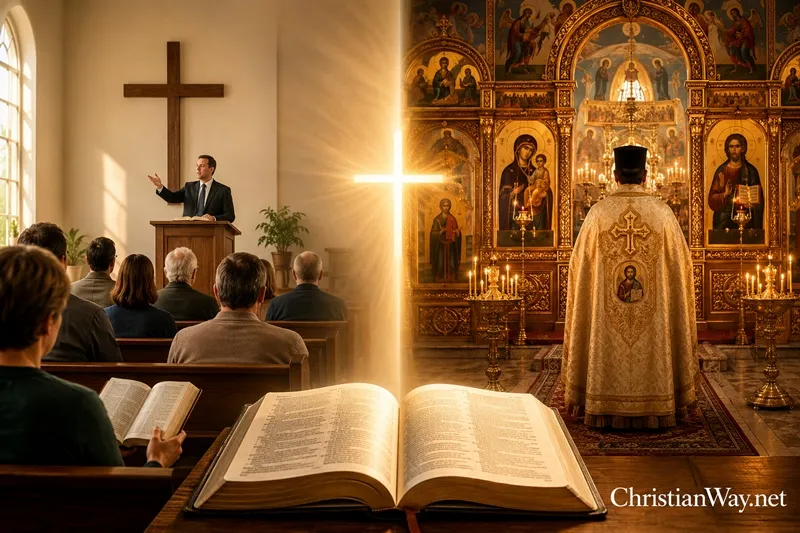
Therefore, any comparison must be made with humility. We should not compare the deepest theology of one tradition with the weakest popular expression of another. Nor should we allow disagreement to become contempt. Christ prayed that His disciples might be one, and every Christian conversation should be conducted beneath the weight and tenderness of that prayer.
To compare Protestantism and Eastern Orthodoxy faithfully is not to decide who deserves kindness and who does not. Every person bears the image of God. Every baptized Christian who sincerely confesses Jesus Christ should be approached as someone for whom Christ died. The purpose of understanding differences is not to sharpen hostility, but to seek truth in love and to recognize more clearly the gifts, wounds, and longings present within the Christian family.
A Brief Historical Background
The Eastern Orthodox Church and the Ancient Christian East
Eastern Orthodoxy is rooted in the ancient Christian communities of the eastern Roman world, including Jerusalem, Antioch, Alexandria, Constantinople, and the regions evangelized by these historic centers. Orthodox Christians see their Church not as a later denomination but as the visible continuation of the apostolic Church through the unbroken life of its bishops, sacraments, councils, worship, and teaching.
During the first centuries of Christianity, the Church clarified its faith through Scripture, prayer, theological controversy, and ecumenical councils. The early councils defended essential Christian doctrines: that Jesus Christ is truly divine and truly human, that God is Trinity, and that the Son of God became incarnate for our salvation.
The Nicene Creed, recited in Orthodox worship, remains a central summary of the faith. It confesses belief in one God, the Father Almighty; in one Lord Jesus Christ, the eternal Son of God; in the Holy Spirit, the Lord and giver of life; and in one, holy, catholic, and apostolic Church.
Over the centuries, tensions grew between Greek-speaking Eastern Christianity and Latin-speaking Western Christianity. These tensions involved language, culture, political authority, theological expression, and the role of the bishop of Rome. The division commonly associated with the year 1054 did not occur in a single moment, but it became the symbol of a long separation between the Eastern Orthodox Church and the Roman Catholic Church.
Eastern Orthodoxy continued to develop in the Byzantine world and later spread deeply into Eastern Europe, Russia, the Balkans, the Middle East, and beyond. Orthodox missionaries brought the Gospel to new peoples while often translating Scripture and worship into local languages. Today, Eastern Orthodoxy is a global Christian communion, though its life remains strongly shaped by the theology and worship of the ancient Christian East.
The Protestant Reformation
Protestantism arose within Western Christianity in the sixteenth century. Reformers such as Martin Luther, Huldrych Zwingli, John Calvin, and others criticized doctrines and practices they believed had departed from biblical truth. Their concerns included the sale of indulgences, corruption among clergy, the spiritual anxiety produced by certain penitential practices, and teachings concerning authority, justification, and the sacraments.
Martin Luther’s protest began within the Roman Catholic world, but conflict eventually led to separation. The Reformation spread and took several forms. Lutheran churches developed in parts of Germany and Scandinavia. Reformed Christianity became influential in Switzerland, France, the Netherlands, Scotland, and elsewhere. The English Reformation produced the Anglican tradition. Later movements gave rise to Baptists, Methodists, Pentecostals, and many evangelical churches.
The Reformers did not all agree with one another. They differed on the Eucharist, baptism, church government, predestination, and the relationship between Church and state. What united many of them was a desire to place Scripture at the center of Christian doctrine and to proclaim salvation as the gift of God’s grace received through faith.
Protestantism eventually became extraordinarily diverse. Some Protestant communities preserved much of the liturgical and sacramental inheritance of Western Christianity. Others moved toward simpler forms of worship and a stronger distinction between the visible institution of the Church and the spiritual fellowship of all true believers.
This historical difference remains important. Eastern Orthodoxy did not participate directly in the Protestant Reformation because the Reformation was largely a dispute within Western Christianity. Orthodox Christians therefore tend to view both Roman Catholicism and Protestantism as Western traditions that developed after the separation between East and West, though in very different directions.
A Summary of Major Similarities and Differences
| Area | Eastern Orthodoxy | Protestantism |
|---|---|---|
| Historical identity | Continuation of the ancient apostolic and conciliar Church | Traditions arising primarily from the sixteenth-century Reformation and later renewal movements |
| Authority | Scripture within Holy Tradition, interpreted in the life of the Church | Scripture as the supreme or sole infallible authority, interpreted in various confessional and congregational settings |
| Church structure | Episcopal and sacramental, with bishops in apostolic succession | Diverse: episcopal, presbyterian, congregational, or independent |
| Salvation | Healing, participation in divine life, and lifelong transformation by grace | Commonly emphasizes justification by grace through faith; views of sanctification vary |
| Sacraments | A fully sacramental life, traditionally speaking of seven major mysteries | Usually recognizes two ordinances or sacraments instituted by Christ, though some traditions recognize more |
| Eucharist | Truly the Body and Blood of Christ, received as a holy mystery | Views range from real presence to spiritual presence or memorial remembrance |
| Baptism | Normally includes infants; understood as participation in Christ’s death and resurrection | Views vary; many baptize infants, while Baptists and others baptize professing believers |
| Mary and the saints | Honored and asked to intercede; Mary is called Theotokos, “God-bearer” | Usually respected as faithful examples, but prayer asking for their intercession is generally rejected |
| Icons | Venerated as witnesses to the Incarnation; worship belongs to God alone | Often absent or used only as decoration; some traditions are cautious about religious images |
| Worship | Liturgical, sacramental, symbolic, and rooted in ancient forms | Ranges from formal liturgy to informal, contemporary, and spontaneous worship |
| Final Christian hope | Resurrection, communion with God, and the renewal of creation | The same central hope, expressed through various theological frameworks |
A table may help the mind see distinctions, but it cannot convey the full spiritual character of either tradition. Faith is not lived inside columns. It is lived in prayer, repentance, worship, suffering, love, and the daily effort to follow Christ.
Scripture and Holy Tradition
The Orthodox Understanding of Authority
One of the deepest differences between Protestantism and Eastern Orthodoxy concerns the relationship between Scripture and Tradition.
Eastern Orthodox Christians hold the Bible to be inspired by God and authoritative for faith. The Holy Scriptures are read constantly in Orthodox worship. The Psalms shape daily prayer; the Gospels are solemnly proclaimed; and the words of Scripture are woven throughout the Divine Liturgy, the sacraments, and the hymns of the Church.
Orthodoxy, however, does not understand Scripture as a book existing independently of the Church. The Bible was written within the community of faith, preserved by that community, read in worship, and recognized through the life of the early Church. The Church did not create the divine authority of Scripture, but the historical process by which the biblical canon was recognized occurred within the Church.
For Orthodox Christians, Holy Tradition is not merely a collection of customs added to the Bible. It is the living transmission of apostolic faith in the Holy Spirit. Scripture is the heart of this Tradition, but Tradition also includes the Nicene Creed, the decisions of the ecumenical councils, the writings of the Fathers, the sacramental life of the Church, its liturgical worship, its iconography, and the consistent witness of the saints.
Orthodox theology often points to Saint Paul’s words: “Stand firm and hold to the traditions that you were taught by us, either by our spoken word or by our letter.” The apostolic faith was communicated both orally and in writing. Orthodoxy believes that this faith continues in the worshiping and teaching life of the Church.
This does not mean that every local custom is infallible or that every statement by a Church Father carries equal authority. Orthodoxy distinguishes the fullness of Holy Tradition from temporary habits, regional practices, or private theological opinions. Authentic Tradition is recognized through the enduring, catholic consciousness of the Church.
The Protestant Principle of Scripture
Most Protestants uphold the principle commonly called sola Scriptura, meaning “Scripture alone.” This phrase is sometimes misunderstood. Classical Protestants did not necessarily reject all tradition, creeds, councils, or theological teachers. Lutherans, Reformed Christians, and Anglicans often value the ancient creeds and the writings of the early Church. The principle means that Scripture is the only infallible rule by which all doctrines and traditions must finally be judged.
The Reformers believed that Church authorities could err and that some teachings had developed without sufficient biblical foundation. They therefore appealed to Scripture as the supreme standard. Their concern was not to make every individual Christian an isolated authority, but to ensure that the Church remained accountable to the written Word of God.
In practice, Protestant approaches to interpretation vary greatly. Confessional Protestants read Scripture through historic statements of faith. Many evangelicals emphasize careful biblical study and the guidance of the Holy Spirit. Some independent communities allow greater freedom for individual interpretation. This diversity has produced both vitality and fragmentation.
The Protestant love of Scripture has borne abundant fruit. Bible translation, public preaching, literacy, personal study, family devotion, and missionary work have all been strengthened by the conviction that ordinary believers should hear and read the Word of God.
Orthodox Christians may ask, however, who possesses the authority to settle disputes when sincere readers interpret Scripture differently. Protestants may respond that no human institution is protected from error and that fidelity to Scripture requires continual reform. Here we encounter not simply a disagreement about particular verses, but two different visions of how Christ preserves His Church in truth.
The Nature and Authority of the Church
The Church as a Visible Sacramental Communion
Eastern Orthodoxy understands the Church as both spiritual and visibly embodied. The Church is the Body of Christ, the temple of the Holy Spirit, and the people gathered around the bishop in the Eucharist. Its visible structure is not considered a secondary convenience. Bishops, priests, deacons, councils, sacraments, and apostolic succession belong to the way Christ has given the Church life in history.
Orthodox bishops are understood to stand in continuity with the apostles through ordination and shared faith. No individual bishop is regarded as universally infallible or supreme over the whole Church. Orthodox churches are governed synodally, meaning through councils of bishops. Local churches may be administratively independent while remaining united in doctrine and sacramental communion.
This structure can appear complex, especially because Orthodoxy has experienced jurisdictional disputes and tensions among its local churches. Yet its basic ecclesiology remains clear: the fullness of the Church is manifested where the apostolic faith, the bishop, the Eucharist, and the faithful are united.
Protestant Understandings of the Church
Protestant views of the Church are diverse. Many Protestants distinguish between the visible church, which includes all who outwardly profess the faith, and the invisible Church, known perfectly to God and consisting of all true believers united to Christ.
Some Protestant traditions retain episcopal government. Anglicans and many Lutherans have bishops, though their understanding of apostolic succession may differ from that of Orthodoxy. Presbyterian churches are governed by elders in graded councils. Baptist and congregational churches emphasize the authority of the local congregation. Independent churches may be led by pastors and elders without a larger denominational structure.
Most Protestants affirm that the true Church exists wherever the Gospel is faithfully preached and the sacraments or ordinances are rightly administered. The unity of the Church is therefore often understood primarily as spiritual unity in Christ rather than full visible unity under one sacramental structure.
This flexibility has allowed Protestant Christianity to adapt rapidly to different cultures and missionary settings. It has also contributed to the multiplication of denominations. Protestant Christians may see denominational diversity as an imperfect but manageable expression of freedom in nonessential matters. Orthodox Christians tend to see the division of Christians at the Eucharistic table as a more serious wound to the visible unity intended by Christ.
Salvation: Justification, Healing, and Participation in God
Perhaps no subject requires greater care than salvation. Both Protestants and Orthodox Christians proclaim that salvation is possible only because of the grace of God revealed in Jesus Christ. Neither tradition teaches that human beings can save themselves. Yet they often organize the biblical language of salvation in different ways.
The Protestant Emphasis on Justification by Faith
The Reformation placed great emphasis on justification by grace through faith. The Reformers proclaimed that sinful human beings are accepted by God not because they have earned righteousness through good works, but because of Christ’s saving work. His righteousness is received by faith as a gift.
Saint Paul writes, “Since we are justified by faith, we have peace with God through our Lord Jesus Christ.” For many Protestants, justification refers especially to God’s gracious declaration that the believer is righteous in Christ. Forgiveness and acceptance rest on Christ’s merit, not on the believer’s moral achievement.
Good works remain essential as the fruit of genuine faith, but they do not purchase salvation. As the Letter to the Ephesians teaches, we are saved by grace through faith, “not the result of works,” and yet we are created in Christ Jesus “for good works.” Faith that produces no love, obedience, repentance, or mercy is regarded as dead.
Different Protestant traditions explain the relationship between justification and sanctification in different ways. Lutherans strongly distinguish them while affirming that living faith bears fruit. Reformed theology emphasizes union with Christ as the source of both justification and sanctification. Methodists place particular emphasis on holiness and the transforming work of grace. Pentecostal and evangelical Christians often stress personal conversion, new birth, and life in the Holy Spirit.
The Orthodox Understanding of Salvation as Healing and Theosis
Eastern Orthodoxy affirms forgiveness, justification, redemption, reconciliation, and new birth. Yet Orthodox theology often presents salvation primarily as healing and participation in the life of God.
Humanity is not only guilty before God; humanity is also wounded, enslaved by sin, subject to corruption, and afraid of death. Christ comes as physician, liberator, conqueror of death, and restorer of the divine image within us. Through His Incarnation, death, resurrection, and ascension, He opens the way for human beings to share in divine life.
This participation is called theosis, or deification. The term can sound alarming to those unfamiliar with it. Orthodoxy does not teach that human beings become God by nature or cease to be creatures. Rather, by grace we are united to God and transformed into the likeness of Christ. Saint Peter speaks of believers becoming “participants of the divine nature.” Saint Athanasius famously expressed the mystery by teaching that the Son of God became human so that humanity might share in God’s life.
Theosis is a lifelong journey of grace, repentance, prayer, sacramental communion, and love. It is not a spiritual achievement accomplished through human effort. God acts first, accompanies us, heals us, and brings the work to completion. Yet human freedom is not erased. Orthodoxy often speaks of synergy, the cooperation of the human person with divine grace.
This cooperation does not mean that grace and human effort are equal partners. Even our ability to respond is itself sustained by grace. But love does not force communion. God calls, heals, strengthens, and transforms, while the human person is invited to repent, trust, obey, and open the heart.
Some Protestants worry that this language compromises the sufficiency of grace. Orthodox Christians worry that a purely legal account of justification can separate forgiveness from actual transformation. In reality, the New Testament contains legal, sacrificial, relational, medicinal, and participatory images of salvation. The disagreement concerns how these images are connected and which receive primary emphasis.
Sin and the Human Condition
Eastern Orthodox Christians commonly speak of “ancestral sin” rather than using the Western framework of original sin in precisely the same way. Orthodoxy teaches that humanity inherits from Adam a fallen condition marked by mortality, corruption, and an inclination toward sin. Human beings are born into a world enslaved by death, and each person adds personal sins to this inherited brokenness.
Orthodoxy generally does not teach that every person bears Adam’s personal guilt in a strictly inherited juridical sense. The tragedy inherited from Adam is death and corruption, from which sinful actions arise. Christ enters this mortal condition, remains without sin, destroys death through death, and restores humanity.
Protestant understandings of original sin vary, though many are shaped by Saint Augustine and the Western theological tradition. Classical Lutheran and Reformed theology emphasizes the depth of humanity’s fall and inability to return to God without sovereign grace. Other Protestant traditions place greater stress on prevenient grace, through which God enables the human person to respond freely to the Gospel.
Despite these differences, both traditions insist that sin is more than a collection of mistakes. It is a spiritual power that distorts the heart, damages communion, and leads to death. Both proclaim that Christ alone conquers sin and renews the human person.
The Cross and Resurrection of Christ
Protestants and Orthodox Christians stand together in confessing that Jesus Christ died for our sins and rose bodily from the dead. Yet the imagery used to explain the saving work of Christ often differs.
Many Protestants, especially within Reformed and evangelical traditions, emphasize penal substitution: Christ bears the judgment deserved by sinners and satisfies divine justice on their behalf. This teaching seeks to preserve the seriousness of sin, the holiness of God, and the astonishing grace of Christ, who willingly gives Himself for us.
Not all Protestants explain the cross in exactly the same way. Lutheran, Anglican, Methodist, Anabaptist, and other Protestant theologians may combine substitution with themes of reconciliation, sacrifice, victory over evil, moral transformation, and union with Christ.
Eastern Orthodoxy strongly emphasizes Christ’s victory over death, the devil, and corruption, often described as Christus Victor. By entering death freely, Christ breaks its power from within. The Resurrection is not merely proof that the sacrifice was accepted; it is the decisive defeat of the grave and the beginning of a renewed creation.
This is proclaimed triumphantly in the Orthodox Paschal hymn: Christ is risen from the dead, trampling down death by death and giving life to those in the tombs.
Orthodoxy does affirm that Christ dies “for us” and “for our sins.” It speaks of sacrifice, ransom, reconciliation, and substitution. But it is often cautious about explanations that seem to portray the Father as directing anger toward an unwilling Son. The Father, Son, and Holy Spirit act in perfect unity for human salvation. The Son freely offers Himself in love, and through His death and resurrection restores communion between God and humanity.
The differences are real, yet Christians should remember that no single image exhausts the mystery of the cross. Christ is the Lamb of God, the victorious King, the suffering servant, the great High Priest, the ransom for many, the new Adam, and the healer of wounded humanity.
Baptism and Entry into the Christian Life
Eastern Orthodoxy understands baptism as a sacrament through which a person is united to the death and resurrection of Christ, cleansed from sin, and incorporated into the Church. Infants are baptized because salvation is understood as divine gift and entrance into the covenant community, not merely as a public expression of mature intellectual belief.
Orthodox baptism is normally performed through threefold immersion in the name of the Father, the Son, and the Holy Spirit. It is followed immediately by chrismation, the sacramental gift of the Holy Spirit, and then by reception of the Eucharist. Even baptized infants participate fully in the sacramental life.
Protestant practice varies. Lutherans, Reformed Christians, Anglicans, Methodists, and several other traditions baptize infants, though they explain baptism differently. Baptists, Pentecostals, many evangelicals, and independent churches practice believer’s baptism, holding that baptism should follow a personal confession of faith.
Some Protestants understand baptism as a means through which God truly gives grace. Others see it principally as an outward sign of an inward conversion already received by faith. Nearly all agree that Christ commanded baptism and that it publicly identifies the believer with His death, resurrection, and people.
Behind the debate lies a deeper question: Is baptism primarily God’s action toward the person, the believer’s testimony toward God and the community, or both? Eastern Orthodoxy strongly emphasizes God’s sacramental action, while many Protestant traditions emphasize personal faith and public confession.
The Eucharist and the Presence of Christ
The Eucharist stands at the center of Orthodox Christian life. Orthodox Christians believe that the bread and wine truly become the Body and Blood of Christ through the action of the Holy Spirit. They do not normally attempt to define the transformation through a precise philosophical mechanism. It is received as a holy mystery.
The Divine Liturgy is not understood as a repetition of Christ’s sacrifice. Rather, the Church is sacramentally drawn into the one eternal and unrepeatable offering of Christ. Heaven and earth meet; the faithful join the worship of the angels and saints; and Christ gives Himself as the medicine of immortality.
Because Eucharistic communion expresses complete unity in faith and Church life, the Orthodox Church ordinarily admits only Orthodox Christians who are properly prepared. This practice can feel painful or unwelcoming to visitors, but its intention is not to declare that others are unloved by God. It reflects the conviction that sharing one chalice is the culmination of full ecclesial unity, not a substitute for it.
Protestant views of Communion range widely. Lutherans strongly affirm the real presence of Christ’s Body and Blood. Reformed Christians often speak of a true spiritual participation in Christ through the Holy Spirit. Anglicans include several theological approaches, many of which are strongly sacramental. Methodists treat Holy Communion as a means of grace. Baptists and many evangelicals understand the Lord’s Supper primarily as a memorial and proclamation of Christ’s death.
Even where the meal is interpreted symbolically, it is not necessarily treated casually. Many Protestant Christians approach Communion with sincere repentance, gratitude, and faith. Still, the contrast can be considerable. For Orthodoxy, the Eucharist is the very center of the Church’s identity. In some Protestant communities, preaching occupies the central liturgical place, while Communion is celebrated less frequently.
Worship: Divine Liturgy and Protestant Diversity
Orthodox worship is ancient, liturgical, sensory, and deeply symbolic. The faithful encounter sung prayer, incense, candles, icons, processions, Scripture, sacramental gestures, and periods of reverent stillness. Worship is directed toward God rather than designed primarily around the preferences of the congregation.
The Divine Liturgy of Saint John Chrysostom, used through much of the year, has been prayed in forms recognizable across many centuries. This continuity gives Orthodox Christians a profound sense that they worship with the whole Church across time and space.
Orthodox worship is also eschatological. It offers a foretaste of the kingdom of God. The church building itself becomes a theological witness. The dome may portray Christ Pantocrator, the ruler of all. The icons reveal the communion of saints. The altar signifies the heavenly throne and the tomb from which Christ rose.
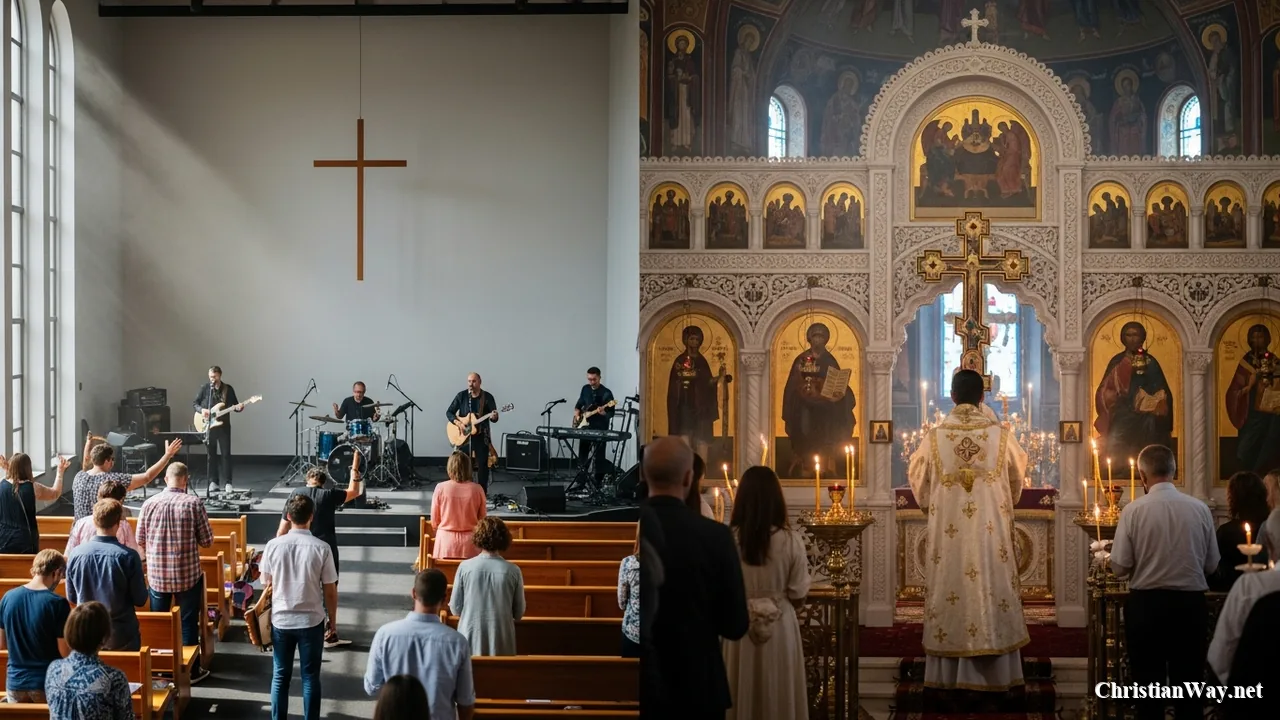
Protestant worship varies from highly liturgical services to informal gatherings. Lutheran and Anglican churches may follow structured liturgies with vestments, lectionaries, hymns, and weekly Communion. Reformed worship often centers on Scripture, preaching, psalmody, and ordered prayer. Baptist and evangelical services usually emphasize congregational singing, biblical preaching, personal testimony, and prayer. Pentecostal worship may include spontaneous praise, healing prayer, prophecy, and other charismatic gifts.
This diversity reflects different theological convictions. Protestants often emphasize intelligibility, congregational participation, and direct engagement with Scripture. Orthodox Christians emphasize entering a received pattern of worship that forms the believer over a lifetime.
Both traditions face temptations. Liturgical worship can become external routine if the heart remains absent. Informal worship can become centered on personality, emotion, or entertainment. True worship requires both truth and Spirit, reverence and love, form and inward surrender.
Mary, the Saints, and Christian Intercession
Eastern Orthodox Christians honor Mary as the Theotokos, a Greek title meaning “God-bearer” or “Mother of God.” This title does not suggest that Mary is the source of Christ’s divine nature. It protects the truth that the one born from her is truly God incarnate. The title was defended in the early Church because it safeguards the unity of Christ’s divine and human person.
Mary is honored as the most blessed among women, the faithful servant who freely received the Word of God, and an image of the Church responding to divine grace. Orthodox Christians ask for her prayers, just as they ask other Christians to pray for them.
The saints are not worshiped. Worship belongs to God alone. Saints are venerated as people in whom the grace of Christ has borne radiant fruit. Because they are alive in Christ, Orthodox Christians believe that the communion of prayer between believers on earth and those with the Lord is not destroyed by death.
Most Protestants reject prayer addressed to Mary or the saints. They emphasize that Christ is the one mediator between God and humanity and that believers may approach the Father directly through Him. They may honor Mary as the mother of Jesus and appreciate faithful Christians of earlier generations, but they generally do not ask for their intercession.
Orthodox Christians respond that asking a saint to pray does not replace Christ’s mediation any more than asking a living Christian friend to pray does. Protestants remain concerned that such practices lack clear biblical command and may obscure the believer’s direct access to God.
Here both sides should speak accurately. Orthodox Christians do not believe that saints are rival deities. Protestants do not necessarily despise Mary or deny the value of Christian history. The disagreement concerns the nature of the communion of saints, the practice of heavenly intercession, and the boundaries of devotion.
Icons and the Mystery of the Incarnation
Icons are among the most recognizable features of Eastern Orthodoxy. An icon is not simply religious decoration. It is a visual confession that the Son of God truly became human and entered the visible, material world.
The Orthodox defense of icons is rooted in the Incarnation. The invisible God cannot be captured or contained, but Jesus Christ has truly taken a human face. To depict Christ is to confess that He did not merely appear human; He became flesh.
Orthodox Christians venerate icons through gestures such as bowing, kissing, or lighting candles. They distinguish veneration from worship. The honor shown to the image passes to the person represented. An Orthodox believer does not believe that wood and paint possess divine nature.
Many Protestants are uncomfortable with this practice. Some fear that physical gestures before images can become idolatrous or confuse ordinary believers. Reformed and evangelical traditions have often preferred plain worship spaces to protect the spiritual nature of worship and the uniqueness of God.
Other Protestants, especially Anglicans and Lutherans, may use religious art, crosses, stained glass, and images of biblical scenes. Yet even these communities generally do not venerate icons in the Orthodox sense.
The disagreement reveals different attitudes toward matter and representation in worship. Orthodoxy sees sanctified material things as capable of bearing witness to grace because the Word became flesh. Protestant caution seeks to obey the command against idolatry and to keep worship fixed on God alone.
Confession, Spiritual Guidance, and Repentance
In Eastern Orthodoxy, confession is a sacramental encounter with Christ’s mercy. The believer confesses sins in the presence of a priest, who serves as a witness, spiritual physician, and minister of reconciliation. The priest does not replace Christ; Christ alone forgives. Yet forgiveness is proclaimed within the sacramental life of the Church.
Confession is not intended merely to remove legal guilt. It is part of the healing of the soul. A spiritual father may offer counsel or a penitential practice aimed at restoration rather than punishment.
Most Protestants emphasize direct confession to God through Christ. Many also encourage accountability, pastoral counseling, and confession to trusted believers, especially in light of the biblical instruction to confess sins to one another. However, they generally do not regard private confession to a pastor as a sacrament required for forgiveness.
Some Lutheran and Anglican traditions preserve forms of private confession and absolution. Once again, Protestantism cannot be reduced to one practice.
Both traditions agree that repentance is indispensable. The Christian life is not sustained by pretending to be righteous. It begins and continues with the prayer, “God, be merciful to me, a sinner.” Whether spoken before a priest, within a congregation, or alone in one’s room, true confession requires honesty, sorrow, trust, and a willingness to turn toward God.
Clergy, Marriage, and Church Leadership
Eastern Orthodoxy has bishops, priests, and deacons. Bishops are chosen from the celibate clergy, usually from monastic life. Parish priests may be married if they marry before ordination, but they may not marry after being ordained. Monasticism holds a central place in Orthodox spirituality, not as a rejection of marriage, but as a distinct vocation of undivided devotion.
Protestant ministry takes many forms. Some traditions have bishops, priests, or pastors; others have elders and deacons. Most Protestant churches allow clergy to marry. Many ordain women, while others reserve pastoral or elder authority to men based on their interpretation of Scripture.
Eastern Orthodoxy ordains only men to the priesthood and episcopate, grounding this practice in apostolic tradition and the sacramental representation of Christ. Debates about ordination, authority, and gender remain significant points of difference both between Orthodoxy and Protestantism and among Protestants themselves.
These questions touch deeply held convictions about Scripture, Tradition, the nature of ministry, and the relationship between the Church and contemporary culture. They should therefore be discussed without ridicule or suspicion toward the sincerity of those who reach different conclusions.
What Protestantism and Eastern Orthodoxy Share
After examining so many differences, it is essential to remember the immense field of shared faith.
Faith in the Holy Trinity
Protestants and Orthodox Christians confess one God in three Persons: Father, Son, and Holy Spirit. God is not a solitary power but eternal communion of love. The Father is God, the Son is God, and the Holy Spirit is God, yet there are not three gods but one God.
This Trinitarian faith is not an abstract puzzle. It reveals that love belongs eternally to the life of God. Creation, redemption, prayer, and the Christian life all flow from the Father, through the Son, in the Holy Spirit.
Faith in Jesus Christ
Both traditions confess that Jesus Christ is truly God and truly human. He was conceived by the Holy Spirit, born of the Virgin Mary, lived without sin, proclaimed the kingdom, healed the sick, welcomed sinners, died upon the cross, rose bodily from the dead, ascended into heaven, and will come again in glory.
This shared confession is the heart of Christianity. Whatever disagreements remain, Christians do not belong to Christ because they have mastered every theological question. They belong to Him because He first loved them, called them, and gave Himself for them.
Reverence for Holy Scripture
Both traditions receive the Bible as the Word of God written and as an indispensable witness to divine revelation. Orthodox Christians may place Scripture within Holy Tradition, while Protestants emphasize Scripture’s supreme authority, but both hear the voice of God through the sacred text.
Both pray the Psalms, proclaim the Gospel, meditate on the apostles’ teaching, and look to Scripture for correction, nourishment, hope, and wisdom.
The Necessity of Grace
Neither Eastern Orthodoxy nor historic Protestantism teaches salvation through unaided human achievement. Grace comes first. Christ seeks the lost, raises the dead, forgives sinners, and sends the Holy Spirit.
Even where the traditions disagree about free will, justification, and cooperation with grace, they agree that salvation is God’s gift. Pride has no place before the cross.
Baptism and the Lord’s Supper
Though their interpretations differ, both traditions obey Christ’s command to baptize and to share the meal He gave His disciples. Water, bread, and wine remain signs of the Gospel and of Christ’s covenant with His people.
These shared practices also reveal the sorrow of division. Christians confess one Lord and one baptism, yet they do not all share one Eucharistic table. This should not become a reason for indifference. It should become a reason for prayer, repentance, patient dialogue, and deeper longing for unity in truth.
Prayer, Holiness, and Love of Neighbor
Protestants and Orthodox Christians pray in the name of Jesus. They seek the guidance of the Holy Spirit. They care for the poor, comfort the grieving, teach children, serve families, support missions, and bear witness to the hope of eternal life.
Both traditions have produced martyrs, missionaries, pastors, theologians, mothers, fathers, monastics, reformers, hymn writers, servants of the poor, and ordinary believers whose hidden faithfulness is known only to God.
The fruits of the Spirit—love, joy, peace, patience, kindness, goodness, faithfulness, gentleness, and self-control—are not owned by one denomination. Wherever these fruits appear, we should give glory to God.
Common Misunderstandings to Avoid
Protestants sometimes assume that Orthodox Christianity teaches salvation by rituals, worships icons, or places human tradition above God. These descriptions do not accurately represent how Orthodox Christians understand their faith. Orthodoxy sees the sacraments as actions of divine grace, veneration as distinct from worship, and Holy Tradition as the living transmission of apostolic Christianity.
Orthodox Christians may assume that Protestants reject history, interpret the Bible however they please, or reduce salvation to a verbal profession without transformation. Such judgments fail to recognize the depth of Protestant scholarship, discipleship, sacrificial service, missionary devotion, and concern for holiness.
There are shallow expressions of every tradition. There are Orthodox Christians who participate culturally without inward conversion, and Protestants who reduce faith to emotional enthusiasm or intellectual agreement. But abuse does not define proper belief.
Christ calls us to truth without caricature. Before criticizing another Christian tradition, we should understand how its most faithful adherents describe themselves. Intellectual honesty is a form of love.
Can Protestants and Orthodox Christians Worship Together?
Protestants are generally welcome to attend Orthodox services, observe the Divine Liturgy, hear Scripture, and pray respectfully. They are not ordinarily permitted to receive the Eucharist because Eucharistic communion signifies full unity in doctrine, sacramental life, and ecclesial belonging.
Orthodox Christians may attend Protestant services under some circumstances, though Orthodox pastoral guidance often distinguishes between visiting respectfully and participating in ways that imply a unity not yet present. Practices and guidance can vary, and an Orthodox Christian should seek direction from a priest when uncertain.
Christians from both traditions can often cooperate in works of mercy, defense of human dignity, support for families, care for the poor, opposition to persecution, and witness to the sanctity of life. They may also join in appropriate forms of prayer, biblical study, and conversation, provided that differences are neither concealed nor exploited.
True unity cannot be created by pretending that doctrine does not matter. Nor can it be served by hostility. Christian unity must be unity in Christ, grounded in truth, holiness, love, and the work of the Holy Spirit.
What Each Tradition May Help the Other Remember
Eastern Orthodoxy may remind Protestant Christians that the Gospel did not begin in the sixteenth century. Christianity is historical, embodied, sacramental, and communal. The early Church, the creeds, the councils, the Fathers, the martyrs, and the ancient patterns of prayer are not museum pieces. They belong to the living inheritance of Christ’s people.
Orthodoxy also bears witness to the importance of reverence, spiritual discipline, fasting, silence, beauty, and the transformation of the whole person. It reminds the modern world that worship is not primarily a product designed to satisfy religious consumers. It is an entrance into the holiness of God.
Protestantism may remind Orthodox Christians that every tradition must remain attentive to the Word of God and that external belonging cannot replace personal repentance and living faith. Protestant preaching often speaks directly to the conscience, calling each person to trust Christ and respond to the Gospel.
Protestant movements have also shown remarkable energy in Bible translation, evangelism, education, humanitarian service, and the formation of active lay believers. They remind the whole Christian world that Scripture should not remain closed, that the Gospel must be proclaimed, and that every Christian is called to bear witness.
These observations should not be used to suggest that one tradition entirely lacks what the other emphasizes. Orthodoxy proclaims Scripture and calls for personal conversion. Protestantism possesses liturgical, historical, sacramental, and contemplative riches. Yet encounters between traditions can reveal neglected dimensions of the Christian life.
Choosing Between Protestantism and Eastern Orthodoxy
Some readers may be comparing Protestantism and Eastern Orthodoxy because they are deciding where to worship or because someone they love belongs to another tradition. Such discernment should not be rushed.
Do not choose a church merely because its atmosphere feels unfamiliar and therefore mysterious. Do not reject a church merely because its worship is culturally different from what you know. Beauty can open the heart, but emotion alone cannot establish truth.
Likewise, do not choose a community solely because its preaching is energetic, its music is moving, or its people are welcoming. These things are genuine gifts, but the deeper questions remain: What is the Church? How has Christ preserved the apostolic faith? What is the Eucharist? How does Scripture function within the life of the Church? What does salvation accomplish in the human person?
Read the New Testament prayerfully. Study Christian history with reliable guidance. Attend worship respectfully. Speak with an Orthodox priest and with thoughtful Protestant pastors from more than one tradition. Ask not only what each group rejects, but what it positively believes.
Most importantly, seek Christ rather than a religious identity that flatters your preferences. The purpose of the Church is not to confirm every instinct we already possess. It is to unite us to Christ, teach us repentance, form us in love, and prepare us for the kingdom of God.
Wherever your journey leads, resist pride. A person may possess correct terminology while lacking mercy. Another may have incomplete theology while sincerely longing for God. Truth matters profoundly, but truth must become love, humility, worship, and holiness within us.
Living the Shared Faith of Christ
The world does not need Christians who use denominational differences as weapons while neglecting the commandments of Jesus. It needs believers whose lives make the Gospel credible.
When Christians forgive enemies, care for the abandoned, remain faithful in marriage, protect the vulnerable, tell the truth, resist greed, welcome strangers, and pray for those who persecute them, the light of Christ becomes visible.
Theological conviction should deepen holiness. If our knowledge of apostolic succession does not lead us to serve, something is missing. If our defense of justification by faith does not produce gratitude and mercy, something is missing. If our love of liturgy does not teach us to recognize Christ in the poor, something is missing. If our love of Scripture does not make us obedient to Scripture, something is missing.
Jesus did not say that the world would recognize His disciples by their ability to win every argument. He said, “By this everyone will know that you are my disciples, if you have love for one another.”
This love is not vague tolerance. Christian love seeks truth, speaks honestly, forgives patiently, and refuses to turn another person into an enemy. It grieves over division without pretending that differences are insignificant. It trusts that the Holy Spirit can lead the Church more deeply into faithfulness.
In the Light of Christ
The comparison between Protestantism and Eastern Orthodoxy reveals two distinct Christian visions shaped by different histories and theological instincts. Eastern Orthodoxy emphasizes continuity with the ancient Church, Holy Tradition, sacramental communion, liturgical worship, and salvation as participation in divine life. Protestantism emphasizes the supreme authority of Scripture, justification by grace through faith, the proclamation of the Gospel, and the personal response of every believer to Christ.
Their disagreements concern serious matters: the nature of authority, the visible Church, the sacraments, the Eucharist, Mary and the saints, icons, salvation, and ordained ministry. These differences should neither be hidden nor exaggerated.
Beneath them remains a profound shared confession: Jesus Christ is Lord. He is the eternal Son of God who became human for our salvation. He died, rose again, reigns in glory, and will renew all creation. The Holy Spirit is at work, calling sinners to repentance and forming a people who reflect the love of God.
Perhaps the first step toward Christian unity is not speaking more loudly but kneeling more humbly. Before the cross, every tradition is summoned to repentance. Before the empty tomb, every believer receives hope. Before the throne of God, none of us will boast in our denominational label. We will boast only in the mercy of the Lamb who was slain and who lives forever.
Let us therefore seek truth without cruelty, conviction without arrogance, and unity without compromise. Let us listen carefully to one another, test every spirit, hold fast to what is good, and place our confidence not in ourselves but in the grace of Jesus Christ.
Lord Jesus Christ, Son of the living God, gather Your people in truth and love. Heal the wounds of division, purify us from pride, and teach us to recognize Your grace wherever it bears holy fruit. Lead all who seek You into deeper repentance, faithful worship, and joyful communion with You. May Your Holy Spirit guide the Church, strengthen those who suffer, and make us one according to Your will. May the peace of Christ dwell richly in every heart, and may His light guide us into the fullness of truth.
— Fr. John Matthew