A pastoral reflection on the deep communion, enduring differences, and shared Christian hope of Eastern Orthodoxy and Catholicism.
Dear friends in Christ,
When people first encounter the differences between Eastern Orthodoxy and Catholicism, they often begin with questions about popes, priests, icons, liturgies, or the events of the Great Schism. These questions are important, but they can also lead us to think of the two traditions merely as competing religious institutions. The reality is far deeper, more sorrowful, and more hopeful.
Eastern Orthodoxy and Catholicism are ancient expressions of the Christian faith, rooted in the preaching of the apostles, nourished by the Holy Scriptures, shaped by the early ecumenical councils, and centered upon the death and resurrection of Jesus Christ. Both confess the Holy Trinity. Both celebrate sacramental worship. Both honor the Virgin Mary and the saints. Both believe that Christ founded a visible Church and entrusted His Gospel to an apostolic ministry.
Yet they are not presently united in full ecclesial communion. Their separation developed gradually through differences of language, culture, political history, theological expression, and church governance. The year 1054 is often presented as the decisive moment of division, but the separation between Christian East and West was a long process rather than a single event.
To understand Eastern Orthodoxy vs Catholicism faithfully, we must resist two temptations. The first is to minimize the real doctrinal and ecclesial disagreements that remain. The second is to speak as though centuries of division have erased the profound faith the two traditions continue to share.
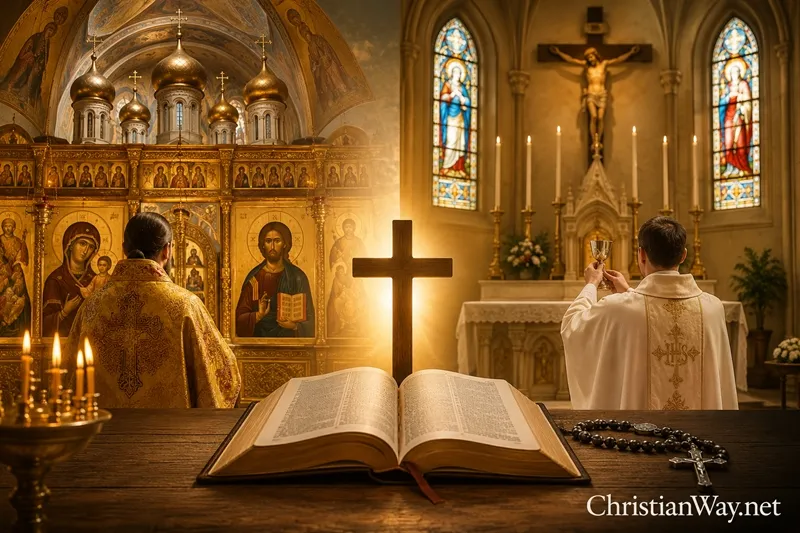
Truth does not require hostility. Love does not require pretending that differences are unimportant. Christians may speak honestly about division while remembering the prayer of Jesus: “That they may all be one; even as thou, Father, art in me, and I in thee” (John 17:21).
The question, then, is not simply which customs appear different. The deeper question is how two apostolic traditions understand authority, doctrine, salvation, worship, and the visible unity of the Church. As we consider these matters, may we do so not as spectators judging from a distance, but as believers standing beneath the cross, where human pride is silenced and every hope of reconciliation begins.
The Shared Apostolic Foundation
Before examining the differences between Eastern Orthodoxy and Catholicism, we should begin with their common inheritance. This shared foundation is not superficial. It touches the very heart of the Christian faith.
Both traditions confess the Nicene faith: one God in three divine Persons—Father, Son, and Holy Spirit. Both believe that Jesus Christ is truly God and truly man, the eternal Son of God who became incarnate for the salvation of the world. Both proclaim that He was crucified, died, rose bodily from the dead, ascended into heaven, and will come again in glory.
Both receive the Old and New Testaments as Holy Scripture. Their biblical canons are not identical in every detail, especially regarding certain Old Testament books, yet both read the Bible within the worshiping life of the Church rather than as a text detached from apostolic tradition.
Both confess one holy, catholic, and apostolic Church. The word “catholic” in the Creed means universal, complete, and possessing the fullness of the faith. Eastern Orthodox Christians therefore confess the catholicity of the Church, although they do not recognize the universal jurisdiction claimed by the Bishop of Rome.
Both traditions maintain apostolic succession. Bishops are understood as successors of the apostles, ordained through the laying on of hands and entrusted with the responsibility of teaching, sanctifying, and shepherding the faithful. Priests serve in communion with their bishops, while deacons assist in the liturgical and charitable ministry of the Church.
Both recognize a sacramental life that includes baptism, chrismation or confirmation, the Eucharist, confession, marriage, ordination, and the anointing of the sick. Although the vocabulary and theological explanations may differ, both believe that God acts through visible signs to communicate invisible grace.
Most importantly, both place the Eucharist at the center of Christian worship.
The Real Presence of Christ in the Eucharist
Catholics and Eastern Orthodox Christians do not regard Holy Communion as merely a symbolic memorial. Both believe that the consecrated bread and wine truly become the Body and Blood of Christ.
Catholic theology commonly uses the term “transubstantiation” to describe this mystery. The substance of bread and wine is changed into the substance of Christ’s Body and Blood, while the appearances remain. Eastern Orthodox theology generally does not insist upon one philosophical explanation, although some Orthodox teachers have used language similar to transubstantiation. Orthodoxy tends to emphasize the sacred mystery of the transformation and the invocation of the Holy Spirit in the Eucharistic prayer.
Despite differences in theological vocabulary, both traditions bow before the same mystery: Christ gives Himself to His people as spiritual food.
The words of Jesus remain central: “He who eats my flesh and drinks my blood abides in me, and I in him” (John 6:56).
In both Catholic and Orthodox churches, the Eucharist is not treated as ordinary food. It is approached with prayer, repentance, fasting, and reverence. The altar is holy because Christ Himself is present and offers His life to the faithful.
Mary, the Saints, and the Communion of Heaven
Both Eastern Orthodoxy and Catholicism honor Mary as the Mother of God, or Theotokos. This title was solemnly affirmed at the Council of Ephesus in 431, not merely to praise Mary, but to defend the truth that the child she bore is truly God incarnate.
Neither tradition worships Mary. Adoration belongs to God alone. Mary is honored because of God’s grace in her life and because of her unique role in the mystery of the Incarnation.
Catholics and Orthodox Christians also ask for the prayers of the saints. They believe that death does not destroy the communion of those who belong to Christ. As Saint Paul teaches, the Church is one body, and the members belong to one another. The saints in heaven are alive in Christ and continue to pray before God.
The two traditions celebrate feast days, preserve the memory of martyrs, venerate relics, and look to holy men and women as witnesses of the transforming power of grace. Their calendars are not identical, but many early saints are shared: Saint Peter, Saint Paul, Saint Ignatius of Antioch, Saint Athanasius, Saint Basil the Great, Saint John Chrysostom, Saint Augustine, and countless others.
The communion of saints reminds Christians that salvation is never an isolated project. We are joined to Christ and, through Him, to one another.
A Brief Comparison
| Area | Eastern Orthodoxy | Catholicism |
|---|---|---|
| Supreme ecclesial authority | The Church is governed synodally by bishops; no bishop has universal jurisdiction over all others | The pope, as Bishop of Rome, possesses universal primacy and authority in the Church |
| Papal infallibility | Rejected as defined by the Catholic Church | Accepted under specific conditions when the pope definitively teaches on faith or morals |
| Nicene Creed | Uses the Creed without the Filioque: the Spirit proceeds from the Father | Commonly uses the Filioque: the Spirit proceeds from the Father “and the Son” |
| Doctrinal development | Emphasizes continuity with the early councils and patristic consensus | Affirms authentic doctrinal development under the guidance of the Holy Spirit |
| Original or ancestral sin | Emphasizes inherited mortality and corruption rather than inherited personal guilt | Teaches original sin as a fallen condition transmitted to humanity, not personal guilt for Adam’s act |
| Salvation | Strongly emphasizes theosis, healing, and participation in divine life | Emphasizes sanctifying grace, justification, holiness, and participation in divine life |
| Clerical marriage | Married men may be ordained priests; bishops are normally chosen from celibate clergy or monastics | In the Latin Church, priests are normally celibate; Eastern Catholic Churches may ordain married men |
| Divorce and remarriage | May permit a second or third marriage as a penitential concession in certain circumstances | Holds sacramental marriage to be indissoluble; annulment concerns whether a valid marriage existed |
| Purgatory | Rejects many specifically Western formulations, while praying for the departed | Teaches a final purification for those who die in God’s grace but still need cleansing |
| Immaculate Conception | Does not accept the Catholic definition, partly because of a different understanding of ancestral sin | Teaches that Mary was preserved from original sin from the first moment of her conception |
| Worship | Primarily follows Byzantine liturgical traditions | Includes the Latin tradition and many Eastern Catholic liturgical traditions |
This table offers only an overview. Each difference has a history and theological depth that cannot be reduced to a few words. We should therefore look more carefully at the principal areas of disagreement.
The Bishop of Rome and the Question of Papal Authority
The most significant difference between Eastern Orthodoxy and Catholicism concerns the authority of the pope.
Catholics believe that Christ gave Saint Peter a unique role among the apostles. They point especially to the words of Jesus: “You are Peter, and on this rock I will build my church” (Matthew 16:18). They also look to Christ’s command that Peter strengthen his brethren and feed the Lord’s sheep.
According to Catholic teaching, the Bishop of Rome succeeds Peter in a ministry of visible unity for the universal Church. The pope is not considered a new source of revelation, nor is he believed to be personally incapable of sin or error. Rather, he holds a unique pastoral office in relation to all bishops and all the faithful.
Catholicism teaches that the pope possesses supreme, full, immediate, and universal authority in the Church. It also teaches papal infallibility under carefully defined conditions: when the pope, acting as the supreme pastor and teacher of all Christians, definitively proclaims a doctrine concerning faith or morals to be held by the whole Church.
Such definitions are rare. Papal infallibility does not apply to every homily, interview, administrative act, personal opinion, or theological judgment made by a pope.
Eastern Orthodoxy recognizes that the Bishop of Rome held a place of honor in the early Church. Orthodox Christians often describe this as a “primacy of honor” or a position as “first among equals.” They do not, however, accept that the pope possesses universal jurisdiction over all bishops or the ability to define dogma independently of the Church’s conciliar reception.
Orthodox ecclesiology emphasizes the local church gathered around its bishop and the communion of bishops expressed through councils or synods. No single bishop is understood to be the source of the Church’s unity. The unity of the Church comes from Christ and is manifested through shared faith, sacramental communion, apostolic succession, and conciliar life.
The disagreement is therefore not about whether unity needs visible expression. Both traditions believe that the Church must be visibly united. The dispute concerns the form that universal primacy should take and the authority attached to the Roman office.
Primacy and Conciliarity
Catholics do not reject councils. The Catholic Church teaches that the college of bishops, always in communion with its head, the pope, shares responsibility for the universal Church. Ecumenical councils have played a decisive role in Catholic doctrine.
Likewise, Orthodoxy is not without primacy. Certain patriarchs and bishops hold positions of precedence within regional and universal relationships. The Ecumenical Patriarch of Constantinople is commonly regarded as first among the Orthodox primates, although he does not exercise authority over the other Orthodox Churches in the manner of the Catholic pope.
The deepest question is how primacy and conciliarity belong together.
Catholics fear that a purely decentralized structure may struggle to resolve universal disputes and preserve visible unity. Orthodox Christians fear that universal jurisdiction concentrated in one bishop may diminish the full apostolic authority of other bishops and alter the conciliar structure of the early Church.
This issue remains central to Catholic-Orthodox dialogue. It is also an area in which historical research has helped both sides recognize that the first millennium was more complex than later polemics sometimes suggested.
The Filioque and the Procession of the Holy Spirit
Another major disagreement concerns the phrase Filioque, meaning “and the Son.”
The original form of the Nicene-Constantinopolitan Creed declares that the Holy Spirit “proceeds from the Father.” In the Latin West, the words “and the Son” were gradually added, so that the Creed confessed the Spirit as proceeding from the Father and the Son.
Catholics understand the Filioque as expressing the intimate communion of the Father and the Son in the eternal breathing forth of the Holy Spirit. Catholic theology maintains that the Father remains the first principle and source within the Trinity. The Son’s involvement does not make the Spirit subordinate or create two separate sources.
Eastern Orthodox Christians object both to the theology and to the manner in which the phrase entered the Creed. They emphasize the “monarchy of the Father”: the Father is the single eternal source of the Son and the Holy Spirit. The Son is eternally begotten of the Father, while the Spirit eternally proceeds from the Father.
Orthodox theologians have often feared that the Filioque confuses the distinct personal properties of the Father, Son, and Holy Spirit. They also object that the Creed approved by an ecumenical council was altered in the West without the consent of another ecumenical council.
Catholic theologians sometimes distinguish between saying that the Spirit proceeds from the Father “and the Son” and saying that the Spirit proceeds from the Father “through the Son.” The latter expression has deep roots in Eastern Christian theology and may provide a bridge for understanding.
This is not a minor disagreement about a single word. It concerns how Christians speak about the eternal life of the Trinity. Yet both traditions confess one Holy Spirit, fully divine, worshiped and glorified with the Father and the Son, active in creation, inspiration, sanctification, and the life of the Church.
The mystery of God is greater than every human formula. Doctrinal language remains necessary, but it must always lead us toward adoration.
Scripture, Tradition, and Doctrinal Authority
Eastern Orthodoxy and Catholicism both reject the idea that the Bible should be separated from the living tradition of the Church.
The Scriptures were received, preserved, proclaimed, and interpreted within the Christian community. The Church did not create the divine authority of Scripture, but the historical process by which the biblical canon was recognized took place within the Church’s worship and teaching.
Catholicism speaks of Scripture and Tradition as forming one sacred deposit of the Word of God, entrusted to the Church. The authentic interpretation of this deposit belongs to the Church’s teaching office, or Magisterium, exercised by the bishops in communion with the pope.
Eastern Orthodoxy likewise understands Scripture within Holy Tradition. Yet Orthodoxy often uses the word “Tradition” more broadly to describe the entire life of the Holy Spirit in the Church: Scripture, liturgy, councils, the writings of the Fathers, iconography, canon law, monastic wisdom, and the lived faith of the people.
The difference appears most clearly in the question of later dogmatic definitions.
Catholics believe that doctrine may develop in clarity while remaining faithful to apostolic revelation. A doctrine defined in a later century may express more precisely a truth that was present implicitly in the Church’s faith from the beginning.
Orthodox Christians are often more cautious about formulations introduced after the separation between East and West. Orthodoxy generally gives unique authority to the first seven ecumenical councils and evaluates later teachings through their continuity with the Fathers, the liturgy, and the consensus of the whole Church.
Catholics accept later ecumenical councils, including those held after the division, as authoritative for the universal Church. Orthodox Christians do not recognize these councils as ecumenical because the Christian East did not participate in or receive them as such.
This disagreement raises an important question: How does the Church faithfully express eternal truth in changing historical circumstances?
Neither tradition believes that divine revelation can be rewritten according to the spirit of the age. Yet both must continually speak the Gospel in new languages, respond to new controversies, and guide believers through situations the early Christians did not face in precisely the same form.
Original Sin and Ancestral Sin
Catholicism commonly speaks of “original sin,” while Eastern Orthodoxy often prefers the expression “ancestral sin.”
These terms reflect different theological emphases, though the traditions are not always as far apart as popular summaries suggest.
Both agree that humanity lives in a fallen condition. Sin has wounded human nature, disrupted communion with God, darkened the mind, weakened the will, and brought death into human experience. No one, apart from Christ and by a unique grace the Virgin Mary as understood in Catholic doctrine, escapes the need for divine mercy.
Eastern Orthodoxy usually emphasizes that humanity inherits the consequences of Adam’s sin—mortality, corruption, and a world inclined toward sin—rather than personal guilt for Adam’s individual act. Each person becomes guilty through his or her own sins.
Catholic teaching also rejects the idea that descendants bear personal blame for Adam’s personal choice. Original sin is called “sin” in an analogous sense. It is a deprived condition: humanity is born without the original holiness and harmony intended by God.
The difference is partly one of theological language and inherited frameworks. Western theology, especially after Saint Augustine, often examined sin through the categories of guilt, justification, and grace. Eastern theology more commonly described sin as sickness, corruption, bondage, and death.
Both sets of images are biblical. Sin is guilt that needs forgiveness, but it is also a wound that needs healing. It is rebellion requiring reconciliation, but it is also slavery from which Christ must free us.
The Gospel answers the whole human tragedy. Christ is Judge and Physician, Redeemer and Victor, the Lamb who takes away sin and the risen Lord who destroys death.
Salvation, Grace, and Theosis
Eastern Orthodox spirituality strongly emphasizes theosis, often translated as deification or participation in the divine life.
Theosis does not mean that human beings become divine by nature or cease to be creatures. It means that, by grace, we are united to God and transformed into the likeness of Christ. Saint Peter writes that believers become “partakers of the divine nature” (2 Peter 1:4).
Salvation is therefore not merely a change in legal status. It is healing, illumination, purification, communion, and transformation. Through the Incarnation, death, and resurrection of Christ, humanity is restored to its true vocation: life with God.
Catholic theology shares this vision more deeply than many realize. Catholicism teaches that sanctifying grace is a real participation in the divine life. It speaks of adoption as children of God, union with Christ, growth in holiness, and the beatific vision.
The Western tradition has frequently emphasized justification, forgiveness, merit understood as the fruit of grace, and the ordering of the soul toward God. The Eastern tradition has frequently emphasized victory over death, spiritual healing, ascetic purification, and the vision of divine light.
These are not necessarily contradictory visions. They may be different windows opening upon the same mystery.
Christ saves us from sin, guilt, corruption, the devil, and death. He reconciles us to the Father, fills us with the Spirit, incorporates us into His Body, and calls us to become holy.
Both Catholicism and Orthodoxy reject the belief that human beings can save themselves through unaided effort. Every movement toward God begins with grace. Yet grace does not destroy human freedom. God calls, heals, strengthens, and transforms us so that we may freely cooperate with His love.
Saint Paul expresses this mysterious cooperation when he writes: “Work out your own salvation with fear and trembling; for God is at work in you, both to will and to work for his good pleasure” (Philippians 2:12–13).
The Immaculate Conception of Mary
The Catholic Church teaches that Mary, from the first moment of her conception, was preserved by God from original sin through the anticipated merits of Jesus Christ.
This doctrine is called the Immaculate Conception. It concerns Mary’s conception in the womb of her mother, not the virginal conception of Jesus.
Catholics believe that Mary was redeemed by Christ in a unique and preventative manner. She still needed a Savior, but the grace of Christ preserved her from falling into the condition from which others are rescued.
Eastern Orthodox Christians honor Mary as “all-holy,” “most pure,” and uniquely graced by God. They celebrate her holiness with extraordinary devotion. Yet most Orthodox Christians do not accept the Catholic dogmatic definition of the Immaculate Conception.
Part of the disagreement comes from different understandings of original or ancestral sin. If Orthodoxy does not describe the inherited fallen condition in the same terms as Western theology, it does not see the need for the same dogmatic solution.
Some Orthodox theologians also believe that the Catholic definition risks separating Mary from the shared human condition she came to heal through her free cooperation with God. Catholics respond that the doctrine does not diminish Mary’s freedom but reveals the power of grace that enabled her free and faithful “yes.”
Despite the disagreement, both traditions love the Virgin Mary and look to her as the foremost example of human obedience to God.
Her words remain a pattern for every disciple: “Behold, I am the handmaid of the Lord; let it be to me according to your word” (Luke 1:38).
Purgatory and Prayer for the Departed
Catholicism teaches that those who die in God’s friendship but remain imperfectly purified undergo a final purification before entering the fullness of heaven. This purification is called purgatory.
Purgatory is not a second chance after death, nor is it a place for those who have definitively rejected God. It is the work of divine mercy in those who belong to Christ but still need to be freed from the lingering effects of sin.
Eastern Orthodoxy does not accept all the theological formulations historically associated with the Western doctrine of purgatory. In particular, Orthodox Christians have resisted overly literal descriptions of purgatorial fire, fixed systems of temporal punishment, or explanations shaped primarily by legal categories.
Nevertheless, Eastern Orthodox Christians pray for the departed. They celebrate memorial services, offer the Divine Liturgy for those who have died, and ask God to grant them rest, forgiveness, and light.
This common practice reveals an important shared conviction: the dead remain in God’s hands, the prayers of the Church are meaningful, and divine mercy extends beyond the limits of earthly perception.
The exact state of souls after death remains mysterious. Christians should therefore speak with humility. Our hope rests not in our ability to map the unseen world but in the goodness of Christ, who descended into death and rose victorious.
Marriage, Divorce, and Remarriage
Both Catholicism and Eastern Orthodoxy regard marriage as holy and sacramental. Marriage is not merely a civil contract or private emotional arrangement. It is a covenant in which a man and a woman are joined before God and called to reveal the faithful love of Christ.
The traditions differ, however, in their pastoral approach to divorce and remarriage.
The Catholic Church teaches that a valid sacramental marriage between baptized persons is indissoluble. A civil divorce may sometimes be necessary for legal protection or safety, but it cannot dissolve the sacramental bond.
An annulment is not a Catholic divorce. It is a declaration that a valid sacramental marriage was not established from the beginning because an essential element—such as genuine consent, freedom, intention, or capacity—was lacking.
Eastern Orthodoxy also teaches the lifelong character of Christian marriage. Yet, in certain tragic situations, it may permit a second or even third marriage as a penitential concession. This is often explained through oikonomia, a pastoral application of mercy in response to human brokenness.
The service for a second marriage traditionally has a more penitential tone than the joyful celebration of a first marriage. The Orthodox Church does not present divorce as good. Rather, it recognizes that sin may destroy a marriage in lived reality and seeks a path of repentance and restoration.
Catholics worry that permitting remarriage while a first spouse is living weakens Christ’s teaching on indissolubility. Orthodox Christians may believe that the Catholic approach can become pastorally rigid when a marriage has been destroyed beyond repair.
Here again, the traditions seek to protect two Gospel truths: the holiness of Christ’s command and the healing mercy offered to sinners. Their disagreement concerns how these truths should be applied when human relationships are deeply wounded.
Clerical Celibacy and Married Priests
Many people assume that Orthodoxy has married priests while Catholicism does not. The reality is more nuanced.
Eastern Orthodox Churches may ordain married men to the priesthood, provided they marry before ordination. Once ordained, a priest may not marry if he is unmarried or remarry if his wife dies. Bishops are normally chosen from celibate clergy or monastics.
In the Latin Catholic Church, priests are ordinarily required to remain celibate. This discipline is not considered an unchangeable doctrine. It is a spiritual and pastoral practice that developed over time, expressing the priest’s undivided dedication to Christ and the Church.
Eastern Catholic Churches, which are in communion with Rome while preserving Eastern liturgical and spiritual traditions, may also ordain married men according to their own discipline. There are also limited circumstances in which married clergy from other Christian communities are ordained as Catholic priests.
Both traditions honor celibacy. Both also honor Christian marriage. The difference concerns the discipline ordinarily required of parish priests, not the holiness of one vocation over the other.
A faithful married priest and a faithful celibate priest both bear witness to the kingdom of God in different ways. One reveals the sanctification of family life; the other reveals the total gift of self in anticipation of the age to come.
Liturgy, Icons, and Spiritual Atmosphere
The contrast between Eastern Orthodox and Catholic worship is often immediately visible.
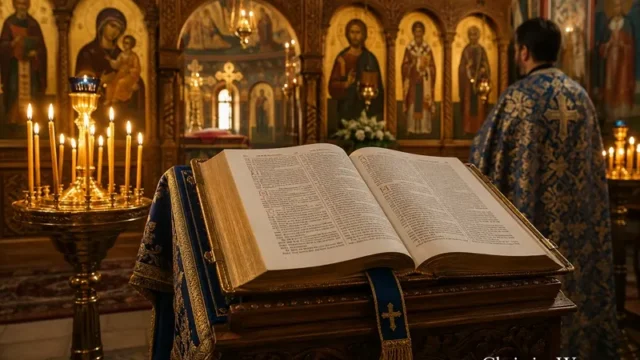
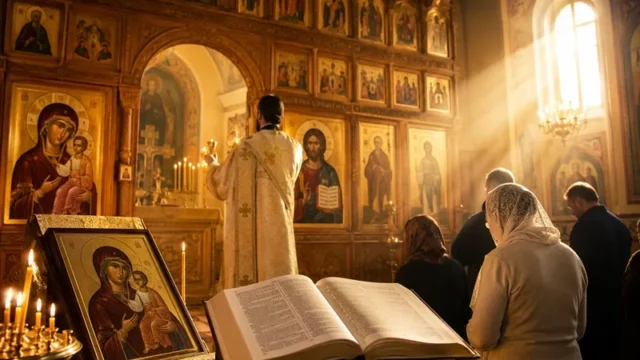
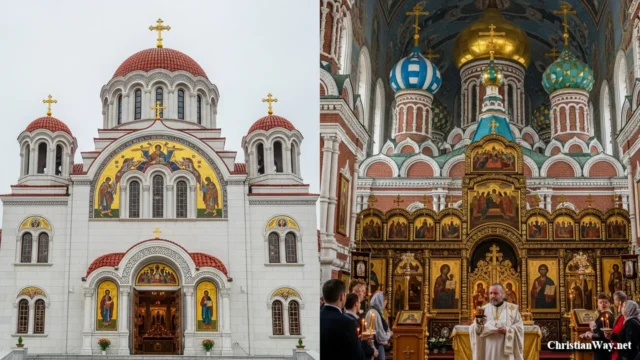
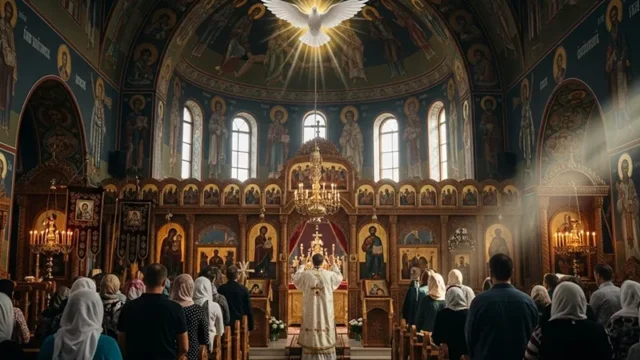
Most Eastern Orthodox Christians worship according to the Byzantine tradition. The Divine Liturgy is sung or chanted, icons fill the church, incense rises continually, and the congregation often stands for much of the service. The sanctuary is separated from the nave by an icon screen called the iconostasis.
Orthodox worship communicates a powerful sense that heaven and earth meet in the liturgy. The faithful do not merely remember salvation; they participate mystically in the worship of the heavenly kingdom.
Catholicism contains a wider variety of liturgical forms. The Roman Rite is the largest, but the Catholic Church also includes Byzantine, Alexandrian, Armenian, Antiochene, East Syriac, and other traditions.
The ordinary Roman Catholic Mass is generally more restrained in outward form than the Byzantine Divine Liturgy, though Catholic worship varies significantly across countries and communities. Latin Catholic churches commonly include statues as well as painted or mosaic images. Eastern Catholic churches may appear almost identical to Orthodox churches in their use of icons, incense, chant, and liturgical structure.
Orthodoxy gives a particularly central role to icons. An icon is not regarded merely as religious decoration. It is a theological image, a witness to the Incarnation, and a window through which the faithful are drawn toward the heavenly reality it represents.
Catholicism also venerates sacred images and defended their use alongside the Christian East at the Seventh Ecumenical Council. Catholics may use icons, statues, stained glass, crucifixes, and other forms of sacred art.
Both traditions distinguish veneration from worship. An image is honored because of the person represented. Worship belongs to God alone.
In an age filled with hurried speech, digital distraction, and superficial images, both Catholic and Orthodox liturgies remind us that the human person is embodied. We worship with the mind, but also with the voice, the eyes, the hands, the body, and the senses.
Different Calendars and the Date of Easter
Some Eastern Orthodox Churches continue to use the Julian calendar for fixed feasts, while others use a revised calendar that corresponds more closely to the Gregorian calendar used in the West.
As a result, Christmas may be celebrated on different civil dates. The date of Easter, or Pascha, also frequently differs because of distinct calendar calculations and ecclesiastical rules, though the dates sometimes coincide.
This difference can be painful. Christians who confess the same resurrection may proclaim “Christ is risen” on different Sundays.
Yet the calendar itself is not the heart of the faith. The heart is the event the calendar celebrates: Jesus Christ has conquered death.
The empty tomb belongs neither to East nor West. It is the hope of the whole world.
Historical Wounds and the Great Schism
The separation between Eastern Orthodoxy and Catholicism cannot be explained by theology alone. Political, cultural, and linguistic factors also played important roles.
The Christian East largely spoke Greek, while the West increasingly spoke Latin. The two regions developed different theological vocabularies, liturgical customs, political relationships, and intellectual traditions.
After the decline of imperial authority in the West, the pope assumed a significant civil and ecclesial role. In the East, the Church continued to exist within the environment of the Byzantine Empire, where bishops, patriarchs, emperors, and councils interacted in a different political structure.
Tensions developed over papal claims, the Filioque, liturgical practices, missionary territories, and competing jurisdictions. Mutual suspicions hardened.
In 1054, representatives of Pope Leo IX and Patriarch Michael Cerularius exchanged excommunications in Constantinople. These actions did not immediately create the full division known today, but they became powerful symbols of an expanding rupture.
The Fourth Crusade inflicted an especially terrible wound. In 1204, Western crusaders captured and sacked Constantinople, a Christian city. Churches were desecrated, sacred objects were stolen, and immense suffering was inflicted upon fellow Christians.
The memory of 1204 remains significant in Orthodox consciousness. It demonstrates how political ambition, greed, and religious arrogance can turn Christians against one another.
Reconciliation requires more than theological documents. It requires repentance, truthful remembrance, forgiveness, and the healing of inherited wounds.
What Each Tradition Can Appreciate in the Other
Dialogue does not mean abandoning conviction. It means learning to see the gifts of God wherever they appear.
Catholics may receive much from the Orthodox emphasis on mystery, the beauty of the Divine Liturgy, the practice of continual prayer, the spiritual wisdom of monasticism, and the vision of salvation as theosis.
The Jesus Prayer—“Lord Jesus Christ, Son of God, have mercy on me, a sinner”—has become a gift not only to Orthodox Christians but to believers throughout the world. Its simplicity leads the heart toward humility, watchfulness, and remembrance of God.
Orthodox Christians may recognize in Catholicism a remarkable commitment to global mission, education, charitable service, theological engagement, and visible universality. The Catholic tradition has founded schools, hospitals, monasteries, relief organizations, and missionary communities in nearly every part of the world.
Catholic spirituality also contains profound contemplative treasures: the writings of Saint Teresa of Ávila, Saint John of the Cross, Saint Thérèse of Lisieux, Saint Francis of Assisi, and many others.
Neither tradition is without sin. Neither should compare its greatest saints with the failures of the other. Fair comparison requires that we judge teaching by its most faithful expression and acknowledge that every Christian community contains both holiness and weakness.
The true glory of any Church is not wealth, influence, architecture, or cultural prestige. Its glory is Christ present among His people.
Can Catholics and Orthodox Christians Receive Communion Together?
Because Catholicism and Eastern Orthodoxy are not in full ecclesial communion, their members ordinarily do not receive the Eucharist in one another’s churches.
For both traditions, Eucharistic communion expresses full unity in faith, sacramental life, and church governance. Sharing Communion before this unity exists could suggest that the divisions are already resolved.
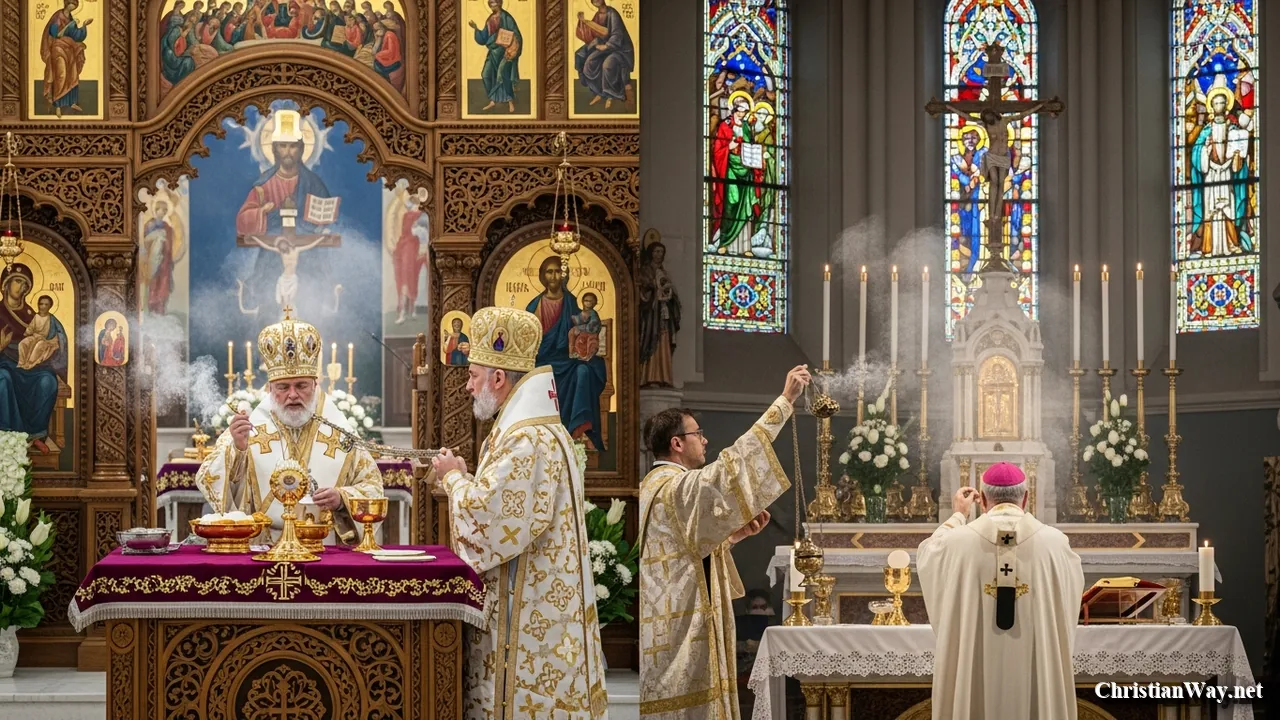
Catholic canon law permits limited sacramental sharing with Eastern Christians in certain circumstances because the Catholic Church recognizes the validity of Orthodox sacraments and priesthood. Orthodox discipline is generally more restrictive, and Orthodox Christians are ordinarily expected to receive the sacraments only within the Orthodox Church.
Pastoral circumstances can be sensitive, especially in mixed families. Catholics and Orthodox Christians should seek guidance from their own priests rather than act solely on personal preference.
The pain of being unable to share the same chalice should not become a cause of bitterness. It should become a prayer.
Every divided Eucharistic table reminds us that Christian disunity contradicts the sign of unity Christ intends His Church to be.
Are Eastern Orthodoxy and Catholicism Equally Christian?
Both Eastern Orthodox Christians and Catholics are Christians in the historic, creedal, Trinitarian sense. Both confess Jesus Christ as Lord and receive the faith of the ancient Church.
However, each tradition also makes strong claims about the fullness of the Church.
The Catholic Church teaches that the Church of Christ subsists in the Catholic Church governed by the successor of Peter and the bishops in communion with him. At the same time, it recognizes that the Eastern Orthodox Churches are true particular Churches with apostolic succession, a valid Eucharist, and genuine sacraments.
Eastern Orthodox Christians generally understand the Orthodox Church to be the one, holy, catholic, and apostolic Church in its fullness. Views differ among Orthodox theologians regarding how precisely to describe the ecclesial status of Catholics, but Orthodoxy does not accept Catholic claims concerning papal authority or later dogmatic definitions.
These claims should be understood honestly. Unity cannot be built by pretending that both traditions interpret the nature of the Church in exactly the same way.
Yet Christians should also resist declaring judgment upon the souls of others. Christ alone knows every heart. The proper response to division is not triumphalism, but humility, prayer, fidelity, and love.
Shared Challenges in the Modern World
Catholics and Eastern Orthodox Christians face many of the same spiritual challenges.
Both live in cultures shaped by consumerism, loneliness, distraction, moral confusion, and the loss of a shared sacred vision. Both encounter people who desire spirituality but distrust institutions. Both minister to families weakened by instability, young people searching for identity, and adults exhausted by work, anxiety, and isolation.
The modern person does not need Christians to offer only arguments about jurisdiction and history. The world needs to see holiness.
It needs parishes where the lonely are welcomed, children are protected, the poor are served, marriages are strengthened, sinners are called to repentance, and wounded people encounter mercy.
The credibility of both traditions depends not only on defending apostolic doctrine but on living it.
Jesus said, “By this all men will know that you are my disciples, if you have love for one another” (John 13:35).
Love does not erase truth. It makes truth visible.
When Catholics and Orthodox Christians pray for persecuted believers, defend human dignity, care for refugees, support families, resist hatred, and bear witness to the resurrection, they reveal a shared Christian faith stronger than the divisions of history.
Unity Without Uniformity
Christian unity does not require every church to sing the same melodies, use the same liturgical language, follow the same calendar, or express theology through identical cultural forms.
The early Church possessed legitimate diversity. Rome, Alexandria, Antioch, Jerusalem, Constantinople, Armenia, Syria, and other regions developed distinct liturgical and spiritual traditions while sharing one faith and sacramental communion.
A restored unity between Catholicism and Eastern Orthodoxy would not require the East to become Latin or the West to become Byzantine. True communion would honor the gifts of both.
The deeper difficulty is not diversity but division over authority and doctrine.
Unity cannot be manufactured through diplomatic optimism. It must be received through conversion, prayer, theological honesty, and the work of the Holy Spirit.
The path may be long. Human calculations may suggest that full reconciliation is impossible. Yet Christians worship the God who raises the dead.
The same Spirit who formed one Church from Jews and Gentiles can heal wounds between East and West. Our responsibility is not to predict the hour of unity but to remain faithful to Christ’s prayer for it.
In the Light of Christ
The comparison of Eastern Orthodoxy vs Catholicism reveals both a profound shared inheritance and serious unresolved disagreements.
The two traditions share faith in the Trinity, the Incarnation, the resurrection, apostolic succession, sacramental worship, the real presence of Christ in the Eucharist, the honor of Mary and the saints, and the hope of eternal life.
They differ especially over papal authority, the Filioque, later dogmatic definitions, the Immaculate Conception, purgatory, divorce and remarriage, and certain approaches to theology and ecclesial governance.
These differences matter. They should be studied carefully, without mockery or exaggeration. But they must also be placed beneath the greater mystery of Christ.
The Lord did not shed His blood so that His followers might take pride in division. He died “to gather into one the children of God who are scattered abroad” (John 11:52).
Perhaps the first step toward unity is not winning an argument but learning to grieve division as Christ grieves it. When Christians become comfortable with separation, they lose something of the heart of the Gospel.
Catholics should not speak of Orthodoxy as though it were merely an exotic collection of national churches. Orthodox Christians should not speak of Catholicism as though every Western development were a betrayal of the ancient faith. Both must resist caricature.
We can ask harder and more fruitful questions.
Does my tradition lead me to repentance? Do I love Christ more deeply? Do I forgive my enemies? Do I care for the poor? Do I pray for the unity of the Church? Do I seek truth with humility, or merely defend my inherited identity?
The saints of East and West did not become holy through contempt. They became holy by surrendering themselves to God.
Let us therefore pray not for a shallow unity that ignores truth, but for a holy unity born from truth and love. Let us pray for bishops, theologians, priests, monks, religious, and lay believers who labor patiently for reconciliation. Let us pray for families divided between traditions and for those whose search for Christ has brought them to difficult questions.
Above all, let us remember that the Church belongs to Jesus Christ. He is her foundation, her Bridegroom, her Good Shepherd, and her eternal Head.
May He forgive the sins that have deepened division. May He purify our memories, heal our wounds, and teach us to recognize His grace in one another.
Lord Jesus Christ, Son of the living God, look with mercy upon Your divided people. Preserve us from pride, hostility, and falsehood. Strengthen us in the apostolic faith, deepen our love for Your truth, and make us patient servants of reconciliation. By the power of the Holy Spirit, lead all Christians toward the unity for which You prayed, so that the world may believe and the Father may be glorified. Amen.
May the peace of Christ dwell richly in your heart, and may His love guide every step you take toward truth, holiness, and unity.
— Fr. John Matthew