A pastoral reflection on Catholic, Orthodox, and Protestant traditions, their differences, shared faith, and hope in Christ.
Dear friends in Christ,
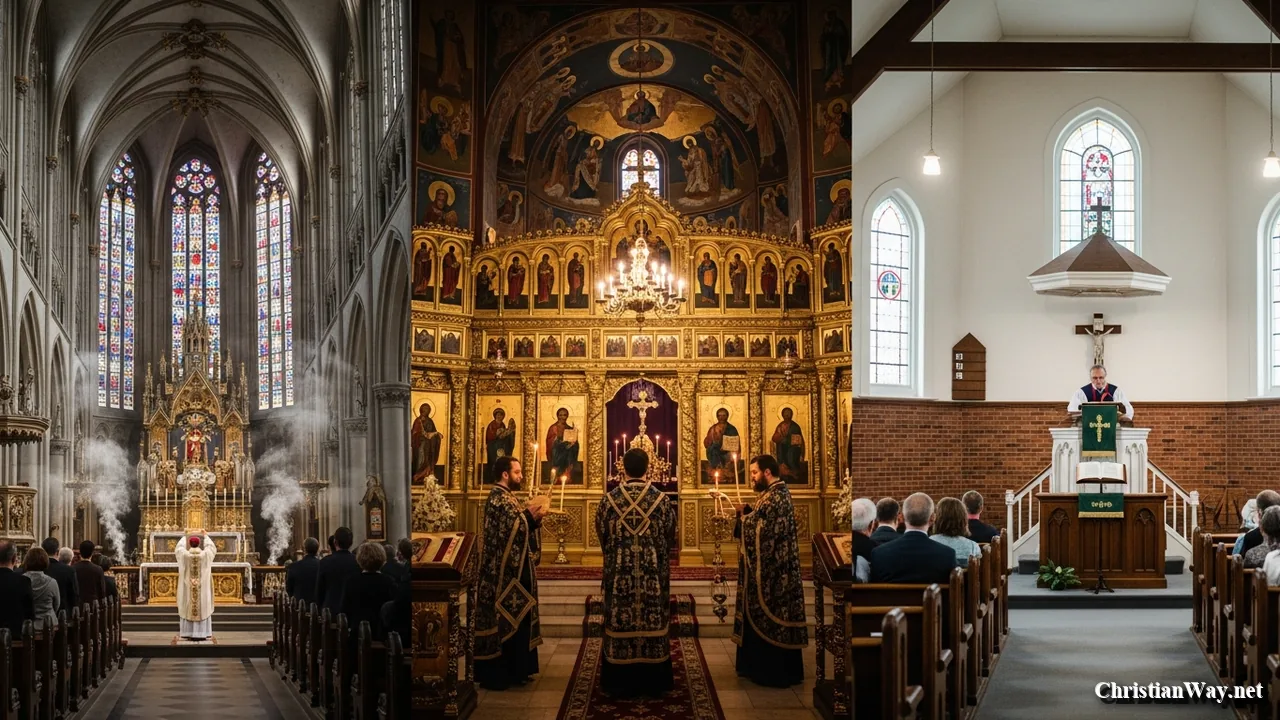
When people first encounter Christianity, they are often surprised to discover how many churches, traditions, and denominations bear the name of Jesus. They may see a Catholic cathedral filled with statues and stained glass, an Orthodox church glowing with icons and candlelight, an Anglican congregation praying from an ancient liturgy, a Lutheran church singing hymns shaped by the Reformation, or an evangelical community gathered around the preaching of Scripture. All confess Christ, yet they may worship differently, organize their churches differently, and express certain doctrines in distinct ways.
For some, this diversity is fascinating. For others, it is confusing or even painful. A sincere seeker may reasonably ask: If Christians believe in one Lord, why are there so many branches? Are Catholics, Orthodox Christians, and Protestants all truly Christian? What unites them, and what separates them? Are their disagreements merely cultural, or do they concern essential matters of faith?
These questions should not be answered with hostility or pride. The divisions within Christianity are part of a long and complicated history, shaped by sincere theological convictions, political conflicts, cultural differences, human weakness, and the continuing search for faithfulness to Christ. Some disagreements are profound and should not be minimized. Yet neither should they cause us to forget the deep spiritual inheritance shared by the great majority of Christians.
At the heart of historic Christianity stands not a denomination, a nation, or an institution considered in isolation, but Jesus Christ: the eternal Son of God who became flesh, died for our sins, rose from the dead, and calls humanity into communion with the Father through the Holy Spirit. Christians may disagree about the precise shape of Church authority, the number and nature of the sacraments, the meaning of justification, or the role of tradition. Yet wherever the apostolic Gospel is confessed, Scripture is received, baptism is administered in the name of the Father, Son, and Holy Spirit, and Christ is worshiped as Lord, we encounter a real connection to the ancient faith of the Church.
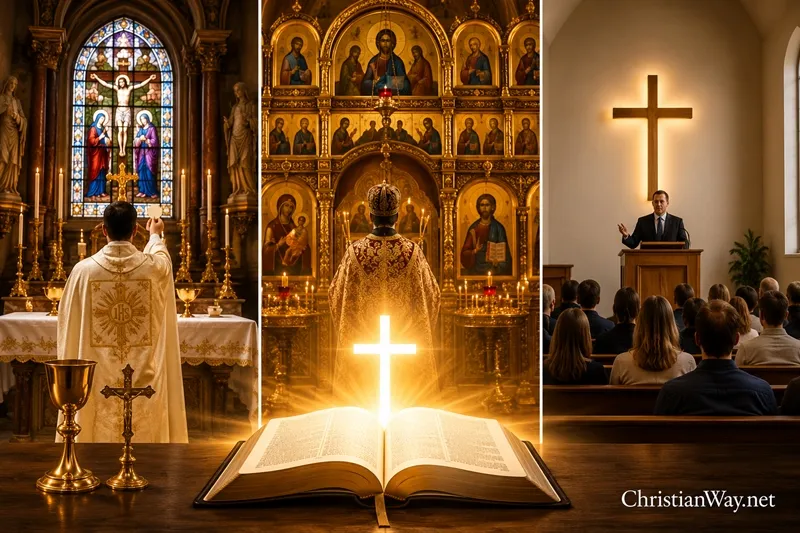
To understand the main branches of Christianity, then, is not merely to memorize religious categories. It is to enter the story of a family that has known both holiness and conflict, unity and division, courage and failure. It is also to hear again the prayer of Jesus for His disciples: “that they may all be one” (John 17:21). That prayer remains both a gift and a summons. It invites every Christian to seek truth without hatred, conviction without arrogance, and unity without pretending that serious differences do not exist.
Christianity Before the Major Divisions
Before speaking about Catholicism, Orthodoxy, and Protestantism, we must remember that Christianity began as one apostolic movement centered upon the person and work of Jesus Christ.
The Church Born From Christ and the Apostles
Jesus did not leave His followers merely with a collection of private spiritual ideas. He gathered disciples, taught them, gave them authority to preach and baptize, instituted the Eucharistic meal, and sent them into the world. After His resurrection and ascension, the Holy Spirit descended upon the disciples at Pentecost, empowering them to proclaim the Gospel.
The book of Acts describes the earliest Christian community as devoted “to the apostles’ teaching and fellowship, to the breaking of bread and the prayers” (Acts 2:42). In this brief description we already see several elements that would remain central across Christian history: apostolic teaching, communal life, sacramental worship, and prayer.
The earliest Christians believed that Jesus was the promised Messiah of Israel and the risen Lord of all creation. They confessed one God while worshiping the Father, the Son, and the Holy Spirit. They baptized converts, celebrated the Lord’s Supper, cared for the poor, read the Hebrew Scriptures, preserved the teaching of the apostles, and awaited Christ’s return.
As the Gospel spread through the Roman world and beyond, local churches developed in Jerusalem, Antioch, Alexandria, Rome, Corinth, Ephesus, and many other places. Bishops, presbyters, and deacons served these communities. Though customs differed from region to region, Christians understood themselves as belonging to one universal Church.
The Formation of Christian Doctrine
The early centuries were not free from disagreement. Christians debated the identity of Christ, the relationship between the Father and the Son, the meaning of salvation, and the proper interpretation of Scripture. Some teachers claimed that Christ was not fully divine. Others denied His full humanity. Still others offered interpretations of God and creation that departed sharply from the faith received from the apostles.
In response, Church leaders gathered in councils to clarify Christian belief. The Council of Nicaea in 325 affirmed that the Son is truly divine, “of one substance” with the Father. The Council of Constantinople in 381 further articulated the Church’s faith in the Holy Spirit. Later councils addressed the mystery of Christ as truly God and truly human.
The Nicene Creed, accepted in various forms by Catholic, Orthodox, Anglican, Lutheran, Reformed, Methodist, and many other churches, remains one of the clearest signs of Christianity’s shared inheritance. It confesses one God, the Father Almighty; one Lord Jesus Christ, the only-begotten Son of God; the Holy Spirit, the Lord and giver of life; one Church; one baptism; the resurrection of the dead; and the life of the world to come.
For roughly the first thousand years, Christians in the Greek-speaking East and Latin-speaking West remained sacramentally connected, though tensions gradually developed. The first great division among the major historic churches eventually separated what would become known as Eastern Orthodoxy and Roman Catholicism. Centuries later, the Protestant Reformation brought another major division within Western Christianity.
The Catholic Church
The Catholic Church is the largest historic Christian communion and understands itself as the Church founded by Christ, guided by the Holy Spirit, and preserved through apostolic succession.
The Meaning of “Catholic”
The word “catholic” comes from a Greek term meaning “universal” or “according to the whole.” Early Christians used the word to describe the universal Church spread throughout the world and united in apostolic faith.
When Catholics speak of the Catholic Church today, they usually mean the worldwide communion of churches in union with the Bishop of Rome, commonly known as the Pope. The Catholic Church includes the Latin Church, often called the Roman Catholic Church, as well as numerous Eastern Catholic Churches. These Eastern communities possess their own ancient liturgies, spiritual traditions, church laws, and forms of governance while remaining in communion with Rome.
Catholicism is therefore not culturally uniform. A Catholic may worship according to the Roman Rite in Italy, the Byzantine Rite in Ukraine, the Maronite tradition in Lebanon, the Syro-Malabar tradition in India, or another ancient Catholic rite. What unites them is shared faith, sacramental communion, and recognition of the Pope’s universal pastoral authority.
Scripture, Tradition, and the Teaching Office
Catholics believe that God’s revelation has been entrusted to the Church through Sacred Scripture and Sacred Tradition. These are not regarded as two unrelated sources but as inseparable ways in which the one apostolic faith is transmitted.
Sacred Scripture is the inspired written Word of God. Sacred Tradition refers not merely to human customs but to the living transmission of the Gospel through the worship, teaching, and life of the Church. Catholics believe that the Holy Spirit guides the Church’s teaching office, called the Magisterium, in faithfully interpreting the deposit of faith.
This does not mean that every statement made by a priest, bishop, or Pope is considered infallible. Catholic theology carefully distinguishes levels of authority. The doctrine of papal infallibility applies only under specific conditions when the Pope formally defines a teaching concerning faith or morals to be held by the whole Church. More broadly, Catholics believe that the bishops in communion with the Pope have a responsibility to guard and teach the apostolic faith.
The Catholic vision is therefore deeply ecclesial. The Bible is read within the worshiping community that received, preserved, and recognized the biblical canon. Personal reading of Scripture is encouraged, but interpretation is not considered an entirely private matter detached from the historic Church.
The Pope and Apostolic Succession
One of Catholicism’s most distinctive teachings concerns the role of the Pope. Catholics believe that Jesus gave Saint Peter a unique pastoral responsibility among the apostles. They point especially to Christ’s words: “You are Peter, and on this rock I will build my church” (Matthew 16:18), as well as His command to Peter to strengthen his brethren and feed His sheep.
The Bishop of Rome is understood as the successor of Peter and the visible servant of the Church’s unity. Catholics do not believe that the Pope replaces Christ. Christ alone is the head of the Church in the fullest and ultimate sense. The Pope’s role is ministerial: to serve the unity of the bishops and to bear a particular responsibility for safeguarding the faith.
Catholics also maintain apostolic succession, meaning that bishops are ordained within a historic line of sacramental ministry reaching back to the apostles. Through the laying on of hands, the episcopal ministry is passed from generation to generation.
The Seven Sacraments
Catholic life is profoundly sacramental. Catholics recognize seven sacraments: Baptism, Confirmation, the Eucharist, Reconciliation, Anointing of the Sick, Holy Orders, and Matrimony.
The Eucharist stands at the heart of Catholic worship. Catholics believe that through the words of consecration and the power of the Holy Spirit, bread and wine truly become the Body and Blood of Christ, while their outward appearances remain. This doctrine is often described by the term transubstantiation.
The Eucharist is not regarded as a repetition of Christ’s sacrifice, as though He needed to die again. Rather, Catholics believe that the one sacrifice of Calvary is made sacramentally present. The Church participates in the once-for-all offering of Christ, who eternally intercedes for His people.
Catholics also practice sacramental confession, believing that Christ gave the apostles authority to forgive sins in His name. In confession, the priest acts not as the source of mercy but as a minister of Christ’s forgiveness.
Mary and the Saints
Catholics honor Mary as the Mother of God because the one she bore is truly God the Son made flesh. This title protects the truth about Christ more than it exalts Mary independently of Him. Catholics believe that Mary was uniquely graced by God and that her faithful “yes” serves as a model of discipleship.
Catholics do not worship Mary or the saints. Worship belongs to God alone. The saints are honored as members of Christ’s glorified body and as witnesses to the transforming power of grace. Catholics ask for their prayers in much the same way that Christians on earth ask one another to pray, believing that death does not sever the communion of those who are alive in Christ.
To some Protestants, this practice appears to lack sufficient biblical support or risks obscuring Christ’s unique mediation. Catholics respond that all prayer among Christians depends entirely upon Christ, the one mediator, and that the intercession of the saints participates in rather than competes with His mediation.
Salvation in Catholic Teaching
Catholics teach that salvation is entirely rooted in the grace of God. No human being can earn the gift of eternal life by natural effort. Christ’s death and resurrection are the foundation of redemption, and the Holy Spirit awakens faith within the human heart.
At the same time, Catholic theology emphasizes that saving faith is living and active through love. Grace does not merely declare the sinner righteous while leaving the person unchanged; it begins a real transformation. Human cooperation with grace is itself made possible by grace.
Good works do not purchase salvation. They are the fruit of union with Christ and the evidence of love formed within the believer. Catholic teaching therefore seeks to hold together divine initiative and human response, forgiveness and transformation, faith and love.
The Eastern Orthodox Church
Eastern Orthodoxy represents another great branch of ancient Christianity. Orthodox Christians understand themselves as preserving the apostolic faith, sacramental life, and conciliar structure of the early Church.
The Meaning of “Orthodox”
The word “orthodox” means “right belief” or “right worship.” For Orthodox Christians, these two meanings belong together. True doctrine cannot be separated from prayer, and authentic worship expresses the faith of the Church.
The Eastern Orthodox Church is not governed by one worldwide bishop possessing authority over all others. Instead, it consists of several self-governing, or autocephalous, churches. These include the Ecumenical Patriarchate of Constantinople and the Orthodox Churches associated with Alexandria, Antioch, Jerusalem, Russia, Serbia, Romania, Bulgaria, Georgia, Greece, and other regions.
Each local church has its own bishops and internal administration, but all are united by a common faith, sacramental communion, and liturgical tradition. The Ecumenical Patriarch of Constantinople is traditionally regarded as “first among equals,” possessing a primacy of honor rather than the universal jurisdiction claimed for the Pope in Catholic teaching.
The Great Schism Between East and West
The division between Eastern Orthodoxy and Roman Catholicism is commonly associated with the year 1054, when representatives of Rome and Constantinople exchanged excommunications. Yet the separation developed gradually over centuries and cannot be reduced to one event.
Cultural and linguistic differences contributed to the growing distance. Western Christianity developed primarily in Latin, while Eastern Christianity flourished in Greek, Syriac, and other languages. Political tensions between the Byzantine East and the Latin West intensified suspicion. Different theological vocabularies sometimes led Christians to misunderstand one another.
Two major theological disputes concerned papal authority and the wording of the Nicene Creed. Western churches added the phrase known as the filioque, teaching that the Holy Spirit proceeds from the Father “and the Son.” The East objected both to the theology as it was sometimes expressed and to the unilateral alteration of a creed established by an ecumenical council.
The role of the Bishop of Rome became an even more enduring disagreement. Orthodox Christians acknowledge that Rome held a place of honor in the early Church, but they reject the later Catholic doctrines of universal papal jurisdiction and papal infallibility.
The wounds deepened dramatically during the Fourth Crusade, when Latin crusaders captured and plundered Constantinople in 1204. Though Catholics and Orthodox Christians today often seek reconciliation and have formally removed some ancient condemnations, full sacramental communion has not yet been restored.
The Mystery of God and Theosis
Orthodox theology emphasizes the mystery and transcendence of God. God can truly be known because He reveals Himself, yet His divine essence remains beyond complete human comprehension. Theology is not merely an intellectual system; it arises from prayer, worship, repentance, and communion with God.
One of the central themes of Orthodox spirituality is theosis, often translated as deification or participation in the divine life. This does not mean that human beings become gods by nature or cease to be creatures. Rather, by grace, they are united with God and transformed into the likeness of Christ.
Saint Peter writes that believers become “partakers of the divine nature” (2 Peter 1:4). Orthodox Christians see salvation as healing, illumination, and transformation. Humanity, wounded by sin and death, is restored through participation in the life of the crucified and risen Christ.
This vision is deeply connected to the Incarnation. The Son of God became truly human so that humanity might be healed and brought into communion with God. Christ saves not only by satisfying a legal requirement but by conquering death, defeating the powers of evil, and restoring the divine image within humanity.
Orthodox Worship and the Divine Liturgy
Orthodox worship is ancient, symbolic, and deeply sensory. The church building, icons, incense, chanting, processions, candles, and liturgical gestures all proclaim that heaven and earth meet in the worship of God.
The principal Eucharistic service is called the Divine Liturgy. Orthodox Christians believe that the bread and wine truly become the Body and Blood of Christ through the action of the Holy Spirit. They generally avoid defining this mystery through the precise philosophical terminology used in later Western theology, though they strongly affirm Christ’s real presence.
Orthodox worship is not designed primarily as a religious lecture. It is participation in the heavenly liturgy. The congregation joins the angels, saints, apostles, and all the faithful in glorifying the Holy Trinity.
Icons occupy an important place in Orthodox spirituality. An icon is not regarded as an idol or a replacement for God. It is a sacred image that bears witness to the Incarnation. Because the invisible God truly became visible in Jesus Christ, Orthodox Christians believe that Christ may be depicted according to His humanity.
Honor shown to an icon passes to the person represented. The wood and paint are not worshiped. Rather, the icon becomes a window through which the believer remembers the communion of saints and the reality of God’s saving work.
Scripture and Holy Tradition
Like Catholics, Orthodox Christians receive Scripture within Holy Tradition. Tradition is understood as the life of the Holy Spirit in the Church, expressed in Scripture, the ecumenical councils, the liturgy, the writings of the Fathers, the lives of the saints, and the continuing worship of the Christian community.
The Bible holds a central and honored place in Orthodox worship. Large portions of Scripture are sung, read, and prayed throughout the liturgical year. Yet Orthodoxy resists the idea that the Bible should be interpreted apart from the apostolic and liturgical life of the Church.
Orthodox theology tends to be less inclined than Western theology to define every mystery in highly systematic terms. It often preserves tensions that Western debates seek to resolve through exact formulas. This does not mean Orthodoxy lacks doctrinal clarity. Rather, it approaches doctrine as truth to be worshiped and lived, not only analyzed.
Mary, the Saints, and the Sacraments
Orthodox Christians honor Mary as the Theotokos, meaning “God-bearer” or “Mother of God.” They celebrate her role in salvation history with profound love and reverence. Like Catholics, they distinguish veneration from the worship due to God alone.
The saints are honored as transfigured members of the body of Christ. Their icons fill Orthodox churches not to distract from Christ but to show what His grace accomplishes in human lives.
Orthodox Christians commonly speak of seven major sacraments, though they may prefer the term “holy mysteries” and are less likely to restrict sacramental reality to an exact number. Baptism, chrismation, Eucharist, confession, marriage, ordination, and anointing are central, but the whole life of the Church is understood sacramentally.
Oriental Orthodox Christianity
A complete understanding of the main branches of Christianity should also acknowledge the Oriental Orthodox Churches, which are distinct from the Eastern Orthodox Church.
The Oriental Orthodox family includes the Coptic Orthodox Church, the Armenian Apostolic Church, the Syriac Orthodox Church, the Ethiopian Orthodox Tewahedo Church, the Eritrean Orthodox Tewahedo Church, and the Malankara Orthodox Syrian Church.
These churches separated from the churches that accepted the Council of Chalcedon in 451. The controversy concerned how to speak correctly about the divine and human natures of Christ. For centuries, Christians often accused one another of theological errors that each side denied holding.
Modern dialogue has revealed that many historic disagreements resulted partly from differences in terminology and theological emphasis. Oriental Orthodox Christians fully confess that Jesus Christ is truly divine and truly human. Though ecclesial divisions remain, relationships between Oriental Orthodox, Eastern Orthodox, and Catholic Christians have greatly improved.
These ancient communities have preserved remarkable traditions of prayer, fasting, monasticism, martyrdom, and biblical worship. Their witness reminds us that Christianity has never belonged only to Europe. Some of the oldest continuous Christian communities are found in Egypt, Armenia, Ethiopia, India, Syria, and the wider Middle East.
Protestant Christianity
Protestantism arose in Western Europe during the sixteenth-century Reformation. It is not one single church but a broad family of churches and movements shaped by efforts to reform Western Christianity according to Scripture and the Gospel of grace.
The Setting of the Reformation
By the late Middle Ages, the Western Church faced serious spiritual and institutional problems. Many Christians longed for reform. Corruption, political struggles, inadequate clergy formation, financial abuses, and confusion surrounding indulgences created scandal.
Reform movements existed before Martin Luther, and many Catholic figures also sought renewal. Yet the events beginning in 1517 became a turning point. Luther, an Augustinian monk and professor of theology, publicly challenged abuses connected with indulgences and eventually questioned several established teachings concerning authority, justification, the sacraments, and the papacy.
What began as a call for debate developed into a far-reaching separation. Other reformers, including Huldrych Zwingli, John Calvin, Thomas Cranmer, and many lesser-known pastors and theologians, shaped distinct Protestant traditions.
The Reformation was not purely theological. Political rivalries, the rise of national identities, economic interests, printing technology, and popular dissatisfaction all influenced its development. Yet it would be unjust to reduce the movement to politics. At its heart were serious questions about salvation, Scripture, grace, faith, worship, and the nature of the Church.
Scripture as the Supreme Authority
One of the defining principles of Protestantism is commonly called sola Scriptura, meaning “Scripture alone.” This does not necessarily mean that tradition, creeds, councils, and teachers have no value. Classical Protestants honored the early creeds and frequently quoted the Church Fathers.
Rather, sola Scriptura means that Scripture is the only infallible rule by which all Christian doctrines and traditions must finally be judged. Church authorities may err; the Word of God remains the highest standard.
Catholic and Orthodox Christians often respond that Scripture itself emerged within the apostolic community and cannot be separated from the Church’s living tradition. Protestants generally answer that the Church serves the Word and recognizes its authority but does not create that authority.
Within Protestantism, the principle of biblical authority has led both to renewal and fragmentation. It encouraged Bible translation, widespread literacy, personal study, and powerful preaching. At the same time, without a single worldwide teaching authority, Protestant communities have sometimes reached sharply different interpretations.
Justification by Faith
Another central Reformation teaching is sola fide, or justification by faith alone. Reformers emphasized that sinners are declared righteous before God not because of their moral achievements but because of Christ’s saving work, received through faith.
Martin Luther found profound comfort in Saint Paul’s teaching that the righteous live by faith. He came to understand divine righteousness not merely as the standard by which God condemns sinners but as a gift granted through Christ.
Classical Protestantism does not teach that genuine faith can remain barren or indifferent to love. Good works are necessary as the fruit of salvation, though not as the basis upon which God accepts the sinner. A common Protestant formula states that believers are saved by faith alone, but saving faith is never alone.
Catholic teaching also insists that salvation begins in grace and cannot be earned. The deepest disagreements concern how justification should be described, how righteousness is imparted or counted, and how faith, love, sacraments, and human cooperation relate within the life of grace.
In modern ecumenical dialogue, Catholics and some Protestant communities have found significant areas of agreement, even while important differences remain.
Protestant Views of the Sacraments
Most Protestant traditions recognize two primary sacraments or ordinances instituted directly by Christ: Baptism and the Lord’s Supper. Yet they interpret these in different ways.
Lutherans strongly affirm Christ’s real presence in the Eucharist, though they reject the Catholic explanation of transubstantiation. Reformed Christians often speak of a true spiritual participation in Christ through the Holy Spirit. Baptists and many evangelicals understand Communion primarily as a memorial act of obedience, though not necessarily as an empty symbol.
Baptism is also understood differently. Lutherans, Anglicans, Presbyterians, Methodists, and many Reformed Christians baptize infants and view baptism as a means of grace or a sign of God’s covenant. Baptists, Pentecostals, and many independent evangelicals practice believer’s baptism, administering it to those who personally profess faith.
These differences demonstrate why Protestantism should never be treated as though it were a single, uniform denomination.
The Major Protestant Families
Protestant Christianity contains numerous traditions, each with its own history and spiritual emphasis.
Lutheranism
Lutheranism emerged from the reforming work of Martin Luther and his colleagues. Lutherans emphasize justification by grace through faith, the authority of Scripture, the centrality of Christ, and the proclamation of the Gospel.
Lutheran worship often retains a formal liturgy, vestments, a church calendar, and a strong sacramental life. Many Lutheran churches confess baptismal regeneration and the real presence of Christ in the Eucharist.
Lutheran spirituality is frequently shaped by the distinction between law and Gospel. God’s law reveals sin and calls humanity to repentance, while the Gospel announces the free forgiveness granted in Christ.
The Reformed and Presbyterian Traditions
The Reformed tradition developed through figures such as Huldrych Zwingli, John Calvin, and Heinrich Bullinger. It emphasizes God’s sovereignty, covenant theology, disciplined worship, and the careful exposition of Scripture.
Presbyterian churches belong to the wider Reformed family and are governed through councils of elders rather than bishops. Reformed Christians have made major contributions to theology, education, missions, political thought, and biblical scholarship.
The doctrine of predestination is often associated with Calvinism, but Reformed theology is much broader than this one teaching. At its best, it seeks to place every aspect of life under the glory and lordship of God.
Anglicanism
Anglicanism emerged from the English Reformation. Its history is complex because political conflict, Catholic continuity, Protestant reform, and national identity all shaped its development.
Anglicans generally recognize Scripture as the supreme authority while also valuing tradition and reason. Anglican worship is deeply influenced by the Book of Common Prayer and often preserves ancient liturgical forms, bishops, creeds, sacraments, and the church calendar.
Some Anglicans identify strongly with Protestant theology. Others, especially Anglo-Catholics, emphasize Catholic continuity, sacramental worship, and apostolic succession. Still others represent a broad middle tradition. Anglicanism is therefore sometimes described as a bridge between Catholic and Protestant Christianity, though not all Anglicans would define it in precisely the same way.
The Baptist Tradition
Baptists emphasize personal faith, believer’s baptism, congregational responsibility, religious liberty, and the authority of Scripture. They generally teach that baptism should follow a conscious profession of faith and should normally be administered by immersion.
Baptist churches are often locally autonomous, meaning that each congregation governs its own affairs. Yet many cooperate through associations and conventions for missions, education, and charitable work.
Baptist life varies widely, ranging from highly traditional congregations to contemporary evangelical communities.
Methodism
Methodism grew from the ministry of John and Charles Wesley within the Church of England. The Wesleyan movement emphasized personal conversion, disciplined discipleship, the assurance of God’s grace, holiness of life, and concern for the poor.
Methodists teach that grace precedes, accompanies, and empowers the human response to God. They emphasize sanctification: the work of the Holy Spirit by which believers grow in holy love.
Methodist hymns, small groups, preaching, education, prison ministry, and social reform have had a lasting influence throughout the world.
Pentecostal and Charismatic Christianity
Pentecostalism emerged in the early twentieth century, drawing attention to the power and gifts of the Holy Spirit. Pentecostal Christians emphasize personal conversion, prayer, healing, evangelism, spiritual gifts, and a living experience of God’s presence.
Speaking in tongues, prophecy, and prayer for healing are prominent in many Pentecostal communities. Some teach that speaking in tongues is the initial sign of baptism in the Holy Spirit, while others take a less strict view.
The Charismatic Renewal brought similar emphasis on spiritual gifts into Catholic, Orthodox, Anglican, and older Protestant communities. Pentecostal and charismatic Christianity have grown especially strongly in Africa, Asia, and Latin America.
Evangelical Christianity
Evangelicalism is not a single denomination but a movement found across many Protestant traditions. Evangelicals generally emphasize the authority of the Bible, personal conversion, the saving work of Christ on the cross, and active evangelism.
An evangelical Christian may be Anglican, Baptist, Presbyterian, Methodist, Pentecostal, independent, or part of another church. The movement contains considerable diversity in worship, theology, politics, and church organization.
At its best, evangelicalism calls believers to personal faith in Christ, love for Scripture, missionary zeal, and holy living. Like every tradition, it also faces temptations, including celebrity culture, shallow teaching, political captivity, and an overly individualistic understanding of faith.
What Catholic, Orthodox, and Protestant Christians Share
The differences among the main branches of Christianity are real, but so is the shared foundation.
Faith in the Holy Trinity
Historic Catholic, Orthodox, and Protestant Christians confess one God in three persons: Father, Son, and Holy Spirit. The Trinity is not a secondary doctrine added by theologians. It is the Christian understanding of the God revealed through Jesus Christ and the outpouring of the Holy Spirit.
Christians do not believe in three gods. They confess one divine being eternally existing as three distinct persons. The Father is God, the Son is God, and the Holy Spirit is God, yet there is one God.
Jesus Christ as Lord and Savior
The main branches of Christianity confess that Jesus Christ is truly divine and truly human. He was conceived by the Holy Spirit, born of the Virgin Mary, crucified under Pontius Pilate, died, was buried, and rose bodily from the dead.
Christ is not merely a moral teacher, spiritual guide, or religious prophet. He is the eternal Word made flesh, the Savior of the world, and the Lord before whom every knee shall bow.
Catholics, Orthodox Christians, and Protestants proclaim that salvation is possible because of His death and resurrection. They may explain the mystery of atonement with different emphases, but all look to Christ as the one who reconciles humanity to God.
The Holy Bible
All major Christian traditions receive the Bible as inspired and authoritative. They read the Old and New Testaments in worship, preaching, prayer, and theological reflection.
There are differences concerning the exact contents of the Old Testament canon. Catholic and Orthodox Bibles include books that most Protestants classify as Apocrypha or Deuterocanonical writings. Nevertheless, all share the central scriptural testimony to creation, covenant, prophecy, the life of Christ, the apostolic Church, and the hope of resurrection.
Baptism and Christian Worship
Catholic, Orthodox, and nearly all Protestant churches practice baptism with water in the name of the Father, Son, and Holy Spirit. They understand baptism differently, but all connect it to Christ’s command and the beginning of Christian life.
They also gather for prayer, Scripture, preaching, praise, and some form of the Lord’s Supper. The frequency and theological interpretation of Communion vary greatly, yet the meal instituted by Jesus remains central to Christian identity.
The Call to Love and Holiness
All historic branches teach that Christians are called to love God and neighbor. Faith must bear fruit in mercy, justice, forgiveness, humility, generosity, and care for the vulnerable.
Every tradition has produced saints, martyrs, missionaries, pastors, theologians, parents, workers, and ordinary believers whose lives have reflected the love of Christ. Every tradition has also known scandal, hypocrisy, abuse, and failure.
No Christian community should boast as though holiness belonged exclusively to itself. All stand under the judgment and mercy of God.
The Most Important Differences
Christian unity cannot be built by pretending that divisions are unimportant. Genuine reconciliation requires truthfulness.
Authority in the Church
Catholics believe that Scripture and Tradition are authentically interpreted by the Church’s teaching office under the leadership of the Pope and bishops.
Orthodox Christians receive Scripture within Holy Tradition and emphasize the authority of ecumenical councils and the consensus of the Church, without accepting universal papal jurisdiction.
Protestants regard Scripture as the only infallible rule of faith and differ among themselves concerning the authority of creeds, confessions, bishops, councils, and local congregations.
The Nature of the Church
Catholics understand the Church as a visible, worldwide communion governed by bishops in union with the Pope.
Orthodox Christians understand the Church as a communion of local churches united in the same apostolic faith, sacraments, and episcopal order.
Protestant views range widely. Some retain episcopal structures and strong claims of historic continuity. Others define the Church primarily as the fellowship of all true believers, expressed locally through congregations.
Salvation and Justification
All agree that salvation comes through Jesus Christ and depends upon God’s grace. The differences concern how grace, faith, justification, sanctification, sacraments, freedom, and good works relate.
Catholics emphasize grace that forgives and inwardly transforms, received through faith and lived through love.
Orthodox Christians often describe salvation as healing and participation in divine life.
Protestants commonly emphasize justification by faith apart from works as the basis of acceptance before God, followed by sanctification as the fruit of salvation.
These approaches are not always mutually exclusive, but their language and theological frameworks differ significantly.
The Eucharist
Catholics affirm transubstantiation and understand the Mass as the sacramental making-present of Christ’s one sacrifice.
Orthodox Christians affirm the true transformation of the gifts and Christ’s real presence while treating the precise manner as a holy mystery.
Protestants range from strong forms of real presence to spiritual presence to primarily memorial interpretations.
Mary and the Saints
Catholic and Orthodox Christians honor Mary and the saints, ask for their intercession, celebrate their feast days, and preserve sacred images.
Most Protestants honor biblical saints as examples but do not pray for their intercession. They worry that such practices may distract from direct access to God through Christ.
This remains one of the most visible differences in everyday devotion.
Are All Christian Denominations Equally True?
It may sound charitable to say that every Christian tradition is simply another path and that all differences are unimportant. Yet such an answer does not take the convictions of Christians seriously.
Catholics, Orthodox Christians, and Protestants make claims that cannot all be correct in precisely the same sense. The Pope either possesses universal authority by Christ’s will, or he does not. The Eucharistic elements either undergo the transformation described by Catholic doctrine, or they do not. Scripture alone is either the Church’s only infallible rule, or it is not.
Love does not require us to abandon the search for truth. It requires us to pursue truth without hatred.
A Christian should study these matters prayerfully, listen to the strongest representatives of each tradition, read Scripture deeply, learn Church history, and resist caricatures. Catholics should not imagine that Protestants reject good works or Christian history. Protestants should not imagine that Catholics believe salvation can be purchased by human effort. Neither should misunderstand Orthodox theology through purely Western categories.
We must also distinguish between an official teaching and the behavior of individual members. A poorly instructed Catholic may not represent Catholic doctrine. A harsh fundamentalist may not represent the best of Protestant theology. A culturally Orthodox person who rarely prays does not reveal the spiritual riches of Orthodoxy.
Truth should be sought at its deepest source, not through its weakest examples.
Christianity Beyond the Three Main Branches
The common threefold division—Catholic, Orthodox, and Protestant—is useful, but it does not describe every Christian community perfectly.
The Church of the East developed separately from both the Roman and Byzantine worlds and preserves an ancient Syriac tradition. Restorationist movements, independent churches, and new Christian communities do not always fit neatly into older categories.
There are also groups that use Christian language but reject doctrines historically considered essential to Christianity, especially the Trinity or the full divinity of Christ. Historic Catholic, Orthodox, and Protestant churches generally do not recognize non-Trinitarian movements as expressions of classical Christianity.
This distinction should be made without contempt for individuals. Every person deserves respect, patience, and freedom of conscience. Yet theological clarity requires acknowledging that the word “Christian” has historically referred to a definite confession concerning God, Christ, and salvation.
Living Faithfully Amid Christian Division
For most believers, the question of Christian branches is not merely academic. It may affect marriage, family life, friendships, worship, and personal identity.
A Catholic may marry a Protestant. An Orthodox Christian may live where no Orthodox parish is nearby. A young evangelical may become curious about liturgy and Church history. A Catholic may be moved by Protestant preaching or Orthodox spirituality. A seeker may feel overwhelmed by competing claims.
In such moments, anxiety is not a reliable guide. Neither is the pressure to choose quickly.
Begin with Christ. Read the Gospels. Pray sincerely. Ask the Holy Spirit for wisdom. Study the history of the early Church. Attend worship respectfully. Speak with knowledgeable and humble clergy from different traditions. Examine not only what a church rejects but what it positively teaches about God, salvation, worship, holiness, and communion.
Do not choose a church merely because its services are emotionally exciting, because its architecture is beautiful, because its members are friendly, or because it confirms every opinion you already hold. These things may matter, but the deeper question is whether its faith is true and whether its life leads you into faithful communion with Christ.
At the same time, beware of communities built upon fear, manipulation, personality cults, financial exploitation, or claims that salvation belongs only to followers of one contemporary leader. The shepherds of Christ should lead people toward the Lord, not make disciples dependent upon themselves.
The Hope of Christian Unity
Christian division is not something to celebrate as though separation itself were a spiritual achievement. Diversity of culture, language, music, and local custom can be beautiful. Division at the Lord’s Table is a wound.
Jesus prayed for His followers to be one so that the world might believe. Saint Paul pleaded with Christians to maintain “the unity of the Spirit in the bond of peace” (Ephesians 4:3). Unity does not require uniformity, but it does require communion in truth and love.
During recent generations, many Christians have taken meaningful steps toward reconciliation. Catholic, Orthodox, Anglican, Lutheran, Methodist, Reformed, and evangelical leaders have entered dialogue. Ancient condemnations have been reconsidered. Shared statements have clarified misunderstandings. Christians increasingly cooperate in defending human dignity, serving the poor, caring for refugees, protecting the unborn and vulnerable, translating Scripture, and bearing witness in places of persecution.
Yet institutional unity remains difficult. Centuries of separation cannot be healed by diplomacy alone. Unity will require repentance, theological honesty, forgiveness, patience, and above all the work of the Holy Spirit.
Ordinary believers also have a role. We can refuse mockery. We can correct false claims about other Christians. We can pray for one another. We can recognize the grace of God wherever it bears fruit. We can hold our convictions firmly while speaking with gentleness.
True ecumenism does not ask us to pretend that doctrine does not matter. It asks us to seek the fullness of truth together beneath the cross of Christ.
Reflect and Pray
The main branches of Christianity tell a story filled with both divine faithfulness and human frailty. Catholicism bears witness to the universality, sacramental life, and visible continuity of the Church. Eastern Orthodoxy preserves a profound vision of worship, mystery, and participation in the life of God. Protestantism reminds the whole Church of the centrality of Scripture, the freedom of grace, the necessity of personal faith, and the constant need for reform.
Each tradition contains treasures that can awaken gratitude. Each also faces temptations and needs continual purification.
The deepest question is not whether one tradition can boast over another. It is whether we are allowing Christ to convert our hearts. A person may defend correct doctrine while lacking love. Another may speak constantly about unity while avoiding difficult truths. Christ calls us beyond both pride and indifference.
The Church belongs to Him. He is her cornerstone, her shepherd, her bridegroom, and her hope. Every bishop, pastor, priest, theologian, missionary, and congregation stands beneath His judgment. Every sacrament, sermon, creed, council, and ministry must point toward Him.
When the noise of religious controversy becomes exhausting, return to the face of Jesus. See Him washing the feet of His disciples. Hear Him praying for those who would believe through their testimony. Stand beneath His cross, where pride is silenced. Look toward the empty tomb, where death itself has been overcome.
There, we remember that Christianity is not finally about winning an argument. It is about being reconciled to God and transformed into the likeness of Christ.
Let us pray:
Lord Jesus Christ, eternal Son of the Father,
You called Your disciples to be one as You and the Father are one.
Forgive the sins, pride, violence, and hardness of heart
that have wounded the unity of Your people.
Preserve us from indifference to truth,
but also from the arrogance that turns truth into a weapon.
Teach Catholics, Orthodox Christians, Protestants,
and all who confess Your holy name
to recognize Your grace in one another.
Guide those who are searching for a spiritual home.
Give them wisdom, patience, courage, and peace.
Lead every church into deeper faithfulness to Your Gospel,
and purify us by the fire of Your love.
May the Holy Spirit draw all Christians
toward the unity for which You prayed,
so that the world may behold not our divisions,
but Your mercy shining through us.
May the peace of Christ dwell richly in your heart, and may His truth and love guide you into deeper communion with Him.
— Fr. John Matthew