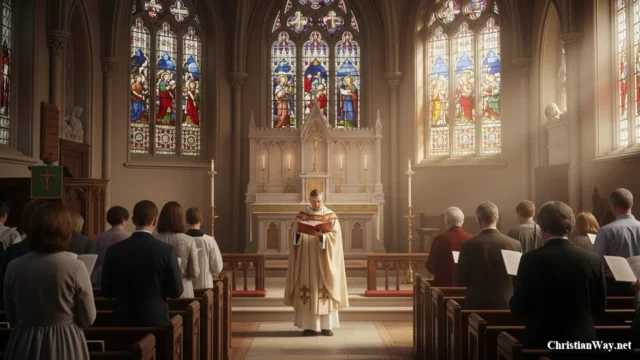
A pastoral reflection on Anglicanism, its worship, history, beliefs, and its desire to follow Christ in faithful communion.
Dear friends in Christ,
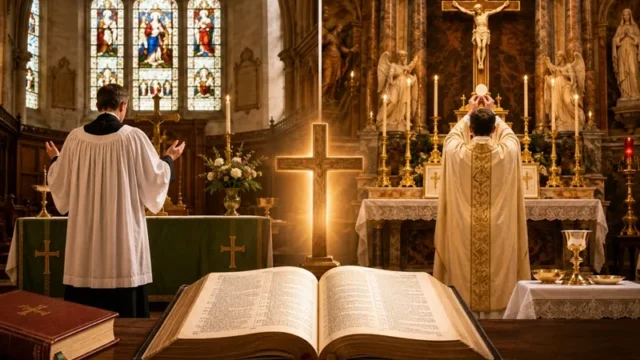
When people first encounter Anglicanism, they sometimes find it difficult to describe. It may appear Catholic in its worship, Protestant in its history, ancient in its prayers, and remarkably diverse in its theology. In one Anglican church, a visitor may see candles, vestments, incense, a formal liturgy, and the reverent celebration of Holy Communion. In another, the service may center on biblical preaching, contemporary music, spontaneous prayer, and evangelical mission. Both congregations may call themselves Anglican, and both may sincerely believe that they are living within the same Christian tradition.
This diversity can be beautiful, but it can also be confusing. What, then, is Anglicanism? Is it Catholic or Protestant? What do Anglicans believe about the Bible, the sacraments, salvation, bishops, saints, and the Church? How did a tradition that began in England become a global Christian family present in many nations and cultures?
At its heart, Anglicanism is a tradition within Christianity that seeks to worship the Triune God, proclaim the Gospel of Jesus Christ, remain faithful to Holy Scripture, preserve the historic ministry of bishops, and pray in continuity with the ancient Church. It arose in its distinct historical form during the English Reformation, yet it did not understand itself as creating Christianity anew. Instead, it sought to reform the existing Church in England while retaining much of its ancient structure, worship, sacramental life, and connection to the universal Christian inheritance.
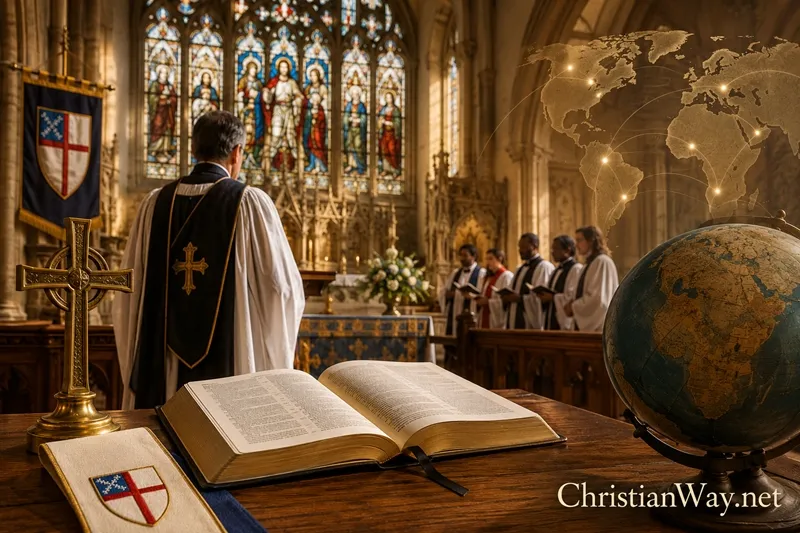
To understand Anglicanism well, we must look beyond political events and denominational labels. We must enter its churches, listen to its prayers, hear its Scriptures, observe its celebration of the sacraments, and recognize its deep longing to hold together truths that Christians have too often separated. Anglicanism tries to unite Word and sacrament, personal faith and common prayer, ancient tradition and continuing reform, spiritual freedom and ecclesial order.
Like every Christian tradition, Anglicanism bears both gifts and wounds. It contains profound spiritual treasures, but it also faces disagreements that can test its unity. Yet within its best expressions, Anglicanism continues to offer Christians a way of following Christ that is biblical, liturgical, pastoral, sacramental, intellectually serious, and attentive to the mystery of God.
Anglicanism in Simple Terms
Anglicanism is a worldwide Christian tradition historically connected with the Church of England. The word Anglican comes from a Latin term meaning “English,” but Anglicanism today is far larger and more culturally diverse than England itself.
Anglican churches are found throughout Africa, Asia, Europe, Oceania, North America, South America, and the Caribbean. Many Anglican provinces have developed their own local forms of worship, leadership, music, pastoral ministry, and public witness. In some countries, Anglican churches are growing rapidly and are deeply involved in education, health care, evangelization, reconciliation, and service to the poor.
Anglicanism belongs to the larger Christian family. Anglicans confess faith in one God—Father, Son, and Holy Spirit. They proclaim Jesus Christ as Lord and Savior. They receive the Bible as Holy Scripture. They baptize in the name of the Trinity. They celebrate the Eucharist, also called Holy Communion or the Lord’s Supper. They confess the ancient creeds and seek to continue the apostolic mission entrusted by Christ to His Church.
Anglicanism is commonly described as one of the principal traditions that emerged from the Protestant Reformation. This is historically true, yet Anglicanism developed differently from many continental Protestant movements. It retained bishops, cathedrals, liturgical worship, a sacramental understanding of Christian life, and many elements inherited from the ancient and medieval Church.
For this reason, Anglicans often speak of their tradition as both catholic and reformed. The word catholic here means connected with the universal and historic Church, not necessarily subject to the authority of the pope. The word reformed expresses the Anglican conviction that the Church must continually be corrected, renewed, and brought into greater conformity with the Gospel.
The Historical Roots of Anglicanism
Christianity in England Before the Reformation
Christianity existed in Britain long before Anglicanism became a distinct tradition. Christian communities were present in Roman Britain, and the faith continued to grow through the work of missionaries, monks, bishops, and local believers.
One of the most important moments came in the late sixth century, when Pope Gregory the Great sent Augustine of Canterbury and other missionaries to evangelize the Anglo-Saxon kingdoms. Augustine became the first Archbishop of Canterbury, and Canterbury would remain a central spiritual symbol in English Christianity.
Over the centuries, the Church in England developed monasteries, dioceses, parishes, schools, shrines, and centers of learning. It produced saints, theologians, missionaries, poets, and pastoral leaders. It shared in the faith, sacraments, and ecclesiastical structures of Western Christianity under the authority of the bishop of Rome.
Anglicanism therefore did not begin as the introduction of Christianity into England. It emerged from a much older Christian community whose roots reached back more than a thousand years.
The English Reformation
The decisive separation between the Church of England and the papacy took place during the reign of King Henry VIII in the sixteenth century. Political, marital, legal, and theological issues were all involved.
Henry initially opposed the teachings of Martin Luther and was recognized by the pope for his defense of Catholic doctrine. Yet his desire to have his marriage to Catherine of Aragon declared invalid led to a prolonged conflict with Rome. When the requested annulment was not granted, the English crown rejected papal jurisdiction, and the king was declared the supreme head of the Church of England.
It would be too simple, however, to say that Anglicanism was created merely because a king wanted a divorce. Henry’s marital conflict was a major catalyst, but the English Reformation soon became part of the wider religious upheaval already transforming Europe. Questions about biblical authority, justification, worship, clerical life, church property, the sacraments, and the role of the papacy became deeply important.
During Henry’s reign, many traditional doctrines and practices remained. Under his son Edward VI, stronger Protestant reforms were introduced. Archbishop Thomas Cranmer played a central role in shaping the emerging Anglican tradition, particularly through the development of the Book of Common Prayer.
Under Queen Mary I, England returned for a time to communion with Rome, and many Protestants were persecuted. Under Queen Elizabeth I, a more lasting settlement was established. The Church of England rejected papal authority, retained bishops, adopted a reformed theological identity, and preserved a liturgical pattern of worship.
This history was painful. Catholics, Protestants, clergy, and ordinary believers all suffered amid political instability and religious conflict. The divisions of that period should not be remembered triumphantly. They should be remembered with humility, repentance, and a renewed longing for the unity of Christ’s people.
The Elizabethan Settlement
The religious settlement associated with Elizabeth I shaped Anglicanism for generations. It sought to establish a national church broad enough to include different convictions while maintaining common worship and ecclesiastical order.
The Church of England would be governed by bishops and united by an authorized liturgy. Its doctrine would be expressed through Scripture, the historic creeds, the Book of Common Prayer, the Ordinal for the consecration of bishops and ordination of clergy, and the Thirty-Nine Articles of Religion.
This settlement did not eliminate disagreement. Some wanted the Church of England to retain more traditional Catholic practices. Others, especially Puritans, wanted a more thorough reform. These tensions would continue and sometimes erupt into open conflict.
Nevertheless, a distinct Anglican character gradually developed. It valued theological seriousness, ordered worship, biblical preaching, pastoral prayer, ecclesiastical continuity, and a degree of comprehensiveness within a shared structure.
From the Church of England to a Global Communion
Anglicanism spread beyond England through migration, missionary work, colonial expansion, chaplaincies, educational institutions, and local evangelization. The history of that expansion is morally complex.
Christian missionaries often served with courage, humility, and sacrificial love. They translated Scripture, established schools and hospitals, defended vulnerable communities, and shared the Gospel across cultural boundaries. At the same time, Anglican expansion was sometimes connected with colonial power, cultural domination, and injustice. Faithfulness requires an honest acknowledgment of both realities.
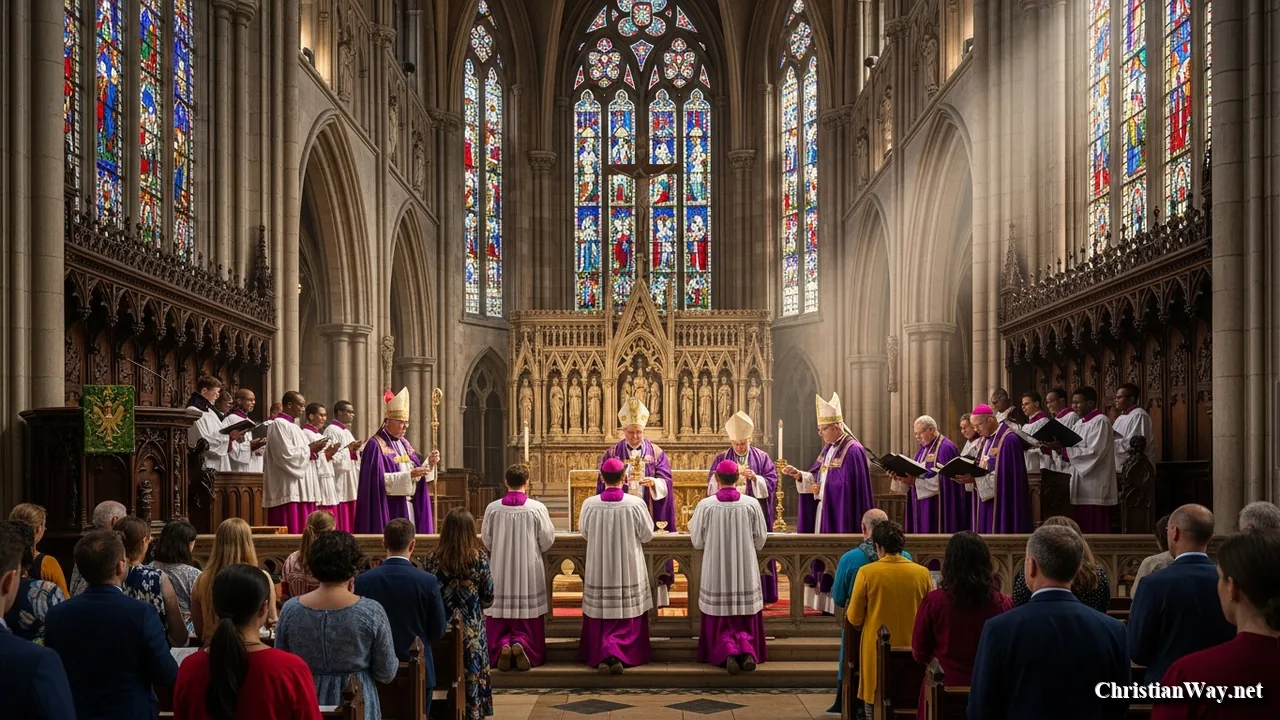
Over time, Anglican churches outside England became increasingly independent. They formed self-governing provinces with their own bishops, synods, liturgical texts, and pastoral priorities. Today, Anglicanism is not simply an English church exported abroad. It is a global communion in which many of the largest and most vibrant churches are located in the Global South.
What Do Anglicans Believe?
Anglicanism does not rest upon the teachings of one founder or a single exhaustive theological document. Its faith is expressed through Holy Scripture, the ancient creeds, liturgical prayer, historical formularies, the sacraments, episcopal ministry, and the ongoing life of the worshiping Church.
This can make Anglican theology appear less systematized than some other traditions. Yet beneath its diversity lies a recognizable Christian foundation.
Faith in the Holy Trinity
Anglicans believe in one God in three Persons: Father, Son, and Holy Spirit. This is not a secondary doctrine but the center of Christian faith and worship.
The Father is the Creator of heaven and earth. The Son, Jesus Christ, is eternally begotten of the Father and became truly human for our salvation. The Holy Spirit is the Lord and giver of life, who dwells within the Church and sanctifies the faithful.
Anglican worship is thoroughly Trinitarian. Prayers are commonly offered to the Father, through the Son, in the power of the Holy Spirit. Baptism is administered in the name of the Father, the Son, and the Holy Spirit. Blessings, creeds, hymns, and Eucharistic prayers continually draw the faithful into the mystery of the Triune God.
Jesus Christ as Lord and Savior
Anglicans confess that Jesus Christ is fully divine and fully human. He is the eternal Word who became flesh, lived among us, proclaimed the kingdom of God, healed the suffering, forgave sinners, died upon the cross, rose bodily from the dead, ascended into heaven, and will come again in glory.
The Gospel is not merely the message that human beings should become more religious or morally respectable. It is the good news that God has acted decisively in Jesus Christ to reconcile humanity to Himself.
On the cross, Christ entered the full depth of human sin, suffering, alienation, and death. In His resurrection, death was conquered and a new creation began. Salvation is therefore rooted not in human achievement, but in the grace of God revealed in the crucified and risen Lord.
Anglican preaching and worship repeatedly return to the mystery of Christ. The Christian year moves through Advent, Christmas, Epiphany, Lent, Holy Week, Easter, Ascension, Pentecost, and the long season of ordinary discipleship. Through this sacred rhythm, believers are invited not merely to remember events in Christ’s life but to live within their spiritual meaning.
The Authority of Holy Scripture
Anglicans receive the Old and New Testaments as Holy Scripture and as the foundational written witness to God’s saving revelation.
The Bible is read publicly in worship, proclaimed in preaching, prayed in the Daily Office, sung in psalms and canticles, and woven into Anglican liturgy. Much of the language of the Book of Common Prayer is either drawn directly from Scripture or shaped by biblical imagery.
Anglicans have sometimes described Scripture as containing all things necessary for salvation. This does not mean that every theological question is answered by an isolated verse. Rather, it means that the saving truth entrusted to the Church cannot contradict the witness of Scripture.
Anglicanism traditionally reads Scripture within the worshiping community and in conversation with the historic Church. The Bible is not treated as a collection of private messages detached from the body of Christ. It is received as the Church’s sacred book, entrusted to God’s people for proclamation, prayer, correction, comfort, and transformation.
The proper response to Scripture is therefore more than analysis. It is attentive listening. As the priest or reader announces the biblical text, the congregation hears not only ancient words but the living Word addressing the Church today.
Scripture, Tradition, and Reason
Anglican theology is often associated with the relationship between Scripture, tradition, and reason. These are sometimes called the three legs of a stool, although this image can be misleading if it suggests that all three possess equal authority.
Scripture remains foundational. Tradition refers to the accumulated wisdom of the Church: its creeds, councils, liturgy, theological reflection, and experience of holiness across the centuries. Reason is the God-given capacity to think carefully, interpret faithfully, consider evidence, and apply Christian truth to new circumstances.
These three belong together. Scripture protects the Church from inventing a faith of its own. Tradition protects believers from assuming that Christianity began with their generation. Reason helps the Church understand, articulate, and apply the faith with intellectual integrity.
When held together humbly, Scripture, tradition, and reason can serve the Church’s discernment. When separated from one another, each may be distorted. Scripture can be misused without the wisdom of the Christian community. Tradition can become rigid if it is never examined in the light of the Gospel. Reason can become proud if it refuses the mystery and authority of divine revelation.
The Ancient Creeds
Anglicans generally confess the Apostles’ Creed and the Nicene Creed. These creeds summarize the central beliefs shared by Christians across many traditions.
The creeds speak of the Trinity, creation, the incarnation, Christ’s death and resurrection, the Holy Spirit, the Church, baptism, the forgiveness of sins, the resurrection of the body, and eternal life.
To recite a creed is not merely to list religious opinions. It is to stand within the faith of generations. A worshiper may arrive burdened, distracted, uncertain, or spiritually dry. Yet when the congregation says, “We believe,” the faith of the whole Church carries the individual believer.
There are days when our personal emotions feel strong and days when they feel weak. The creed reminds us that Christian truth does not rise and fall with our moods. We are held within a faith greater than ourselves.
Grace, Salvation, and Christian Discipleship
Anglicans believe that salvation is the gift of God’s grace. Human beings cannot save themselves by moral effort, religious performance, social respectability, or intellectual knowledge.
Sin is not merely the breaking of rules. It is the deep disorder of the human heart that separates us from God, wounds our relationships, distorts our desires, and leads toward death. We need forgiveness, healing, liberation, and new life.
God meets this need in Jesus Christ. Through His incarnation, death, and resurrection, Christ reconciles sinners to the Father and opens the way to eternal life.
Salvation is received through faith, but living faith does not remain barren. Grace produces repentance, love, obedience, mercy, and holiness. Good works do not purchase salvation; they are the fruit of a life being renewed by the Holy Spirit.
Anglican spirituality therefore resists both spiritual pride and passive belief. The Christian does not boast, “I have earned God’s favor.” Nor does the Christian say, “Because grace is free, my life need not change.” Grace forgives us and begins to transform us.
This transformation unfolds through prayer, Scripture, the sacraments, fellowship, repentance, service, and daily obedience. It is usually gradual. God works patiently within the human heart, healing what is wounded and forming the likeness of Christ within us.
Worship and the Book of Common Prayer
One of Anglicanism’s most distinctive treasures is its tradition of common prayer.
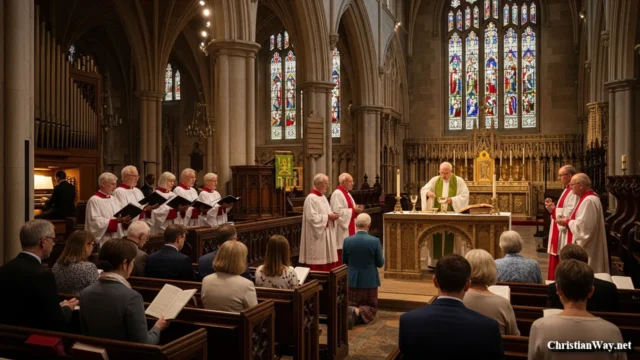
Christian worship is not simply a gathering of individuals who happen to pray in the same room. It is the prayer of the body of Christ. Anglicans therefore emphasize a shared pattern of worship in which Scripture, confession, praise, intercession, preaching, sacrament, and blessing are held together.
The Book of Common Prayer
The Book of Common Prayer has profoundly shaped Anglican identity. The first English prayer book appeared in 1549 under the leadership of Thomas Cranmer. It brought together patterns of daily prayer, Holy Communion, baptism, marriage, burial, ordination, and other forms of worship.
Different Anglican churches now use different editions and authorized liturgical books. Some services retain traditional language, while others use contemporary forms. Yet the ideal of common prayer remains central.
The purpose of liturgy is not to prevent sincerity. It is to give sincerity a faithful form. When believers do not know what to say, the prayers of the Church lend them words. When they are overwhelmed by grief, the liturgy carries them. When they are joyful, it gives their gratitude depth. When they have sinned, it teaches them to confess. When they are divided, it teaches them to pray as one body.
A written prayer can become deeply personal when prayed with attention. The same words may be spoken by a child, a bishop, a grieving widow, a prisoner, a soldier, a monk, a family, or a congregation gathered in a rural village. Common prayer creates a spiritual fellowship across geography, culture, and time.
The Daily Office
Morning Prayer and Evening Prayer, often called the Daily Office, are central features of Anglican spirituality.
The Daily Office usually includes psalms, readings from Scripture, canticles, the Apostles’ Creed, intercessions, and collects. Its purpose is to sanctify the day through regular prayer.
This rhythm can be especially valuable in modern life. Many people wake immediately to messages, news, demands, and anxieties. The Daily Office teaches the soul to begin elsewhere—with God’s Word, with praise, with repentance, and with the needs of the world.
In the evening, the believer places the day back into God’s hands. Successes, failures, unfinished tasks, fears, and hopes are surrendered to divine mercy.
Such prayer does not always produce intense emotion. Often it works quietly, as water shapes stone. Over months and years, the repeated words of Scripture enter the memory. The heart learns to pray even in dryness. Time itself becomes an offering.
The Christian Year
Anglican worship commonly follows the seasons of the Christian year.
Advent teaches watchfulness and hope. Christmas celebrates the incarnation of the Son of God. Epiphany reveals Christ as light for the nations. Lent calls the Church to repentance, fasting, prayer, and mercy. Holy Week leads believers into the passion of Christ. Easter proclaims the victory of the resurrection. Pentecost celebrates the coming of the Holy Spirit.
The Christian calendar helps rescue believers from a life shaped only by commercial seasons, political cycles, work deadlines, or entertainment schedules. It teaches us to inhabit sacred time.
Year after year, the Church returns to the same mysteries, but we are not the same people. A Gospel passage heard in youth may speak differently in old age. The cross may be understood differently after bereavement. Resurrection may become more precious after a season of despair.
The Sacraments in Anglicanism
Anglicans recognize baptism and the Eucharist as the two great sacraments instituted by Christ and entrusted to the whole Church.
Many Anglicans also speak sacramentally of confirmation, reconciliation, marriage, ordination, and the anointing of the sick. The precise terminology and theological emphasis may differ, but Anglicanism generally possesses a rich sacramental vision of Christian life.
A sacrament is not merely a mental reminder. It is an outward and visible sign through which God communicates inward and spiritual grace. Physical things—water, bread, wine, oil, touch, spoken promises—become instruments through which divine love meets embodied human beings.
Christianity does not teach that matter is evil or irrelevant. The Son of God took flesh. He ate, drank, touched, wept, suffered, died, and rose bodily. Sacramental worship reflects the mystery of the incarnation: the invisible grace of God reaches us through visible creation.
Holy Baptism
In baptism, a person is washed with water in the name of the Father, the Son, and the Holy Spirit. Baptism signifies forgiveness, new birth, union with Christ, incorporation into the Church, and the gift of the Holy Spirit.
Most Anglican churches baptize both infants and adults. Infant baptism expresses the priority of grace: before a child can understand or achieve anything, the love of God is already at work. The child is received into the covenant community and is later called to grow into the faith professed on his or her behalf.
Adult baptism normally follows instruction, repentance, and personal profession of faith. Whether administered to an infant or an adult, baptism is not the completion of Christian discipleship. It is the beginning of a lifelong journey.
The baptized are called to continue in prayer, resist evil, repent when they fall, proclaim the Gospel, love their neighbors, seek justice, and respect the dignity of every person.
Holy Communion
The Eucharist stands at the center of Anglican worship.
Bread and wine are offered in thanksgiving, the saving work of Christ is proclaimed, the Holy Spirit is invoked, and the faithful receive Holy Communion. Anglicans believe that Christ truly gives Himself to His people in the sacrament, though they differ in how they explain this mystery.
Some Anglicans speak in language close to Catholic sacramental theology. Others emphasize spiritual reception by faith. Still others avoid precise definitions, preferring to kneel before the mystery of Christ’s promise.
Despite these differences, the Eucharist is far more than a casual memorial meal. It is the Church’s act of thanksgiving, the proclamation of Christ’s death, communion in His body and blood, a foretaste of the heavenly banquet, and a sign of unity in the body of Christ.
At the altar, believers come not because they are spiritually impressive, but because they are hungry. They stretch out empty hands and receive a gift. Holy Communion teaches the heart that the Christian life depends upon grace.
Other Sacramental Ministries
Confirmation is commonly associated with a mature affirmation of baptismal faith and prayer for the strengthening gifts of the Holy Spirit.
Ordination sets apart deacons, priests, and bishops for particular ministries within the Church.
Holy Matrimony joins a couple in a covenant of faithful love and mutual service.
Reconciliation, sometimes called confession, offers the assurance of forgiveness through the ministry of the Church. Private confession is not universally required in Anglicanism, but it is available in many communities and can be a profound source of healing.
Anointing and prayer for the sick express Christ’s compassion toward those who suffer in body, mind, or spirit.
Through these ministries, Anglicanism seeks to accompany human beings through the concrete realities of life: birth, growth, vocation, marriage, failure, illness, suffering, death, and hope.
Anglicanism as Catholic and Reformed
One of the most common ways of describing Anglicanism is to say that it is both catholic and reformed.
Its catholic character is seen in its creeds, bishops, liturgy, sacraments, church year, continuity with ancient Christian worship, and respect for the Fathers of the Church.
Its reformed character is seen in its emphasis on the authority of Scripture, the priority of grace, preaching, worship in the language of the people, and the conviction that church practices must be examined in the light of the Gospel.
Anglicanism has sometimes been called a via media, or middle way. This expression is useful when it means a refusal to choose unnecessarily between complementary truths. Anglicanism seeks to hold together Word and sacrament, faith and order, ancient wisdom and present responsibility.
Yet the middle way should not mean vague compromise or choosing the safest position between two convictions. Christian truth is not always found at the mathematical midpoint. The real Anglican vocation is not moderation for its own sake, but faithful comprehensiveness centered in Christ.
At its best, Anglicanism does not ask, “How little must everyone agree upon?” It asks, “How can Christians remain in communion while seeking truth together through Scripture, prayer, sacrament, humility, and love?”
Different Traditions Within Anglicanism
Anglicanism contains several recognizable spiritual and theological streams.
Anglo-Catholic Anglicanism
Anglo-Catholic Anglicans emphasize the continuity of Anglicanism with the ancient and medieval Church. Their worship may include vestments, incense, icons, candles, sung liturgy, devotion to the saints, frequent celebration of the Eucharist, and private confession.
They often stress apostolic succession, the real presence of Christ in the Eucharist, sacramental grace, and the visible unity of the Church.
The Anglo-Catholic renewal became especially influential through the Oxford Movement in the nineteenth century. Its leaders called Anglicans to recover the Church’s catholic inheritance and to resist the idea that the Church was merely a department of the state.
Evangelical Anglicanism
Evangelical Anglicans emphasize biblical authority, personal conversion, the atoning death of Christ, justification by faith, evangelism, mission, discipleship, and preaching.
Their services may be less ceremonial and more centered on the sermon, congregational singing, personal testimony, and direct engagement with Scripture.
Evangelical Anglicanism has played a major role in missions, biblical scholarship, social reform, and movements of spiritual renewal. Figures such as John Newton, Charles Simeon, and William Wilberforce were shaped by this stream of Anglican faith.
Broad Church and Liberal Anglicanism
Broad Church Anglicans have often emphasized intellectual inquiry, pastoral flexibility, social engagement, and openness to developments in science, philosophy, biblical scholarship, and culture.
This stream has encouraged Anglicanism to address new questions rather than retreat from them. It has sometimes served as a bridge between sharply divided groups.
Yet openness requires discernment. The Church must listen carefully to human knowledge and experience without allowing the Gospel to be reduced to the assumptions of any particular age.
Charismatic Anglicanism
Charismatic Anglicans emphasize the active presence and gifts of the Holy Spirit. Their worship may include contemporary music, spontaneous prayer, healing ministry, prophecy, and renewed emphasis on personal encounter with God.
In many Anglican communities, charismatic spirituality exists alongside liturgical and sacramental worship. A congregation may celebrate the Eucharist according to an ancient pattern while also praying freely for healing and spiritual renewal.
These streams can enrich one another. The catholic tradition reminds the Church of sacramental depth and historical continuity. The evangelical tradition calls the Church to biblical faithfulness and mission. The charismatic tradition emphasizes the living power of the Holy Spirit. The broad tradition encourages thoughtful engagement with complex human realities.
The danger comes when any group assumes that it alone represents authentic Anglicanism or complete Christianity. The body of Christ needs gifts that no single party possesses by itself.
Bishops, Priests, Deacons, and Church Governance
Anglican churches preserve the threefold ordained ministry of bishops, priests, and deacons.
Bishops are called to guard the faith, teach, ordain clergy, confirm believers, provide pastoral oversight, and serve as signs of unity.
Priests preach the Word, celebrate the sacraments, pronounce absolution, bless, teach, and care for the people entrusted to them.
Deacons serve especially in ministries of compassion, proclamation, and connection between the worshiping Church and the needs of the world.
Laypeople are not passive recipients of ministry. Through baptism, the whole people of God share in Christ’s mission. Lay Anglicans serve as teachers, evangelists, theologians, musicians, caregivers, administrators, community leaders, readers, intercessors, and witnesses in daily life.
Anglican provinces are generally self-governing. They are often organized into dioceses under bishops, with synods or conventions that include clergy and lay representatives.
The Archbishop of Canterbury holds a place of honor within the global Anglican Communion, but he does not govern all Anglicans in the way the pope governs the Catholic Church. He is often described as the first among equals among Anglican bishops and serves as a focus of unity.
Because there is no single centralized authority with universal jurisdiction, Anglican unity depends heavily on relationship, consultation, shared worship, common heritage, and mutual recognition. This structure allows significant local freedom, but it can also make worldwide agreement difficult.
Mary and the Saints
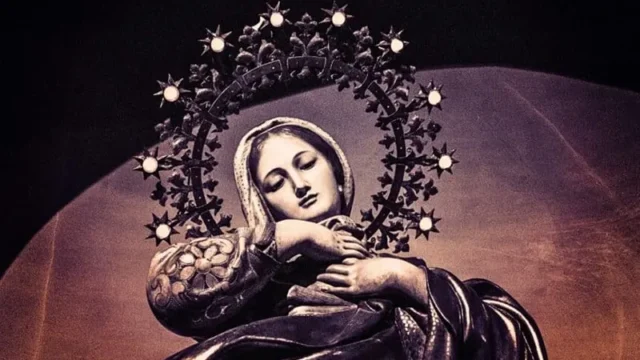
Anglicans honor the Virgin Mary as the mother of Jesus Christ and therefore as the Theotokos, the God-bearer, a title affirmed by the ancient Church to protect the truth of Christ’s divine identity.
Mary is remembered for her faith, obedience, courage, and unique role in the mystery of the incarnation. The words of the Magnificat are sung regularly in Anglican Evening Prayer: Mary’s song of praise, justice, humility, and divine mercy.
Anglican churches also commemorate apostles, martyrs, theologians, missionaries, pastors, reformers, and other faithful Christians.
Attitudes toward asking for the intercession of Mary and the saints vary. Anglo-Catholic Anglicans may practice such devotions. Evangelical Anglicans generally prefer to direct prayer to God alone while honoring the saints as examples of faith.
Despite these differences, Anglicans widely affirm the communion of saints: the truth that all who belong to Christ are united in Him, whether living on earth or resting in God.
The saints do not compete with Christ. Their holiness bears witness to His grace. Their lives show what God can do in human weakness.
Anglicanism and Other Christian Traditions
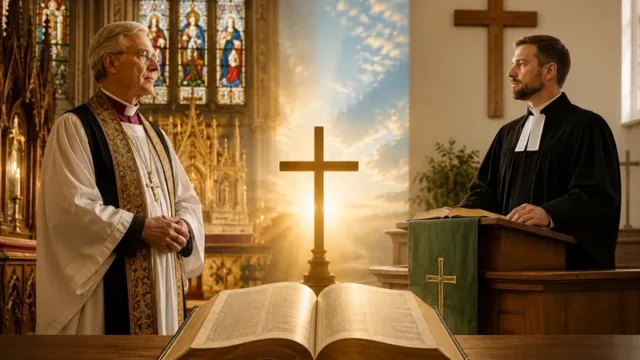
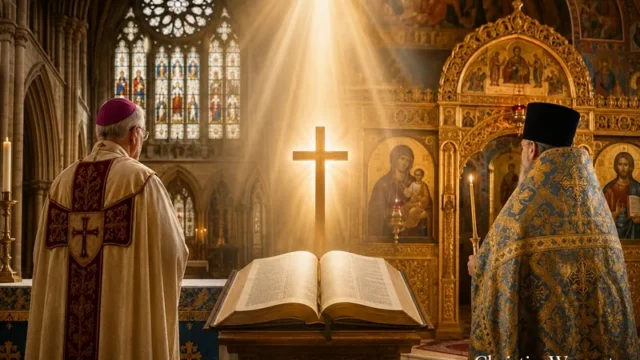
Anglicanism shares much with Catholicism, Eastern Orthodoxy, and Protestant Christianity, yet it remains distinct from each.
With Catholicism, Anglicanism shares liturgical worship, episcopal ministry, sacramental life, ancient creeds, and a strong sense of historical continuity. It differs especially over the universal jurisdiction of the pope and certain later Catholic doctrines.
With Eastern Orthodoxy, Anglicanism shares respect for the early councils, the Fathers, the liturgy, the sacraments, and the mystery of the Church. Yet significant theological and ecclesial differences remain, including questions of authority, ordination, doctrine, and moral teaching.
With Protestant traditions, Anglicanism shares the heritage of the Reformation, emphasis on Scripture, the centrality of grace, vernacular worship, and the importance of preaching. It differs from many Protestant churches by retaining bishops, a formal liturgical tradition, and a more sacramental understanding of the Church.
These comparisons should not become competitions. Christians are not called to build their identity by caricaturing one another. Each tradition should speak honestly about real differences while also recognizing the faith it shares with others.
Christ prayed that His disciples would be one. Christian unity cannot be created by pretending disagreements do not matter. Nor can it be served by hostility, suspicion, or pride. Unity grows through truth spoken in love, patient dialogue, shared prayer where possible, repentance for past sins, and renewed attention to Christ.
Anglican Faith in Everyday Life
Anglicanism is not only a theological position or style of worship. It is a way of living before God.
The rhythm of common prayer teaches faithfulness when emotion fades. Weekly Communion teaches dependence upon grace. Confession teaches honesty. The peace exchanged during worship teaches reconciliation. The reading of Scripture forms the imagination. The church year gives spiritual shape to time.
An Anglican may begin the morning with a psalm and end the day with the words, “Into your hands, O Lord, I commend my spirit.” A family may mark Advent with prayer, observe Lent through fasting and generosity, celebrate Easter with joyful worship, and remember departed loved ones in the hope of resurrection.
Faith must also enter work, relationships, public life, and suffering.
The Gospel speaks to the employee tempted to act dishonestly, the parent exhausted by responsibility, the student anxious about the future, the elderly person facing loneliness, the refugee seeking safety, the prisoner longing for redemption, and the grieving person who cannot yet imagine joy.
Anglican spirituality does not ask believers to escape the world. At its best, it sends them into the world as servants of Christ.
Many Anglicans have worked for the abolition of slavery, the education of children, the care of the sick, the relief of poverty, peace between communities, and the defense of human dignity. Such service is not an optional addition to worship. The Eucharist leads naturally toward love of neighbor.
We receive the body of Christ at the altar so that we may recognize and serve the body of Christ in the suffering people around us.
The Gifts and Challenges of Anglicanism
Anglicanism offers many spiritual gifts.
Its liturgy gives believers language for prayer when their own words fail. Its sacramental vision reveals God’s grace within ordinary creation. Its commitment to Scripture keeps the Gospel at the center. Its historic ministry connects present communities with generations of Christian witness. Its comprehensiveness can teach patience, humility, and charity amid difference.
Its poetry and music have enriched the wider Church. Its tradition of pastoral theology has often joined intellectual seriousness with compassionate care. Its pattern of common prayer reminds Christians that faith is not merely private.
Yet Anglicanism also faces serious challenges.
Its diversity can become fragmentation. Its desire for comprehensiveness can become doctrinal vagueness. Local autonomy can weaken common witness. Cultural pressure can tempt churches to reshape Christianity according to political or social expectations rather than allowing the Gospel to judge every culture.
Anglicans disagree deeply over biblical interpretation, sexuality, marriage, ordination, ecclesial authority, and other questions. These disputes have strained communion and, in some cases, led to separation.
Such wounds should neither be concealed nor used as weapons. They call the Church to deeper prayer, clearer teaching, genuine repentance, and patient discernment.
The future of Anglicanism will not be secured merely by institutional survival, political influence, beautiful buildings, or historical prestige. It will depend upon faithfulness to Jesus Christ.
A church may preserve ancient ceremonies and yet lose its love. It may defend biblical truth and yet become harsh. It may speak of inclusion and yet cease to call people to repentance. It may value tradition and yet resist the renewing work of the Holy Spirit.
Every Christian community must return again and again to the Lord who stands at its center.
Becoming Part of an Anglican Church
A person interested in Anglicanism may begin simply by attending worship.
The service may at first feel unfamiliar. There may be standing, sitting, kneeling, responses, prayers, readings, hymns, and sacramental actions. There is no need to understand everything immediately.
Liturgy is learned gradually, much as a child learns the language of a family. In time, repeated prayers become familiar. The pattern begins to reveal its wisdom. What once felt formal may become deeply intimate.
A newcomer may speak with a priest, join an introductory course, participate in Bible study, attend Morning or Evening Prayer, or learn about preparation for baptism or confirmation.
The most important question is not whether every detail of Anglican history is immediately clear. The deeper question is whether Christ is being proclaimed, Scripture faithfully heard, the sacraments reverently celebrated, prayer sincerely offered, and love embodied within the community.
No congregation is perfect. The Church is a hospital for sinners, not a gathering of the spiritually flawless. Yet a healthy church should help people encounter Jesus, grow in holiness, receive mercy, practice forgiveness, and serve their neighbors.
In the Light of Christ
What is Anglicanism?
It is a Christian tradition born from the complex history of the Church in England and now expressed through a worldwide communion of cultures and peoples. It is reformed in its commitment to biblical renewal and catholic in its reverence for the historic faith, sacraments, creeds, and episcopal ministry.
It is a tradition of common prayer, where believers are formed by words they did not invent for themselves. It is a sacramental tradition, where water, bread, wine, touch, time, and human voices become signs of divine grace. It is a scriptural tradition, continually called back to the Word of God. It is a missionary tradition, sent to proclaim Christ and serve the world.
Yet Anglicanism, like every Christian tradition, has meaning only insofar as it leads people to Jesus Christ.
The Church does not exist to proclaim itself. Its beauty, liturgy, history, music, buildings, theology, and ministry are meant to become windows through which the light of Christ shines.
Perhaps this is one of Anglicanism’s deepest gifts: the desire to gather the whole of human life into prayer. Joy and sorrow, beauty and brokenness, certainty and questioning, ancient wisdom and present need are brought before God.
There, at the font, we remember that we belong to Christ.
There, in the Scriptures, we hear His voice.
There, at the altar, we receive His grace.
There, in the poor and suffering, we are called to serve Him.
And there, within a community of imperfect believers, we learn slowly to forgive, to hope, to pray, and to love.
Let us pray.
Lord Jesus Christ, gather Your divided people into the unity of Your truth and love. Deepen our faith, purify our worship, and teach us to hear Your voice in Holy Scripture. Nourish us with Your grace, strengthen us by Your Spirit, and make Your Church a faithful witness to Your mercy. Where we are proud, humble us. Where we are wounded, heal us. Where we are divided, lead us toward reconciliation. May every tradition, every congregation, and every Christian heart seek not its own glory, but Yours alone.
May the peace of Christ dwell richly in your heart, and may His light guide you into deeper faith, faithful prayer, and loving service.
— Fr. John Matthew