Dear friends,
When we look upon the storied, two-thousand-year history of the Church, we see more than a succession of leaders; we witness the hand of the Holy Spirit at work, guiding the vessel of salvation through treacherous waters. The popes, as successors to Saint Peter, have been called to this sublime and demanding task: to strengthen their brethren in the faith (Luke 22:32), to guard the sacred deposit of Christian doctrine, and to be a visible sign of unity for all of Christ’s scattered sheep.
To compile a list of the “greatest” is not to offer a final judgment of perfection, for all shepherds are but men, prone to the same struggles as their flock. Rather, it is an act of spiritual gratitude, acknowledging those who, by their exceptional holiness, theological brilliance, or profound impact on civilization, have served as true ‘Servants of the Servants of God.’ Their reigns represent crucial turning points, where the timeless truth of the Gospel met the urgent challenges of a changing world, whether facing barbarian hordes, the rise of new political powers, or the call for spiritual renewal.
As we reflect on these ten exemplary pontiffs, let us seek not merely to recount historical facts, but to grasp the spiritual lessons embedded in their service. We are invited to marvel at the providence of God, who raises up leaders precisely when the Church and the world are in greatest need. Their lives stand as a testament to the enduring promise of Christ: that the gates of hell shall not prevail against His Church (Matthew 16:18).
May this journey through the papacy inspire us to embrace our own call to holiness, for the greatness of the Church is ultimately measured by the sanctity of its members, from the humblest believer to the Supreme Pontiff. Let the examples of these great popes encourage us to hold fast to the unchanging Christ amidst the ever-changing tides of this world.
Table of The Top 10 Greatest Popes in the History of the Catholic Church
| Rank | Pope | Reign (Approx.) | Key Achievement |
|---|---|---|---|
| 10 | St. Leo XIII | 1878–1903 | Launched Catholic Social Teaching with Rerum Novarum. |
| 9 | St. Pius V | 1566–1572 | Implemented the reforms of the Council of Trent; secured the victory at Lepanto. |
| 8 | St. John XXIII | 1958–1963 | Convened the Second Vatican Council (Vatican II), ushering in renewal. |
| 7 | Innocent III | 1198–1216 | Reached the height of medieval papal authority; convened the Fourth Lateran Council. |
| 6 | St. Nicholas I | 858–867 | Firmly asserted papal supremacy as a source of justice and moral authority. |
| 5 | St. Leo I (The Great) | 440–461 | Defended the orthodox faith at Chalcedon; famously met with Attila the Hun. |
| 4 | St. Gregory VII | 1073–1085 | Led the Gregorian Reform, liberating the Church from secular control (Investiture Controversy). |
| 3 | St. John Paul II | 1978–2005 | Globally influential evangelist; pivotal in the fall of Communism; founded World Youth Day. |
| 2 | St. Gregory I (The Great) | 590–604 | Consolidated the Church’s temporal and spiritual power; missionary to England; Doctor of the Church. |
| 1 | St. Peter | c. 30–c. 64 AD | The first Pope, appointed by Christ as the “Rock” and holder of the Keys to the Kingdom. |
Top 10. St. Leo XIII (Vincenzo Gioacchino Raffaele Luigi Pecci)
As we journey deeper into the modern era, we encounter Pope Leo XIII, whose papacy spanned a quarter-century and faced a world utterly transformed by the Industrial Revolution. In an age of burgeoning capitalism and socialist thought, the Church was faced with the ‘Social Question’: the ethical and spiritual condition of the working poor. Leo XIII, a man of profound learning and diplomatic skill, stepped into this breach not with political maneuvering, but with prophetic teaching. He saw the necessity of applying the timeless principles of the Gospel to the material struggles of modern life, offering a bridge between the spiritual and the economic.
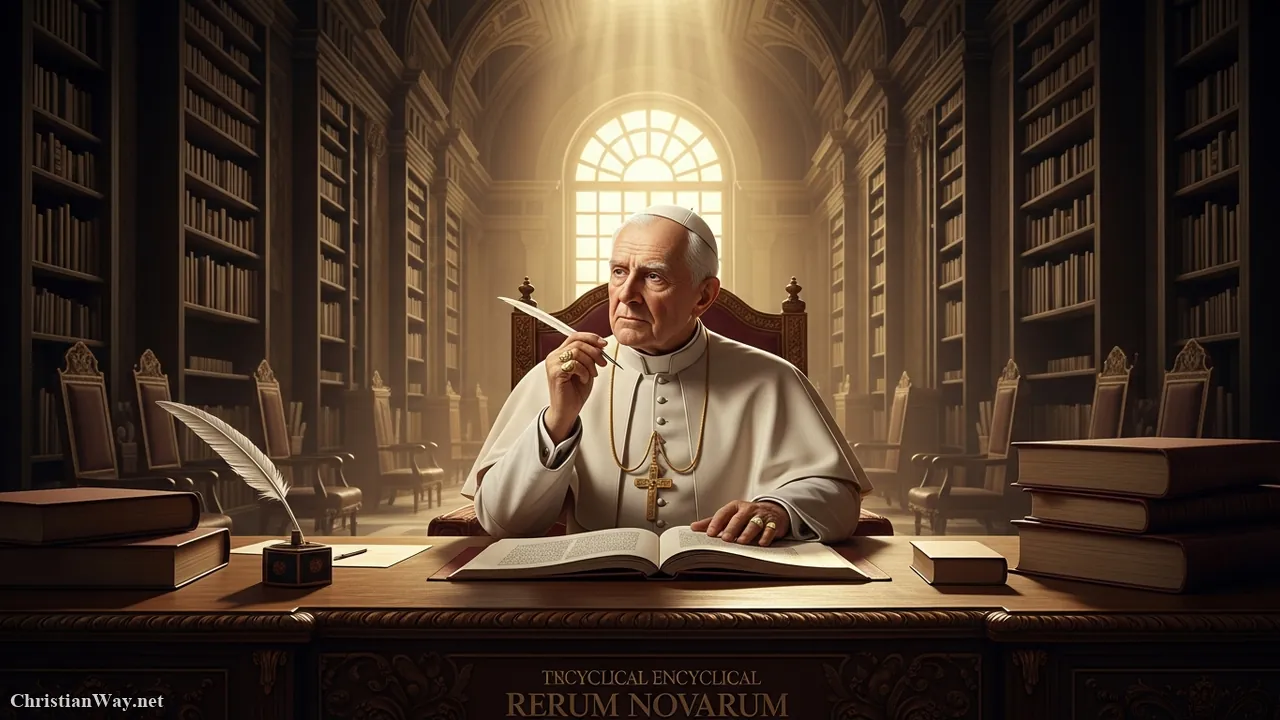
His great encyclical, Rerum Novarum (On Capital and Labor, 1891), was nothing short of revolutionary. It boldly affirmed the dignity of the laborer, the right to form labor unions, and the right to a just and living wage. At the same time, it defended the principle of private property and criticized the errors of pure socialism. Here, we see Jesus’ heart for the poor (Matthew 25:40) given modern, intellectual expression. The Church was not withdrawing from the world but engaging it directly, establishing the foundational tenets of Catholic Social Teaching that continue to inspire movements for justice today. His teaching reminds us that our faith is not merely for Sunday mass, but for the marketplace, the factory floor, and the halls of governance.
Spiritual Highlights
- The Gospel of Work: Established the Church’s definitive stance on the rights and dignity of the worker.
- A Timeless Legacy: The encyclical Rerum Novarum is the foundation of modern Catholic social doctrine.
- Scripture in Focus: “The laborer deserves his wages.” (Luke 10:7)
Top 9. St. Pius V (Antonio Ghislieri)
Turning our hearts to the tumult of the 16th century, we find St. Pius V, a Pope whose very character was forged by the ascetic rigor of the Dominican order. Elected in the wake of the Protestant Reformation, he was not a diplomat of nuance but a shepherd determined to restore the moral fiber of the Church. His greatness lies in the courage and sanctity he brought to the practical implementation of the Council of Trent, which was the Church’s comprehensive response to internal corruption and theological challenge.
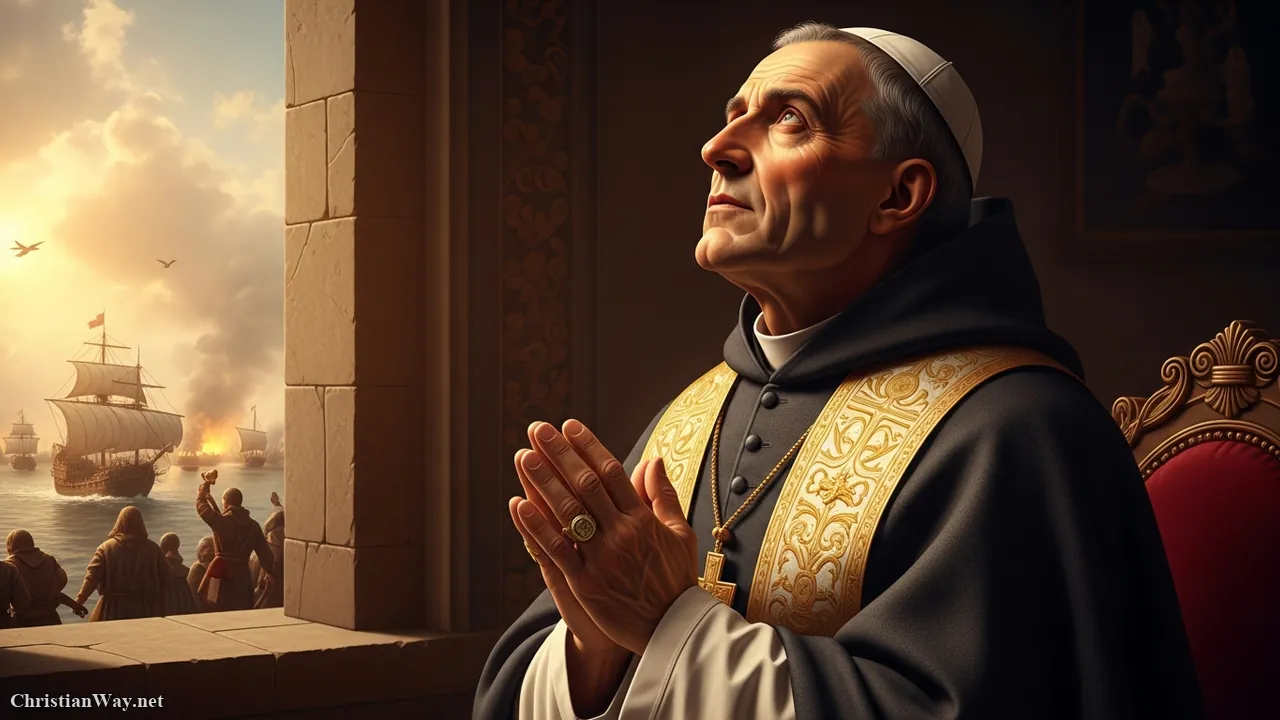
He enforced residency for bishops, suppressed abuses like simony, and sought to purge Rome of moral laxity, all while living a life of personal poverty and devotion. Theologically, he oversaw the publication of the Roman Catechism, the revised Roman Breviary, and the new Roman Missal, solidifying the liturgy and doctrine for centuries to come. His vision for the Church’s strength was not merely internal; in 1571, he rallied the Christian forces of Europe into the Holy League, praying the Rosary incessantly for victory against the Ottoman fleet at the Battle of Lepanto. The decisive victory was attributed to his spiritual leadership, demonstrating that prayer and holiness are the true source of all earthly power. His life challenges us to practice our faith with rigorous personal integrity and trust in the intercession of the Blessed Mother.
Spiritual Highlights
- The Tridentine Reformer: Systematically implemented the moral and disciplinary decrees of the Council of Trent.
- Defender of the West: Led the spiritual and political effort culminating in the victory at Lepanto.
- A Call to Prayer: Instituted the Feast of Our Lady of Victory (now Our Lady of the Rosary).
Top 8. St. John XXIII (Angelo Giuseppe Roncalli)
In the mid-20th century, the Church, secure in its ancient truths, faced a world rapidly modernizing, haunted by global conflict, and increasingly secular. An elderly, gentle, and widely loved man, Pope John XXIII—the “Good Pope John”—was elected, and many expected a brief, transitional papacy. Instead, in a burst of supernatural inspiration, he announced the convocation of the Second Vatican Council (Vatican II) in 1959. This call was not to condemn error, but to open the windows of the Church, letting in the “fresh air” of the Holy Spirit, embracing a posture of mercy (aggiornamento or “updating”).
His vision was deeply pastoral, seeking to articulate the Gospel message in a language and manner that the modern world could understand, while reaffirming the Church’s missionary vocation. Though he lived to see only the first session, his spirit guided the entire Council, leading to profound reforms in liturgy, ecumenism, and the Church’s relationship with other faiths. His final encyclical, Pacem in Terris (Peace on Earth), addressed not only Catholics but “all men of good will,” pleading for universal human rights, justice, and disarmament in the midst of the Cold War. His papacy is a powerful lesson in the spiritual virtue of openness and the boundless possibilities that arise when we surrender our plans to the wisdom of the Spirit.
Spiritual Highlights
- A New Pentecost: Courageously convened the Second Vatican Council, modernizing the Church’s approach to the world.
- Ambassador of Peace: Authored Pacem in Terris, a landmark plea for universal human rights and global peace.
- The Heart of a Shepherd: Known as “Good Pope John” for his profound humility and pastoral warmth.
Top 7. Innocent III (Lotario dei Conti di Segni)
Pope Innocent III, elected at the age of 37, presided over the medieval papacy at its most influential zenith. His reign was a profound meditation on the power Christ entrusted to Peter, and he wielded that authority to enforce moral reform, maintain political order, and protect the vulnerable. He saw the papacy as being “less than God but greater than man,” the vicar of Christ on Earth, a power necessary to hold the often-brutal temporal kings to a Gospel standard of justice.
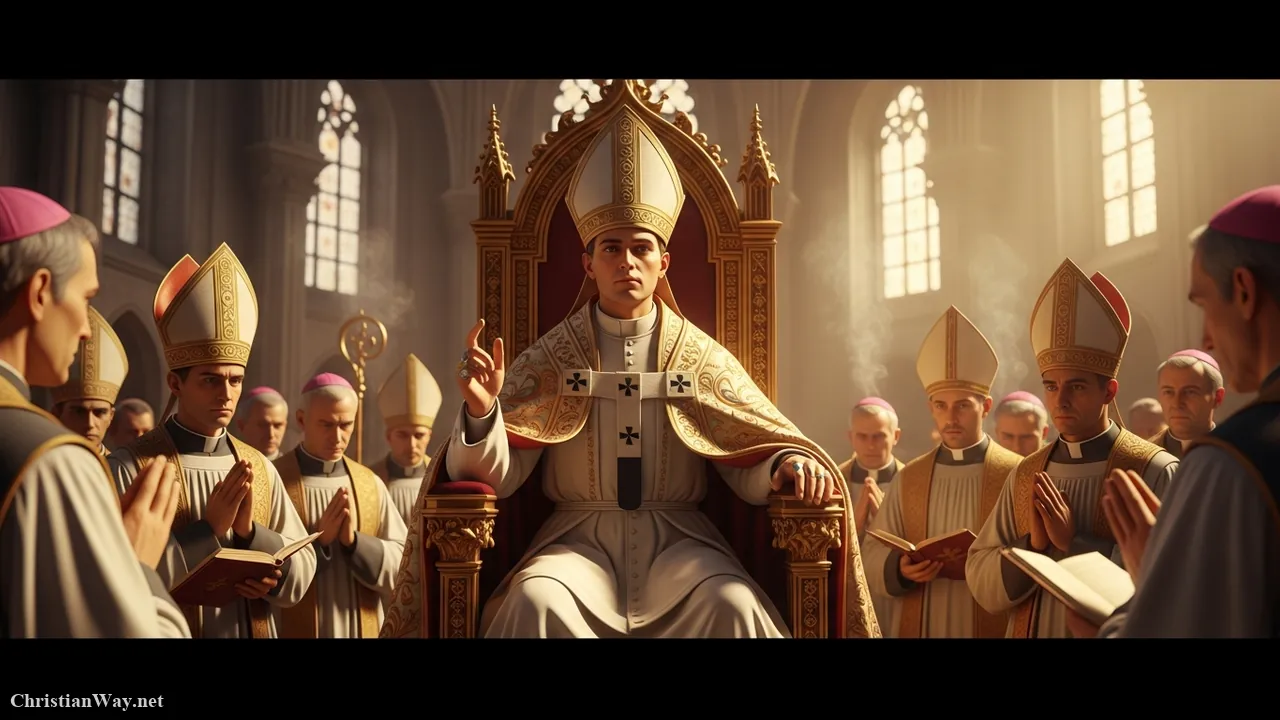
His greatest ecclesiastical achievement was the Fourth Lateran Council (1215), a pivotal event that solidified doctrine, requiring the faithful to confess their sins and receive Holy Communion at least once a year, and defining the term transubstantiation. This work grounded the spiritual life of millions, ensuring a minimum standard of devotion. Politically, he mediated disputes across Europe, reminding kings of their moral obligations to the Church. Though history notes his involvement in Crusades and political struggles, his core spiritual concern was to shepherd the people through the sacraments and discipline, bringing the transformative power of Christ’s presence into every facet of life. He demonstrates that genuine authority is a heavy cross, borne for the salvation and order of the flock.
Spiritual Highlights
- Defining the Faith: Established the annual requirement for Confession and Communion.
- Order in the Church: Convened the Fourth Lateran Council, a major legislative body.
- A Visible Witness: Asserted papal spiritual primacy over the temporal affairs of the kings of Europe.
Top 6. St. Nicholas I (Nicholas the Great)
As we approach the heart of the first millennium, we find St. Nicholas I, one of the few Popes to be called “The Great.” His pontificate came during a tumultuous period following the disintegration of the Carolingian Empire, an age of confusion when secular princes sought to dominate the Church. Nicholas I’s unique greatness lay in his unyielding moral courage and his insistence on the universal jurisdiction of the Roman See—not for self-aggrandizement, but as the essential guarantor of objective moral truth and justice within the Church and the world.
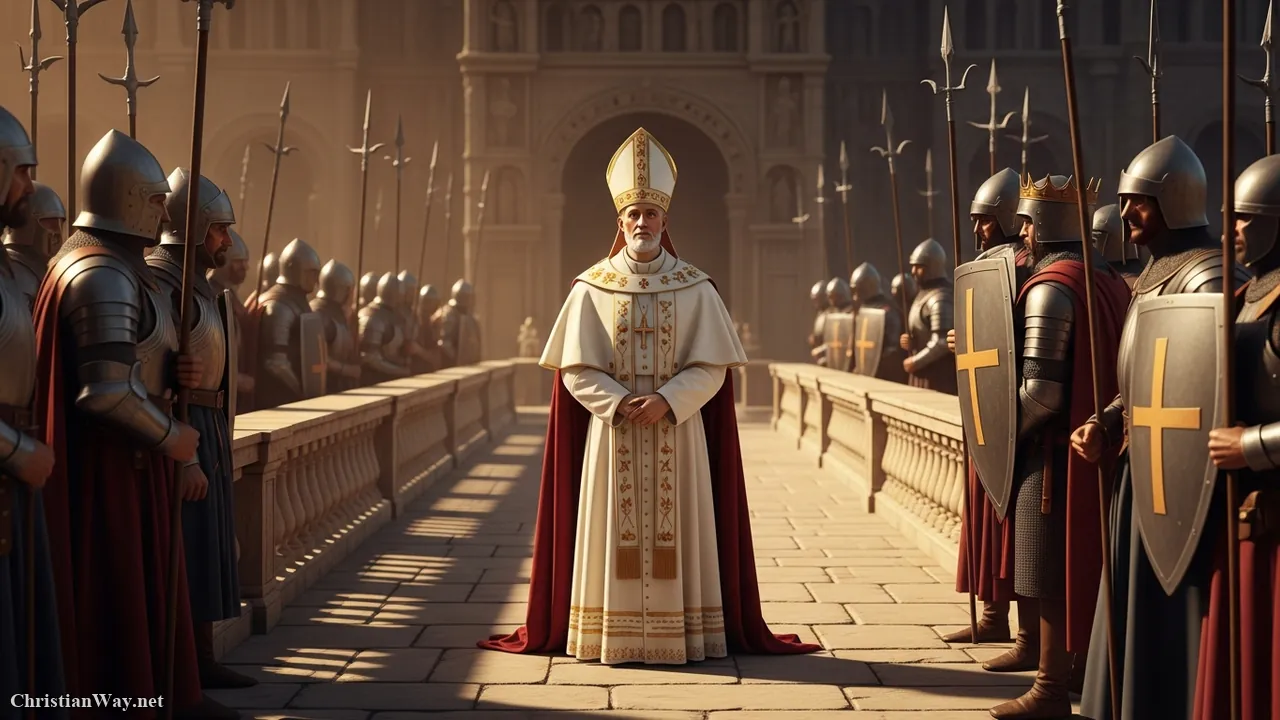
He intervened fearlessly against powerful archbishops who disregarded canon law and against kings who sought to set aside their legitimate wives in favor of new unions. Standing firm against the political pressure of emperors and princes, he defended the sanctity of marriage, echoing the clear teaching of Christ (Matthew 19:6). His papacy was a powerful assertion that the ultimate court of appeal for spiritual and moral disputes lay with the successor of Peter, demonstrating that the Church’s freedom is indispensable for its service to humanity. His firmness, rooted in deep prayer, provides a strong witness for us today, reminding us that there can be no true compassion without truth.
Spiritual Highlights
- Defender of Canon Law: Fearlessly held kings and archbishops accountable to the Church’s moral and legal standards.
- Guardian of Matrimony: Defended the indissolubility of marriage against royal decrees.
- The Rock of Justice: Maintained the papal primacy as the last, authoritative moral check on European powers.
Top 5. St. Leo I (Leo the Great)
St. Leo I, “The Great,” stands as a pivotal figure who masterfully balanced theological rigor with political diplomacy in a collapsing Roman world. His papacy (440–461) was defined by two monumental acts: defending the two natures of Christ and defending the city of Rome itself. Theologically, he issued the masterful Tome, a concise and brilliant exposition of Christology, affirming that Christ is one person in two natures—fully human and fully divine—without confusion or separation. This document was ratified at the Council of Chalcedon (451), forever safeguarding the central mystery of the Incarnation against various heresies.
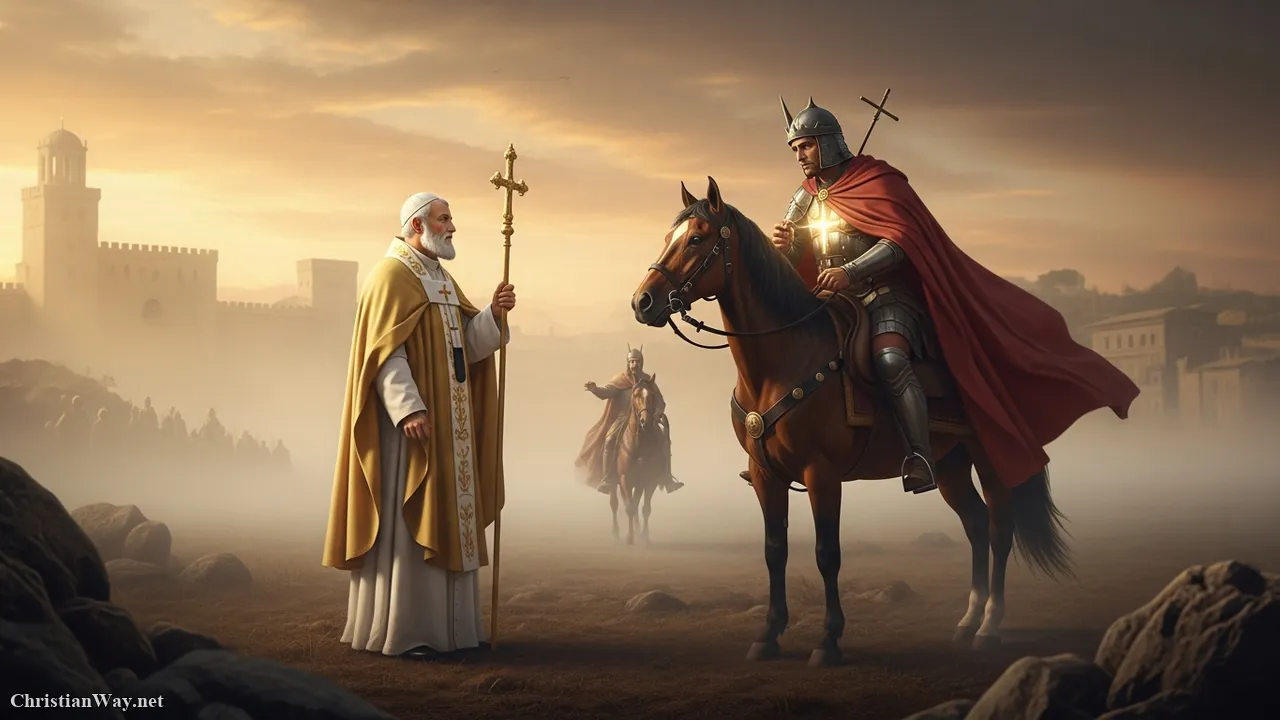
The scene of his diplomatic courage in 452 is legendary: clad in his pontifical robes, he rode out to meet Attila the Hun at the gates of Rome, persuading the ferocious “Scourge of God” to turn back. While secular factors may have been at play, the spiritual power of Leo’s presence saved the ancient city from certain ruin. His greatness lies in his seamless combination of the spiritual and the temporal: a Doctor of the Church who saved Christian doctrine, and a statesman who saved Christian civilization. He reminds us that true Christian leadership must protect both the sacred truth and the physical well-being of the human person.
Spiritual Highlights
- Theological Clarity: Authored the Tome, the definitive text on the two natures of Christ.
- Savior of Rome: Negotiated the retreat of Attila the Hun from Italy in 452.
- Doctor of the Church: Ascribed the title for his masterful doctrinal sermons and letters.
Top 4. St. Gregory VII (Hildebrand)
The 11th century was marked by a deep-seated struggle over who held ultimate authority over the Church: the Pope or the secular rulers (emperors and kings). Pope St. Gregory VII, known as Hildebrand before his election, transformed this struggle into a fundamental reform of the entire Church structure. The Christian Way could not thrive if bishops were appointed by kings for political gain, or if clerical celibacy was ignored, leading to inherited Church property. Gregory VII saw the solution in the Gregorian Reform, aimed at liberating the Church from the corrosive influence of lay power.
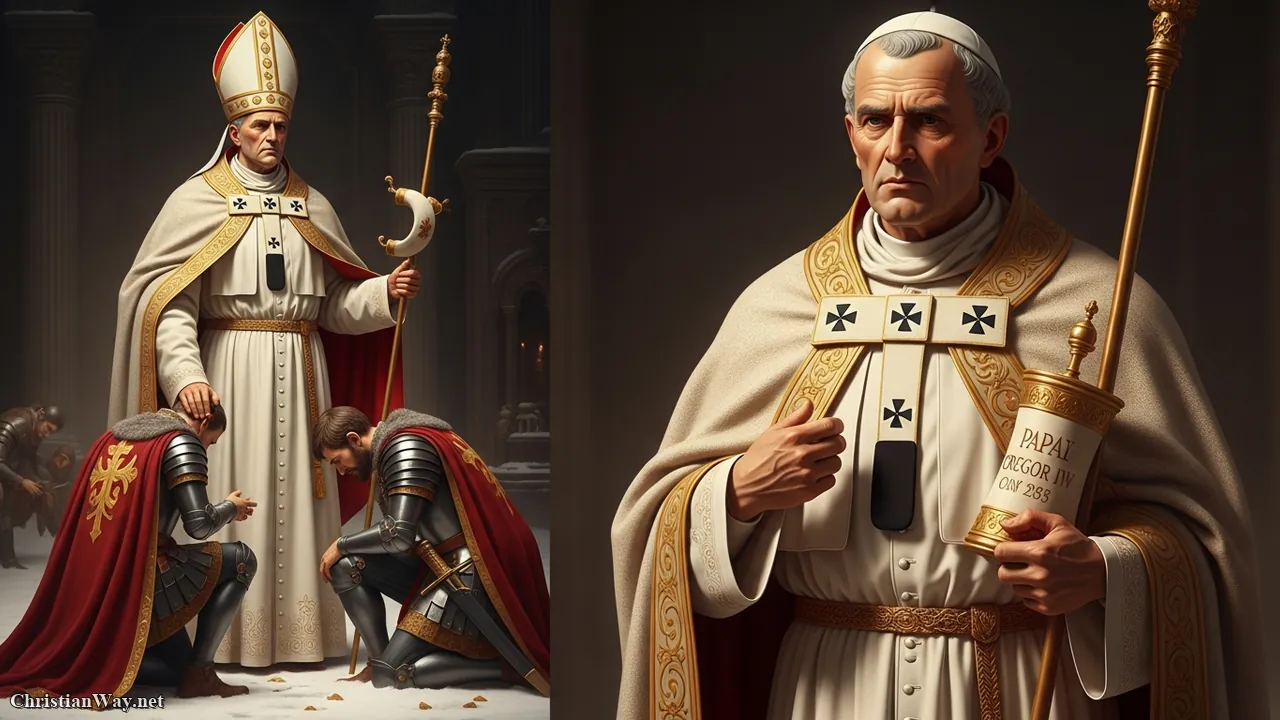
His most famous confrontation was with the Holy Roman Emperor Henry IV over the issue of Investiture—who had the right to invest a bishop with the symbols of his spiritual office. Gregory’s willingness to excommunicate the Emperor and stand firm for the Church’s spiritual independence demonstrated an awesome resolve. The pilgrimage of the penitent Emperor to Canossa in 1077 remains an enduring image of the supremacy of spiritual authority over temporal power when moral issues are at stake. Gregory VII’s vision ensured the Church’s prophetic voice could not be silenced by political expediency. He calls us to examine our own lives for areas where we have allowed the “world” to invest us, compromising our spiritual freedom.
Spiritual Highlights
- The Great Reformer: Vigorously fought simony (selling of Church offices) and clerical marriage.
- Spiritual Independence: Central figure in the Investiture Controversy, securing the Church’s freedom from emperors.
- A Radical Vision: Wrote the Dictatus Papae, asserting the Pope’s unique, God-given authority.
Top 3. St. John Paul II (Karol Józef Wojtyła)
St. John Paul II, whose papacy spanned over 26 years, was the first non-Italian Pope in 455 years and the first Slav. His election in 1978 ushered in an era of dynamic global evangelization and moral clarity. A philosopher, poet, and tireless traveler, he transformed the papacy into a moral superpower, connecting with millions of youth and the faithful on a personal level in a way no predecessor had.
His greatness is multifaceted: he delivered a profound body of theological work, including the “Theology of the Body,” defining the meaning of human love and sexuality. He was a tireless advocate for the “Culture of Life” against the “Culture of Death.” Most importantly, he was a pivotal political and spiritual force in the collapse of Soviet Communism in Eastern Europe, using his native Polish heritage and moral stature to inspire freedom movements, standing as a living embodiment of courage and hope against totalitarian systems. Having survived an assassination attempt, his prolonged public struggle with Parkinson’s disease offered the world a final, powerful homily on the dignity of suffering, old age, and a holy death. He truly fulfilled Christ’s call to go and make disciples of all nations (Matthew 28:19).
Spiritual Highlights
- Global Evangelist: Travelled more than all previous Popes combined, galvanizing Catholic youth with World Youth Day.
- Moral Champion: Key political and spiritual figure in the dismantling of the Iron Curtain.
- Theological Depth: Developed the “Theology of the Body” and founded the Divine Mercy devotion.
Top 2. St. Gregory I (Gregory the Great)
Sharing the title of “The Great” with Leo I, Pope St. Gregory I’s papacy marks the true transition from the classical age to the medieval world, shaping the character of the Church for the next thousand years. A former wealthy Roman noble who became a Benedictine monk, Gregory embraced the role of Pope with humility, adopting the title Servus Servorum Dei (“Servant of the Servants of God”)—a title used by Popes ever since. In a world abandoned by imperial administration and ravaged by Lombard invasions, Gregory stepped into the void, feeding the populace, ransoming prisoners, and negotiating peace treaties, effectively consolidating the Church’s temporal role in Italy.
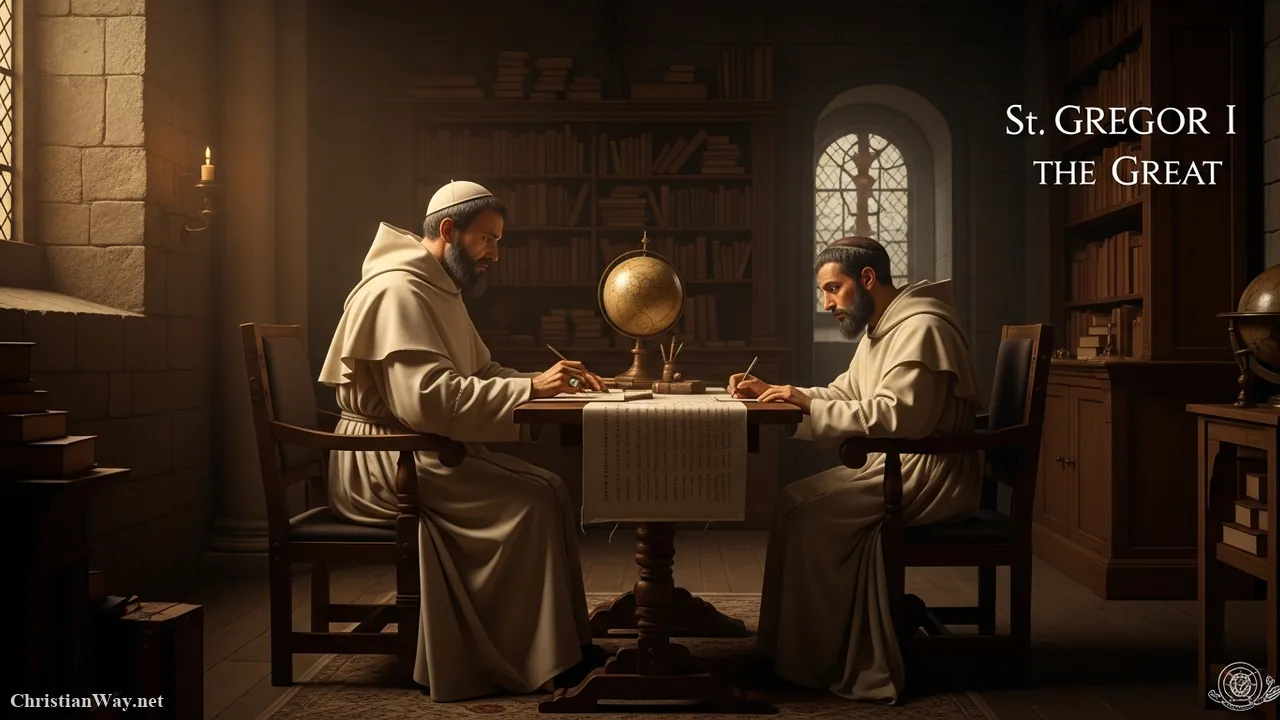
Spiritually, he was a profound administrator and liturgist, leading the mission to convert the Anglo-Saxons (St. Augustine of Canterbury), reforming the Roman liturgy (lending his name to Gregorian Chant), and writing influential works on moral and pastoral theology (Pastoral Rule). His immense body of letters and sermons provides a practical, warm guide to Christian life, earning him the title of Doctor of the Church. His life teaches us that true Christian authority is always expressed through humble, tireless service, putting the needs of the flock—spiritual and material—above all else. He was a perfect embodiment of the compassionate shepherd.
Spiritual Highlights
- Servant of Servants: Established the enduring papal title Servus Servorum Dei.
- Founder of Medieval Papacy: Consummate administrator who managed civil affairs and defended Rome.
- Missionary Spirit: Launched the pivotal mission to evangelize England.
Top 1. St. Peter (Simon, son of Jonah)
To speak of the “greatest” Popes is, first and foremost, to look upon the man Christ chose as the foundation: St. Peter the Apostle, the fisherman of Galilee. He is in a category of his own, for his authority was given to him directly by the Incarnate Word of God. The scene on the road to Caesarea Philippi is the heart of the papacy: after Peter’s inspired confession, “You are the Christ, the Son of the living God,” Jesus declares, “You are Peter, and on this rock I will build my church, and the gates of hell shall not prevail against it” (Matthew 16:18).
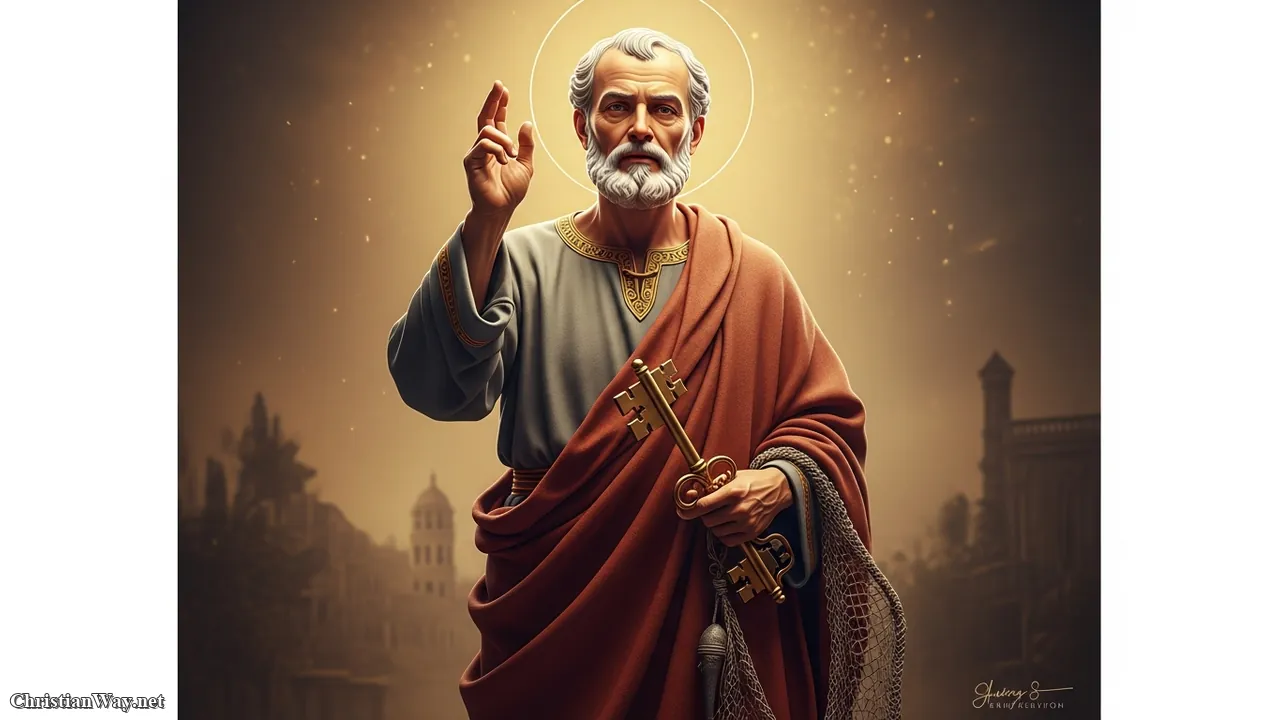
Peter’s life, marked by zeal, profound love, human failure (his triple denial), and ultimate repentance, provides the perfect model for the papacy. He was given the Keys of the Kingdom, the authority to “bind and loose,” but he was also told by Christ to “feed my sheep” (John 21:17). He was the leader of the Apostles, the first to preach on Pentecost, and the first to admit Gentiles into the Church. His life ended in martyrdom in Rome, a profound witness to his fidelity to the Lord. His example, an imperfect man chosen for a perfect, divine task, is a source of immense comfort for all of us in the Christian Way: Christ works His glory through our redeemed weakness.
Spiritual Highlights
- The Cornerstone: Named by Jesus as the Rock upon which the Church is built.
- Holder of the Keys: Received the authority to bind and loose (Matthew 16:19).
- A Shepherd’s Heart: Commanded by Christ to “Feed my lambs… tend my sheep.”
Reflect and Pray
The lives of these greatest Popes are not meant to be relics of history, but beacons of light for our own pilgrimage of faith. Their strength was not their own; it was the power of the Holy Spirit working through their human instruments. Whenever we feel overwhelmed by the challenges of the world, whether personal doubt or cultural confusion, we can look to these successors of Peter and see the stability of the Church in action.
Let us pray for our Holy Father today, and for all who are called to leadership in the Church. May we all be granted the wisdom of Leo the Great, the humility of Gregory the Great, the courage of John Paul II, and the foundational faith of St. Peter, that we may all faithfully contribute to building up the Kingdom of God.
— Fr. John Matthew, for Christian Way